
Published on May 8, 2019

By
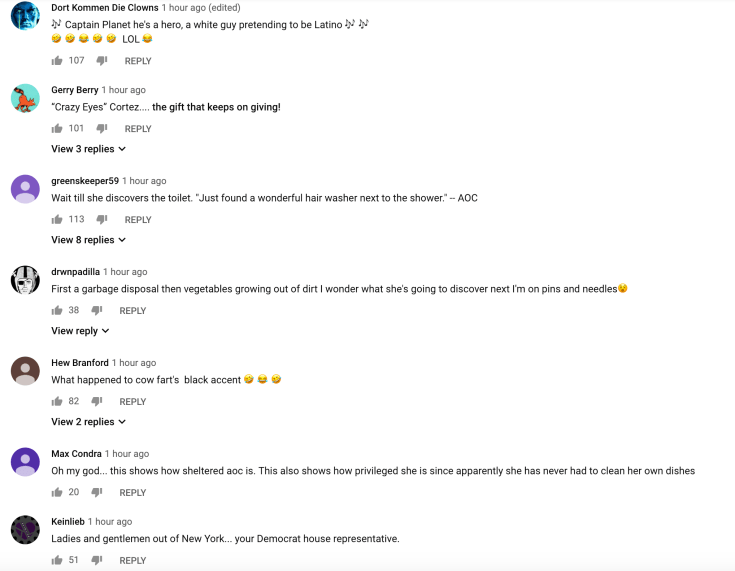
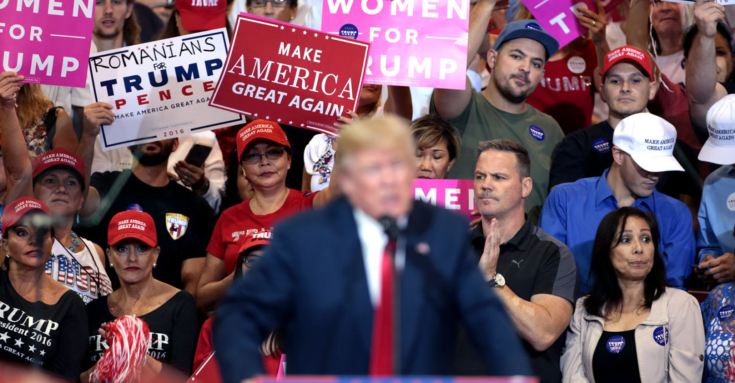
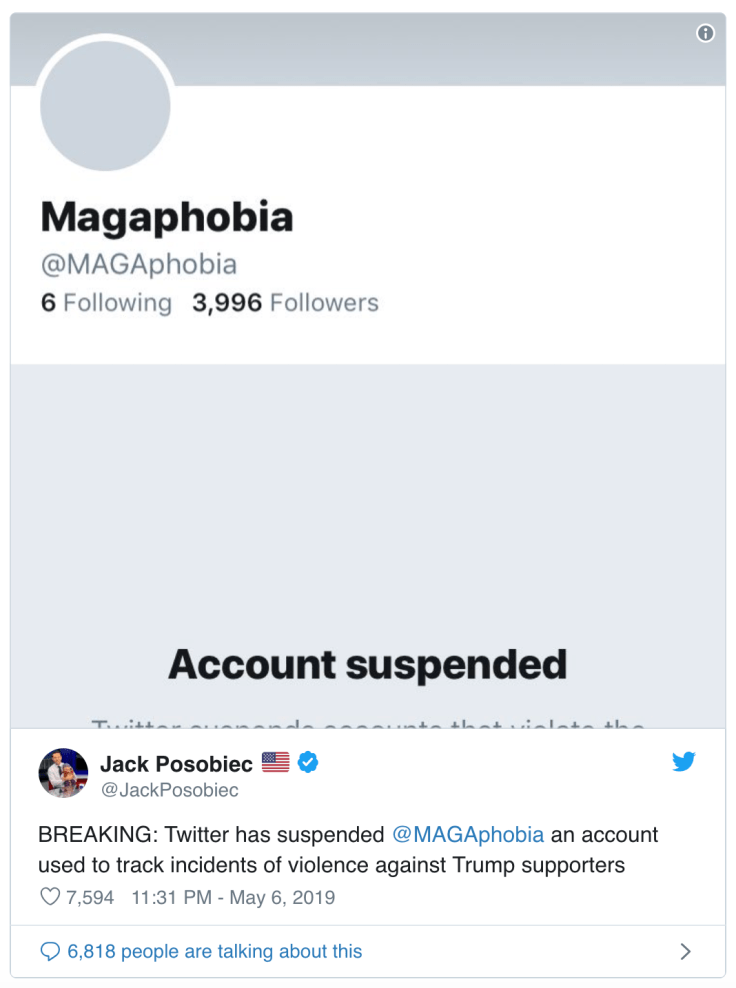
In the midst of a late night purge of conservative accounts, Twitter banned the conservative user who used the platform to log all instances of violence used against supporters of President Trump. As Big League Politics has detailed over the last several months, vocal supporters of the president are routinely attacked in public, have their property vandalized or destroyed, and face intimidation for simple acts, such as wearing a ‘Make America Great Again’ hat or having it displayed in a vehicle.
Also last night, a parody account mocking Rep. Alexandria Ocasio-Cortez was banned last night, with Twitter sending the user an email suggesting he did not properly identify it as a parody, even though the word “parody” was used both in the account’s name and bio.
Anti-Trump violence appears to be on the rise around the country.
Just this year, prominent Trump supporters Brandon Straka, Michael Knowles, and Owen Shroyer were all attacked in one day, an immigrant man was attacked in his neighborhood for wearing a ‘MAGA’ hat, a man was attacked for wearing his ‘MAGA’ hat during a Christchurch mosque vigil, a Massachusetts woman attacked a man for wearing his ‘MAGA’ hat then claimed to be the victim of the altercation, and Canadian conservative Faith Goldy and another man were attacked in nearby Toronto, Canada for wearing pro-Trump accessories and holding signs with anti-racism slogans.
The situation is exacerbated when considering crimes against private property.
Since March, at least three individuals have had their property vandalized for supporting President Trump. A recreational vehicle used to sell pro-Trump merchandise outside rallies was battered overnight, a man had his tires slashed by a woman who later admitted to being provoked by the ‘MAGA’ hat on his dashboard, and just this week tires were slashed outside a pro-Trump event.
By Lucas Nolan
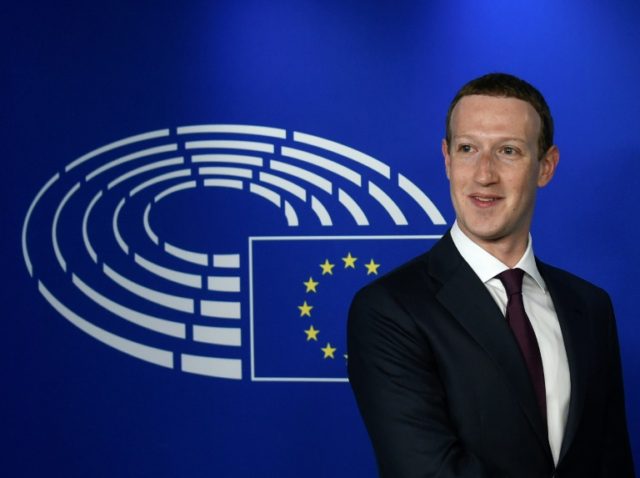
A recent report from Politico provides an insight into Facebook’s new “election war room” established ahead of the upcoming European election. Facebook has previously deployed a similar “war room” in the United States ahead of the midterm elections in November 2018. In October, Breitbart News reported on the war room providing an insight into the aim of the project. Facebook’s Product Manager of Civic Engagement, Samidh Chakrabarti, said in an interview that the war room is a physical room which will be used to “take quick and decisive action” against possible cases of foreign interference during the midterm elections.
“We have many measures that we’ve put in place to try to prevent problems: the political ad transparency, blocking fake accounts, combating foreign interference, and preventing the spread of misinformation. But we know we have to be ready for anything that happens,” stated Chakrabarti. “And so that’s why we’ve been building this war room, a physical war room [with] people across the company, of all different disciplines, who are there. So, as we discover problems that may come up in the hours leading up to the election, we can take quick and decisive action.”
Now, Politico has reported on the company’s efforts to establish a similar project in Dublin, Ireland ahead of the upcoming European elections. Politico described the project writing:

The group of twentysomething coders, engineers and content specialists sit hunched over multiple screens, scanning the platform for potential illegal behavior. Wall-mounted television monitors keep them up to date on the latest chatter on the world’s largest social network, Instagram and WhatsApp. A single European Union flag hangs on the wall, next to a poster emblazoned with the slogan “New Ways of Seeing.”
Yet despite Facebook’s 40-person European election “operations center,” which got underway on April 29, the tech giant is struggling to keep on top of the threats.
Political groups from Hungary to Spain have been able to circumvent Facebook’s new political transparency tools to quietly buy partisan social media advertising aimed at swaying potential voters, according to an analysis by POLITICO. That includes paid-for messages by Viktor Orbán, the Hungarian prime minister, Verein Recht und Freiheit (Association for the Conservation of the Rule of Law and Civil Liberties), a support group for right-wing politicians in Germany and Petra De Sutter, a Belgian candidate for the Green Party.
It seems that Facebook is aware, however, of accusations of censorship and bias. The company’s chief lobbyist in Europe told Politico that Facebook is avoiding taking too harsh a line on the content allowed on the platform:
“We recognize that some people think we should remove everything,” said Richard Allan, Facebook’s chief lobbyist in Europe, in reference to the reams of political content now flooding the digital platform. “But we have concerns of removing everything during a political election.”
“We don’t believe it’s the right place to be for us to be the regulator of political campaigns,” he added. Facebook may not want the role, but its global reach puts it at the heart of the democratic process from France to the Philippines.
Politico described the new Dublin team tasked with monitoring misinformation, writing:
The team, which includes speakers of all of the EU’s 24 official languages, is split along national boundaries, with specialists — primarily men who would not look out of place in any startup office — monitoring activity on both Facebook’s social media platforms and those of rivals, notably Google and Twitter.
Facebook would not say how much content the group reviews daily, though each Facebook staffer had multiple screens open monitoring news events and other political discussions online.
Once an issue is flagged, Facebook’s engineers can then work with their counterparts across Europe and elsewhere to determine if the activity infringes the company’s standards, and then delete, play down or leave the content on the network, depending on the outcome. Topics for review include possible misinformation, voter suppression and hate speech, and the company said that it had investigated hundreds of incidents within the last week.
“Even though we’re a tech company, speaking face to face is invaluable,” said Sturdy, the Facebook executive.

MAY 6, 2019
CNN’s Brian Stelter called Trump the “Infowars president” after he retweeted videos from Paul Joseph Watson and Millie Weaver over the weekend, as reported on Sunday.
But later on in an email newsletter, Stelter called the president’s tweets “dangerous,” accordingto the Washington Free Beacon.
“Trump legitimizing Infowars is dangerous,” the newsletter reportedly said. “Sometimes, we tend to dismiss Trump’s Twitter activity as not mattering much. But it does. Think about this: The President of the United States worked in the last couple of days to legitimize and promote Infowars, while simultaneously working to delegitimize credible news organizations.”
“This weekend’s tweets from the president were not only morally repugnant, they were dangerous…”
Keep in mind that CNN cheerleaded the purge of Alex Jones, so it isn’t a stretch to suggest that CNN is now targeting the ‘dangerous’ president for removal from social media or, at the very least, demanding more shadow banning of Trump’s tweets.
Also, keep in mind that the corporate media attacks Trump more than Alex Jones, so what’s stopping them from targeting him next?
And what better way than to cost Trump the 2020 election by restraining his presence on social media? He won the presidency in no small part by reaching Americans directly while bypassing the filter of mainstream media.

By
Facebook, Instagram, YouTube, and Twitter have all faced some extent of an advertiser boycott, with the blame levied on users who are deemed not to be “advertiser friendly.”
This has been YouTube’s excuse to demonetize popular right wing channels, and likely went into consideration for Twitter when they summarily banned Infowars, and Facebook and Instagram last week when they went a step further and said they would ban any user who so much as posted a link to Infowars video content or Alex Jones.
Boogie2988, a YouTube streamer who became famous for his parody videos, video game live streams, and for chronicling his weight loss journey, offered a nuanced take during the podcast.
“I know a lot of people that work at Walmart,” Boogie said on the podcast, “And I know people that work in advertising at Walmart, and somebody from Walmart, and I won’t say which person specifically, said to me ‘We don’t really care about any of that censorship crap, we don’t really care about any of the drama.’”
He continued, quoting his conversation with an anonymous Walmart advertising employee, “‘We care about lowering our bids, so we’re going to do a six months or one year hiatus, and when we come back, we’re going to have much lower bids.’”
If true, it would seem the exodus of large advertisers from big tech platforms, and the sacrifice of many large content creators that followed, may be driven almost entirely by finance.
If YouTube, Facebook, Instagram, and Twitter are perceived as dangerous places to advertise, the cost of doing so on the platforms would naturally decrease exponentially.
As Twitter user Justin Whang wrote succinctly, “Advertisers played YouTube like a fiddle.”
By Sean Moran
Facebook announced on Thursday that they have banned several conservative personalities such as Infowars host Alex Jones, Infowars contributor and YouTube personality Paul Joseph Watson, journalist and activist Laura Loomer, and Milo Yiannopoulus. The social media giant also banned Louis Farrakhan from its platforms.
Facebook said that they banned these personalities because they were “dangerous.”
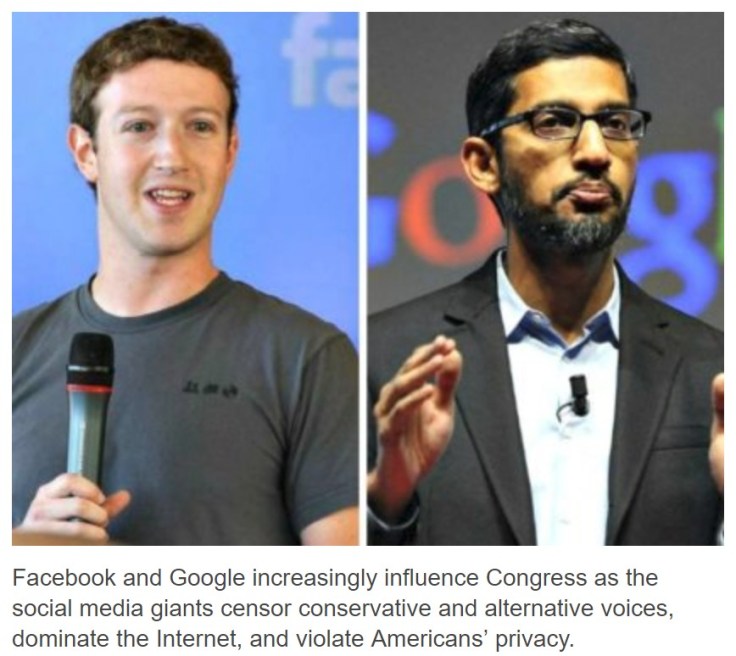
Amid calls for greater regulation of social media companies’ potential anticompetitive behavior, censorship of conservative and alternative voices, and privacy violations, Facebook and Google have remained at the top of Open Secret’s database of top spenders lobbying Congress.
So far in 2019, Facebook spent $3,400,000 and Google’s parent company, Alphabet, $3,530,00 in lobbying Congress. Alphabet also ranked as the eighth total highest spender in lobbying in 2018, spending $21,740,000, while Facebook spent $12,620,000.
Facebook’s influence has continued to rise over the years. In the early years of President Barack Obama, Facebook spent below one million dollars in 2008 and 2009. From 2011 to 2018, Facebook’s lobbying spending skyrocketed and reached historic highs in 2018, when they spent $12.6 million.
In 2019, Facebook lobbied heavily on H.R. 1644, the Save the Internet Act, a Democrat bill which would restore the Obama-era Federal Communications Commission (FCC) net neutrality regulations, which arose as the result of Google’s heavy lobbying of the Obama administration. In 2019, Google also lobbied on the Save the Internet Act.
In 2018, one of Facebook’s bills on which they lobbied Congress was H.R. 2520, the Browser Act, sponsored by then Rep. and now Sen. Marsha Blackburn (R-TN), which would require social media companies such as Facebook and Google to obtain explicit permission from users for collecting their private data. The Browser Act would also stipulate that these social media companies cannot deny services to users who do not opt-in to these companies’ collection of their private data. In 2017, the Browser Act was the most important issue on Capitol Hill.
Sen. Blackburn said that her legislation would establish one set of rules that would balance the relationship between ISPs and Facebook and Google. The legislation would also prevent the social media giants from unfairly profiting off of Americans’ private data without their explicit consent.
“We need one set of rules for the entire internet ecosystem with the FTC [Federal Trade Commission] as the cop on the beat,” said Senator Blackburn. “The FTC has the flexibility to keep up with changes in technology and its principal mission is consumer protection. The BROWSER Act will enable consumers to make more educated decisions regarding the nature of their relationship with tech companies.”
In contrast, Alphabet’s most prominent issues in Congress in 2019 and 2018 related to labor and antitrust, as well as telecommunications and technology.
Facebook and Google’s dominance on the Internet has become increasingly apparent as Google has approximately 90 percent of web search traffic, whereas in digital advertising, Google and Facebook amount to nearly two-thirds of American digital ad spending, with Amazon at a “distant third” at under nine percent.
In 2018, Google lobbied Congress fourteen separate times on multiple pieces of legislation that would have increased liability for companies that enabled sex trafficking.
Facebook and Google’s influence in Congress extends to its trade group, the Internet Association. In the fourth quarter of 2018, the Internet Association spent $840,000. In total, the social media giants spent $2.6 million in 2018 for lobbying. In 2019, the association has spent $690,000 so far. Over the last two years, the Internet Association has focused on the Save the Internet Act as well as on legislation that would increase edge providers’ liability for hosting content that enables sex trafficking.
Facebook and Google influence political elections as well. During the 2018 election cycle, Alphabet donated:
During the 2018 midterm elections, Facebook donated:
As Facebook and Google and other social media giants continue to increasingly censor and blacklist conservative and alternative voices, more and more conservative voices have called for addressing the social media giants’ dominance of the Internet. Facebook and Google’s influence in Congress also relates to political confrontations; during a hearing in December 2018, the then-ranking member of the House Judiciary Committee delivered a sharp rebuke of Republican accusations of Google’s political bias affecting its search engines, even though Google was his top donor.
During a Senate Judiciary Committee hearing in April, Sen. Ted Cruz (R-TX) said he envisions three potential remedies for big tech’s violation of free speech and dominance on the Internet.
Cruz’s three solutions include:
“No one wants to see the federal government regulating what is allowed to be said, but there are at least three potential remedies that can be considered by Congress or the administration or both,” Cruz said.
By Justin Caruso
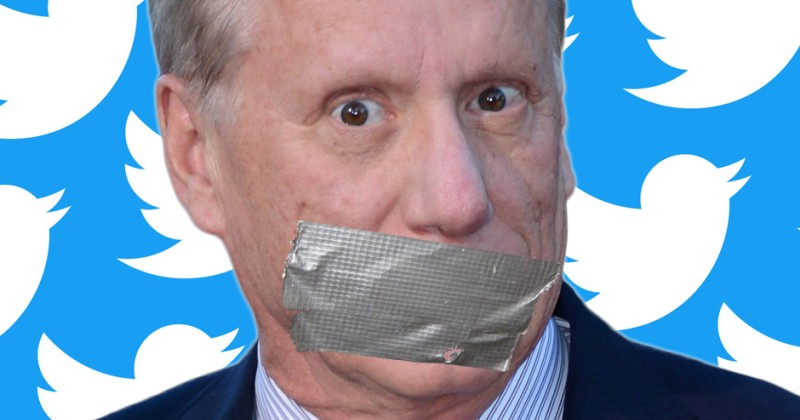
Twitter suspended Woods for a tweet that read, “‘If you try to kill the King, you best not miss’ #HangThemAll,” according to his girlfriend Sara Miller.
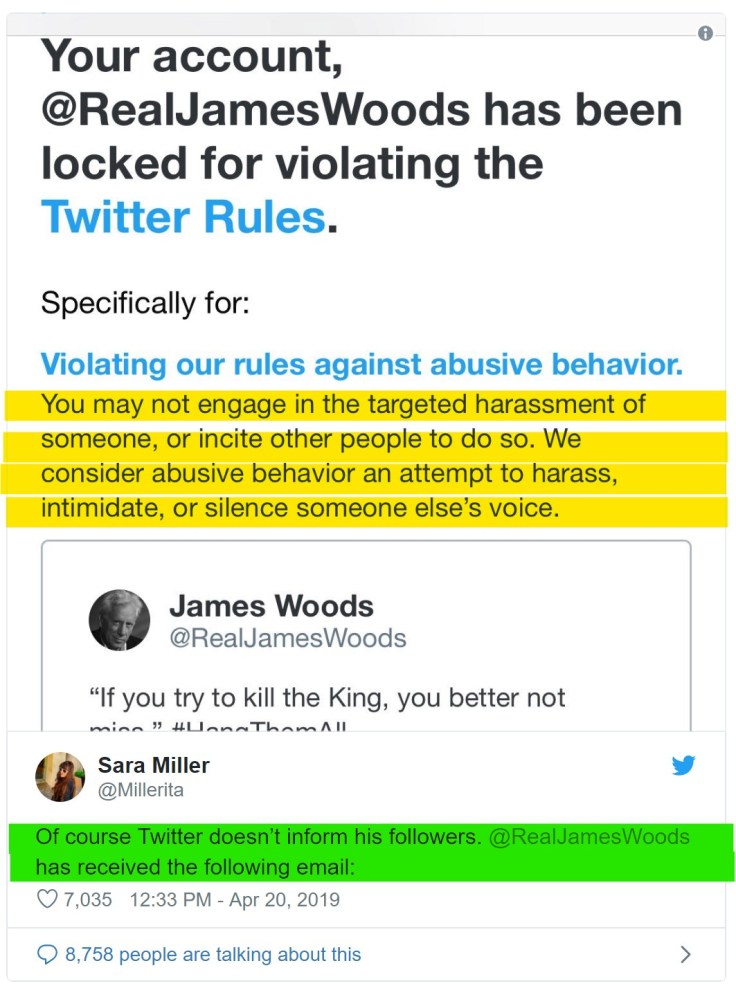
The tweet was apparently in reference to the Mueller report, which found no conspiracy between the Trump campaign and Russia. The quote is from Ralph Waldo Emerson and has been used in various forms in movies and TV shows like The Wire.
Nevertheless, this post apparently met the threshold on Twitter for “abusive behavior.”
Twitter does not appear to have the same standard for leftists. As Breitbart News has reported, there are several examples of actual violent threats going unchecked by the social media company.
Woods has been locked out of his account before for posting a meme.
Twitter CEO Jack Dorsey has previously claimed that while he is “more left-leaning,” his company does not target users over political views.
“I think the real question behind the question is, are we doing something according to political ideology or viewpoints? We are not. Period. We do not look at content with regards to political viewpoint or ideology. We look at behavior,” he said last year.
By Jerome Hudson
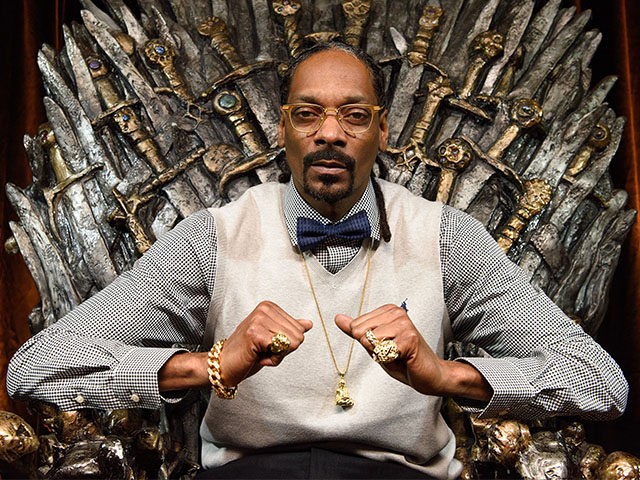
“If you’re down with it like I’m down with it, post your favorite Mr. Farrakhan videos on your Instagram and Facebook page,” Snoop Dogg said in an Instagram video posted Thursday. “Show some love to a real brother.”
Breitbart TV
“How the fuck y’all gonna ban Minister Louis Farrakhan for putting the truth out there?” Snoop asked in a separate video. “I stand with him. I’m with him. Ban me, motherfucker.”
Snoop Dogg encouraging his followers to post videos of Farrakahn on Facebook and Instagram appears to be in clear violation of the platform’s rules, which do not allow the promotion of “hate speech […] because it creates an environment of intimidation and exclusion and in some cases may promote real-world violence.”
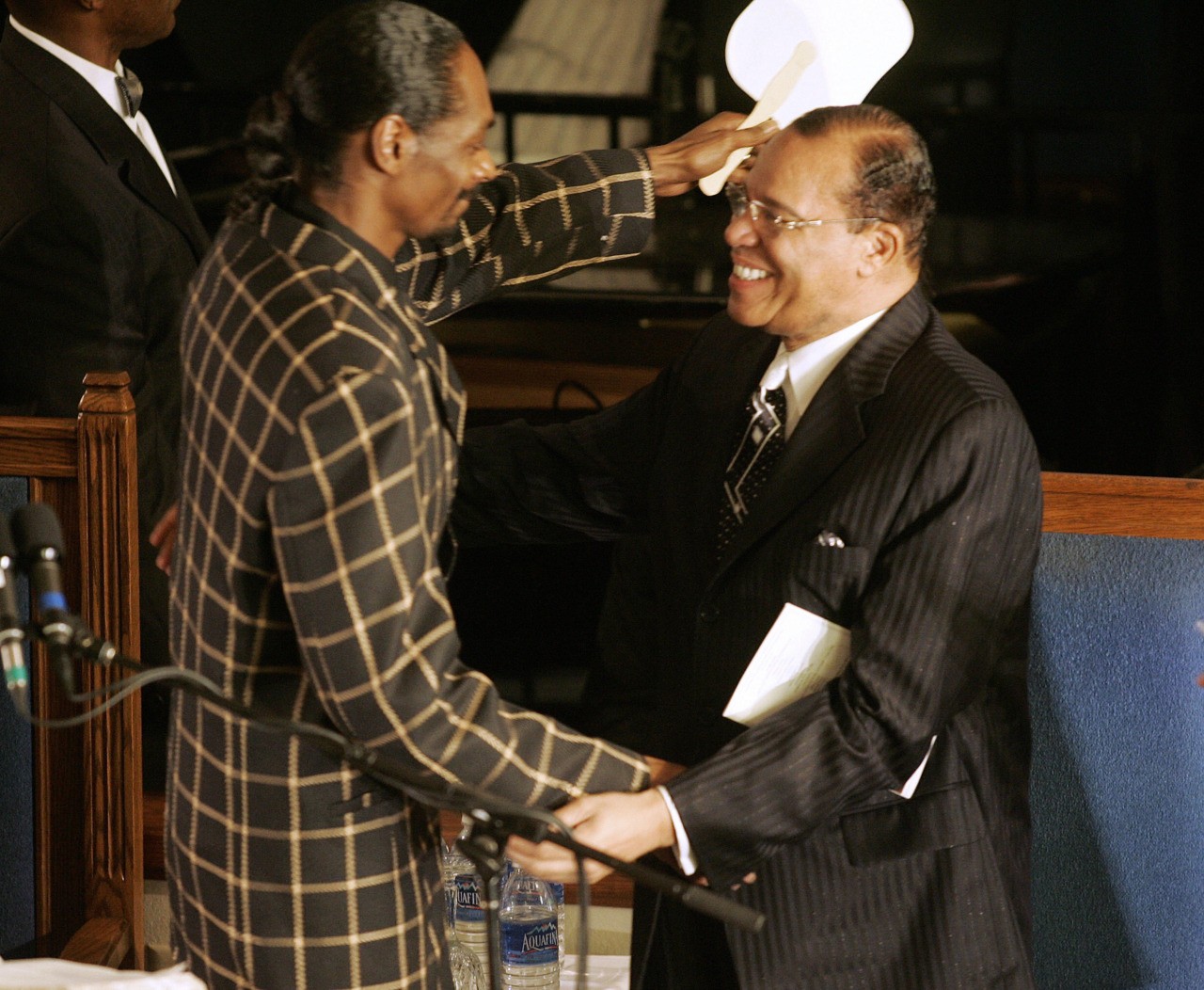
As recently as October Farrakhan posted a video to Twitter in which he called Jews “termites.” Twitter removed Farrakhan’s “verified” blue checkmark for hate speech.
Facebook and Instagram’s purge of conservative personalities also included Infowars host Alex Jones, Infowars contributor Paul Joseph Watson, and journalist and activist Laura Loomer.


 Tom's Blog