Minister Szijjarto: “Hungary maintains zero tolerance stance on migration”

By HUNGARY JOURNAL 4 February 2019

Hungary has a policy of zero tolerance for migration and will never back any document that uses the UN’s global migration compact as a point of reference, foreign minister Peter Szijjarto said, responding to a query by MTI.

Peter Szijjarto commented on recent reports by several Hungarian news portals citing a German news agency’s EU diplomatic source as saying that Hungary’s government has refused all of the European Union’s offers of a compromise on a joint position on migration, and has isolated itself within the bloc.

“Pro-migration politicians are continuing to run amok”, the minister said. Every EU document will try to refer to the UN’s global migration compact in spite of the fact that nine EU member states did not vote for it, he added.

Szijjarto said the Hungarian government will never support the compact, which he said wanted to facilitate immigration. “A document on which there is no unanimous agreement by all member states cannot be a point of reference”, he said.

The minister added that Hungary’s isolation “has long been a pipe dream for those who support migration”. “Anyone who says no to migration will continue to be our ally”, he said.

“Migration most serious threat to Europe”, says Hungarian defence minister

By HUNGARY JOURNAL 31 January 2019

Migration is the biggest threat to the safety of Europeans, the Hungarian defence minister Tibor Benko said ahead of a two-day meeting with his European Union counterparts in Bucharest.

Europe, and Hungary specifically, have entered a new phase in terms of security policy, Tibor Benko told MTI. Europe’s security has deteriorated considerably, he said, adding that routine solutions were not adequate for dealing with new types of security challenges.

The ministerial meeting will focus on European defence initiatives, coherence between the various defence training projects and military operations, Benko said. He urged European leaders to take the security threats facing the continent and its citizens seriously and start pursuing a new direction on migration. Benko added new global security challenges like terrorism, migration or cyberwarfare required a joint European response.

Viktor Orban attacks George Soros, who “is open about wanting to take over European institutions”

By 

The European Parliament’s debate on the rule of law in Hungary will be a “George Soros-type seance, an election rally, a campaign event”, Prime Minister Viktor Orban told public Kossuth Radio.

Orban said he had always fought for “the Hungarian national interest” but he would not aid and abet next week’s “pro-migration campaign event” in Brussels.

The European left wing’s Spitzenkandidat, Frans Timmermans, who is currently the first Vice-President of the European Commission, is “Soros’s man”, he said, referring to the American-Hungarian billionaire.

“Soros is now open about wanting to take over European institutions”, the prime minister insisted.

See the source image

The progress of the infringement procedures against Hungary, which the commission decided to step up on Thursday, is also a sign of Soros’s big influence “and that he wants to increase it even further”, Orban said. This attempt should be thwarted at May’s EP election, “where we want pro-migration MEPs to be left in minority”, he said.

Regarding the EP’s decision to triple the funding of “Soros’s NGOs”, Orban said that this was “a decision executing point six of the Soros-plan”. The initiative to couple funding with the rule of law in member states was a “primitive proposal”contrary to EU rules, he said. Such a ruling would need the votes of all member states, and he would never vote for it. “It will not become reality”, the prime minister said.

Orban said his ruling Fidesz party had always opposed such “anti-Hungary” decisions, while the Hungarian opposition had supported them.

HUNGARY OFFICIAL: “SOROS PULLS THE STRINGS IN BRUSSELS”

Hungary Official: "Soros Pulls the Strings in Brussels"

MEP demands an explanation

Hungary Journal – JANUARY 14, 2019

Fidesz believes George Soros’s people “are pulling the strings of the European Commission’s leading politicians” and demands an explanation, Fidesz MEP Tamas Deutsch said at a press conference on an unrelated topic in Budapest on Saturday.

Deutsch noted that daily Magyar Idok learned that U.S. billionaire Soros had met for talks with the EU leaders on at least 20 occasions. Soros held talks with Jean-Claude Juncker, Frans Timmermans, Emmanuel Macron and Dimitris Avramopoulos, he added.

A poster slamming George Soros in Szekesfehervar, Hungary (Photo by Attila Kisbenedek / Contributor via Getty Images)

Deutsch said it was “absurd” that a person claiming to be a philanthropist who represents the official viewpoint of not a single country can meet with EU leaders more frequently than the prime minister or head of state of any EU member state.

Fidesz will ask for explanations, in writing, on the subject matter of all of these meetings, he added.

Hungary can be proud that it was the first country to prove that migration can be stopped – PM

By   

Prime Minister Viktor Orban 

Addressing an international press conference on Thursday, Prime Minister Viktor Orban said Hungary’s goal is to have “anti-immigration forces” in the majority in every European Union institution.

Hungary wants to see an anti-immigration majority first in the European Parliament, then the European Commission and eventually, through member states’ national elections, in the European Council as well, Orban said.

The prime minister said May’s European parliamentary elections would be historic because Europeans would finally get to have their say on the issue of migration. Hungary so far has been the only member state where the people have been given the chance to express their views on migration, he said. Orban added that his Fidesz party’s aim for the elections was “to be the most successful party” in Europe and in the European People’s Party.

Migration is not simply an issue that will be in the focus of the European parliamentary elections but one that is profoundly transforming European policies, Orban said. The traditional division of parties into left wing and right wing is being replaced by a new division based on either being pro-migration or anti-migration, he said.

The migration debate also has bearing on attitudes to Christianity, making the protection of Christian culture a political duty, Orban said. It also has a bearing on the debate about sovereignty because migration advocates disrespect the decisions of those against taking in migrants, he added.

The prime minister said that migration would be Europe’s defining issue in next 15-20 years, arguing that the population growth rates of Africa and Asia were higher than their population retention rates.

Hungary can be proud that it was the first country to prove that migration can be stopped on land, and for a long time not even countries with maritime borders attempted to achieve such a feat, the prime minister said. Italian Interior Minister Matteo Salvini was the first to say that this could be done, Orban said, adding that this had made Salvini a “hero” in his eyes.

The prime minister said the Polish-Italian axis was “one of the best things to happen” and great hope was set in store for this development.

Orban noted that Fidesz is a member of the EPP and added that “loyalty in Hungary is a political value”. “As long as we are [in the EPP]— hopefully for a long time — we will always be loyal to our party family”.

At the same time, he added, the issue of migration “does not recognise party borders” and requires the cooperation of governments. The prime minister said he was always ready to meet Salvini if the migration issue justified doing so and as long as Salvini was responsible for migration issues in Italy.

Migration has already brought about significant changes in terms of Europe’s future, Orban said. In some countries it is already clear that their civilisations will be mixed going forward, and it is only a question of how the people will coexist, he added.

Migration in western Europe is a question of coexistence, Orban said. But in central Europe the debate is centred on “how we can prevent a situation like the one that can already be seen in western Europe”, he added.

Orban said migration had driven western and central Europe far apart, adding that the question was how they can remain united “now that they’ve chosen such different futures”.

homogeneous European civilization is being replaced by two civilizations: one that builds its future on the coexistence of Islam and Christianity, and the central European model which continues to conceive Europe “as a Christian civilization”, Orban said.

He said the issue of migration was dismantling the EU’s structure and was also behind Brexit. All liberal democrats, he said, were pro-migration, he added.

EU politicians to join anti-Hungarian Government protests ‘to serve interests of George Soros’

By HUNGARY JOURNAL 8 January 2019

screen shot 2019-01-08 at 11.03.25 am

The left-wing RED movement – founded by Socialist MEP Istvan Ujhelyi – holds a protest on Tuesday in Brussels’ Schuman Square.

The Hungarian speakers – MEP Istvan Ujhelyi (MSZP/S&D), Barnabas Mester (RED), MEP Benedek Javor (Parbeszed/Greens-EFA), Balazs Nemeth (Momentum), Janos Kendernay (LMP) and MEP Csaba Molnar (DK/S&D) – will be joined by Dutch Green MEP Judith Sargentini, the rapporteur of the report about the rule of law in Hungary.

According to Fidesz MEP Tamas Deutsch, left-liberal opposition parties want to form a joint, pro-immigration list for the elections. He accused them of serving George Soros’s interests and questioned Sargentini’s objectivity and motivations.


Europe’s patriots on course to win European elections as globalist Macron has lost control

By 

Capture

The European Parliamentary elections are in May 2019. This year, more than previous MEP elections is likely to be profoundly consequential with a turnout that has not been previously seen.

According to the Financial Times, it will be a showdown between the beleaguered French President Emmanuel Macron and the man voted by his own people as the most trusted and popular politician in history, Italy’s Deputy Premier and Interior Minister Matteo Salvini. A battle between Globalists and Populists.

Mr. Salvini was already popular with Italian voters, but when he stood up to Brussels over his ‘Italian’s first’ budget, the people of Italy only grew to love him more. In fact, in recent polls the Italian people said they see him as the real leader of Italy, even over the Prime Minister.

The populist Minister Salvini has challenged the outgoing French President Emmanuel Macron’s pro-European agenda which interferes with individual countries’ sovereignty.

Many people in Italy now see Emmanuel Macron as the enemy of their country, as he embodies all that is imperialist about the EU.

Some of Macron’s advisors have warned against a political showdown with Salvini because his own popularity has bottomed out in his own country, weakening his position. As Salvini’s influence strengthens, Macron’s influence weakens.

As one of the Yellow Vest protesters summed up Macron’s ‘leadership’: “Our elites are talking about the end of world when we are talking about the end of the month.”

If the parties on the right can form a unified front potentially under Salvini, the elections could be the biggest overhaul of the EU since its founding.

The Financial Times states that “according to an aggregation of surveys by Pollofpolls.eu, Mr. Salvini’s League will surge from six per cent of the vote and five of Italy’s seats in the European Parliament in 2014, to 33 per cent and 29 seats.

France’s right is on course to win 21 per cent, pushing Mr Macron’s La République En Marche! centrist party into second place, and giving Ms Le Pen a chance of redemption EUROafter a disappointing presidential election campaign in 2017.

Viktor Orban’s right-wing Fidesz party is almost certain to confirm its dominance in Hungary. The Eurosceptic Alternative for Germany looks likely to double its tally of seven per cent and seven seats.

Poland’s conservative Law and Justice party is expected to win 41 per cent and 24 seats, up from 32 per cent and 19 seats.”

It is no wonder, given Mr. Macron’s tarnished image due to the Yellow Vests in his country, that Salvini is not expecting much of a challenge from the French President.

As he told Politico this month, “Macron is not a problem for me. He is a problem for the French people”.

We don’t want to mix Islam with our culture, it’s not good – Hungarian Prime Minister

By   

Capture

Hungarian Prime Minister Viktor Orban has criticised countries that “mix two cultures” and think it will “create something new and good”.

“There are countries that think that mixing two cultures, Christianity and Islam, creates something new and good. We see it differently.

“If the others want to mix their cultures, then they have a right to this attempt. But we do not want to start any trials in Hungary.

“We do not want to mix our Christianity-based culture, values, attitude to life with other cultures,” the Hungarian Prime Minister said.

With his eyes on the upcoming European election in May, Orban hopes voters “want to retain and protect their national identity, as well as their Christian customs” as they are being threatened by increased migration flows.

Earlier the Hungarian Prime Minister said about Islam:

“We caution all against harbouring the idea that Islam is part of any European country. It is good to know the answers about Islam. And we Hungarians know them. For example, if we say that Islam is part of Germany, ‘in Islam’ it means that Germany is part of Islam.”

Orban’s Fidesz party has increased it’s lead since the elections and is now supported by 54 per cent of voters.

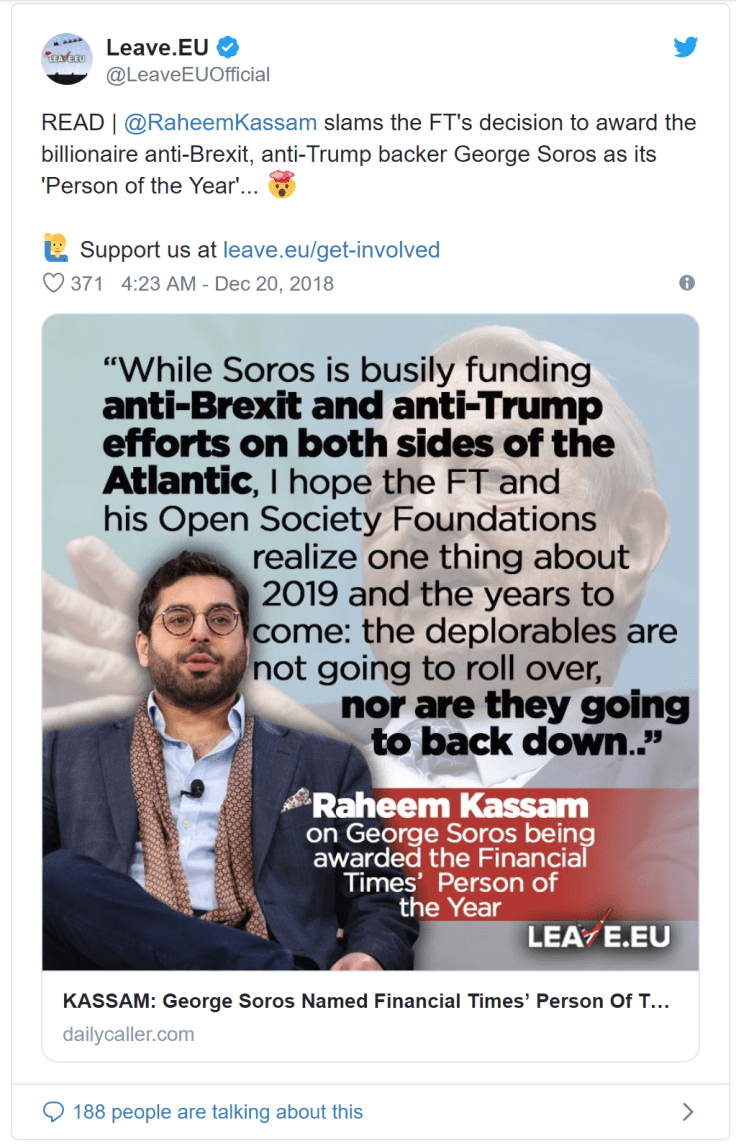
Soros ‘person of the year’ indeed: In 2018 globalists pushed peoples’ patience to the edge

By Robert Bridge

Capture.PNG

Since 2015, the proponents of neoliberalism have been pushing ahead with their plans for open borders and globalist agenda without the consent of the people. The last 365 days saw that destructive agenda greatly challenged.

In light of the epic events that shaped our world in 2018, it seems the Yellow Vests – the thousands of French citizens who took to the streets of Paris to protest austerity and the rise of inequality – would have been a nice choice for the Financial Times’ ‘person of the year’ award. Instead, that title was bestowed upon the billionaire globalist, George Soros, who has arguably done more meddling in the affairs of modern democratic states than any other person on the planet.

Perhaps FT’s controversial nomination was an attempt to rally the forces of neoliberalism at a time when populism and nascent nationalism is sweeping the planet. Indeed, the shocking images coming out of France provide a grim wake-up call as to where we may be heading if the globalists continue to undermine the power of the nation-state.

See the source image

It is no secret that neoliberalism relentlessly pursues a globalized, borderless world where labor, products, and services obey the hidden hand of the free market. What is less often mentioned, however, is that this system is far more concerned with promoting the well-being of corporations and cowboy capitalists than assisting the average person on the street. Indeed, many of the world’s most powerful companies today have mutated into “stateless superpowers,” while consumers are forced to endure crippling austerity measures amid plummeting standards of living. The year 2018 could be seen as the tipping point when the grass-roots movement against these dire conditions took off.

Since 2015, when German Chancellor Angela Merkel allowed hundreds of thousands of undocumented migrants into Germany and the EU, a groundswell of animosity has been steadily building against the European Union, perhaps best exemplified by the Brexit movement. Quite simply, many people are growing weary of the globalist argument that Europe needs migrants and austerity measures to keep the wheels of the economy spinning. At the very least, luring migrants with cash incentives to move to Germany and elsewhere in the EU appears incredibly shortsighted.

Indeed, if the globalist George Soros wants to lend his Midas touch to ameliorating the migrant’s plight, why does he think that relocating them to European countries is the solution? As is becoming increasingly apparent in places like Swedenand France, efforts to assimilate people from vastly different cultures, religions and backgrounds is an extremely tricky venture, the success of which is far from guaranteed.

One worrying consequence of Europe’s season of open borders has been the rise of far-right political movements. In fact, some of the harshest criticism of the ‘Merkel plan’ originated in Hungary, where its gutsy president, Viktor Orban, hopes to build “an old-school Christian democracy, rooted in European traditions.” Orban is simply responding to the democratic will of his people, who are fiercely conservative, yet the EU parliament voted to punish him regardless. The move shows that Brussels, aside from being adverse to democratic principles, has very few tools for addressing the rise of far-right sentiment that its own misguided policies created.

Here it is necessary to mention once again that bugbear of the political right, Mr. Soros, who has received no political mandate from European voters, yet who campaigns relentlessly on behalf of globalist initiatives through his Open Society Foundations (OSF) (That campaign just got some serious clout after Soros injected $18bn dollars of his own money into OSF, making it one of the most influential NGOs in the world).

With no small amount of impudence, Soros has condemned EU countries – namely his native Hungary – for attempting to protect their territories by constructing border barriers and fences, which he believes violate the human rights of migrants (rarely if ever does the philanthropist speak about the “human rights” of the native population). In the words of the maestro of mayhem himself: “Beggar-thy-neighbor migration policies, such as building border fences, will not only further fragment the union; they also seriously damage European economies and subvert global human rights standards.”

Through a leaked network of compromised EU parliamentarians who do his bidding, Soros says the EU should spend $30 billion euros ($33bln) to accommodate “at least 300,000 refugees each year.” How will the EU pay for the resettling of migrants from the Middle East? Soros has an answer for that as well. He calls it “surge funding,” which entails “raising a substantial amount of debt backed by the EU’s relatively small budget.”

See the source image

Any guesses who will be forced to pay down the debt on this high-risk venture? If you guessed George Soros, guess again. The already heavily taxed people of Europe will be forced to shoulder that heavy burden. “To finance it, new European taxes will have to be levied sooner or later,” Soros admits. That comment is very interesting in light of the recent French protests, which were triggered by Emmanuel Macron’s plan to impose a new fuel tax. Was the French leader, a former investment banker, attempting to get back some of the funds being used to support the influx of new arrivals into his country? The question seems like a valid one, and goes far at explaining the ongoing unrest.

At this point, it is worth remembering what triggered the exodus of migrants into Europe in the first place. A large part of the answer comes down to unlawful NATO operations on the ground of sovereign states. Since 2003, the 29-member military bloc, under the direct command of Washington, has conducted illicit military operations in various places around the globe, including in Iraq, Libya and Syria. These actions, which could be best described as globalism on steroids, have opened a Pandora’s Box of global scourges, including famine, terrorism and grinding poverty. Is this what the Western states mean by ‘humanitarian activism’? If the major EU countries really want to flout their humanitarian credentials, they could have started by demanding the cessation of regime-change operations throughout the Middle East and North Africa, which created such inhumane conditions for millions of innocent people.

This failure on the part of Western capitals to speak out against belligerent US foreign policy helps to explain why a number of other European governments are experiencing major shakeups. Sebastian Kurz, 32, won over the hearts of Austrian voters by promising to tackle unchecked immigration. In super-tolerant Sweden, which has accepted more migrants per capita than any other EU state, the anti-immigrant Sweden Democrats party garnered 17.6 percent of the vote in September elections – up from 12.9 percent in the previous election. And even Angela Merkel, who is seen by many people as the de facto leader of the European Union, is watching her political star crash and burn mostly due to her bungling of the migrant crisis. In October, after her Christian Democratic Union (CDU) suffered a stinging setback in Bavaria elections, which saw CDU voters abandon ship for the anti-immigrant AfD and the Greens, Merkel announced she would resign in 2021 after her current term expires.

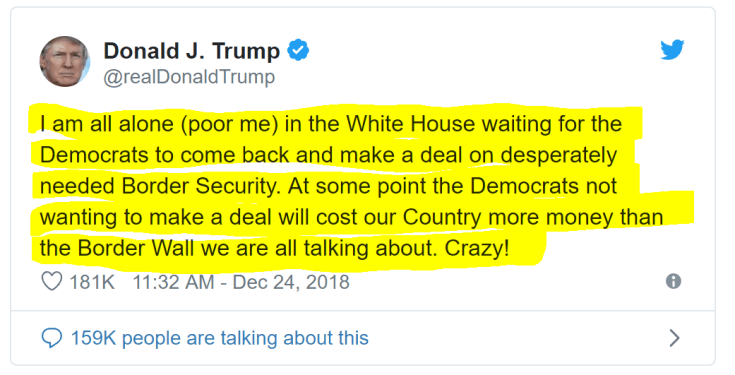
Meanwhile, back in the US, the government of President Donald Trump has been shut down as the Democrats refuse to grant the American leader the funds to build a wall on the Mexican border – despite the fact that he essentially made it to the White House on precisely that promise. Personally, I find it very hard to believe that any political party that does not support a strong and viable border can continue to be taken seriously at the polls for very long. Yet that is the very strategy that the Democrats have chosen. But I digress.

Capture

The lesson that Western governments should have learned over the last year from these developments is that there exists a definite red line that the globalists cross at risk not only to the social order, but to their own political fortunes. Eventually the people will demand solutions to their problems – many of which were caused by reckless neoliberal programs and austerity measures. This collective sense of desperation may open the door to any number of right-wing politicians only too happy to meet the demand.

Better to provide fair working conditions for the people while maintaining strong borders than have to face the wrath of the street or some political charlatan later. Whether or not Western leaders will change their neoliberal ways as a populist storm front approaches remains to be seen, but I for one am not betting on it.

@Robert_Bridge

Like this story? Share it with a friend!

(GLOBALISTS) -George Soros crowned ‘person of the year’ by Financial Times, but not everyone is cheering

George Soros crowned ‘person of the year’ by Financial Times, but not everyone is cheering

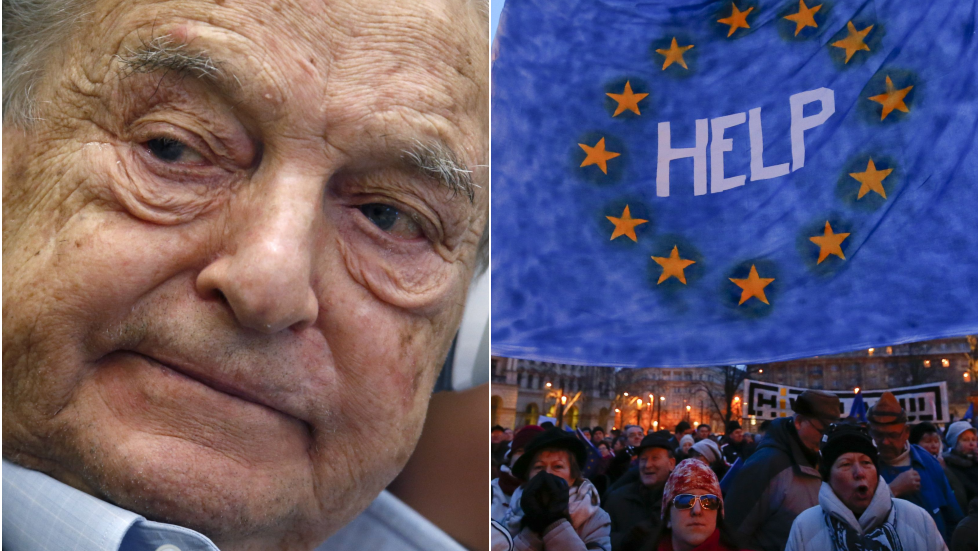
Georges Soros (L) ; Anti-Orban demonstrators in Hungary © Reuters / Charles Platiau / Laszlo Balogh

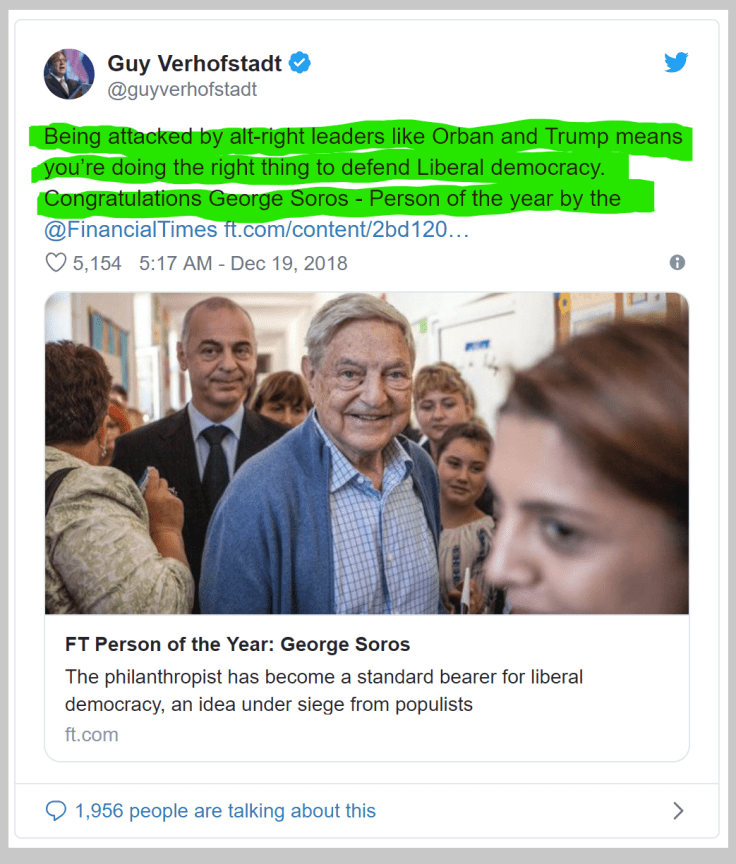
Being “under siege” from Donald Trump and Vladimir Putin has earned George Soros the FT’s ‘person of the year’ title. Eyebrows were raised over the not-at-all biased description of the billionaire as a champion of democracy.

For thirty years, liberal businessman and philanthropist Soros has used his vast wealth to crusade against“authoritarianism, racism and intolerance,” the FT profile reads.
Capture

Armed with his expansive grant-giving network, Open Societies Foundations (OSF), the Hungarian-American spread his influence to some 100 countries across the globe. The NGO currently has annual expenditures of over $940 million, with 26 national and regional foundations and offices.

There’s hardly a question over whether the Soros-funded apparatus is doing the right thing. The first paragraph of the story says it just “helped thwart an allegedly corrupt nuclear power plant contract with Russia” – a feat to be admired in the liberal world.

“We haven’t stopped having a beneficial influence,” Soros is then quoted as saying.

ALSO ON RT.COMGeorge Soros’ Open Society foundation ends operations in Hungary

But there’s a worrying trend for the Democrat mega-donor, passionate advocate for open borders and outspoken critic of Brexit. More and more detractors see his work as an existential threat to conservative values and even state sovereignty.

The “standard bearer of liberal democracy and open society” has found his ideals “under siege” as he “has attracted the wrath of authoritarian regimes and, increasingly, the national populists who continue to gain ground,” writes FT.

Capture

At one point Soros sounds a bit more critical of himself than the paper, as he acknowledges he’s a divisive figure, something he still believes indicates his effectiveness as an activist.

“I’m blamed for everything, including being the anti-Christ,” Soros says. “I wish I didn’t have so many enemies, but I take it as an indication that I must be doing something right.”

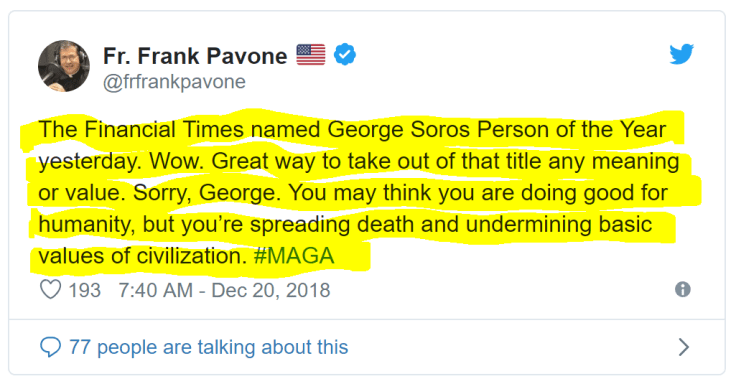
Soros wasn’t joking. Hungarian lawmaker Andras Aradszki of the Christian Democratic People’s Party (KDNP) once declared that it is a Christian’s duty to oppose Soros’ calls for Europe to take in asylum seekers from Africa and the Middle East – what Aradszki called Satan’s Soros plan.” The lawmaker added that “Soros and his comrades want to destroy the independence and values of nation states.”
Capture

In May, the OSF ended its operations in Hungary, citing an “increasingly repressive political and legal environment.” A month later, Hungary’s parliament passed the ‘Stop Soros’ law which threatens jail time for anyone helping illegal immigrants claim asylum.

Hungarian PM Viktor Orban accused Soros of attempting to use mass migration to undermine Europe’s stability.

“Soros has antagonized not only us but also England, President Trump and Israel too,” Orban said in February.“Everywhere he wants to get migration accepted. It won’t work. We are not alone and we will fight together… and we will succeed.”

ALSO ON RT.COMHungary approves ‘Stop Soros’ law criminalizing aid to illegal migrants

In the UK, the billionaire has been sharply criticized for his donations of over £800,000 ($1,062,000) to pro-EU campaigns. The pledges included £400,000 to Best for Britain, a campaign group that has been at the forefront of anti-Brexit activism.
Capture

The businessman’s activities have received similar hostility in the United States, where some have accused him of providing assistance to the so-called “migrant caravan” which made its way from Central America to the US’ southern border. “The venom, long concealed among extreme right networks, has leaked into the mainstream,” laments the FT.

Capture

Soros, along with other notable critics of Donald Trump, such as former President Barack Obama, the Clintons and CNN, was recently targeted by an alleged pipe bomb mailed to his home in New York.

A prominent backer of the Democratic Party, Soros has called Trump a “danger to the world,” and once (wrongly) bet that stocks would collapse if Donald won presidency. The bet reportedly cost him $1 billion – quite affordable for the investor who is currently worth $8.3 billion after his 2017 transfer of $18 billion to the OSF.

ALSO ON RT.COM‘Lock him up!’ Smiling Trump joins chant against Soros (VIDEO)

For a man who made billions short-selling the UK pound sterling and has been accused of several more currency crises in Asia, FT’s Soros comes across as a wise old benefactor “looking beyond his formidable legacy” in his “twilight years.”

READ MORE: Soros sold off Facebook stocks before they tanked, documents show

But for all the accolades, the paper may have forgotten that the businessman has long had his sights set on a title more ambitious than merely the ‘person’ of the year. In a 1993 interview with the UK Independent, Soros actually confessed that he suffers from a god complex.

Capture

“It is a sort of disease when you consider yourself some kind of god, the creator of everything, but I feel comfortable about it now since I began to live it out,” he said.

Think your friends would be interested? Share this story!

Blog at WordPress.com.

Up ↑