By Peak Prosperity – 2/26/2020
Coronavirus: the Economic Impact
2/26/2020
Financial markets plunged again on Tuesday as investors continued to worry about the spread of the coronavirus.
Yes, prepare for a pandemic.. as though it wasn’t already a pandemic
Contagion more rapid than thought
Dr. John Campbell – 2/26/2020
Still loads of people posting how the flu is 100 times worse than Covid-19. The message is still not getting through to the masses. This is much worse than seasonal flu.
Coronavirus: Iran’s deputy health minister tests positive as outbreak worsens
2/26/2020
Several European countries have announced their first coronavirus cases, with all appearing to be linked to the growing outbreak in Italy.
His palms are sweaty. Knees weak. Arms are heavy. Corona virus spreading in his system already.
Breaking: Dow Drops 960 Points at Open Over Fears of Coronavirus

February 24, 2020
The Dow Jones erased all gains for 2020 at its open on Monday over fears of the spread of the coronavirus.
The stock market was down 3.12% when it opened on Monday.
Over the weekend there were major outbreaks of the coronavirus reported in South Korea, Italy and Iran.
The virus is spreading.
Six nations banned people crossing the border from Iran in an attempt to cut off the spread of the deadly virus.
There are at least 600 cases reported in South Korea.

Rabobank: Our Coronavirus Base Case Is Rapidly Shifting From “Bad” To “Ugly”


by Tyler Durden
Mon, 02/24/2020 – 09:38
Submitted by Michael Every of Rabobank
Regular readers will know that our four projected COVID-19 scenarios were “Bad, Worse, Ugly, and Unthinkable”. Current news today suggests risks that the base case is rapidly shifting from “Bad”, meaning only China is impacted, to “Ugly”, where both emerging Asia and developed economies see soaring infection rates and deaths.
After all, following Vietnam, Iran now has eight deaths and an uncertain number of cases, prompting schools and universities to closed and the borders with Afghanistan and Pakistan to be sealed from the other side. For an economy already being crushed by sanctions, this is all that it needed. More worrying for markets, South Korea (with a GDP of over USD1 trillion) has also been swamped by hundreds of new cases, a 20-fold leap in just five days, and, as in China, is seeing the highest-level emergency declared, cities on lock-down, gatherings and travel bans in place, and the national assembly additionally suspended. Samsung has had to shutter at least one factory, in the city of Gumi. The Asian economy, already reeling, it about to suffer another major kick.
Worse, in Europe there also are over 160 cases in a cluster in northern Italy, with three deaths so far, and the regions of Lombardy and Veneto, the industrial and financial heartlands, in both panic and lockdown. Venice’s Carnival has been cancelled, and so was a recent fashion show. Italy is 11% of Eurozone GDP, and those two regions are 30% of Italy’s GDP. For a Eurozone already close to recession, that shock could well be more than enough to generate a downturn. Once again, we also see what we said we would in our recent virus special report: a “China-style” response: yesterday a train from Venice to Munich was stopped at the Austrian border because of fears that two passengers on board may have had the virus. So much for Schengen? Recall that the origins of the world “quarantine” come from Venice in an earlier phase of globalisation, and refer to the *40* days sailors had to stay on a visiting ship to prove they were not carrying an infectious disease. No just-in-time supply chains in those days though.

Meanwhile, China is saying the virus may not have started in the seafood market; hot-headed Chinese social media is saying it might have been America who started it; experts are saying COVID-19 can linger on surfaces for nine days, and is airborne, and can be passively carried with no symptoms for up to *27* days, nearly double the 14 days previously thought; and other reports show that false negative tests are a serious issue, with at least one confirmed case of a patient being tested negative twice and then switching to positive. As the WHO, which has urged us all to travel as normal until now, “because markets”, wails, the window to stop this becoming a global pandemic is closing.
By contrast, China is doing its best to say that all is well. Unsurprisingly, since Party Chairman Xi Jinping placed his hand-picked people in charge, new cases have dropped sharply. Optimists see this means the lockdowns have worked – which means more global lockdowns must now be priced in, however; pessimists suggest data goal-seeking is playing a role here. However, deaths have not fallen yet, with another 97 yesterday raising the overall fatality rate worryingly (and one study of 53 Wuhan patients suggests a 61.5% fatality rate for those with any co-morbidity factor such as diabetes and/or heart or lung disease).
Just as unsurprisingly, Xi has publicly promised China will have beaten the virus by the end of March, and that the overall economic goals for 2020 are still in place, even as right now we are still basically flat-lining as shown by traffic congestion, pollution, and property sales. As we have already covered in recent weeks, the only way for BAU to return ASAP is for everyone to start travelling and gathering and working again: which is exactly how the virus will spread, especially after we have been told there is a 27-day latent period, as well as a clear tendency of asymptomatic carriers, and even more so now it has legs outside China too. Even so, people are being urged back to work as eagerly as they were being told to lock themselves in at home just two weeks ago.

Equally unsurprisingly, the PBOC, who have already lowered rates 10bp, are making clear that COVID-19 “will be short-lived and will not change the country’s sound economic fundamentals”. With several reports suggesting up to 85% of China’s small business are going to run out of cash within three months, and many within weeks, its banks riddled with bad loans and already under-capitalised, and the state clearly about to embark on another massive debt-splurge to build more infrastructure to keep to a set GDP number regardless, even when China does re-emerge from COVID-19 it will be sagging under an even more unsustainable debt load, and the state will be playing an even larger economic role. It’s also unclear if foreign firms will be as willing to be embedded in a long, China-centric supply chain regardless, making USD inflows less likely; and all of those issues above will mean the weaker CNY we have referred to for years. It is no surprise we are through 7 again; the larger surprise is that we are not closer to 7.20.
More broadly, of course, the “Ugly” scenario is seeing US Treasury yields test critical support levels. The 10-year is now at 1.47% and another leg down will see us in whole new territory. Likewise, the USD is on a roll upwards and threatening to push higher: imagine if European virus cases spread, the same happens in Japan, and China cannot reopen as planned. And imagine what a stronger USD on top of this virus backdrop will mean for emerging-market USD borrowers. Ugly indeed.
Such is the news-flow that I hardly have time to relate that Bernie Sanders handily won the Nevada Democratic caucus, leaving Joe “White Walker” Biden in a poor second place and Mike Bloomberg looking as user-friendly as his terminals are. That makes Bernie the clear presidential nominee front-runner at this stage – and makes many Never-Trumpers into Rather-Trumpers, I would imagine. And imagine if Bernie’s plans for free healthcare for all intersect with a virus outbreak in the US….(on which note, please see our recent Through The Looking Glass report imagining a Sanders presidency).
Coronavirus: South Korea has seen its confirmed cases spike – BBC News
2/21/2020
The leader of the WHO saying he doesn’t know how transmissible the disease is after 3 months. Really says it all right there.
The WHO is run by incompetent clowns and China apologists.
Coronavirus pandemic could wipe $1.1 TRILLION off global economy — Oxford Economics

China’s GDP growth is expected to fall from six percent last year to 5.4 percent in 2020 due to the spread of the COVID-19 virus, said the latest report by Oxford Economics.
It has modeled two scenarios on the coronavirus outbreak morphing into pandemic. Under the first scenario, if it spreads more widely in Asia, world GDP would fall by $400 billion this year, or 0.5 percent. The second scenario foresees the global GDP dropping $1.1 trillion or 1.3 percent, if the virus outbreak becomes a pandemic and a disruption to manufacturing in Asia spreads worldwide. Such a decline would be the same as losing the entire annual output of Indonesia, which is the world’s 16th largest economy.

“Our scenarios see world GDP hit as a result of declines in discretionary consumption and travel and tourism, with some knock-on financial market effects and weaker investment,” wrote the analysts.
Oxford Economics said it still expected the impact of the virus to be limited to China and to have a significant, but short-term impact, bringing world GDP growth just 0.2 percent lower than January at 2.3 percent.
The growth of new confirmed cases of the deadly coronavirus has slowed down this week, but experts warn it is too early to call the all-clear for the risk of a pandemic. So far, there are over 75,500 confirmed cases and more than 2,100 deaths.
Shocking Spike In COVID-19 Cases Puts Beijing On High Alert; Officials Weigh “Wuhan-Level” Lockdown

by Tyler Durden
Thu, 02/20/2020 – 12:57
Summary:
-
Iran confirms 5 cases of COVID-19
-
Japanese officials defend their handling of ‘Diamond Princess’ quarantine
-
Beijing tightens lockdown after dozens more cases reported
-
As outbreak ex-China accelerates, WHO warns case #s “won’t stay low for long.”
-
Hong Kongers evacuated from ‘Diamond Princess’ after Japanese government confirms 2 deaths
-
Researchers confirm COVID-19 more contagious than SARS and MERS
-
Tim Cook welcomes back employees, customers as Apple reopens some China stores
* * *
Update (1420ET): WSJ reports that Japan’s top health officials have defended their handling of the ‘Diamond Princess’ quarantine during a statement to Japan’s parliament, the Diet.
Japan’s Health Minister Katsunobu Kato told Parliament the two people from the Diamond Princess cruise ship who died had “received the best medical treatment” but couldn’t be saved after catching the novel coronavirus on board. As of Thursday, 634 passengers and crew members were diagnosed with the virus out of 3,063 tested. Slightly more than half have no symptoms at all, officials said, and many of the remainder have only mild fever or a cough. Among patients who tested positive for the virus, 28 were reported in serious condition Thursday.
Doctors have said the virus can be particularly harmful in elderly patients, and one of the two fatal cases from the Diamond Princess, a Japanese man in his 80s, had pre-existing bronchial asthma and had been treated for angina. The other, a Japanese woman in her 80s without underlying illnesses, came down with a fever on Feb. 5, the same day passengers were told they would be quarantined in their cabins for two weeks, according to health ministry officials. The next day, she started suffering from diarrhea and saw a doctor on board.
She wasn’t taken to a hospital until Feb. 12 when she started suffering shortness of breath. Her virus test came back positive the following day, and despite treatment with antiviral drugs normally used to treat HIV infection, she died Thursday.
Asked about the woman’s case, health ministry official Hiroshi Umeda said, “I believe it was handled promptly.” He said the ship was a difficult environment for medical staff but they worked day and night and tried to prioritize the most serious cases.
The country has been widely criticized for appearing to break quarantine on the cruise ship, which was home to the largest COVID-19 outbreak outside China. More than 700 passengers who tested negative for the virus disembarked the ship on Wednesday and Thursday.
* * *
Update (1415ET): A group of 59 Hong Kong police officers has been quarantined after a fellow officer tested positive for the virus, according to a statement released publicly by the city’s police.
* * *
Update (1250ET): Less than an hour ago, we mentioned that Beijing’s heavy-handed virus-fighting measures had become the subject of an intense “public debate” about whether they were doing more harm than good.
Well, according to an unconfirmed report from the Epoch Times’ Jennifer Zeng, party officials in Beijing are upgrading its “epidemic prevention” status to “Wuhan-level” – meaning a complete lockdown where residents aren’t allowed to leave their homes without specific permission.

Another tweet sent earlier in the day reported new restrictions being imposed at a Beijing apartment complex.

How much longer can the party keep this up before it damages public confidence to a degree that can’t be repaired.
* * *
Update (1200ET): In what appears to be yet another consequence of Beijing’s rushed push to get all of China “back to work” nearly two weeks ago, the Global Times, a Chinese tabloid that also publishes in English.
A hospital in Central Beijing has reported 36 novel coronavirus cases as of Thursday, a sharp increase in the number of cases reported in the capital city. The new cases bring Beijing’s total to 45, stoking fears that the outbreak could accelerate.
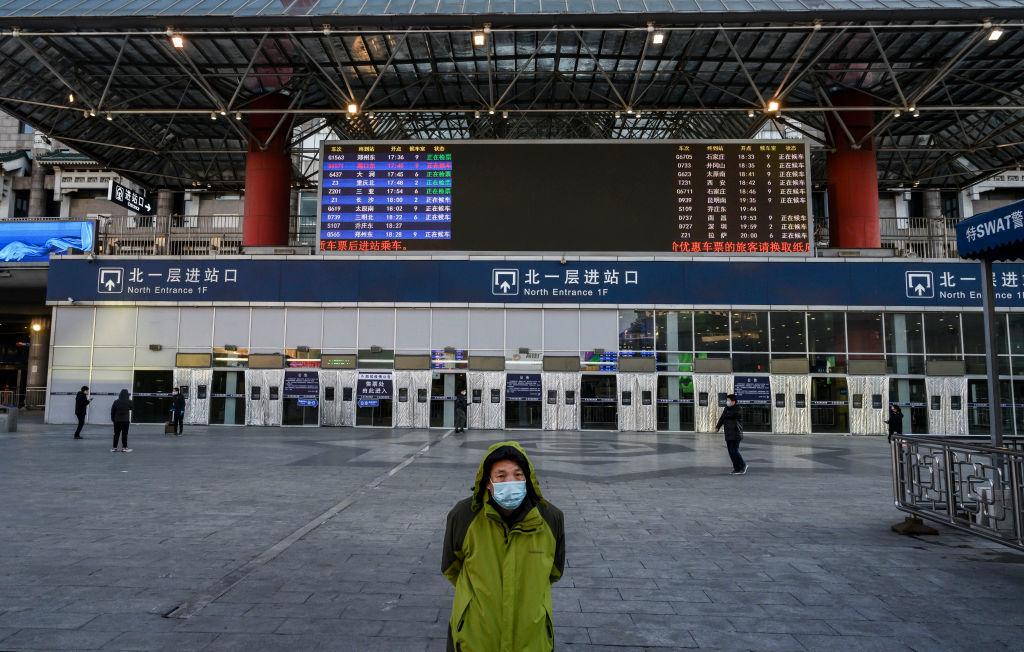
Among the infected at Fuxing Hospital in Beijing’s Xicheng district were eight medical workers, nine cleaning staff and 19 patients, along with members of their families.
These confirmations follow reports that Beijing officials quarantined whole office buildings following after some employees were suspected of having the virus.
“Considering 36 confirmed cases were found in Fuxing Hospital, it is more about one case of multiple infections rather than an epidemic of the whole area,” Wang Guangfa, director of the department of respiratory and critical care medicine at Peking University First Hospital, told the Global Times on Thursday.
“This coronavirus issue is big. It will effect a lot of companies, and I think the market’s have underestimated what a big supply-side shock this is,” said Mohammad El-Erian, Bill Gross’s former No. 2 man at PIMCO and a widely watched economist who works now with PIMCO parent Allianz.
Peking University People’s Hospital, another major hospital in Beijing, confirmed that it had received three patients carrying the virus earlier this week on Feb. 17. Already, a total of 164 medical workers at the hospital have been placed under close medical observation after they had “close contact” with the patients – something that seems almost unavoidable for nurses and doctors.
A total of 164 people including medical staff at People’s Hospital who have had close contact with the patients have been put under close The hospital said it had conducted coronavirus tests on 251 personnel, and so far, they’ve all been negative.
In other news, another analyst has told the GT that Apple’s iPhone sales in China will shrink 40% to 50% in the near term after the company closed all its retail stores in the country earlier this month. Those stores have only just started to reopen.
Liang Zhenpeng, a senior industry expert, told the Global Times on Thursday the COVID-19 outbreak has dealt a heavy blow to the sales of all mobile phone suppliers in China, including Apple.
“The iPhone’s sales in the first quarter of this year are likely to be less than half of the same quarter in 2019,” he said. “Mobile phone sales, both online or offline, are very difficult during this period, because the supply chains can hardly be normalized.”
Apple CEO Tim Cook said on his Sina Weibo account, China’s Twitter-like social media, that the company is welcoming back employees and customers and is looking to work closely with their manufacturing partners to get everything back on track.
We suspect this is what triggered the market plunge over the last 30 minutes.
Circling back to Beijing, the municipal officials said that all hospitals in Beijing should “accelerate hospitalization of patients and try their best to diagnose suspected cases to treat the infected patients at the earliest time.”
So far, the confirmed cases in the city have been scattered around 15 of its 16 districts.
The hysteria surrounding the outbreak across China has actually sparked an interesting public debate – something you don’t see much in China – about whether all of the heavy-handed government measures – the quarantines and lockdowns and roadblocks – and the work stoppages are really necessary.
Some even contend that by impoverishing regular Chinese people via work stoppages that damage the economy, the government might be doing more harm to the population than the virus has, according to the New York Times.
With hundreds of millions of people in China now essentially living in isolation and its economy nearly at a standstill, experts in the country are increasingly arguing that Beijing’s efforts to fight the coronavirus are hurting people’s lives and livelihoods while doing little to the stop the virus’s spread.
If the country becomes poorer because of emergency health measures, they say, that drop might hurt public health more than the virus itself.
The debate – including questions about whether mandatory 14-day quarantines, roadblocks and checkpoints are really necessary in areas where there have been few cases – is unusual in a country where dissent is usually censored.
It comes as China reported a significant decrease in new coronavirus infections on Thursday, as health officials changed the way they counted confirmed cases for the second time in over a week.
Of course, President Xi and China’s senior economic officials claim that there won’t be any economic pullback, since Beijing is obviously winning the ‘People’s War’.
* * *
Update (1010ET): Talk about a spike in deaths: Iran is now reporting 9 deaths after shocking the world by revealing that two Chinese nationals infected with the virus had died in the city of Qoms earlier this week.
The Iranian regime has reportedly imposed a China-style crackdown on Qoms, deploying military and crowd-control police across the city.
It’s just the latest sign that the cases and deaths ex-China are accelerating.
CNBC’s Eunice Yoon reports that Beijing has warned Hubei not to allow people back to work before March 10.

Local leaders said yesterday that they would launch a special financing vehicle to help struggling companies in the province survive the outbreak.
Following the WHO’s daily press conference, Director General Dr. Tedros said the WHO had confirmed 1,000 cases outside mainland China (with more than half of them infected aboard the ‘Diamond Princess’), and 7 deaths, likely excludes some of the deaths announced over the past 12 hours. Though he added that the data coming out of China “appeared to show a decline in new cases.”
“Outside China, we have seen a steady drip of new cases, but we have not yet seen sustained local transmission, except in specific circumstances like the Diamond Princess cruise ship,” he added.
More ominously, Dr. Tedros exclaimed that the outbreak is far from over, and if governments don’t take adequate steps to fight the virus, the number of cases outside China “won’t stay low for very long.”
Worried about more shortages of personal protective equipment like facemasks, Dr. Tedros pleaded with a dozen different manufacturers to do whatever they can to keep up appropriate global supplies.
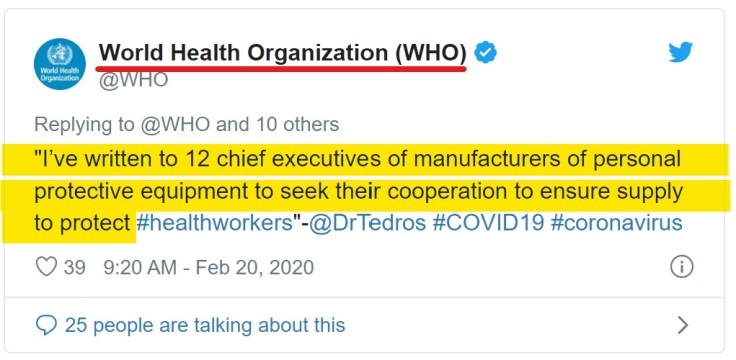
The director said the WHO expects to have more data from two clinical trials for treatments in roughly 3 weeks.
Since we haven’t posted a breakdown of new cases yet today, we figured we’d share this list of countries, cases and deaths courtesy of the Associated Press:
According to the Associated Press, the latest figures provided by each government’s health authority as of Thursday in Beijing are:
-
Mainland China: 2,118 deaths among 74,576 cases, mostly in the central province of Hubei
-
Hong Kong: 65 cases, 2 deaths
-
Macao: 10
-
Japan: 727 cases, including 634 from a cruise ship docked in Yokohama, 3 deaths
-
Singapore: 84
-
South Korea: 51, 1 death
-
Thailand: 35
-
Taiwan: 24 cases, 1 death
-
Malaysia: 22
-
Vietnam: 16
-
Germany: 16
-
United States: 15 cases; separately, 1 U.S. citizen died in China
-
Australia: 14
-
France: 12 cases, 1 death
-
United Kingdom: 9
-
United Arab Emirates: 9
-
Canada: 8
-
Iran: 5 cases, 2 deaths
-
Philippines: 3 cases, 1 death
-
India: 3
-
Italy: 3
-
Russia: 2
-
Spain: 2
-
Belgium: 1
-
Nepal: 1
-
Sri Lanka: 1
-
Sweden: 1
-
Cambodia: 1
-
Finland: 1
-
Egypt: 1
In other news, UK passengers aboard the ‘Diamond Princess’ will be evacuated by their government on Friday. The chartered evacuation flights (following the standard template) will land at Boscombe Down airbase in Wiltshire. Elsewhere in the anglosphere, Australia has extended its travel ban for arrivals from China into a fourth week. It will last until Feb. 29, the Guardian reported.
* * *
Hours after Japanese press reports claimed that two passengers who contracted COVID-19 aboard the ‘Diamond Princess’ died yesterday – news that was later confirmed by Japanese authorities – South Korea reported its first fatality while one of its major cities asked citizens to stay inside and avoid venturing outdoors, according to the Washington Post.
According to Japanese government officials, both of the virus-related fatalities were Japanese citizens in their 80s who had been moved off the ship more than a week ago for treatment in a Japanese hospital, though the government has so far declined to release names.
The latest reports Thursday morning confirmed another 13 cases aboard the DP bringing the total to 634. The odds that individuals being released from the 2 week quarantine on Thursday and Friday might have contracted the virus, but have yet to show symptoms, remains high. The death in South Korea raised the death toll ex-China to 10.
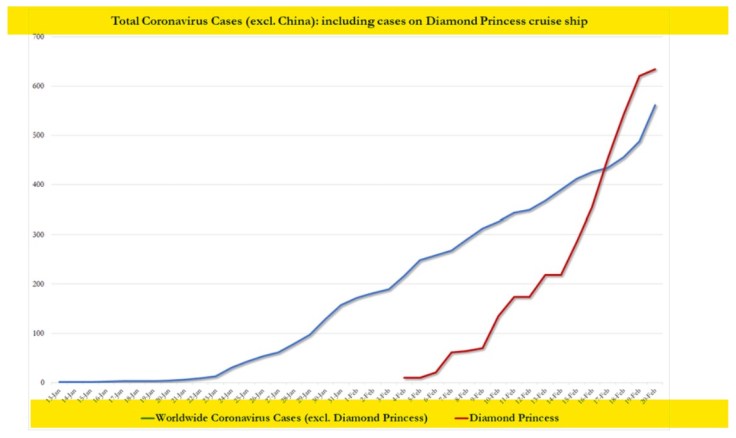
The speed is hardly a surprise for those who have been paying attention to all of the new research, instead of dismissing it for being ‘alarmist’ and ‘not peer reviewed’.
Finally, earlier this week, researchers published the largest study yet of the outbreak, which confirmed that COVID-19 is more contagious than SARS and MERS, leaving it on par with seasonal influenza.
Still, experts insist that the virus’s fatality rate is probably around 2%, meaning that it’s less deadly than SARS, but the wider spread will result in more deaths, CNN reports.
“My sense and the sense of many of my colleagues, is that the ultimate case fatality rate … is less than 2%,” Dr. Anthony Fauci, director of the National Institute for Allergy and Infectious Diseases, told CNN’s Jim Sciutto on “New Day” Tuesday. “What is likely not getting counted is a large number of people who are either asymptomatic or minimally symptomatic, so the denominator of your equation is likely much much larger.”
“So I would think at tops it’s 2% and it likely will go down when all the counting gets done to 1% or less. That’s still considerable if you look at the possibility that you’re dealing with a global pandemic,” he added.
Even as President Xi does everything in his power to present an image of success to the Chinese people – in his speeches, he claims the Chinese government’s strict quarantines have been an unmitigated success – global experts, including the WHO, have warned that the disease will continue to spread globally, and that the end of this crisis is still far from certain.
And as new confirmed cases dropped substantially on Wednesday in Hubei, everywhere else, the rate of new infections is accelerating.
In South Korea, the number of cases soared by almost two-thirds to 104 overnight, further emphasizing our observation that the number of cases ex-China has started to accelerate notably as the curve starts to resemble an exponential progression.

One WHO health expert told a Japanese TV station on Thursday that the virus is “a moving target” making it difficult to collect information and treat people: “Nobody has ever had to deal with this situation before, this is a new virus on a ship with 4,000 people, there are no guidelines for that.” He added that he suspects there was a substantial amount of transmission before it arrived in Yokohama, adding that it was “not possible” to isolate everybody individually.
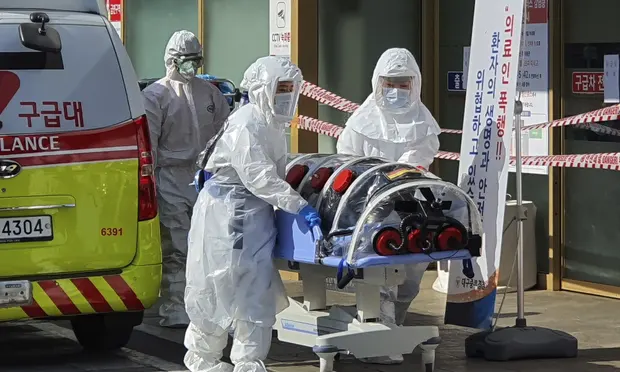
The WHO senior epidemiologist was responding to claims made by another expert in infectious disease that the Japanese had failed to observer proper quarantine protocols.
Back in Korea, the mayor of Daegu, a city of 2.5 million where 10 South Koreans contracted the disease from a church service, asked residents to stay indoors. Iran also reported two infected that then died.
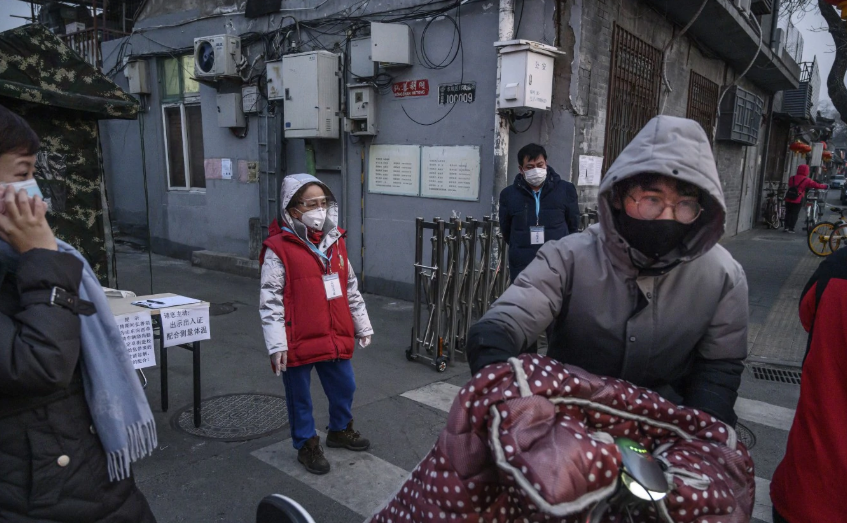
Experts suspect that one woman in Daegu may have infected at least 40 others by going to her Christian church, according to Yonhap. The alleged ‘superspreader’ is the reason for the huge jump in new cases on Thursday. Experts say the city is now facing an “unprecedented crisis” following the spike in cases.
“We are in an unprecedented crisis,” Daegu’s mayor, Kwon Young-jin, told the press.
Cases are also surging in Singapore, where Deutsche Bank confirmed that an employee in its Singapore office had contracted the virus.
Adding to its woes, Iran reported three new cases on Thursday a day after it confirmed two virus-related deaths in the city of Qoms.
Warnings about the virus’s economic blowback are increasing, as Goldman said Thursday that stocks aren’t completely pricing in the risks from the virus.
Meanwhile, Air France-KLM, Qantas, and the global container shipping giant Maersk became the latest companies to warn about the financial impact from the continued spread of the coronavirus.
As President Xi balances the risks to tens of thousands of lives on one hand, and keeping his promise to double the size of China’s economy by 2020 on the other, it seems the leadership in Beijing are beginning to believe their own propaganda. Premier Li Keqiang, Xi’s No. 2 who is in charge of the committee managing the crisis, local governments should seek to increase the rate of resumed production and work, according to China Central Television.
Put another way: Come on in, the water’s fine, and if you get the virus and die, we’ll cremate your body and tell your family you died of “pneumonia.”
China’s smartphone shipment declined 50%-60% during the 2020 Spring Festival holidays due to the coronavirus outbreak. About 60 million smartphones remain unsold.
Chinese officials are pulling out all the fiscal and monetary stops to protect China’s damaged economy, and on Thursday local officials from Hubei announced a new lending scheme – a “special financing vehicle” – worth 50 billion yuan (more than $7 billion) to stabilize financing for local companies.
To be sure, the drop in new cases last night was largely caused by health officials reversing their decision to include “clinically diagnosed” patients – i.e. those who haven’t yet tested positive due to a shortage of effective tests – in the case totals.
The spate of deaths rattled investors overnight, and US equity futures are pointing to a lower open on Thursday, and a rush of risk-off trading in Asia has pushed the BBG dollar index to a 4-month high following the latest piece of evidence that the coronavirus isn’t simply “another flu”.
China Has Ground To A Halt: “On The Ground” Indicators Confirm Worst-Case Scenario
by Tyler Durden
Back on Monday, when analysts and investors were desperately seeking clues whether China has managed to reboot its economy from the 2-week long hiatus following the Lunar New Year/Coronavirus pandemic amid the information blackout unleashed by the communist party in the already opaque country, we pointed out some alternative ways to keep tabs of what is really taking place “on the ground” in China, where Xi Jinping has been urging local businesses and workers to reopen and resume output, while ignoring the risk the viral pandemic poses to them (with potentially catastrophic consequences).
Specifically, Morgan Stanley suggested that real time measurements of Chinese pollution levels would provide a “quick and dirty” (no pun intended) way of observing if any of China’s major metropolises had returned back to normal. What it found was that among some of the top Chinese cities including Guangzhou, Shanghai and Chengdu, a clear pattern was evident – air pollution was only 20-50% of the historical average. As Morgan Stanley concluded, “This could imply that human activities such as traffic and industrial production within/close to those cities are running 50-80% below their potential capacity.”
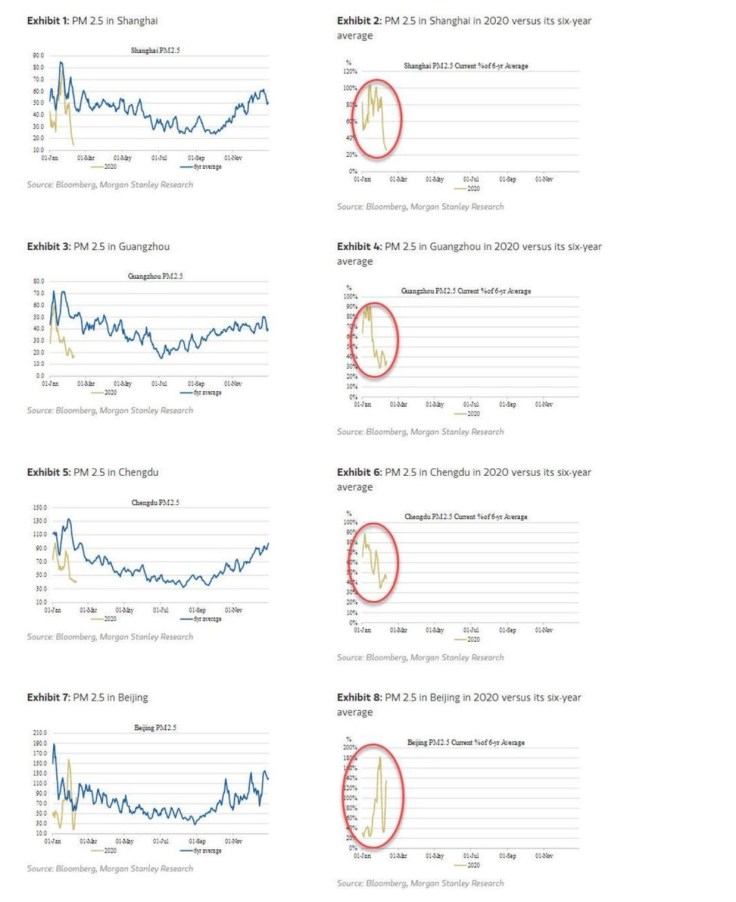
As a reminder, all this is (or technically, isn’t) taking place as President Xi Jinping on Wednesday sought to send a message that progress had been made in bringing the coronavirus outbreak under control and, for most parts of the country, the focus should be on getting back to business.
According to state television, Xi chaired a meeting of the Politburo Standing Committee, China’s supreme political body, on the latest developments on the crisis and future policy responses, concluding that there had been “positive changes” with “positive results”.
Xi also reiterated that all levels of local government and Communist Party committees must strive to achieve China’s social and development goals this year, indicating that he did not want the public health crisis to hinder progress.
Most importantly, Xi urged local authorities to refrain from taking excessive measures to curb contagion, and yet clip after clip from China…
… shows that the measures being taken are far beyond merely “excessive” when it comes to limiting the potential spread of the virus, which probably makes sense considering the unexpected surge in infected cases in Wuhan, which have sent the total for China just shy of 60,000.
Add to this the ongoing uncertainty that Beijing is far behind the curve in containing the virus, and one can see why most businesses are reluctant to “get back to normal.”
In the latest confirmation of just that, several other indicators have emerged showing that despite Xi’s stark demands for 1.4 billion Chinese to ignore the global pandemic which may very well have been started by one of China’s own experimental labs…
… virtually all of China – and all those critical supply chains that keep companies across the globe humming and stocked with critical inventory – remain on lockdown.
As confirmation, while we wait for an update from Morgan Stanley on the latest Chinese pollution data (at least until Beijing’s definition of “pollution” is also revised) here is JPMorgan showing that while traditionally daily coal consumption – the primary commodity used to keep China electrified – rebounds in the days following the Lunar New Year collapse when China hibernates for one week, this year there hasn’t been even a modest uptick higher, indicating that so far there hasn’t been even a modest uptick in output.
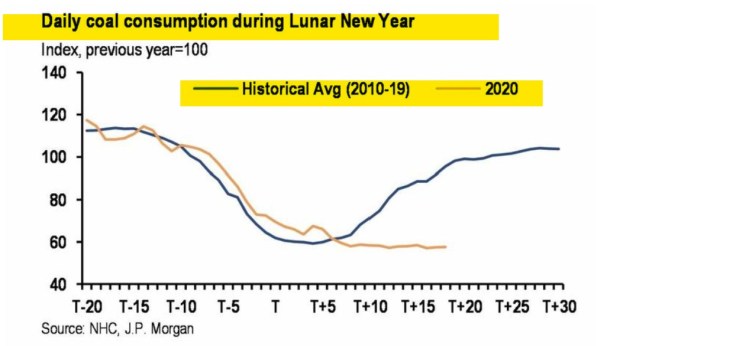
Yet electricity is just one core indicator of real-time economic activity. Perhaps an even more critical one is human transit across the 1.4 billion person strong nation. Conveniently there is a way to track rudimentary traffic patterns across some of China’s key metro areas, and they show that – in a confirmation of the worst-case scenario – activity, as measured by travel, across most of China appears to have ground to a halt.
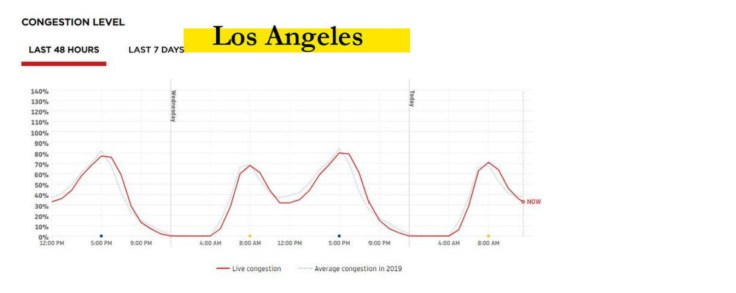
The charts below show TomTom’s traffic congestion data across key Chinese cities such as Beijing, Shanghai and Wuhan as compared to the average measurement for 2019. What they show is that virtually nobody appears to be driving in China!
Here is Beijing’s congestion level over the past 48 hours (a 7 day average is also available) compared to 2019. The data indicates that travel is about 70% below its 2019 peak.
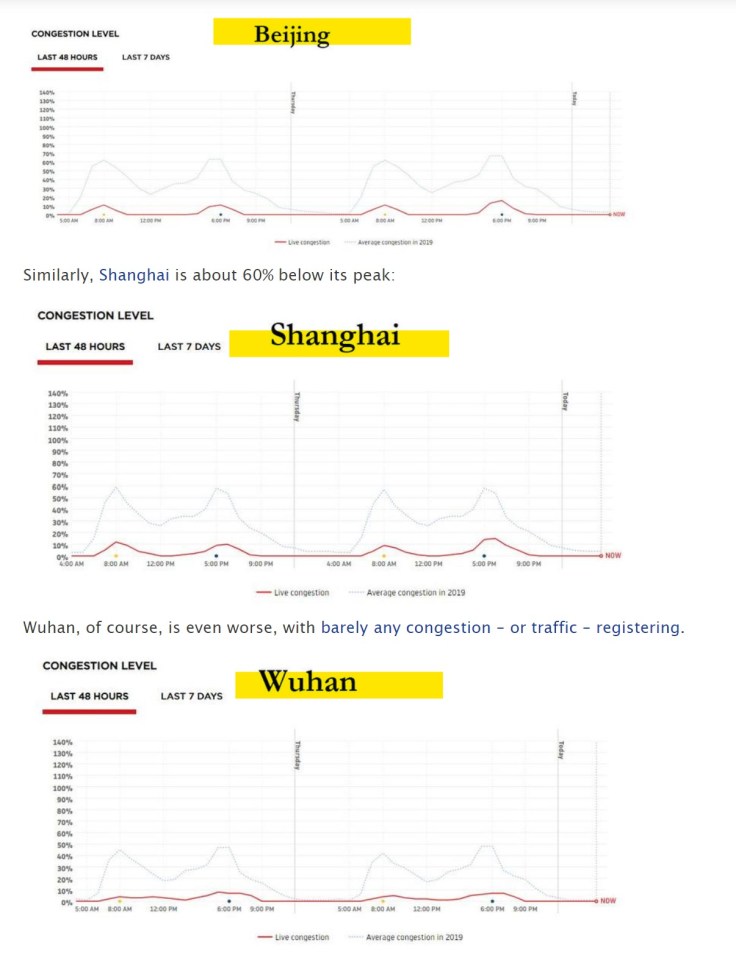
Amazingly, the industrial hub of Guanghzhou also appears to have ground to a crawl:
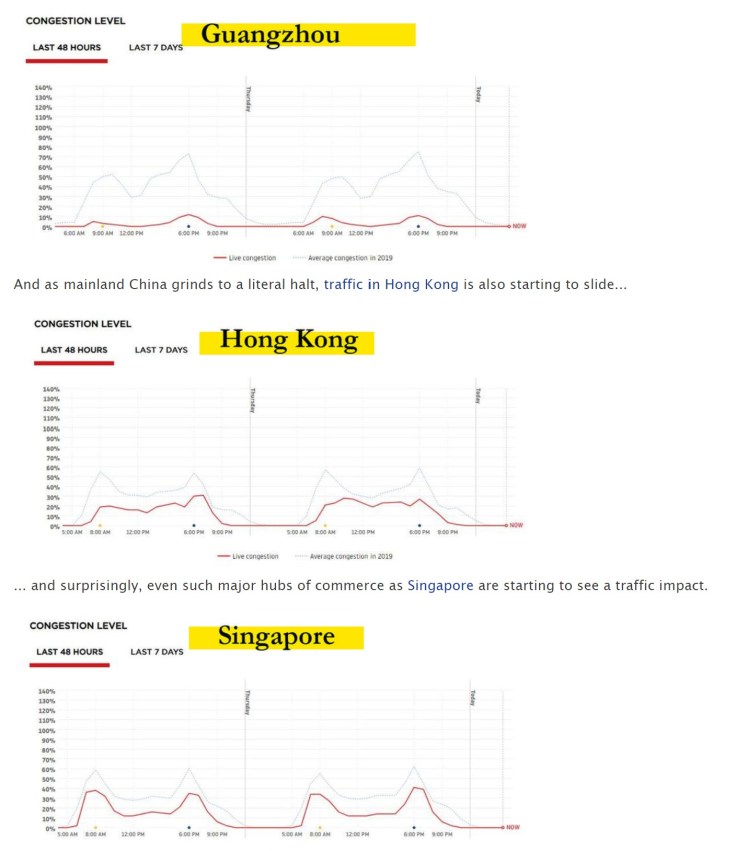
By comparison, here is what Los Angeles traffic looks like over the past 48 hours vs 2019 average.
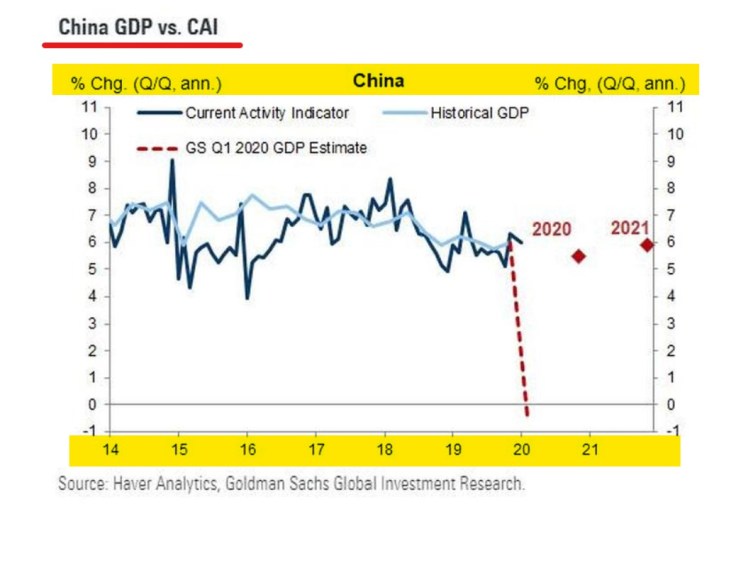
While not perfect, and certainly not a comprehensive view of what is really taking place “on the ground”, the above data is a useful real-time indicator of how the people in China perceive the threat of the coronavirus pandemic, and one thing is abundantly clear: as the pandemic spreads further without containment, and as the charts above flatline, so will China’s economy, which means that while Goldman’s draconian view of what happens to Q1 GDP is spot on, the expectation for a V-shaped recovery in Q2 and onward will vaporize faster than a vial of ultra-biohazardaous viruses in a Wuhan virology lab.
 Tom's Blog