‘Wuhan, you can do it!’: Quarantined residents sing from their balconies in stirring VIDEOS

CAP

1/28/2020

As China fights the worsening coronavirus outbreak, residents under quarantine in Wuhan have shared videos online of their battle against cabin fever, showing how they are lifting each other’s – and the nation’s – spirits.

The city, home to roughly 11 million people, was the epicenter for the coronavirus outbreak which has now spread across the globe. Residents have been told to remain in their homes as authorities fight to bring the outbreak under control, but many have grown understandably restless waiting for the crisis to end.

The best medicine? Song, apparently, with rousing eyewitness video posted on Twitter showing people singing the national anthem and chanting “Wuhan, you can do it!” from their apartment balconies.

The total number of confirmed  ‘2019-nCoV’ coronavirus cases in China had surged to 4,515 as of January 27, while the death toll jumped to 106 as the number of new infections in one day almost doubled.

China’s PM calls for ‘resolute fight’ against coronavirus outbreak as death toll climbs to 106 with over 1,700 new cases

CAP

China has taken extraordinary measures to curb the outbreak, including the aforementioned quarantine of the entire city of Wuhan, as well as the construction of an entirely new hospital to house the infected, which is expected to be completed by February 3.

The government has also urged citizens to refrain from travelling abroad, while extending national holidays with the aim of keeping people at home to reduce the likelihood of further contamination “in order to protect the health and safety of Chinese and foreign people.”

“Reducing people’s cross-border movement helps to prevent and control outbreaks,” the National Immigration Administration said in a statement.

For now, at least, the city of Wuhan remains a ghost town, with only the haunting song of its quarantined residents left to lift the city’s spirits.

Oil prices plummet over fears of coronavirus outbreak spreading

CAP

The price of crude continued to plunge on Monday, dragged down by fears of the deadly coronavirus outbreak, raising concerns about the global economic growth.

International benchmark Brent crude was down 2.95 percent to $58.90 a barrel, after hitting $58.68 earlier, the lowest level since late October. US West Texas Intermediate crude nosedived more than three percent to $55.52, after falling to a four-month low of $52.1 a barrel.

The coronavirus could cut into demand by around 260,000 bpd and reduce oil prices by about $3 per barrel, according to a report from Goldman Sachs.

Why the coronavirus is a real threat to China’s economy

CAP

Saudi Arabia’s minister of energy Prince Abdulaziz bin Salman said OPEC will be closely monitoring developments in global oil markets amid “gloomy expectations” of the outbreak’s impact on the Chinese and global economy.

“Such extreme pessimism occurred back in 2003 during the Sars outbreak, though it did not cause a significant reduction in oil demand,” he said.

The coronavirus, was identified in December and was linked primarily to stallholders who worked at Wuhan’s Hunan Seafood Market in China, has already killed 80 people and infected nearly 2,800 worldwide. The virus has spread to South Korea, Japan, Thailand, Vietnam, and the United States, among other places. On Friday, the CDC confirmed the second case in the US.

Chinese coronavirus spreads with no visible symptoms as death toll grows to 81, over 2,800 infected worldwide

CAP

Oil prices are also down due to flight disruptions during one of China’s busiest travel seasons — the Lunar New Year holiday. Chinese authorites have put on lockdown cities in Hubei province, including Wuhan, believed to be the epicenter of the outbreak, affecting millions of travelers.

China has announced an extension of its Lunar New Year holiday through February 2 and suspended sales of package tours to help battle the spread of the disease.

Chinese Researcher Removed from Infectious Disease Lab for Alleged “Administrative Matters”

By Jose Nino – 1/27/2020

According to a story published on CBC news on July 14, 2019, a researcher connected to China was escorted out of the National Microbiology Lab (NML) in Winnipeg during an RCMP investigation into what was described as a possible “policy breach.”

Dr. Xiangguo Qiu, her husband Keding Cheng, and an undisclosed number of her students from China were removed from Canada’s only level-4 lab on July 5, according to a CBC News report.

A Level 4 virology facility is a lab with the equipment to work with the most threatening human and animal diseases. This made the Arlington Street lab one of the very few labs in North America that is able to handle pathogens demanding the highest level of containment, such as Ebola.

According to sources who worked at the lab and did not want to be identified, the couple and the Chinese students had their security access revoked.

Sources claim that this came several months after NML IT specialists entered Qiu’s office after-hours and replaced her computer. Qiu’s frequent trips to China were also being denied.

During meetings on July 8, NML staff were informed that the researchers were on leave for an indefinite period of time. They were instructed not to communicate with them.

Qiu is a renowned virologist who helped out in developing ZMapp, an ebola virus treatment.

Qiu is a medical doctor hailing from Tianjin, China. She migrated Canada for graduate studies in 1996. She was still connected to the university there and has brought in many students over the years to help with her work.

She was leading the Vaccine Development and Antiviral Therapies section in the Special Pathogens Program at the lab. Qiu’s main research field is immunology and she mostly focused on vaccine development, post-exposure therapeutics, and quick diagnostics of viruses like Ebola.

On May 24, 2019, the RCMP received a referral from the Public Health Agency of Canada (PHAC).

“Based on information received to date, the RCMP has assessed that there is no threat to public safety at this time,” Robert Cyrenne informed CBC News in an email.

PHAC described it as a policy breach and “administrative matter” and said the department took steps to “resolve it expeditiously,” Eric Morrissette, the health agency’s chief of media relations, said.

“We can assure Canadians that there is absolutely no risk to the Canadian public and that the work of the NML continues in support of the health and safety of all Canadians,” communications director Mathieu Filion communication in an email.

No one from the Chinese Embassy commented on the situation

Many experts speculated that this could have been a case of intellectual property theft or technology leakage to China.

“The National Microbiology Laboratory would have some pretty sensitive biological research material that … could be shared either with or without authorization with foreign countries,” claimed Gordon Houlden, director of the University of Alberta’s China Institute.

“All of this is unproven, but even microbiology, sometimes especially microbiology, can have issues that involve national security.”

No matter the country, China uses its geopolitical leverage to advance its own interests.

Not just America, but the rest of the West should reconsider how it handles diplomatic and economic relations with China.

NEW RESEARCH CASTS DOUBT CORONAVIRUS EPIDEMIC STARTED AT WUHAN FOOD MARKET

New Research Casts Doubt Coronavirus Epidemic Started At Wuhan Food Market

They determined the first patient had no links to a shady seafood market selling live snakes and bats for human consumption

Zero Hedge – JANUARY 26, 2020

The South China Morning Post reports that a team of researchers at Wuhan’s Jinyintan hospital have retraced the movements of the first individual who was diagnosed with the virus.

They determined that he had no links to a shady seafood market selling live snakes and bats for human consumption.

The development comes despite practically all of the western media reports from the city of Wuhan having claimed that the city’s hospitals have been completely overwhelmed by cases of pneumonia as more cases of the Wuhan coronavirus are confirmed.

Amazingly, SCMP caveated its report by claiming that other patients among the earliest cases had “continuous exposure to the market,” which was shut down on Jan. 1 by Wuhan authorities over fears that its trade in wild animals was linked to the viral outbreak. Authorities have since banned the selling of live animals at markets.

The researchers, seven of whom work at Wuhan’s Jinyintan hospital, designated for patients with the illness, revealed on Friday in The Lancet medical journal that symptoms of the new disease were first reported on December 1 – much earlier than the Wuhan government’s initial announcement on December 31 of 27 cases of the pneumonia-like infection.

According to the report, the first patient had no exposure to the Huanan seafood market which was shut down on January 1 over fears – later confirmed – that the new virus was linked to its trade in wild animals. The researchers added that none of the patient’s family had developed fever or any respiratory symptoms. There was also no epidemiological link between the first patient and the later cases, they found.

The researchers analysed data from 41 patients with confirmed infections who had showed an onset of symptoms up to January 2. Six of those patients died, putting the fatality rate of the group at 15 per cent. The researchers noted that clinical presentations of the patients greatly resembled severe acute respiratory syndrome.

The first patient to die from the new coronavirus had continuous exposure to the market before he was admitted to hospital with a seven-day history of fever, cough and breathing difficulties, according to their report.

Doctors also identified 13 other patients who had no contact with the market, which helps build the case for human to human transmission.

The absence of a link to the seafood market is one of the indicators for human-to-human transmission of the virus and the researchers identified another 13 patients who also had no direct exposure to the market.

“Taken together, evidence so far indicates human transmission for 2019-nCoV,” the report said. “We are concerned that 2019-nCoV could have acquired the ability for efficient human transmission,” the researchers added, along with a strong recommendation for precautions such as fit-tested N95 respirators and other personal protective equipment.

Much to Beijing’s chagrin, a team of Chinese scientists on Friday revealed that symptoms of the virus first emerged as early as Dec. 1, much earlier than the Wuhan government’s initial announcement of the first 27 cases on Dec. 31. The notion that the virus may have been transmitted to humans via consuming bats, rats, badgers or snakes was widely reported in the Western press, even by CNN.

Though the possibility of zoonotic transmission hasn’t been entirely ruled out, these researchers apparently believed that there’s reason to doubt that the fish market was the source of the virus. However, the situation is still very much in flux, and it remains true that some of the other patients did have contact with the market.

Either way, do the researchers findings lend more credence to the other conspiracy theory about the virus’s origin? Wuhan reportedly has two labs that participate in China’s bio-warfare program, as Radio Free Asia first reported, and a handful of US outlets, including the Washington Times, have picked up the story.

Chinese health chiefs warn coronavirus is growing ‘stronger’, MUTATION closely monitored by scientists

CAP

The mysterious coronavirus is now spreading more rapidly and little is still known about it, China‘s senior health officials said, as Beijing grapples with shortages of hazmat suits and protective masks.

“The virus’ transmission ability has become stronger,” National Health Commission Minister Ma Xiaowei said at a press briefing on Sunday.

Ma said that the previously-unknown coronavirus, which has already killed 56 people in China, is spreading faster, while the outbreak is entering a “more serious and complicated phase.”

The official noted that the government’s knowledge of the new virus remains limited and they remain puzzled about the risks posed by its mutations. Beijing will dispatch additional teams of medics to assist patients and study the virus, he added.

Chinese Center for Disease Control and Prevention head Fu Gao said that there were no signs of clear mutation of the virus so far, but further surveillance is needed.

Local media has reported about the shortage of basic protective gear, like goggles and masks, in Wuhan, the capital of the central Hubei Province, which has been hit hardest by the outbreak. Vice Minister of Industry and Information Technology Wang Jiangping said that Hubei needs about 100,000 protective medical suits per day but the factories across the country are making only 30,000 of them daily.

Chinese virus death toll rises to 56, with nearly 2,000 infected nationwide & more cases confirmed abroad

CAP

The authorities have ordered an increase in production and have diverted millions of masks, along with scores of hazmat suits, gloves and goggles, to Wuhan. The local office of the Red Cross has set up a 24-hour hotline for accepting donations of equipment. E-commerce giant Alibaba, laptop-maker Lenovo, and the world’s largest gaming company Tencent have all pledged to donate large sums of money to purchase medical supplies.

Wuhan and nine other major cities in Hubei were partially quarantined in an effort to contain the outbreak. Ma said that the week-long Lunar New Year vacation provides the best window for the “isolation and disinfection” of the area.

Did patient zero really catch new Chinese virus by eating infected bat soup? It’s actually perfectly possible

CAP

By Peter Andrews

A group of Chinese scientists today reported that the likely source of the deadly 2019‐nCoV virus is snakes, based on genetic analysis. However, grisly images from a Chinese restaurant suggest bats may also be on the menu.

Their findings were fast-tracked to publication yesterday in the Journal of Medical Virology, and report that infected people were exposed to various wildlife species at the market, where live poultry, seafood, bats and snakes among others, were present.

A detailed genetic analysis of 2019‐nCoV revealed that it is a new strain which seems to be a mixture of two other coronaviruses; one of which is from bats and another unknown strain. The group presented evidence that the last place the virus resided before hitting humans was a snake species, based on certain biological markers in the virus’s surface proteins. These proteins are what allow viruses to invade host cells, and the mutated form is allowing 2019‐nCoV to easily attack human cells.

Beijing city cancels major public events including Chinese New Year temple fairs due to coronavirus outbreak

CAP

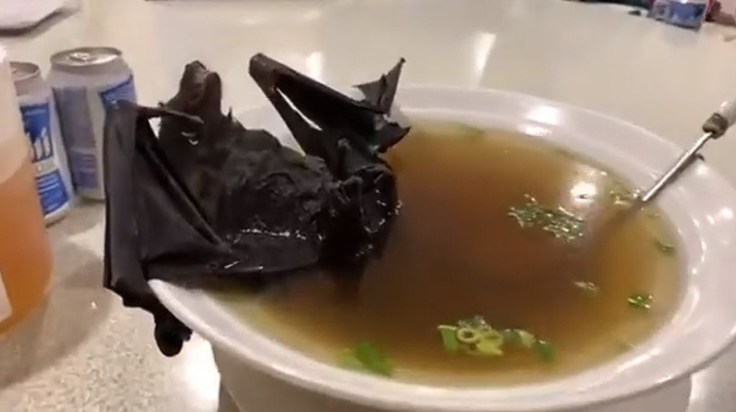
So according to the scientists, at some point a bat virus jumped into snakes, and adapted to its immune system. Later, people at the Wuhan market either handling or eating snake meat became infected. But images surfacing from Wuhan, and released by the Daily Star Online, offer another, even grosser explanation. Could the virus have leapt directly to humans from bats?

Soup du jour

Different cultures eat exotic foods, and Chinese people are well known for having a taste for some meats that might raise eyebrows or even churn stomachs. But bat soup?! Amazingly, it is apparently very popular in China, and considered a delicacy there.

The images have to be seen to be believed — they appear to show the full body of a small black bat, leathery wings and all, perched in a dish of brown liquid and leering like a vampire in disguise. One video shows a girl putting the creature whole into her mouth as she dines with friends. But it looks like the bats may have had the last laugh.

Second city shuts down all public transport amid deadly virus outbreak in China

CAP

The Chinese outbreak of the SARS virus in the early 2000s was eventually traced back to a colony of horseshoe bats in Yunnan province. Since we know that 2019‐nCoV is genetically closer to SARS than it is to any other virus, it seems probable that bats could be the carriers for this one too. These bats do not appear to have the tell-tale large ears of horseshoe bats, but they could be a closely-related species.

Offal-ly bad news

Most suggestively, in some of the images the bats’ guts are visible floating in the soup. If undercooked offal was consumed by humans this a likely source of the virus reaching humans, as some organs are breeding grounds for viruses.

Just last year there were reports of a plague that killed a husband and wife in western Mongolia — unrelated to the present outbreak. The couple ate the raw stomach, kidney and gall bladder of a marmot, and died soon after from a severe case of pneumonic plague. This plague, while having symptoms similar to the current outbreak, is caused by the bacteria Yersinia pestis. They used the offal as a traditional remedy. This prompted officials to quarantine the couple’s township, but happily there was no further spread of the plague.

Of course, cooking meat properly and thoroughly is one way of killing any bugs it may have been carrying. But viruses are more resistant to heat than many bacteria, and in any case, do you really trust the chefs serving up whole bats in murky broth to have passed their food safety inspection with flying colors?

But whether it is from snakes, bats or a combination of the two, as the virus rages on, researchers at least have a lead, if not a cure.


Blog at WordPress.com.

Up ↑