By Dr. John Campbell
By Dr. John Campbell

March 16, 2020
Pelosi is still working out the “major differences” with Treasury Secretary Steve Mnuchin.
Last week it was reported that Pelosi tried to sneak in federal funding for abortion into the Coronavirus response bill.
Now it’s being reported that the House met twice on Monday morning and gaveled in and gaveled out and have NOT approved the changes to the bill.
This is a huge problem because the House cannot send the bill to the Senate until they approve of the technical changes.
Rep. Louie Gohmert (R–TX) insists on reading the changes (rightfully so) to the bill because as Pelosi has shown, she will sneak in funding for Democrat-backed causes.
Politico reported:
Pelosi and Treasury Secretary Steven Mnuchin were still working on the details Monday.
House sources said Monday that “major differences” remained between the White House and House Democrats over what was adopted and needed to be changed. This is slowing down the time table for House completion of the bill and sending it onto the Senate.
Pelosi and administration officials still remain hopeful they can achieve a workable compromise, but were tight lipped about the state of play on Monday.
The House passed its emergency package early Saturday morning but needs to make some technical corrections. Adding to the uncertainty on timing, Rep. Louie Gohmert (R-Texas) is threatening to hold up the bill until he reviews the corrections.
Gohmert insists that he is not holding up the bill. There are 87 pages of changes to the language that he insists on reading and most Senators aren’t back in DC yet.

“Someone should at least read” the bill a source told Fox News.

Never forget that Nancy Pelosi held up a vote on Coronavirus a few weeks ago so that Democrats could run ads against Republicans on Super Tuesday.

The seemingly unstoppable spread of coronavirus has already led the government to declare a national emergency over the deadly disease that has so far claimed 41 lives nationwide, and infected more than 1,600 people across the country, according to the Centers for Disease Control and Prevention (CDC).
However, certain unsavory characters apparently decided to exploit the already tense situation to stoke more fear in the hearts of Americans and provoke real panic. People across the US received text messages claiming the president is about to impose martial law in a day or two, while urging people to stockpile supplies. This comes as many shops have already reportedly run out of toilet paper among other things.

The messages, citing insider information from “military friends up in DC,” and warning of nothing less than a “two week mandatory quarantine for the nation,” fell on fertile ground. It immediately became a hot topic on social media as people posted thousands of messages on the topic.
Some rushed to break the “bad news” or to wonder if anyone else received the disturbing message. Others said that many of their friends forwarded the messages to them.
More attentive readers noticed, however, that the messages, which were fake, referred to Trump’s plan to invoke the Stafford Act as the reason for claiming martial law is coming.
In fact, the president already invoked the law two days ago when he declared a national emergency. The government unlocked additional powers and funding for disaster response and involved the Federal Emergency Management Agency (FEMA) in the fight against coronavirus – but nothing close to martial law was imposed.
Still, the impact of the hoax apparently reached such proportions that the National Security Council decided it was time to intervene, posting a statement on Twitter saying the text message rumors were fake.
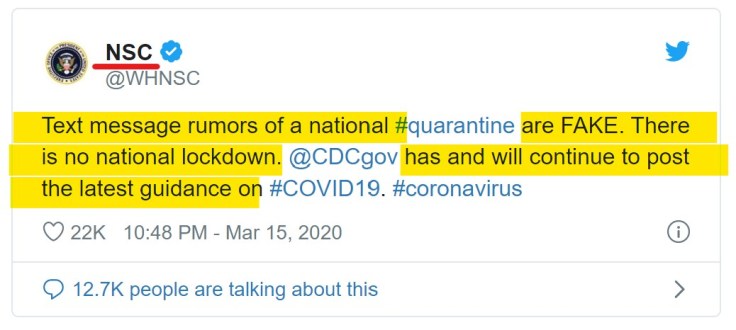
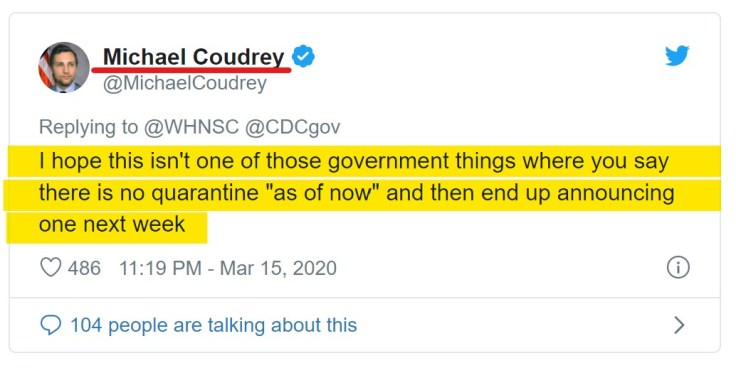
However, this was not enough to convince everyone that there is no possibility of martial law being imposed in a week or two.
By TRENT BAKER 3/13/2020
With some from China suggesting the coronavirus was a weapon devised by the U.S. military and deployed in Wuhan and Democrats claiming that saying the disease originated in China is xenophobic, Fauci said “there’s no doubt” it came from China.
“It absolutely came from Wuhan,” Fauci stated. “There’s no doubt about that.”
In the interview, Fauci also called for people to “socially distance” themselves to help prevent the spread of the virus.
“The situation is different in Seattle, in Washington, because they’ve had the unfortunate situation of having community spread there. Also, in certain areas of California. That’s a bit different than other areas in which there still will ultimately be infection but not exactly the way it is right now,” Fauci advised. “So, you want to be proportionate in what you do, but for sure, you don’t want to do nothing. You want to start doing something to socially distance yourself. How dramatic that is, closing schools and doing other things, should be proportionate. A lot of people, a lot of sections are doing it anyway. I don’t criticize them for that. They may get fatigued from that, but I’d rather them do that than do nothing.”
By Neil Clark
Compare and contrast. In his speech to the nation last night, Macron declared: “This virus has no passport.” He added: “We will undoubtedly take measures to close borders, but only when it is relevant… It is at the European level that we have built our freedoms.”

Macron is closing all schools, nurseries, universities and day care centres from next week and has called on the vulnerable to isolate themselves. But if anyone can still come into France unchecked from countries where coronavirus is even more of a problem, won’t those measures be undermined?
Ditto Germany. Angela Merkel said this week that “we in Germany, in any case, are of the opinion that border closures are not an appropriate response to the challenge.”
Contrast this ‘open borders,’ ‘we must protect Schengen’ approach with that of the Czech Republic, Slovakia, Austria and Hungary who are all EU member states. Declaring a 30-day ‘state of emergency,’ the Czech government has closed its borders to people from 15 countries hit by coronavirus and banned its citizens from visiting these countries too. From Monday next week, all international travel to and from Czechia will be essentially prohibited.
Slovakia is closing its borders today to all foreigners except those who have a residency permit, while announcing that all Slovaks who have been abroad will have to face two weeks of quarantine. Austria has barred all people entering the country from Italy, unless they have a medical certificate. Hungary has banned arrivals from Italy, China and Iran.
But in Western Europe, it seems a commitment to maintaining ‘open borders,’ even at a time of a potentially very extreme health crisis, trumps other concerns.
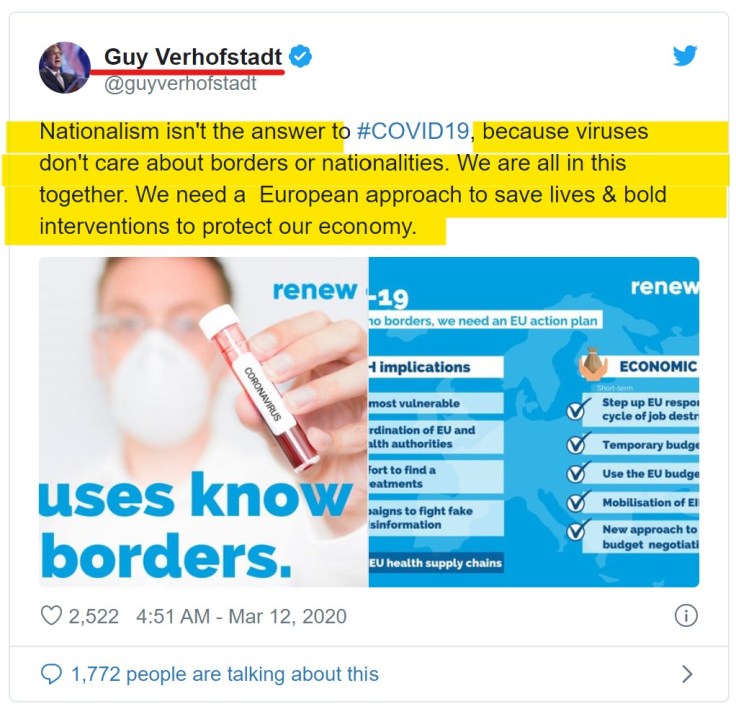
An example of this fundamentalist and very dogmatic approach can be seen in the tweet from Belgian MEP Guy Verhofstadt who declared: “Nationalism isn’t the answer to COV19, because viruses don’t care about borders or nationalities.”
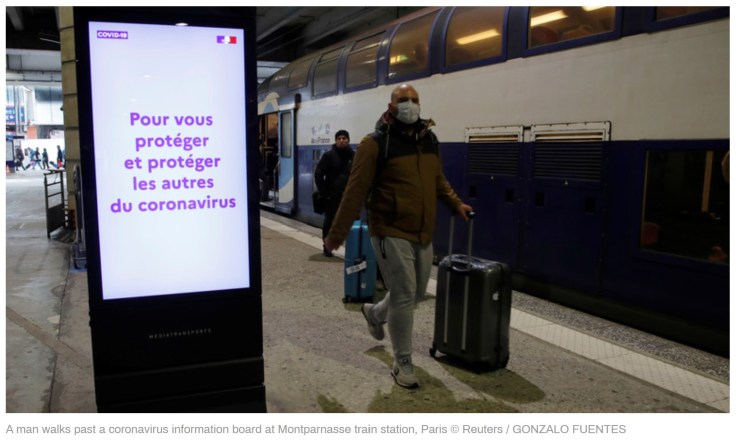
International travel may broaden the mind, but unfortunately, it also helps Covid-19 to spread.
You really don’t have to be Albert Einstein to understand that the more open the borders, the greater chance of a country seeing its coronavirus cases rise. Yet the most powerful countries in the EU – unlike the more pragmatic ones in central and eastern Europe – seem to be putting virtue signaling and liberal ideology first. Of course, there’s a moral case that can be made for ‘free movement,’ but in a time of crisis, governments have to forget all that and put protecting their own citizens first. Nationalism? No, it’s just doing what governments are elected to do.
If we can criticize Macron and Merkel on these grounds, we can criticize Boris Johnson too. Plane loads of people arriving from the worst affected areas of Italy have been arriving in Britain without any proper checks. On last night’s BBC Question Time, Professor John Ashton, a former director of public health, noted how around 3,000 supporters of the Spanish football team Atletico Madrid were in Liverpool this week for a Champions League tie. Spain’s Corona cases, as of Wednesday, had surpassed 1,600 with about half of them in the Madrid region.
Two-thirds of Spain’s deaths from the virus have occurred in the Madrid region. Yet, as Professor Ashton pointed out, the Madrilenos would have been out and about in Liverpool on Tuesday and Wednesday, drinking in bars, staying in hotels, traveling on public transport. How can governments say they are doing everything they can to stop the spread of coronavirus when unrestricted travel from Covid-19 ‘hotspots’ is still taking place?
It may be true, as Macron says, that “It is at the European level that we have built our freedoms,” but what price ‘freedom’ if it means the ‘freedom’ to die from coronavirus because the most logical, common sense step of all is not taken?


By
Thousands of itinerant migrants have been seeking to enter Greece in recent weeks after Turkey allowed the large migrant population it had been housing to pass through the country.
Ylva Johansson, the EU commissioner for home affairs and a Swedish national, is traveling to the country on Thursday to state a list of demands and mandates from Brussels for the nation. Johansson isn’t happy that Greece is refusing to provide a byzantine(no pun intended) legal process for so-called refugees storming the country.
Johansson claims Greece is treaty-obligated as a member of the union to permit migrants to apply for asylum.
It probably won’t go over well in the Mediterranean country that a foreign bureaucrat intends to lecture them on their response to the crisis of mass immigration flowing over the border from Turkey. Citizens of Greece largely expect the EU to assist them in dealing with the problem, namely in compelling Turkey to shut down the transit of migrants from the eastern parts of the country to its European border with Greece.
Greece is the latest country to question in policy the supposedly universal right to request asylum, a legal tactic often applied by illegal immigrants without a genuine case for refugee protections and utilized by human smugglers to facilitate illegal immigration in Europe and North America.
Thousands of migrants remain camped on Greece’s border with Turkey. Unfortunately for them, they can’t count on solidarity and assistance from the European Union in dealing with the problem, but rather a set of mandates and demands to let them in.

By Allum Bokhari – 3/11/2020
Szóka is the president of TechFreedom, a non-profit that presents itself as an opponent of “top-down solutions” in tech policy.
The non-profit is deeply tied to Google. Disclosures from the tech giant show that TechFreedom not only receives funding from Google, but it is also part of its Public Policy Fellowship program, which places Google-picked interns at public policy organizations around the world, including TechFreedom.
Szóka’s tweet drew condemnation from a wide range of conservatives and Trump supporters, including Rep. Jim Banks (R-IN), Harmeet Dhillon, and Ann Coulter.

The TechFreedom president later deleted and apologized for the tweet, saying he would “never wish death upon anyone” and that it “doesn’t represent my organization’s opinion.”
However, the tweet could come back to haunt Szóka, who has attempted in recent years to persuade Republican lawmakers that they shouldn’t use their power to tackle political bias from Big Tech companies.
In 2018, Szóka supplied testimony to a House Judiciary Committee hearing on online censorship arguing that tech companies should not be stripped of their government-backed legal privilege, which renders them immune from lawsuits relating to the removal of certain types of content, as well as lawsuits related to the hosting of content.
Szóka argued that any attempt to tackle Silicon Valley’s well-documented bias against conservatives would be akin to a “fairness doctrine” for the internet.
He has also argued against crackdowns against Big Tech companies for their numerous violations of user privacy, telling the House Energy & Commerce committee in 2012 that “As valuable as ‘privacy’ can be, its value is not absolute.”
Given that Szóka’s job appears to consist of the increasingly difficult task of persuading policymakers not to go after Big Tech, his anti-Trump social media posts may come back to haunt him. As the tweet from Rep. Banks shows, Szóka’s anti-Trump invective is not endearing him to Republican policymakers.
Szóka has not responded to a Breitbart News request for comment.
https://www.mrctv.org/embed/548118
https://www.mrctv.org/videos/twisted-strategy-cnn-fantasizes-how-virus-can-help-dems-win-2020
https://www.mrctv.org/node/548118
Steve Watson

As part of its primary night broadcast Tuesday, CNN’s anchors and guests discussed how the panic over the spread of the virus will hinder Trump’s relection.
Democrat dropout Andrew Yang suggested there will be a growing “real hunger for” an administration like former President Obama’s among “many, many Americans if the coronavirus crisis continues to grow.”
Yang suggested that “when” Joe Biden becomes President, there would be “a return to moral normalcy, but it’s also going to begin to look like a return to competence because Trump and the Republicans have been running the government in sort of an anti-government frame, which is not what you want when you’re dealing with a health crisis.”
“And we all know when Joe becomes our president, he’s going to bring back many of the Obama alums who are really, really competent and technocratic,” Yang further claimed.
Anderson Cooper chimed in, suggesting “We’ve also never seen a situation like this, certainly in modern times, in terms of a potential pandemic influencing the next couple of months in a way that’s kind of hard to even imagine.”
“I mean, obviously there is the difference on health care between Sanders and Biden, but if — You know, if hospitals are overwhelmed, if, you know, the military is called in, if people are being triaged in school gymnasiums on respirators or whatever, however bad it may get..” Cooper continued.
“Nothing makes you appreciate a functional government like a global pandemic.” Yang interjected.
“There are very few people who have seen what happens when a society, you know, has the potential to really burst at the seams,” Cooper added.
This is how desperate Democrats have become. Acknowledging that the only way they can defeat Trump is if society completely collapses.
 Tom's Blog