Josh Hawley Moves to End Immunity Privileges for Big Tech Monopolies Unless They Protect Free Speech

The freshman Senator from Missouri is taking action to protect digital freedom.

By Shane Trejo

Sen. Josh Hawley (R-MO) has emerged as the leading reformer against social media censorship, as he is going after their special immunity privileges under Section 230 of the Communications Decency Act.

As it states right now, Section 230 states that “no provider or user of an interactive computer service shall be treated as the publisher or speaker of any information provided by another information content provider.”

Howley’s bill, the Ending Support for Internet Censorship Act, would remove that exemption for Big Tech firms if they act like publishers instead of neutral platforms. Corporations would have to comply with external audits proving their algorithms and content moderation are not biased.

“With Section 230, tech companies get a sweetheart deal that no other industry enjoys: complete exemption from traditional publisher liability in exchange for providing a forum free of political censorship,” Hawley said in a statement. “Unfortunately, and unsurprisingly, big tech has failed to hold up its end of the bargain.”

“There’s a growing list of evidence that shows big tech companies making editorial decisions to censor viewpoints they disagree with,” Hawley added. “Even worse, the entire process is shrouded in secrecy because these companies refuse to make their protocols public. This legislation simply states that if the tech giants want to keep their government-granted immunity, they must bring transparency and accountability to their editorial processes and prove that they don’t discriminate.”

The Electronic Frontier Foundation (EFF), the left-leaning civil liberties organization, warns against changing the regulations.

“Though there are important exceptions for certain criminal and intellectual property-based claims, CDA 230 creates a broad protection that has allowed innovation and free speech online to flourish,” the EFF added on their website.

“This legal and policy framework has allowed for YouTube and Vimeo users to upload their own videos, Amazon and Yelp to offer countless user reviews, craigslist to host classified ads, and Facebook and Twitter to offer social networking to hundreds of millions of Internet users,” they added.

“Senator Hawley’s misguided legislation sets the table for stricter government control over free expression online,” Americans for Prosperity Policy Analyst Billy Easley said in a statement.

“Eroding the crucial protections that exist under Section 230 creates a scenario where government has the ability to police your speech and determine what you can or cannot say online,” Easley added.

ECommerce trade group NetChoice opposes the legislation because they admit that it would restrict the ability of tech giants to censor.

“This bill prevents social media websites from removing dangerous and hateful content, since that could make them liable for lawsuits over any user’s posting” said Carl Szabo, who works as General Counsel at NetChoice, in a statement. “Sen. Hawley’s bill creates an internet where content from the KKK would display alongside our family photos and cat videos.”

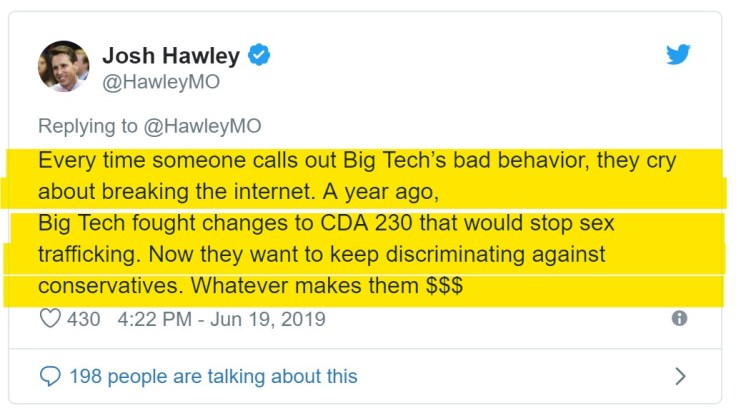
Hawley isn’t phased by the critics, and continues to put Big Tech in his crosshairs.
CAP

Full text of the legislation can be seen here.

Harvard pulls pro-gun Parkland survivor’s acceptance over years-old racial slurs

CAP

Conservative pundit Kyle Kashuv will not join fellow Parkland shooting survivor and gun control advocate David Hogg at Harvard, saying that school pulled his acceptance over racial slurs he made in private messages when he was 16.

Having been set to attend Harvard in 2020 after taking a year off school, Kashuv announced in a series of tweets on Monday that the Ivy League institute had decided to rescind his acceptance “over texts and comments made nearly two years ago, months prior to the shooting.”

Kashuv was one of the students at Marjorie Stoneman Douglas High in Parkland, Florida, during the February 2018 attack that left 17 students and staff killed and another 17 injured. While Hogg and several other seniors became celebrity gun control activists, Kashuv made public his pro-gun views, including the right to arm school staff.

CAP

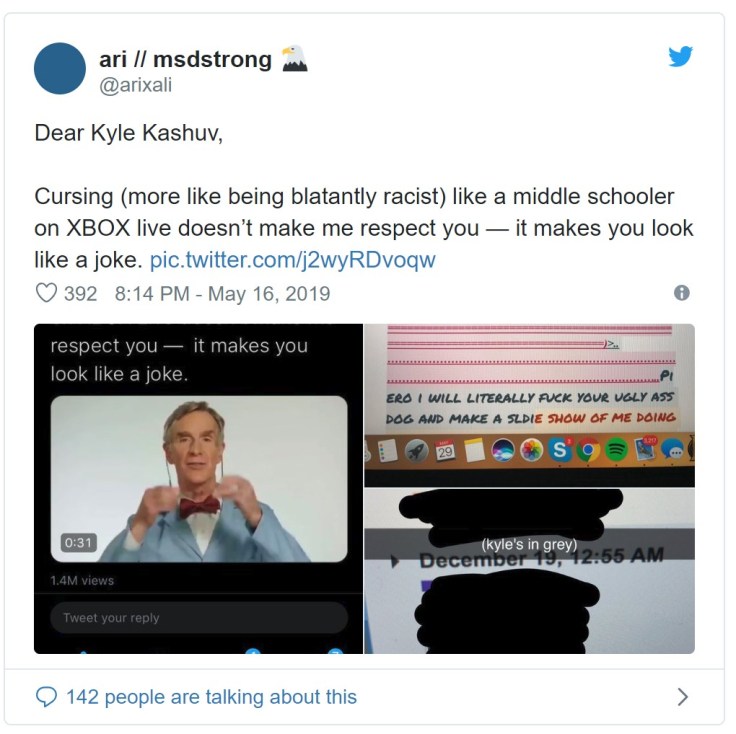
He worked for the high-school outreach wing of the pro-Trump organization Turning Point USA, and even met with the president himself. In May, however, someone dug up a private chat from 2016 in which Kashuv repeatedly used a racial slur referring to African-American.

Although he was 16 at the time and the comments were made in private, Kashuv took responsibility in a public apology on Twitter, saying his remarks had been “idiotic,” “callous and inflammatory.”

CAP

Harvard seemingly agreed with his assessment, but didn’t feel like his apology was quite enough. After reviewing the apology letter, the school replied saying he would no longer be welcome to attend, citing concerns over his “maturity and moral character.”

Despite seeking guidance from the Office of Diversity and Inclusion, and requesting a face to face meeting regarding the incident, Harvard had already made its decision. In his tweets, Kashuv pointed out the irony of university’s apparent message that in contemporary society, certain “mistakes brand you as irredeemable,” especially considering the school’s own “checkered past.”

CAP

“If Harvard is suggesting that growth isn’t possible and that our past defines our future, then Harvard is an inherently racist institution. But I don’t believe that,” Kashuv added.

Harvard has yet to issue any public response to his comments.
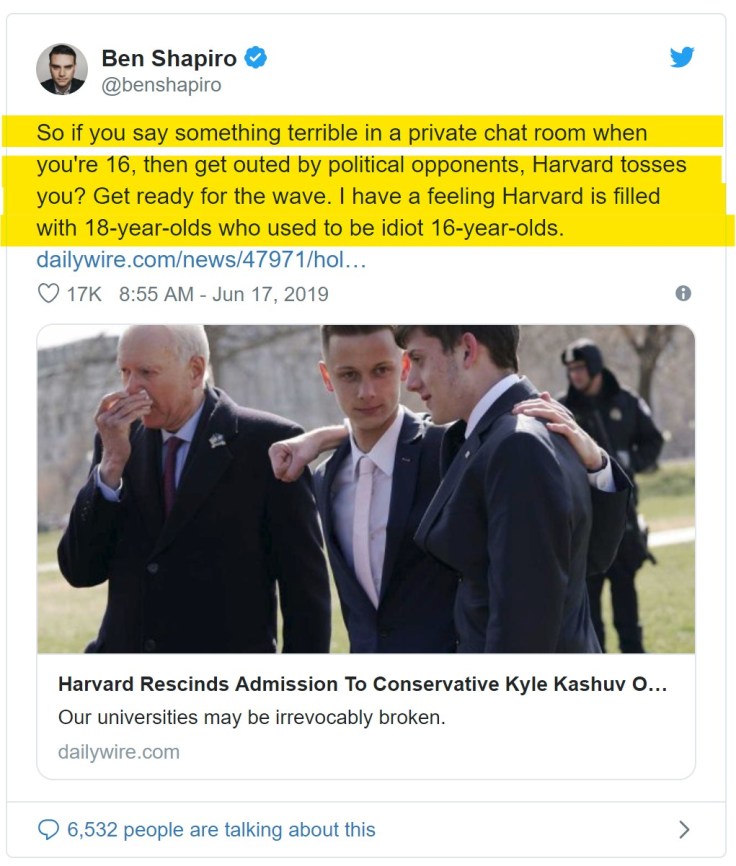
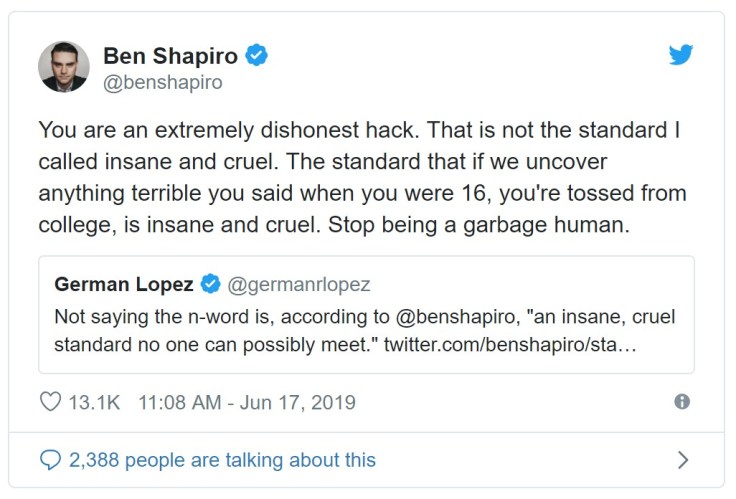
Despite the blow, Kashuv has gotten some support from conservative media personality Ben Shapiro, who argued that uncovering things people said when they were teenagers and holding it against them creates an “insane and cruel”standard, and sets a dangerous precedent.

CAP

CAP

One has to wonder what implications the decision will have for future applicants– or even those already attending the prestigious institution. Around the same time Kashuv’s comments were unearthed in May, the Harvard Lampoon ran an image of Holocaust victim Anne Frank in a bikini which was widely panned as anti-Semitic and even condemned by the New England regional director of the Anti-Defamation League.

It seems that, at least for the time being, their apology was enough.

‘Hateful, ignorant, pedophilic’: Harvard magazine slammed for FAKE IMAGE of Anne Frank in bikini

CAP

Think your friends would be interested? Share this story!

Facebook’s Process to Label You a ‘Hate Agent’ Revealed

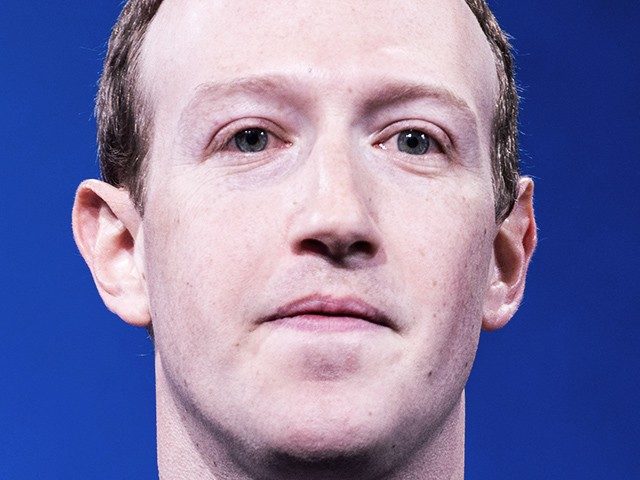
Facebook CEO Mark Zuckerberg closeup

By Allum Bokhari

Facebook monitors the offline behavior of its users to determine if they should be categorized as a “Hate Agent,” according to a document provided exclusively to Breitbart News by a source within the social media giant.

The document, titled “Hate Agent Policy Review” outlines a series of “signals” that Facebook uses to determine if someone ought to be categorized as a “hate agent” and banned from the platform.

Those signals include a wide range of on- and off-platform behavior. If you praise the wrong individual, interview them, or appear at events alongside them, Facebook may categorize you as a “hate agent.”

Facebook may also categorize you as a hate agent if you self-identify with or advocate for a “Designated Hateful Ideology,” if you associate with a “Designated Hate Entity” (one of the examples cited by Facebook as a “hate entity” includes Islam critic Tommy Robinson), or if you have “tattoos of hate symbols or hate slogans.” (The document cites no examples of these, but the media and “anti-racism” advocacy groups increasingly label innocuous items as “hate symbols,” including a cartoon frog and the “OK” hand sign.)

Facebook will also categorize you as a hate agent for possession of “hate paraphernalia,” although the document provides no examples of what falls into this category.

The document also says Facebook will categorize you as a hate agent for “statements made in private but later made public.” Of course, Facebook holds vast amounts of information on what you say in public and in private — and as we saw with the Daily Beast doxing story, the platform will publicize private information on their users to assist the media in hitjobs on regular American citizens.

Breitbart News has already covered some of the individuals that Facebook placed on its list of potential “hate agents.” Paul Joseph Watson eventually was categorized as “hateful” and banned from the platform, in part, according to the document, because he praised Tommy Robinson and interviewed him on his YouTube channel. Star conservative pundit Candace Owens and conservative author and terrorism expert Brigitte Gabriel were also on the list, as were British politicians Carl Benjamin and Anne Marie Waters.

The Benjamin addition reveals that Facebook may categorize you as a hate agent merely for speaking neutrally about individuals and organizations that the social network considers hateful. In the document, Facebook tags Benjamin with a “hate agent” signal for “neutral representation of John Kinsman, member of Proud Boys” on October 21 last year.

Facebook also accuses Benjamin, a classical liberal and critic of identity politics, as “representing the ideology of an ethnostate” for a post in which he calls out an actual advocate of an ethnostate.

In addition to the more unorthodox signals that Facebook uses to determine if its users are “hate agents,” there is also, predictably, “hate speech.” Facebook divides hate speech into three tiers depending on severity and considers attacks on a person’s “immigration status” to be hate speech.

Here’s how “hate speech” — both on and off Facebook — will be categorized by the platform, according to the document:

Individual has made public statements, or statements made in private and later made public, using Tier 1, 2, or 3 hate speech or slurs:

3 instances in one statement or appearance = signal
5 instances in multiple statements or appearances over one month = signal

If you’ve done this within the past two years, Facebook will consider it a hate signal.

Other signals used by Facebook to determine if its users should be designated as hate agents include carrying out violence against people based on their “protected or quasi-protected characteristics,” attacks on places of worship, and conviction of genocide.

Are you a source at Facebook or any other corporation who wants to confidentially blow the whistle on wrongdoing or political bias at your company? Reach out to Allum Bokhari securely at allumbokhari@protonmail.com.

Blog at WordPress.com.

Up ↑