Published on Jun 4, 2019


By Shane Trejo
“It’s shocking,” Rebecca Friedrichs, the founder of For Kids & Country, said in an interview with The Christian Post. She spoke of relay races where 10- and 11-year-old girls are trained to put condoms on a prosthetic male erection as the boys watch on.
Kids as young as 11 years old are trained in how to engage in oral and anal sex and taught to experiment with bisexuality by public school teachers.
“It is medically risky on multiple levels. And when you read the curriculum … it’s written almost like a college fraternity wrote this curriculum in a very crass and a juvenile way,” she said of the ongoing sexualization of children.
“I always tell people that the scary thing is, I’ll give radio interviews and I can’t even say on the radio things that are being taught in our elementary and middle school classrooms in mixed company. There’s something very wrong there,” said Friedrichs, a conservative activist who taught in public schools for 28 years.
“No one believes it until they see it,” she said. “Now that we’ve been able to help parents to understand what’s actually in the curriculums and they’re viewing it for themselves, they see the urgent need to rescue the kids. Now there’s a groundswell of parents that’s growing fast and fighting back.”
Transgenderism is also being pushed on children, prompting unsuspecting kids to adopt a lifestyle that is known to result in a spike of suicide attempts, mental illness, and other harmful behaviors.
A lawsuit in Oregon alleges a teacher indoctrinated a second grader with propaganda books and reality TV shows to induce gender confusion within the 8-year-old boy, indicating this style of education is not isolated to California.
The California Board of Education officially changed their sex ed standards by a vote earlier in the month. The board had even recommended the book, titled S.E.X.: The All-You-Need-to-Know Sexuality Guide to Get You Through Your Teens and Twenties, to be read by children before removing it after public outrage.
Parents are banned from removing their children from lessons inducting them into the LGBT lifestyle with propaganda about gay marriage and gender fluidity.
“The reason why people cannot opt out of the gender identity [lessons] is because the unions and their allies have labeled that anti-bullying,” Friedrichs said.
“It’s this anti-bullying campaign so that LGBT children don’t get bullied because they claim there’s this big problem with bullying of those children. There’s a big problem of bullying everyone. Everyone gets bullied, that’s a problem. We teach kindness and Judeo-Christian values to combat bullying,” she added.

“What the unions do,” Friedrichs explained, “is they push their agenda by saying, ‘We have to stop all this bullying, so every single child in America needs to be exposed to this anti-bullying in the form of gender spectrum and gender identity. It’s caused a lot of confusion for parents here, because parents will say, ‘Oh, I don’t need to worry, I can opt out.’ Well, you can’t opt out of all of it.”
The Unions are joined by leftist advocacy groups such as Equality California and the American Civil Liberties Union (ACLU) to aggressively push this sexual agenda upon children.
“I have had multiple school board members tell me anonymously that they have been personally threatened by the ACLU. So they’re scared. So when parents come in and complain, and they can’t understand why the school board won’t listen to them. And then the parents who push back are called haters and all this stuff, and they just want to protect their kids,” Friedrichs said.
If Democrats are able to pass the Equality Act nationally, these abusive standards will eventually become uniform across the country.

MARCH 8, 2019
At the center of the controversy is CNN’s Oliver Darcy who has spearheaded efforts to have Infowars and Alex Jones banned.
But who is Oliver Darcy?
A deeper look into his past reveals how the establishment is using both sides to purge the right of blue-collar conservatives.


By Gregg Re, Catherine Herridge
The sources said the sessions covered a slew of topics addressed during the public hearing before the oversight committee — including the National Enquirer’s “Catch and Kill” policy, American Media CEO David Pecker and the alleged undervaluing of President Trump’s assets.
COHEN DOCS UNDERCUT CLAIMS TRUMP LAWYERS MADE EDITS TO ALTER CRUCIAL TIMELINE
But, Republicans have raised concerns with the sessions, with Ohio Rep. Mike Turner sending a letter to Cohen’s team on Wednesday demanding answers.
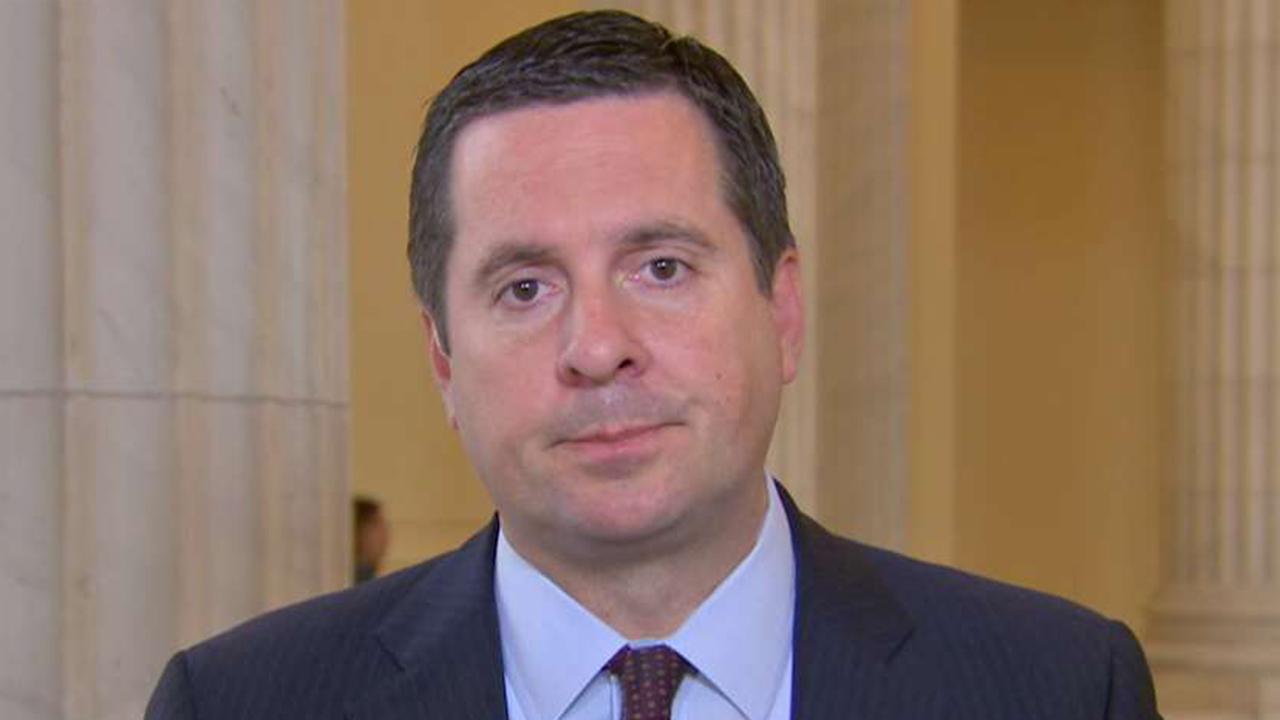
‘No matter how much witness tampering you do, you’re not going to find collusion,’ the Republican tells ‘Fox & Friends’ after sources say President Trump’s former personal attorney met with the Intelligence Committee chairman for hours before testifying.
Turner specifically asked for confirmation of Cohen’s contacts, if any, “with Democratic Members or Democratic staff of SSCI [Senate Select Committee on Intelligence], COR [House Committee on Oversight and Reform], or HPSCI [House Permanent Select Committee on Intelligence] prior to his appearances before House and Senate committees last week” — as well as the lengths of such contacts, their locations and who exactly was involved.
“These questions are important for the public to understand whether or not they were watching witness testimony, a public hearing, or well-rehearsed theater,” he wrote.
During last month’s seven-hour public hearing before the House Oversight Committee, Cohen hesitantly acknowledged, under questioning from Ohio GOP Rep. Jim Jordan, that he had spoken with Schiff “about topics that were going to be raised at the upcoming hearing.”
But, he did not elaborate on the discussions, which Fox News is told extended significantly longer than the seven hours that the public hearing itself lasted.
One by one, during the dramatic hearing, Cohen fielded questions on precisely the same topics that the sources told Fox News he discussed with Schiff’s staff during the sit-downs in New York.
For example, in response to questioning from Rep. Carolyn Maloney, D-N.Y., Cohen discussed the purported practice of paying for the rights to news stories harmful to Trump, only to bury them.
“I was involved in several of these catch-and-kill episodes,” Cohen told Maloney, “but these catch-and-kill scenarios existed between David Pecker and Mr. Trump long before I started working in 2007.”

Records provided by President Trump’s former personal lawyer Michael Cohen on his false 2017 congressional testimony undercut allegations that Trump attorneys made critical edits to alter the timeline of the Trump Tower negotiations in Moscow; Catherine Herridge reports.
Cohen went on to testify that Pecker, whose company publishes the National Enquirer, had paid $30,000 to a former Trump World Tower doorman who alleged he had information about a supposed love child fathered by Trump. The former Trump fixer asserted that Trump was concerned also about the “treasure trove of documents” Pecker had that could implicate him.
Further, Cohen was asked by Rep. Alexandria Ocasio-Cortez, D-N.Y., “To your knowledge, did the president ever provide inflated assets to an insurance company?”
Cohen replied: “Yes.”
COHEN SUES TRUMP ORGANIZATION FOR MILLIONS IN LEGAL FEES
“Who else knows that the president did this?” Ocasio-Cortez pressed.
“Allen Weisselberg, Ron Lieberman and Matthew Calamari,” Cohen said, referring to the Trump Organization’s chief financial officer and other key Trump associates. “You deflate the value of the asset and then you put in a request to the tax department for a deduction.”
Cohen also brought documents that he claimed proved Trump “inflated” his assets in order to obtain loans from Deutsche Bank.
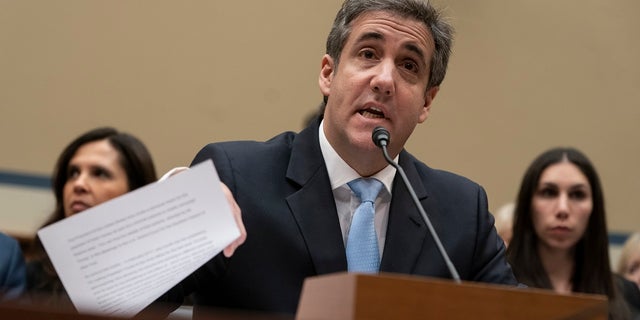
Michael Cohen, President Donald Trump’s former personal lawyer, testified last month before the House Oversight Committee on Capitol Hill. (AP Photo/J. Scott Applewhite, File)
Asked about the revelations by email, a House Intelligence Committee spokesman defended the Schiff staff’s pre-hearing discussions with Cohen.
“We are running a professional investigation in search of the facts, and we welcome the opportunity to meet with potential witnesses in advance of any testimony to determine relevant topics to cover in order to make productive use of their time before the Committee,” spokesman Patrick Boland told Fox News.
“Despite this professed outrage by Republicans, it’s completely appropriate to conduct proffer sessions and allow witnesses to review their prior testimony before the Committee interviews them — such sessions are a routine part of every serious investigation around the country, including congressional investigations.”
Schiff was asked about the frequency of his contacts with Cohen on CBS News’ “Face the Nation” this weekend, and gave the number “seven” — but Schiff did not distinguish between the number of his own contacts with Cohen and the committee staff’s interactions with him.
Schiff asserted, “The extent of my contact was just inviting him to testify and also trying to allay his concerns about the president’s threats against him and his family … but our staff certainly sat down to interview him, and that’s what you do in any credible investigation.”
A source close to Schiff claimed some details about the staff meetings were “not accurate” but did not point to specifics.
On Cohen, a source familiar with his closed-door testimony before the House Intelligence Committee would not comment directly on the number and substance of the meetings between Cohen and the Schiff staff, but said more broadly that Schiff “pledged to release the full transcript of Mr. Cohen’s eight hour testimony, at which point Mr. Cohen will be vindicated and others will be implicated.”

Thursday, March 07, 2019
When asked by Rogan if company employees “read direct messages,” Dorsey replied, “We don’t read direct messages.”
Gadde followed up, explaining that the only direct messages read by employees are those which have been reported to Twitter support.
Rogan pressed further, asking if it was possible for Twitter employees to intentionally peruse a user’s direct messages.
“I don’t think so,” Gadde replied.
However, according to multiple Twitter engineers who discussed the subject of direct messages with undercover Project Veritas journalists, Dorsey and Gadde may have been misleading with their answers, at best.
“There’s teams dedicated to it [reading direct messages],” said Clay Haynes, a senior network security engineer at Twitter. “I mean, we’re talking… at least three or four hundred people… they’re paid to look at dick pics.”
“It is creepy Big Brother.”
Pranay Singh, a direct messaging engineer, revealed that all content shared on the platform — including private messages — are stored on Twitter servers for analytical and advertising purposes.
“So all your sex messages and your dick pics are on my server now,” Singh said. “Everything. Anything you post online.”
“A machine is going to look at it. An algorithm will look at it, and they’ll make a virtual profile about you.”
Watch the full exchange here.
Published on Mar 7, 2019

/cdn.vox-cdn.com/uploads/chorus_image/image/63188116/acastro_180720_1777_facebook_0001.0.jpg)
By Nick Statt
In addition to Yelp and Duolingo, PI found that two Muslim prayer apps, as well as a bible app and a job search app called Indeed, also sent similar data to Facebook that could be used to help identify users for ad targeting purposes when they browse the social network. It’s not clear exactly what type of data is being sent in this case, other than that a user opened the app at a given time, but PI’s report says this transmission may also reveal custom identifiers that help Facebook track that user across its network of services and when that person opens Facebook on a mobile device.
The report builds on a similar investigation from PI last December that first revealed that big-name Android apps were sending data to Facebook without a user’s consent and without proper disclosure. It also highlights that this problem is universal across both iOS and Android; last month, The Wall Street Journal revealed that these same set of developer tools that scrape data when you use a mobile app and send it to Facebook are employed on iPhone apps, despite Apple’s much more stringent privacy rules and protections.
“This is hugely problematic, not just for privacy, but also for competition. The data that apps send to Facebook typically includes information such as the fact that a specific app, such as a Muslim prayer app, was opened or closed,” reads PI’s report, published earlier today. “This sounds fairly basic, but it really isn’t. Since the data is sent with a unique identifier, a user’s Google advertising ID, it would be easy to link this data into a profile and paint a fine-grained picture of someone’s interests, identities and daily routines.”
As Facebook’s privacy practices come under even greater scrutiny in the aftermath of last year’s Cambridge Analytica data privacy scandal, a spotlight is being shone on the lesser-known arrangements between large advertising companies and the smaller app makers that use those platforms to reach new users and target existing ones with ads. As revealed by the WSJ last month, a number of prominent iOS app makers use a Facebook analytics tool known as “custom app events” that, in this case, was sharing sensitive health, fitness, and financial data with the social network for ad targeting purposes.
On Android, Facebook has long collected sensitive user data such as contact logs, call histories, SMS data, and real-time location data, for the purpose of informing its ad targeting and improving features like friend suggestions. Yet the practices have caused vocal outcry from privacy advocates and users concerned Facebook is amassing far too much data about their personal lives and online and offline behaviors. Following reports about Facebook using its location-tracking capabilities to catch company interns skipping work, it said it would allow Android users the ability to explicitly disable the feature.
In this case, PI is underscoring one of Facebook’s longstanding indirect data collection policies, one that relies on third-party apps to autonomously collect and send information about app usage to the social network without telling users about the arrangement.
“Facebook routinely tracks users, non-users, and logged-out users outside its platform through Facebook Business Tools. App developers share data with Facebook through the Facebook Software Development Kit (SDK), a set of software development tools that help developers build apps for a specific operating system,” PI explained in the initial December 2018 report. The report found that nearly two thirds of the 34 Android apps PI tested — including big names like Spotify and Kayak and all of which had between 10 and 500 million installs — sent information to Facebook without informing users or gaining express consent.
PI says that a number of apps stopped the practice following its December report. Similarly, most of the operators of the iOS apps highlighted in the WSJ report also ceased using Facebook’s analytics and developer tools to collect sensitive user data. However, it appears some apps, like Yelp’s and Duolingo’s, continue to do so. PI says it’s in contact with Duolingo, and the company has agreed to suspend the practice, but it’s not clear how many other apps in the Android or iOS ecosystem may be skirting Apple and Google’s data-collection and user privacy policies to improve Facebook’s ad targeting tools.
In these situations, Facebook puts the onus on app makers not to break platform rules or misuse its developer tools by collecting sensitive information. The company has also claimed not to use a majority of this sensitive data and, in some extreme cases like credit card numbers and Social Security numbers, automatically deletes it. But it’s not clear why the data is being collected in the first place and what ways it’s been put to use in the past, either by the apps collecting it or by Facebook.
“Apps relay on the Facebook SDK to integrate their product with Facebook services, like Facebook’s login and ad tracking tools. However, Facebook places all responsibility on apps to ensure that the data they send to Facebook has been collected lawfully,” reads PI’s report. Facebook not immediately available for comment.