NBC’s Peter Alexander reports from President Donald Trump’s reelection kickoff rally, noting that “these folks are fired up,” and saying that it “reminds me” Of 2016.



JUNE 18, 2019
Asked by host Joy Reid how he would get his proposals through a Senate controlled by the GOP, Biden said, “There are certain things where it just takes a brass knuckle fight.”
The former Vice-President then appeared to walk back his rhetoric, saying it was the president’s job to “persuade the public”.
“So you go out and beat them….you make the case — you make an explicit case,” said Biden.
However, he then suggested, rather than to just “go home,” it was better to turn to more extreme methods.
“Or let’s start a real physical revolution if you’re talking about it because we have to be able to change what we’re doing within our system,” said Biden.
Given how polarized America is right now, one wonders what the reaction would have been to a Republican making similar comments.
———————————————————————————————————————
There is a war on free speech. Without your support, my voice will be silenced.
Please sign up for the free newsletter here. Donate to me on SubscribeStar here.
Support my sponsor – Turbo Force – a supercharged boost of clean energy without the comedown.

By Neil Munro
If signed, the agreement will give U.S. border officers the legal authority to quickly repatriate migrants who pass through Guatemala, regardless of the catch-and-release loopholes created and preserved by the U.S. Congress and courts. In effect, the deal would create a legal wall against Latin American, African, and Indian migrants who pass through Guatemala.
The tweet also said enforcement agencies will accelerate the repatriation of “millions” of illegal immigrants — even though Democrats and many establishment GOP legislators are blocking the legal reforms and funding needed to repatriate more than a small percentage of the more-than-11-million illegal migrants now living throughout the United States.
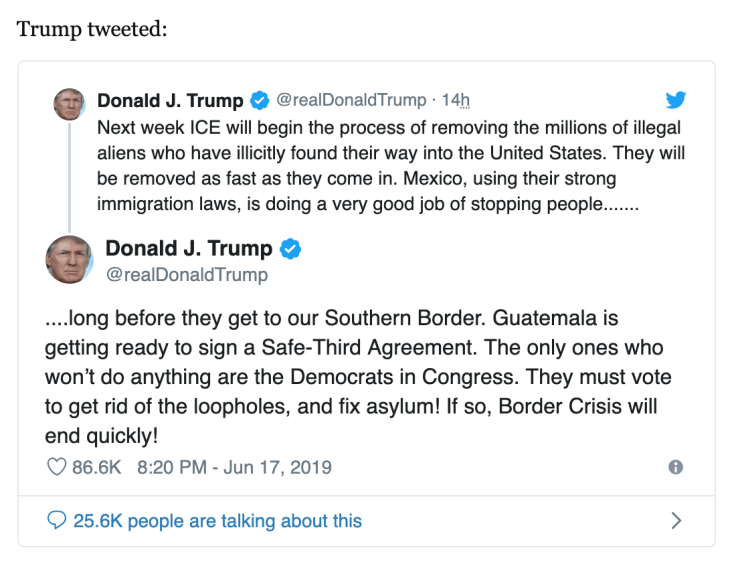
Trump’s deputies are also pushing Mexico to sign a safe third country deal if Mexico cannot sharply reduce the huge migration by Latin Americans through its own territory to the United States.
Pro-migration advocates denounced the Guatemalan “safe third country” plan — even though their policies are allowing up to 1 million Central American migrants to flood into Americans’ workplaces, neighborhoods, and classrooms. That wave of migrants — which now includes a growing number of Africans and Indians — is good for university class professionals, investors, and for business groups, but it hurts ordinary Americans by lowering wages, raising rents and importing more chaotic diversity.
“I don’t know what this is about,” said a tweet from Todd Schulte, director of a pro-migration, cheap-labor lobbying group set by West Coast investors, including Mark Zuckerberg. He continued:
But ICE does NOT have the ability/resources to “begin the process of removing millions” of people. People should be responsible when sharing this & note that, especially in these tough times. On “Safe Third Country”, its designed to end all asylum.
However, the plan for a safe third country deal with Guatemala has hit a major obstacle on June 13, according to the Voice of America news service:
The State Department readout on the first day of talks suggested that there had been a “complete misinterpretation” by the Guatemalans regarding the draft agreement.
According to the readout, Guatemalan ministers reiterated “political will to reach an asylum burden sharing agreement,” but raised “legal and constitutional issues” that would make a safe third country agreement “a challenging lift.”
Rather than wrapping up the talks before Guatemala’s scheduled national election on Sunday, the talks are likely to continue into next week.
The readout, sent by email Thursday evening from State Department legal adviser Marik String to staff, was obtained by VOA Friday morning from a State Department official who declined to be identified.
…
But according to the internal readout, the draft White House agreement was being viewed differently by the two sides.
“While [the Guatemalans] are supportive of taking returns from the United States, they did not realize they would be obligated to process the asylum claims of the returned individuals,” String wrote.
According to String, the Guatemalan government thought the agreement would be “analogous to Mexican Migrant Protection Protocols (MPP),” a system currently in place between Mexico and the U.S. requiring migrants seeking asylum in the U.S. to wait in Mexico pending the adjudication of their claims.
The “Remain in Mexico” program is a step short of “safe third country.”
It allows the U.S. officials to send large numbers of migrants back into Mexico until U.S. officials are ready to bring them in for their asylum hearing before a judge. That policy prevents the migrants from getting U.S. jobs — and so prevents the cartels from getting paid for delivering migrants to the U.S. border. Only about one-in-six migrants have been awarded asylum during the last few years, partly because the vast majority are economic migrants who would drive down wages for Americans.
Each year, roughly four million young Americans join the workforce after graduating from high school or university.
But the federal government then imports about 1.1 million legal immigrants and refreshes a resident population of roughly 1.5 million white-collar visa workers — including approximately one million H-1B workers — and approximately 500,000 blue-collar visa workers.
The government also prints out more than one million work permits for foreigners, tolerates about eight million illegal workers, and does not punish companies for employing the hundreds of thousands of illegal migrants who sneak across the border or overstay their legal visas each year.
This policy of inflating the labor supply boosts economic growth for investors because it ensures that employers do not have to compete for American workers by offering higher wages and better working conditions.
Flooding the market with cheap, foreign, white-collar graduates and blue-collar labor also shifts enormous wealth from young employees towards older investors, even as it also widens wealth gaps, reduces high-tech investment, increases state and local tax burdens, and hurts children’s schools and college educations. It also pushes Americans away from high-tech careers and sidelines millions of marginalized Americans, including many who are now struggling with fentanyl addictions. The labor policy also moves business investment and wealth from the Heartland to the coastal cities, explodes rents and housing costs, shrivels real estate values in the Midwest, and rewards investors for creating low-tech, labor-intensive workplaces.

By Shane Trejo
A video released by ICE showed government personnel performing a host of services to make transgender migrants feel comfortable and pampered while they are held in a facility as they attempt to gain refugee status.
Transgender migrants were shown how to braid their hair to accentuate their femininity, working on their gardening skills, using elliptical machines, shooting hoops, playing volleyball, enjoying meals, writing leisurely, enjoying medical care, reading in a library, using computers, singing songs, and getting access to subsidized legal services to help them become legal U.S. residents.
ICE released tweets showing the world their “Dedicated Transgender Unit” at the Cibola County Correctional Center in Milan, NM.






While ICE focuses on virtue signaling for the LGBT community, the border crisis is worse than ever. Recent data shows that African migrants are pouring across the U.S. southern border in record numbers.
“We are continuing to see a rise in apprehensions of immigrants from countries not normally encountered in our area,” said Raul Ortiz, who works as the head of the U.S. Border Patrol’s Del Rio sector.
Over 500 African migrants were found coming across the border by the Border Patrol’s Del Rio sector in just one week. That dwarfs the 211 African migrants that were found crossing the border during the entire year of 2018.
Acting Secretary of Homeland Security Kevin McAleenan addressed troubling numbers last week showing how migrants are skipping hearings meant to adjudicate their asylum status and thus flooding the nation as federal officials lack the resources to stop the invasion.
“Out of those 7,000 cases, 90 received final orders of removal in absentia, 90 percent,” McAleenan said to Sen Lindsey Graham (R-SC) during a Senate Judiciary Committee hearing, describing the results of a DHS pilot program tracking families making asylum requests.
“90 percent did not show up?” Graham asked.
“Correct. That is a recent sample from families crossing the border,” McAleenan replied.
ICE would be wise to put 100 percent of their resources toward solving a crisis that is an existential threat to the future of the U.S. rather than worrying about the feelings of a population predisposed for mental illness and lascivious behavior.

By Thomas D. Williams, PHD.D.
“Dear friends, time is running out!” the pope told a group of participants in a Vatican-sponsored conference on energy transition Friday. “We cannot afford the luxury of waiting for others to come forward or of prioritizing short-term economic benefits. The climate crisis requires decisive action from us, here and now.”
Despite the pontiff’s frequent denunciation of a “politics of fear,” he seemed determined to paint as frightening a picture as possible of an impending climate apocalypse in order to incite people to action.
This conference “takes place at a critical moment,” Francis said. “Today’s ecological crisis, especially climate change, threatens the very future of the human family, and this is not an exaggeration. For too long we have collectively ignored the fruits of scientific analysis, and catastrophic predictions can no longer be viewed with contempt and irony.”
The pope’s words Friday went beyond sounding a general alarm and scorning climate-change skeptics. They also urged specific political action, most notably regarding penalties for carbon usage such as a carbon tax.
“A carbon pricing policy is essential if humanity wants to use the resources of creation wisely,” he said. “The failure to manage carbon emissions has produced a huge debt that will now have to be repaid with interest from those who come after us.”
The cost of carbon usage must be paid here and now by those who use it, and not deferred for future generations to cover, he proposed.
“Our use of common environmental resources can be considered ethical only when the social and economic costs of their use are recognized in a transparent manner and are fully sustained by those who use them, rather than by other populations or future generations,” he said.
The pope reiterated the popular belief that “the effects on the climate will be catastrophic if we exceed the 1.5ºC threshold outlined in the Paris Agreement goals,” for which we have “only a little over a decade.”
“In the face of a climatic emergency, we must take appropriate measures, in order to avoid committing a grave injustice towards the poor and future generations. We must act responsibly well considering the impact of our actions in the short and long term,” he said.
“Future generations are soon to inherit a very ruined world,” the pontiff stressed. “Our children and grandchildren should not have to pay the cost of the irresponsibility of our generation.”
Appearing to take a page from AOC’s Green New Deal, Francis expressed his conviction that an energy transition from fossil fuels to a low-carbon society “can generate new employment opportunities, reduce inequality, and increase the quality of life for those affected by climate change.”
Today “a radical energy transition is needed to save our common home,” he warned. “There is still hope and the time remains to avoid the worst impacts of climate change, provided that there is prompt and resolute action.”

by Shane Trejo
Mario Draghi, president of the European Central Bank (ECB) and Christine Lagarde, managing director of the International Monetary Fund (IMF), are urging Trump to abandon his trade war and return to the status quo preferred by globalist financiers.
“We meet at a moment when support for global cooperation and multilateral solutions is waning,” Lagarde said at the 8th ECB conference for the central, eastern and south-eastern European (CESEE) nations on Wednesday.
“Global growth has been subdued for more than six years and the largest economies in the world are putting up, or threatening to put up, new trade barriers. And this might be the beginning of something else, which might affect us all in a more broad way,” she added.
Lagarde also warned: “These troubling developments will create headwinds for all, but certainly for the CESEE growth model, a model that has relied on openness and integration.”
Draghi also forecast doom unless Trump submitted to China, abandoned his nationalistic policies, and let he and his fellow bankster cronies go back to running the global economy.
“Global trade has faced headwinds in recent years as trade-restrictive measures have outpaced liberalising measures,” Draghi said.
“The central and eastern European business model has become vulnerable to shocks to international trade and financial conditions,” he added, warning of potential ill effects of Trump threatening to hike tariffs on European autos.
“The effect of tariffs could be amplified, as a large share of goods cross borders multiple times during the production process,” Draghi said.
“The main long-term challenge is moving towards a more balanced growth and financing model, which is more reliant on domestic innovation and on higher investment spending than it has been so far,” he added.
Regardless of the fear-mongering of the international bankers, President Trump remains undaunted in his resolve to cut China down to size and approve the standing of the U.S. in the world.

Speaking to CNN’s Anderson Cooper on Wednesday night, the socialist stalwart made the case for bringing a European-style healthcare system to the US.
“I suspect that a lot of people in the country would be delighted to pay more in taxes if they had comprehensive health care as a human right,” Sanders told Cooper.
“Your kids in many countries around the world can go to the public colleges and universities tuition-free, wages in many cases are higher,” Sanders continued. “So, there is a tradeoff, but at the end of the day, I think… most Americans will understand that is a good deal.”
Though Sanders cited Germany as an example of an ideal healthcare system, there are some key differences between the German model and the ‘Medicare for All’ plan advocated by Sanders. The German system is a multi-payer system funded by private and public sources. ‘Medicare for All,’ at least in its current iteration, is a single-payer system that would bar employers from providing competing private alternatives and could eliminate America’s $600 billion private insurance industry.
Medicare for All is a generous package that comes with a hefty price tag. The Committee for a Responsible Federal Budget – a supposedly non-partisan think tank – puts the price at $28 trillion, or nearly ten percent of the US’ GDP. Sanders’ own estimate turns out a cost of $13 trillion over ten years, still a roughly 30 percent increase in federal spending and an outlay more than 18 times larger than even the US military’s astronomical annual budget.
Americans largely support the idea of Medicare for All, with 70 percent in favor of a single-payer system, according to a Reuters poll taken last August. However, support for such a system drops off to 37 percent once they learn it would necessitate a massive tax hike to implement.
Bernie Sanders blasts Trump as ‘socialist for rich & powerful’
The sheer cost to the taxpayer of overhauling the US healthcare system has been trumpeted by conservatives to dismiss Sanders’ proposal. To date, Sanders has not managed to clarify exactly how this money would be raised. A paperreleased by his office in April suggested foisting some of the tax burden on employers, applying a premium to middle class households, increasing taxes on the wealthy, and imposing levies on financial institutions and offshore accounts.
Sanders maintains that these tax hikes would cut the country’s overall healthcare expenditure and leave the average American family “in a better financial position than they are under the current system.”

By John Binder
Analysis from Axios this week noted that elected officials are in a “scare” over the nation’s aging population coupled with declining birth rates and no increased incentives for Americans to have children.
The solution, Wall Street executives and open borders lobbyists say, is more legal immigration — that is, increasing the number of legal immigrants that are brought to the U.S. every year. Currently, the U.S. admits more than 1.2 million legal immigrants a year, more than any country in the world, which is subjecting America’s working and middle class to continuously increased foreign competition in the labor market.
“Earth has plenty of workers to do the jobs we need, just not in the countries where the jobs are right now,” the Axios report by Mike Allen concluded. “Fixing that mismatch is shaping up to be a central political challenge for the upcoming decades.”
The importation of more than a million legal immigrants a year to compete against working and middle-class Americans, Wall Street executives and open borders lobbyists claim, is not enough to mass-replace dying Americans.
A report by JPMorgan Funds Chief Global Strategist David Kelly asserts that the U.S. must increase legal immigration levels beyond their already historically high rates to “supply the economy with extra workers” and thus keep businesses and corporations from having to compete for U.S. workers with higher wages in a tightened labor market.
Kelly said:
The longer-term risk of slowing population growth “poses particular economic challenges,” said David Kelly, chief global strategist with JPMorgan Funds, in a recent report. He is concerned policymakers are not addressing the issue, which could hurt the market, especially if some of President Trump’s proposed plans for “merit-based immigration” and increased border security are enacted. [Emphasis added]
…
That’s why Kelly advises that the United States “should probably be having a serious conversation about temporarily boosting, rather than reducing, immigration, at least while the baby boom is retiring.” [Emphasis added]
Likewise, National Immigration Forum Executive Director Ali Noorani argued in an op-ed for Fox News that the projection of baby boomers aging out of the workforce and thus opening up jobs for younger Americans is “not a sustainable trajectory” and must be remedied through amnesty for illegal aliens and continued mass levels of legal immigration to ensure that businesses are always supplied with a never-ending flow of foreign workers.
The analysis is a version of President George W. Bush’s “any willing worker” ideology, wherein the former president advocated for a temporary visa worker program that would have allowed almost any foreign national wanting a U.S. job to come to the country to compete against entry-level Americans.
Noorani wrote:
Between now and 2035, all growth in the U.S. workforce will come from immigrants and their children. That means that without continuing immigration, our economy would be in big trouble. [Emphasis added]
It’s time for Democrats and Republicans to find common ground around immigration reforms that ensure our workforce grows with our economic and social needs. [Emphasis added]
…
Above all, immigration reform should send an unambiguous message: The U.S. remains open to those who want to contribute and provide the dynamism that has powered our growth since the country’s founding. [Emphasis added]
The calls for increased legal immigration levels to the country to replace older Americans aging out of the workforce come as economists and financial experts readily admit that automation is set to throw millions of Americans out of the labor market in the coming decades.
Research conducted by the Brookings think tank reveals that about a third of the U.S. workforce could be replaced by automation by 2030. Those most impacted by automation would be America’s working class in food service jobs, production jobs, transportation, and the construction industry.
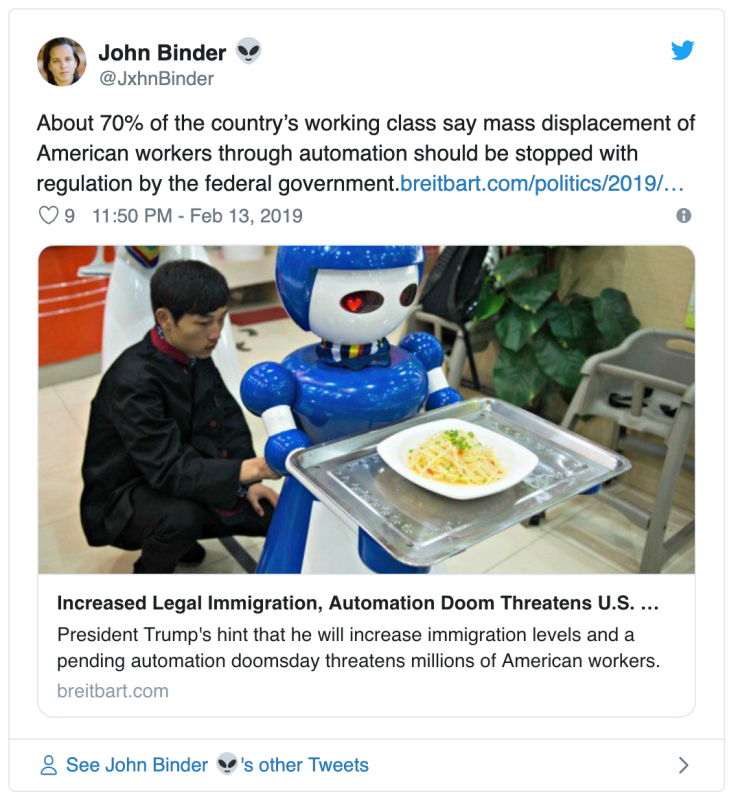
Americans without a high school degree, with only a high school degree, and with some college education are the most likely to suffer if automation is not limited in the U.S. economy. In the northwest region of Ohio, automation threatens to eliminate more than half of all U.S. jobs or job tasks in every county.
Similarly, research by the Center for Immigration Studies’ Steven Camarota has found that immigration has little impact on increasing the working-age population. Camerota’s research finds that if the U.S. implemented an immigration moratorium for the next 40 years, it would hardly have an impact on the number of workers per retirees.
Another study, conducted by the Centre of Expertise on Population and Migration, found that the same results were true in Europe.
“Research has found that even scenarios with unrealistically high increases in fertility (+50%) or double immigration (approximately 20 million every five years) do not have the ability to fundamentally change the European population’s age structure,” the study noted.
As Breitbart News has reported, immigration moratoriums are not uncommon in American history. Currently, there are 44.5 million foreign-born residents living in the country, a 108-year record high. This comes after about four decades of mass legal immigration to the U.S. that, if continued, is likely to hand electoral dominance to Democrats.

The country’s last immigration boom — between 1900 and 1920 — was eventually met with a near immigration moratorium. Between 1925 and 1966, the yearly U.S. legal immigration level did not exceed 327,000 admissions, a four-decades-long near moratorium that allowed the massive inflows of immigrants from before 1925 the ability to assimilate.
Since major changes were enacted in 1965 and in the 1990s to the U.S. legal immigration system — changes that allow foreign nationals to bring as many foreign relatives to the country as they want — legal immigration levels have continued booming for more than five decades.
The nation’s Washington, DC-imposed mass legal and illegal immigration policy — whereby at least 1.5 million unskilled foreign nationals are admitted to the U.S. every year — is a boon to corporate executives, Wall Street, big business, and multinational conglomerates, as America’s working and middle class have their wealth redistributed to the country’s top earners through wage stagnation.
Research by the National Academies of Sciences, Engineering, and Medicine has discovered that immigration to the country shifts about $500 billion in wages away from working and middle-class Americans toward new arrivals and economic elites.
In the last decade alone, the U.S. admitted ten million legal immigrants, forcing American workers to compete against a growing population of low-wage foreign workers. Meanwhile, if legal immigration continues, there will be 69 million foreign-born residents living in the U.S. by 2060.


 Tom's Blog