by Tyler Durden
Summary:
- Two inmates at a UK prison are being tested for coronavirus and have been restricted to their cells
- 13th case diagnosed in San Diego was evacuee rescued from Wuhan, she was briefly accidentally released
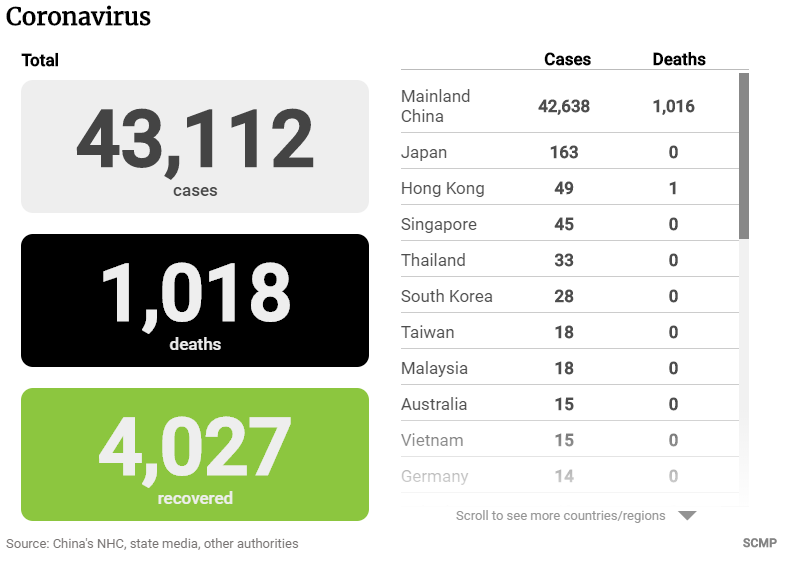
- China death toll tops 1,000, globally cases top 40k
- CNBC’s Eunice Yoon reports on China’s sluggish ‘return to work’
- Hong Kong building residents quarantined over fears virus spread via pipes
- Cruise ship with 0 nCoV cases refused entry to fourth port, in danger of running out of food
- Beijing fires top health officials in Hubei, summons others to Beijing for an explanation
- Scientists in Hong Kong and the mainland present vastly different takes on virus
- 2 Japanese men test positive but were accidentally released
- President Xi says China will be ‘more prosperous’ after outbreak
- Experts suspicious about how Indonesia hasn’t reported any nCoV cases
- Xi also reportedly warned top officials that efforts to contain the virus had gone ‘too far’
- CDC admits lab “mix up” led to coronavirus patient being briefly released back to quarantine
- Another citizen journalist goes missing in China
- Hilton warns travel numbers could be impacted for up to a year after Under Armor saw shares plunge on sales warning
- Bullard warns virus still major “tail risk” for US economy and markets
* * *
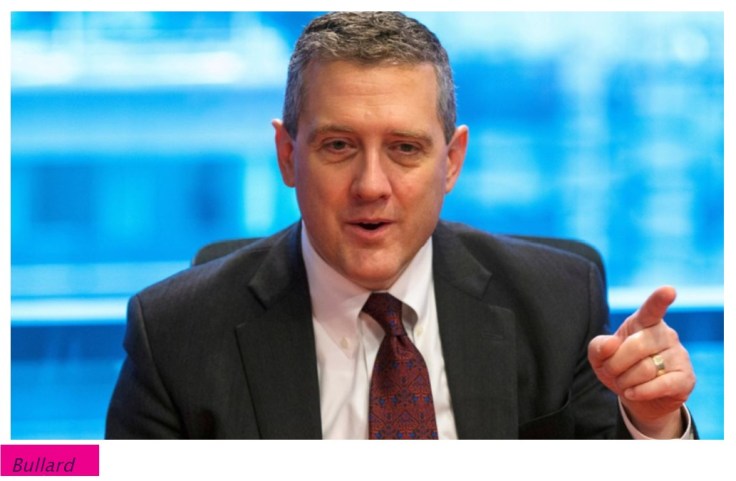
Update (1415ET): For everybody buying on Tuesday, uber-dove Jim Bullard, the president of the St. Louis Fed, has some advice: until the coronavirus pandemic has been completely contained, it will continue to pose a tail risk to the market.
Bullard, who spoke Tuesday following Congressional testimony by Fed Chairman Jay Powell, added that the three rate cuts last year will cushion the economy, but even that might not be enough to offset all of the economic uncertainty that markets are facing this year, from the virus to the presidential race.
This after Powell – who was attacked by President Trump in the middle of his testimony via another Fed-bashing tweet calling for lower rates and a weaker dollar -said that the US economy “looks resilient” despite the coronavirus risk.
But Bullard apparently maintains a somewhat more cautious view:
“The efforts to bring the virus under control are substantial enough that the Chinese economy is expected to grow noticeably slower in the first quarter of 2020 than it otherwise would have,” Mr. Bullard said. “Experience with previous viral outbreaks suggests that the effects on U.S. interest rates can be tangible and last until the outbreak is clearly contained,” he said.
As futures markets price in at least one rate cut in 2020, Bullard said monetary policy “feels a bit too accommodative.” That’s saying something coming from one of the more dovish Fed presidents, though Bullard won’t be a FOMC voter again until 2022, assuming he’s still the president of the St. Louis Fed at that time.
The easing has shifted the outlook for short-term US rates considerably, he added.
“The efforts to bring the virus under control are substantial enough that the Chinese economy is expected to grow noticeably slower in the first quarter of 2020 than it otherwise would have,” Bullard said. “Experience with previous viral outbreaks suggests that the effects on U.S. interest rates can be tangible and last until the outbreak is clearly contained.”
But ultimately, we will need to “wait and see” whether the coronavirus truly becomes the catalyst of a global slowdown, like many analysts fear. Barring that, “the current baseline outlook for 2020 suggests a reasonable chance that a soft landing will be achieved,” Bullard said.
The St. Louis Fed twitter account shared this report that seems to expand upon the theme that monetary policy is much looser than the market realizes.

Update (1330ET): Beijing has reportedly arrested another citizen journalist named Fang Bin. His arrest follows that of Chen Quishi, whose whereabouts are still unknown days after his disappearance.
Hilton is one of the latest American companies to warn about how the coronavirus outbreak will impact its business. The company said it could suppress travel numbers for up to a year, with their predictions based on what happened during the SARS epidemic. Facebook and Cisco have joined Sony and several other firms in pulling out of the Mobile World Congress, which was scheduled for Barcelona, Spain, a place the virus hasn’t yet touched.
This all comes after Under Armor warned about a $60 million sales hit, sending its stock tumbling lower. And it’s only the latest retailer to warn about the virus’s squeeze on sales.
In one of the more shocking revelations on Tuesday, the CDC said a “lab mix-up” is what led to them nearly releasing an infected patient back into mandatory quarantine on a nearby military base.
On the other hand, several carmakers including Hyundai and Ford confirmed that they had reopened at least some plants on Monday after idling them for all of last week.
Dr. Anne Schuchat, a top official at the CDC, told reporters in Washington, admitted that “it turns out there was probably a mix up and the original test wasn’t negative.” Earlier, state officials claimed the initial test was negative, but a second test was positive.
As we noted earlier, four evacuees at Marine Corps Air Station Miramar in San Diego had been in federal quarantine after showing symptoms of the virus. After testing negative for the virus, they were returned to the base on Sunday where they joined more than 200 people who are stuck there under a 14-day quarantine order. The patient who tested positive was immediately returned to isolation, according to CNBC.
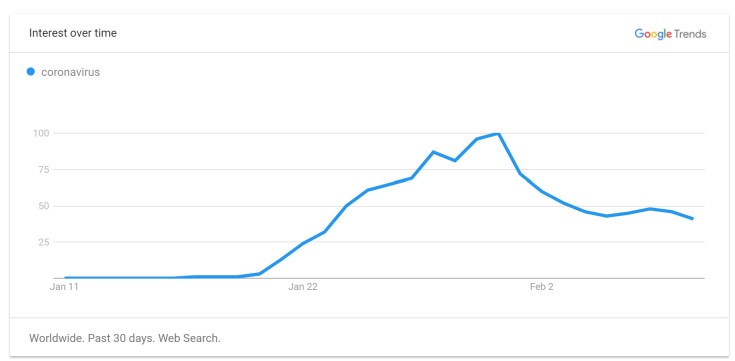
Google trends shows that interest in the virus remains elevated, though it has fallen from a peak reached on Jan. 31.
Finally, the WHO gave the virus a new name: Covid-19.
* * *
Update (1035ET): Two inmates at HMP Bullinton prison in Oxfordshire, UK are being tested for coronavirus, according to Sky News.
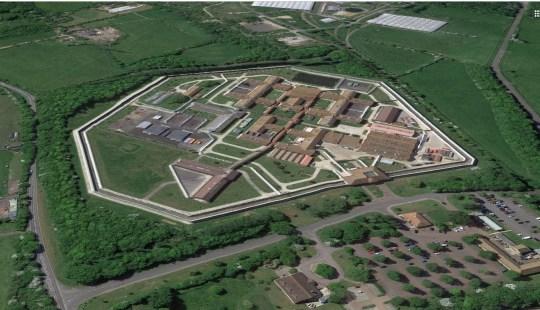
The men are being kept in isolation in their cells, while access has been restricted to the wing where the prisoners are. HMP Bullington has capacity for 1,114 inmates, and holds both prisoners on remand and who have been sentenced, along with young adults aged 18-21, according to Sky.
Eight people in the UK have been confirmed as having coronavirus – four of them testing positive on Monday.
* * *
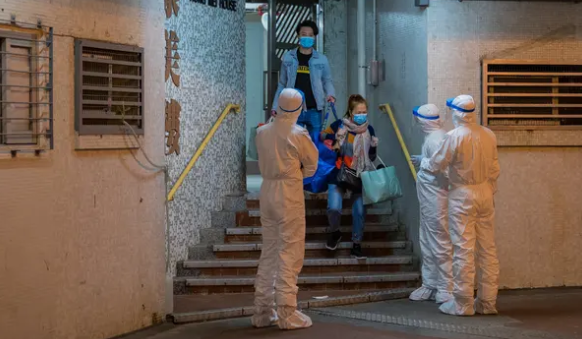
Update (0900ET): The Guardian reports that the diagnosis of four people living in a single apartment block in Hong Kong that has been evacuated and some of its residents quarantined has prompted worried comparisons to SARS.
Medical workers descended on the apartment block in Tsing Yi district wearing full protective suits and evacuated 100 people in 34 apartments after cases were identified more than 10 floors apart, suggesting that the virus may have traveled through the pipes.
One 62-year-old woman was among the victims, and she apparently passed it to her son and daughter-in-law who live with her and were among seven new cases reported on Tuesday, raising the city’s total to 49, leaving it in third place overall, behind mainland China and the ‘Diamond Princess’, which is under quarantine in Yokohama. The worsening outbreak a high profile incident of an individual believed to have tried to escape quarantine prompted Carrie Lam to threaten affixing GPS tracking devices to anyone in an HK quarantine.
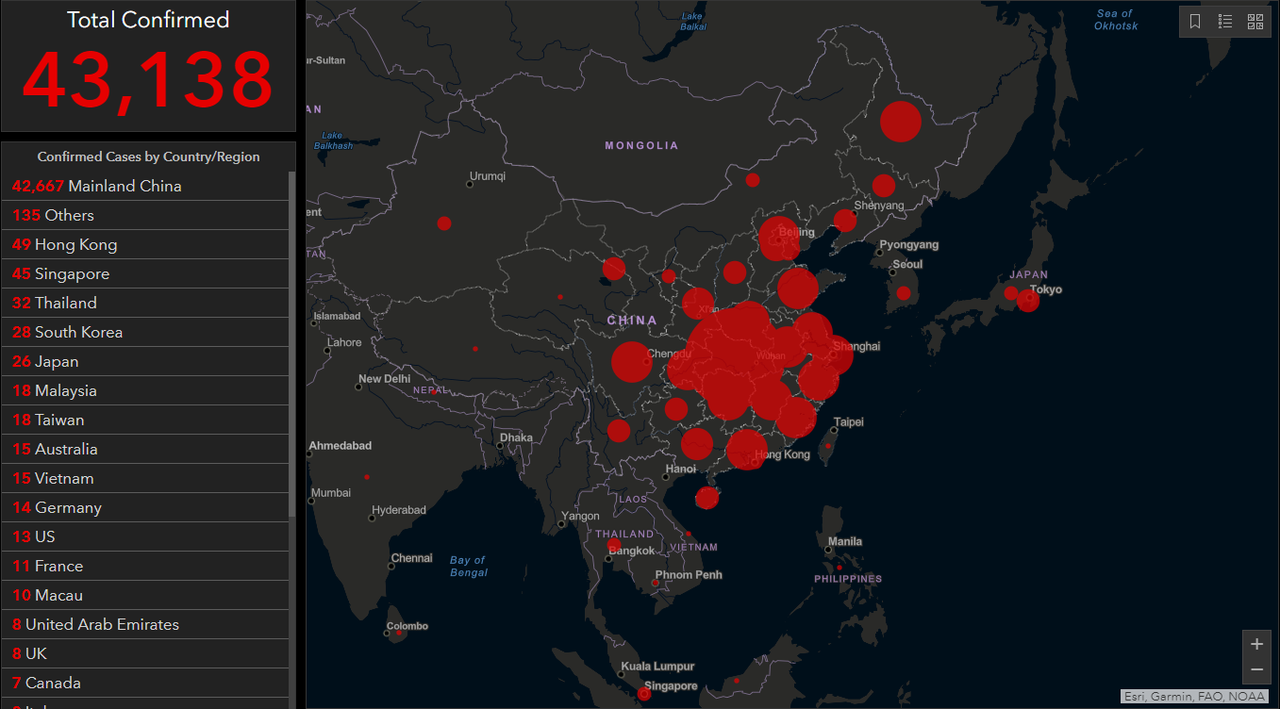
Johns Hopkins
Plumbing was a problem during the SARS outbreak as well, as there were incidents where the virus traveled through the pipes.
Meanwhile, the Westerdam luxury liner still hasn’t found anywhere to dock after Thailand refused it entry earlier on Tuesday, which we noted below.
In other China news, the Communist Party Boss of Huangguang, a city that has been badly impacted by the outbreak, warned taht the crisis in his city is still “Very severe.” We suspect he will be scapegoated by this time tomorrow. After appearing in public yesterday for the first time since the outbreak kicked into high gear, President Xi said Tuesday that China will be “more prosperous” after the outbreak (despite its economy-crushing blowback). It’s the latest sign that Beijing is growing desperate to convince the public that China’s slowing economy can weather the outbreak without a severe downturn.
It begs the question: Will Xi add the capitalist concept of ‘creative destruction’ to his ‘Xi Jinping Thought’?
Meanwhile, Reuters reported on Tuesday that Xi warned top party officials last week that the country’s efforts to contain the outbreak – including quarantining 400 million+ people inside their homes and locking down whole cities – had gone too far. Xi fretted that the lockdown would threaten China’s fragile economy. Protecting and nurturing economic growth is Xi’s No. 1 priority in office and the bedrock of his ‘mandate’ to govern.
It’s unclear where Reuters got its information, but it claimed Xi made the remark during a Feb. 3 Politburo Standing Committee meeting that has already been covered by media reports (hand-picked comments were passed to state press). It just shows how much Cina’s tepid growth last year, the weakest in nearly 30 years, has been weighing on the president’s mind.
After reviewing reports on the outbreak from the National Development and Reform Commission (NDRC) and other economic departments, Xi told local officials during a Feb 3 meeting of the Politburo’s Standing Committee that some of the actions taken to contain the virus are harming the economy, said two people familiar with the meeting, who declined to be named because of the sensitivity of the matter.
He urged them to refrain from “more restrictive measures”, the two people said.
Local authorities outside Wuhan – where the virus is thought to have first taken hold – have shut down schools and factories, sealed off roads and railways, banned public events and even locked down residential compounds. Xi said some of those steps have not been practical and have sown fear among the public, they said.
China’s state council information office did not immediately respond to requests for comment.
In an incident that mirrors the circumstances of the 13th virus case diagnosed in the US by health officials in San Diego, Bloomberg reports that two Japanese men who were evacuated from Wuhan late last month have tested positive for 2019-nCoV after earlier having been cleared by the Japanese health ministry. It’s just the latest sign that the virus may be undetectable – or ‘silent’ – for a period, allowing its host to unknowingly spread it without being detected.
Health officials let the coronavirus patient in San Diego travel back to the army base quarantine briefly before realizing the error and recalling her to the hospital.
The case brings Japan’s total to 28 (not including the 136+ trapped aboard the DP).
In other news, the NYT reported late Monday that scientists are growing increasingly suspicious of Indonesia, and the fact that no cases have been reported in the country, despite thousands of tourists from Wuhan and Hubei visiting the country after the outbreak began. Many worry Indonesia is simply ignoring the threat, given that it was relatively slow to freeze flights from China. A consular official estimated that 5,000 Chinese remained in Bali alone, including 200 people from Wuhan.
“So far, Indonesia is the only major country in Asia that does not have a corona case,” Indonesia’s security minister, Mohammad Mahfud MD, told reporters on Friday. “The coronavirus does not exist in Indonesia.”
None of the 285 people who were evacuated from Wuhan and are now in quarantine on the Indonesian island of Natuna have shown signs of the virus, he added.
* * *
Update (0800ET): CNBC’s Eunice Yoon tweeted out a report that aired early Tuesday morning on CNBC detailing the struggles of one factory owner as China lurches slowly back to work.
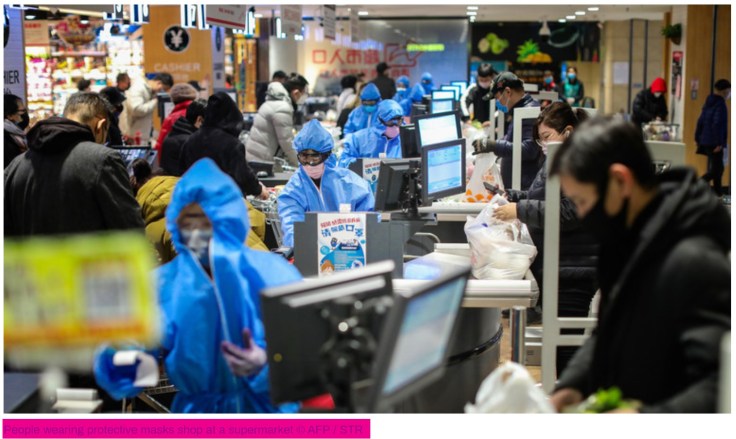
The takeaway: Much of China’s economy, particularly its industrial core, remains shuttered.
* * *
A 13th case of the Wuhan coronavirus has been confirmed in the US after one of the Americans who traveled to California from the epicenter of the outbreak on an evacuation flight last week has been determined to have contracted the virus.
Like with cockroaches, where there is one case of coronavirus, there will likely be more, especially since the patient traveled on a long-haul flight with dozens of others, increasingly the likelihood that at least some of them were infected. The State Department chartered four flights to rescue more than 800 Americans who had been trapped in Wuhan by the quarantine passed by Chinese officials on Jan. 23. One American who apparently opted to stay behind in Wuhan has succumbed to the virus, according to Chinese officials.
Even more alarmingly, the evacuee was accidentally mistakenly released from UC San Diego Medical Center, though she wasn’t released to the public: All evacuees will spend 14 days on designated military bases being repurposed as quarantines. The case was the first in San Diego.
Initially, the hospital reported that four patients undergoing testing at the hospital had tested negative for the virus, and they were discharged and returned to federal quarantine at Marine Corps Air Station Miramar, where more than 200 evacuees are staying. However, “further testing revealed that one of the four patients tested positive for 2019-nCoV,” CDC officials advised San Diego Public Health on Monday morning, and the person was returned to hospital” for observation, the hospital said in a statement.
The CDC said it’s tracing all of the individual’s contacts since arriving in the US, Reuters reports.
“CDC is conducting a thorough contact investigation of the person who has tested positive to determine contacts and to assess if those contacts had high risk exposures.”
Most US-China flights have been suspended by the White House, and only a handful of American nationals arriving on commercial flights from China have been quarantined under rules imposed on Feb. 2 to curb the virus’s spread.
There are now at least 3 cases of the virus diagnosed in California.
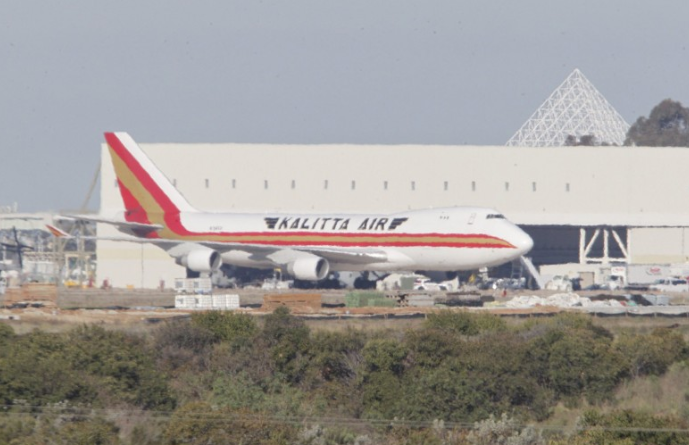
One of the private jets that carried Americans back from Wuhan
Out of eight states that have set up airport screenings for the virus, only six of them said they had no one under quarantine, while NY said it had 4 and Illinois aid it had a “tiny” number.
In China, the scapegoating continued on Tuesday as Beijing fired two of the most senior health officials in Hubei just hours after officials reported 108 new deaths from the virus on Monday, the first time a daily death toll has topped 100. Only 2 of the more than 1,000 deaths occurred outside mainland China.
Zhang Jin, the Communist party boss of the provincial health commission in Hubei, and its director Liu Yingzi were removed by decree of the party yesterday.
In their stead, senior Beijing official Chen Yixin has been sent to Wuhan to lead virus-suppression efforts at the crisis’s ground zero. Chen, a former deputy party chief in Hubei, will be deputy head of a central government group dispatched to the province.
Additionally, 3 senior Wuhan officials have been summoned to Beijing to explain their failings, according to state media reports cited by the SCMP.
Authorities were accused of playing down the extent of the outbreak in early January because they wanted to project an image of stability.
Wuhan authorities also faced criticism for going ahead with an annual public banquet for 40,000 families just days before the city was placed on lockdown, according to the Daily Mail. Beijing is of course trying to deflect attention from the senior Party leadership’s failures – failures that are implicit in their policies which guarantee the suppression of information during crises. However, the death of Dr. Li Wenliang late last week made it almost inevitable that the locals in Wuhan and Hubei would be punished – after all, it was Wuhan police who initially reprimanded Dr. Li for his warnings about the outbreak. Warnings that, if heeded, would have helped save hundreds of lives.
A top Red Cross official in Wuhan was also removed for dereliction of duty earlier this month. Local officials have faced an intense backlash almost since the beginning, once it had become clear that the virus had been allowed to spread within Wuhan without police or health authorities doing anything to stop it.
“Right now I’m in a state of guilt, remorse and self-reproach” said the official in an interview with CCTV last month.”
“If strict control measures had been taken earlier, the result would have been better than now.”
In South Korea, Reuters reports that the first confirmed coronavirus patient is returning to Wuhan (apparently despite the lockdown) after being discharged by the South Korean medical team that treated her.
While searching through virus-related headlines this morning, we stumbled on a telling example of Beijing’s strategy of extreme media censorship after its brief experiment with ‘openness’ provoked widespread public rage Consider this contrast: A doctor who helped lead the fight against SARS in Hong Kong warned Tuesday that nCoV could infect “60% to 80%” of the global population if left unchecked. While on the mainland, the state media reported that another veteran SARS fighter named Zhong Nanshan, the Chinese government’s senior medical adviser, is claiming that the outbreak is peaking right now.
In an interview with Reuters, the 83-year-old scientists who helped fight the SARS epidemic said his model showed the virus should peak in the middle of February.
Echoing comments from President Trump, the scientist added that he hoped the virus would peter out by April.
“I hope this outbreak or this event may be over in something like April,” he said in a hospital run by Guangzhou Medical University, where 11 coronavirus patients were being treated.
“We don’t know why it’s so contagious, so that’s a big problem,” added Zhong, whose previous forecast of an earlier peak turned out to be premature. He said there was a gradual reduction in new cases in the southern province of Guangdong where he was, and also in Zhejiang and elsewhere.
Finally, the man from Brighton believed to be the ‘super spreader’ linked to 11 cases involving a French ski chateau has broken his silence, according to the Guardian.
His name is Steve Walsh, he’s 53 years old, and this is his story:
“I would like to thank the NHS for their help and care – whilst I have fully recovered, my thoughts are with others who have contracted coronavirus.”
“As soon as I knew I had been exposed to a confirmed case of coronavirus I contacted my GP, NHS 111 and Public Health England.”
“I was advised to attend an isolated room at hospital, despite showing no symptoms, and subsequently self-isolated at home as instructed.”
“When the diagnosis was confirmed I was sent to an isolation unit in hospital, where I remain, and, as a precaution, my family was also asked to isolate themselves.”
“I also thank friends, family and colleagues for their support during recent weeks and I ask the media to respect our privacy.”
Over in Hong Kong, dozens of residents of a housing complex in Hong Kong have been quarantined after two people living on separate floors were infected with the virus, raising the possibility that it might have been traveling through the pipes.
Per local officials from Hong Kong’s Center for Health Protection, the decision to partially evacuate the building was made after investigators discovered an unsealed bathroom pipe in the apartment of a 62-year-old woman found to be infected. She lives 10 floors below another resident who was found to be infected, the NYT reports.
Yesterday, we reported that the Westerdam cruise ship had finally been granted permission to dock in Thailand after being turned away from three other countries, despite having ZERO confirmed nCoV cases aboard. Now, Thailand has rejected it, leaving it once again adrift. The ship is set to run out of food and other essentials in just two days.







 Tom's Blog