By Dr. John Campbell
By Dr. John Campbell

The new epicenter of the dreaded pandemic, Italy, has been struggling to stop the spread of Covid-19 for weeks now. The disease has already killed more than six thousand people in the country, with over 60 thousand people infected.
The EU clearly underestimated the virus, blaming the outbreak in Italy on its national healthcare system flaws, according to the two-time foreign minister and OSCE representative. As a result, Brussels, which preaches pan-European solidarity, failed to act when this solidarity was needed in the face of a crisis that eventually affected the entire bloc.
Frankly speaking, Brussels is not doing enough. At the very first moment, Italy was practically alone against the virus. Many said it was all because of the Italian habits, because Italians do not respect the rules. Suddenly, they realized all the other countries were equally affected.
The situation in other major EU states like Germany and France deteriorated rapidly, forcing them to deal with thousands of infected on their own soil.
“Everyone just focused on the situation at home before even thinking about helping others,” Andrea Giannotti, the executive director of the Italian Institute of Eurasian Studies, told RT.

The lack of solidarity was recently noted from outside of the bloc – Serbian President Aleksandar Vucic decried European solidarity as a myth, while praising Beijing for its assistance. His remarks came after Serbia received five million masks from China, which it could not get in Europe.
The EU is now trying “to do more” and somehow “make up” for its initial poor execution of a coordinated response, former Italian MP Dario Rivolta said.
Brussels has indeed ramped up its efforts, suspending the bloc’s strict Stability and Growth Pact regulating budgetary policy among others. Frattini particularly hailed this decision, which allows Rome to act freely in terms of budgetary spending, as “very important.” But this came only after Europe “realized its [measures] were inadequate to give a united response.”
Still, it is not enough, Rivolta told RT, adding that “for the moment,” there are no major changes. And while financial relief is necessary, there are other things to be considered, such as medical assistance.
“As for the medical aspects, the only thing that the EU did up to now was to put barriers between Italy and other countries.”
At one point, requests for help were sent out all over the world, according to Giannotti.
“Some Italian embassies were tasked with negotiating with local governments in order to find any opportunities to receive assistance from abroad, including help with equipment, which Italy lacks.” Russia and China were among those who responded.
In total, Moscow prepared nine cargo planes with emergency aid, delivering vital medical equipment and supplies, as well as bringing experienced specialists in infectious diseases and military doctors to Italy. Now they will be deployed to the most affected regions in the country’s north.
Frattini said the help was of the utmost importance: “What Russia has done is not comparable to what other countries have done, including China because China also sent something but not comparable with the support provided by Russia.”
The specialists have provided “very huge support in terms of expertise… in terms of virology.”
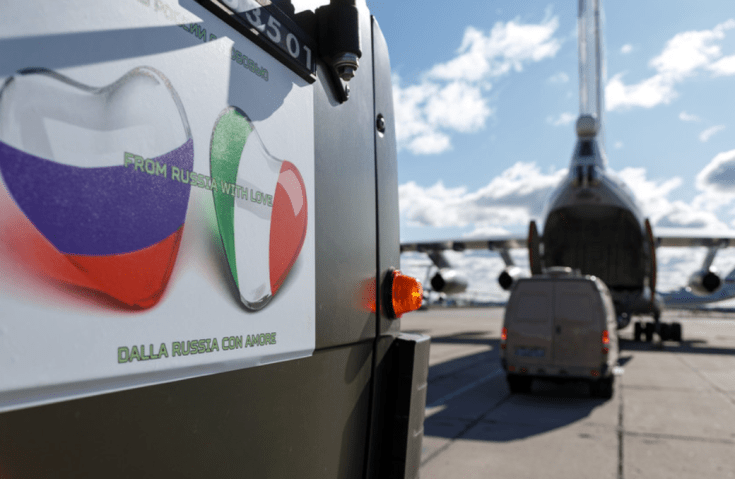
The assistance serves as a gesture of solidarity in times of European sanctions on Moscow and the counter-measures, Giannotti said. Sending help “despite [the fact] the situation in Russia itself may also worsen” means it is a clear message that Moscow is ready to talk and settle issues with Europe when there is a greater need for cooperation.
Speaking to RT, the Italian ambassador to Russia, Pasquale Terracciano, agreed that a joint approach is the best way to put an end to the pandemic.
Thanking Moscow for the contribution, he said: “It will be crucial to recover from this tragic situation, hopefully soon.”
By Isis Almeida and Agnieszka de Sousa
“We’re starting to see this happening already — and all we can see is that the lockdown is going to get worse,” said Tim Benton, research director in emerging risks at think tank Chatham House in London.
Though food supplies are ample, logistical hurdles are making it harder to get products where they need to be as the coronavirus unleashes unprecedented measures, panic buying and the threat of labor crunches.
Consumers across the globe are still loading their pantries — and the economic fallout from the virus is just starting. The specter of more trade restrictions is stirring memories of how protectionism can often end up causing more harm than good. That adage rings especially true now as the moves would be driven by anxiety and not made in response to crop failures or other supply problems.
Related video: Food supply is not where it’s needed
As it is, many governments have employed extreme measures, setting curfews and limits on crowds or even on people venturing out for anything but to acquire essentials. That could spill over to food policy, said Ann Berg, an independent consultant and veteran agricultural trader who started her career at Louis Dreyfus Co. in 1974.
“You could see wartime rationing, price controls and domestic stockpiling,” she said.
Some nations are adding to their strategic reserves. China, the biggest rice grower and consumer, pledged to buy more than ever before from its domestic harvest, even though the government already holds massive stockpiles of rice and wheat, enough for one year of consumption.
Key wheat importers including Algeria and Turkey have also issued new tenders, and Morocco said a suspension on wheat-import duties would last through mid-June.

As governments take nationalistic approaches, they risk disrupting an international system that has become increasingly interconnected in recent decades.
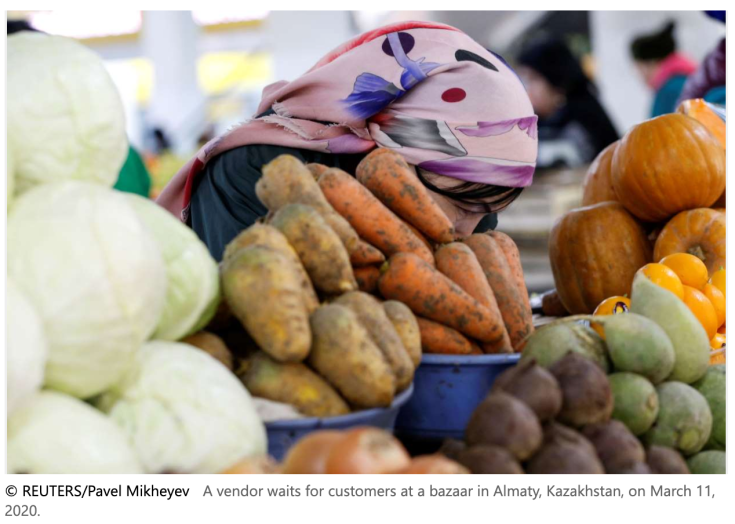
Kazakhstan had already stopped exports of other food staples, like buckwheat and onions, before the move this week to cut off wheat-flour shipments. That latest action was a much bigger step, with the potential to affect companies around the world that rely on the supplies to make bread.
For some commodities, a handful of countries, or even fewer, make up the bulk of exportable supplies. Disruptions to those shipments would have major global ramifications. Take, for example, Russia, which has emerged as the world’s top wheat exporter and a key supplier to North Africa.
“If governments are not working collectively and cooperatively to ensure there is a global supply, if they’re just putting their nations first, you can end up in a situation where things get worse,” said Benton of Chatham House.
He warned that frenzied shopping coupled with protectionist policies could eventually lead to higher food prices — a cycle that could end up perpetuating itself.
“If you’re panic buying on the market for next year’s harvest, then prices will go up, and as prices go up, policy makers will panic more,” he said.
And higher grocery bills can have major ramifications. Bread costs have a long history of kick-starting unrest and political instability. During the food price spikes of 2011 and 2008, there were food riots in more than 30 nations across Africa, Asia and the Middle East.
“Without the food supply, societies just totally break,” Benton said.

Unlike previous periods of rampant food inflation, global inventories of staple crops like corn, wheat, soybeans and rice are plentiful, said Dan Kowalski, vice president of research at CoBank, a $145 billion lender to the agriculture industry, adding he doesn’t expect “dramatic” gains for prices now.
While the spikes of the last decade were initially caused by climate problems for crops, policies exacerbated the consequences. In 2010, Russia experienced a record heat wave that damaged the wheat crop. The government responded by banning exports to make sure domestic consumers had enough.
The United Nations’ measure of global food prices reached a record high by February 2011.
“Given the problem that we are facing now, it’s not the moment to put these types of policies into place,” said Maximo Torero, chief economist at the UN’s Food and Agriculture Organization. “On the contrary, it’s the moment to cooperate and coordinate.”
Read More on Food Issues in Virus Era:
| There’s Plenty of Food in the World, Just Not Where It’s Needed
Americans Drop Kale and Quinoa to Lock Down With Chips and Oreos Cargill Says China Offers Hope for Meat Markets Hit by Virus |
Of course, the few bans in place may not last, and signs of a return to normal could prevent countries from taking drastic measures. Once consumers start to see more products on shelves, they may stop hoarding, in turn allowing governments to back off. X5 Retail, Russia’s biggest grocer, said demand for staple foods is starting to stabilize. In the U.S., major stores like Walmart Inc. have cut store hours to allow workers to restock.
In the meantime, some food prices have already started going up because of the spike in buying.
Wheat futures in Chicago, the global benchmark, have climbed more than 6% in March as consumers buy up flour. U.S. wholesale beef has shot up to the highest since 2015, and egg prices are higher.
At the same time, the U.S. dollar is surging against a host of emerging-market currencies. That reduces purchasing power for countries that ship in commodities, which are usually priced in greenbacks.
n the end, whenever there’s a disruption for whatever reason, Berg said, “it’s the least-developed countries with weak currencies that get hurt the most.”

By Shane Trejo 3/24/2020
The providers of these doomsday bunkers are reporting a drastic increase in business, with coronavirus hysteria causing at least one economic sector to boom.
“As unpopular as coronavirus is, it’s getting the publicity of a Backstreet Boys hit in the ‘90s,” said Gary Lynch, general manager of Texas-based Rising S Bunkers. “People have an infatuation with it.”
Trending: Dr. Fauci Wants America to Become a Police State Like China in Order to Stop Coronavirus
Business is good for Lynch and other bunker manufacturers, as the ultra rich scramble to use their remaining wealth to seclude themselves. There is no limit to the luxuries that can be provided in a modern bunker, with many of these bunker models resembling mansions.
“Movie theaters are common,” Lynch said. “We built one in California that has a shooting range, swimming pool and bowling alley.”
Lynch offers 24 different options for individuals wishing to purchase a bunker. The smallest model costs $39,500 and includes a custom air filtration system, bunk beds, a functioning toilet, and a kitchen counter. A more decadent set-up is the Fortress, which costs $1.009 million, including 15 private bedrooms, 42 bunk beds, a panic room, and a room to house guns.
The most garish model of all is the Aristocrat, which features a sauna, hot tub, swimming pool, gym, greenhouse, billiards room and garage. It costs an incredible $8.35 million to construct and is off limits to all but the super rich. Coronavirus is causing a run on these types of shelters, Lynch explains, as high-class Americans realize the necessity of extreme preparedness.
“In 2008, I talked to a guy for four-five months who was thinking about purchasing a shelter. I think he probably used the coronavirus to convince his wife, because he finally just bought one,” Lynch said. “That’s how most buyers are; they’re not in it for one single reason.”
The providers of these bunkers feel they are supplying a much-needed service in the market to alleviate the authentic fears of families in an increasingly topsy-turvy world.
“We don’t create fear. We resolve it. The true elite all have backdoor plans. They’re jumping on planes and flying to islands,” said Robert Vicino, who is CEO of the shelter-building company Vivos. “We give people the peace of mind that they have their own backdoor solution for when it’s time to take shelter.”
Vicino noted that his clientele has moved from middle class to upper class in recent months, as the wealthy no longer feel insulated from the rest of society from their gated neighborhoods. He reports that interest in his bunkers are up 1,000 percent year-over-year, and sales are up 400 percent, as doomsday fever sweeps throughout America.
“As long as time permits, we will continue to build bunkers. This world won’t be safer tomorrow,” he added.
For the Americans without the wealth to retreat from society, they will have to deal with a tumultuous and dangerous reality for their loved ones as the coronavirus pandemic continues without any sign of slowing.
By Mike Carter

The disease caused by the virus, COVID-19, has proved particularly lethal to the elderly and those with underlying health conditions, and the scientists at the school’s Center for Innate Immunity and Immune Disease have been tasked with trying to understand why in these cases the new virus overwhelms the body’s natural defenses, while in most people it causes only moderate or even mild illness.
The new virus has some unusual characteristics that haven’t been seen in other SARS (Severe Acute Respiratory Syndrome) outbreaks, both in the way it attacks the lungs and how it can infect people quietly, where they will have few or no symptoms for days or weeks but still spread the disease, said Dr. Michael Gale, a professor of immunology at the UW and the center’s director.
“There’s a lot we don’t know,” Gale said. “We don’t know how it interacts with the cell. We don’t know how it invades it. We don’t know how it overcomes the cell’s innate immune system.”
These are all questions that Gale and his team of scientists, working with others around the world, hope to answer as they begin to understand the pathology of the novel coronavirus. That information, in turn, will inform both treatment and prevention of the disease, he said.
“What we do know is that this SARS is very successful in taking over the cell,” he said. So successful, in fact, that the body’s reaction to that takeover can be so violent and overwhelming that, in essence, it ends up killing itself.
Earlier this month, the King County Medical Examiner’s Office released a list of the first 22 people in King County to die from COVID-19 before announcing that it was no longer taking jurisdiction over SARS deaths. The list identified patients, their age and their gender, and listed the cause of death and contributing factors. Gale and another noted immunologist and pathologist, Dr. Julian Leibowitz at Texas A&M University College of Medicine, reviewed the list and remarked on how the information fits with what is known and being learned about COVID-19 and how it attacks the body.
Both were cautious to point out that the information was extremely limited and did not contain autopsy reports, tissue-sample slides or other detailed information they would need to provide anything more than general observations.
Leibowitz, however, said he has reviewed detailed results of a COVID-19 autopsy performed in China and published online. What he was able to glean from the medical examiner’s list led him to conclude the pathology was similar.
“This follows the pattern of SARS in general,” he said. “This virus clearly causes a viral pneumonia” similar to the SARS outbreak in 2003 that infected 8,089 people around the world. Like that outbreak, he said, the chance of serious illness or death is significantly higher in older populations, he said. The average age of the individuals on the medical examiner’s list was 66, with the oldest being 98 and the youngest 44.
But this new coronavirus is likely more infectious, certainly more insidious, and more lethal that the ‘03 SARS virus. That outbreak killed 774 people before being contained in about nine months. COVID-19 has infected more than 208,000 people worldwide and killed nearly 8,700 of them, and has spread into a pandemic.
Leibowitz said one thing really jumped out at him from the King County list: the number of cases of cardiomyopathy, a hardening of the heart muscle that can be caused by a drastic immune response. Four of the 22 King County fatalities had cardiomyopathy listed as the primary cause of death.
Similarly, an article published Thursday in the Journal of the American Medical Association detailing a review of the outcomes of 21 COVID-19 patients admitted to the Intensive Care Unit at Kirkland’s EvergreenHealth Medical Center made a similar observation, finding cardiomyopathy developed in seven of the 21 patients. At the time of publication, 14 of the 21 had died.
“It is unclear whether the high rate of cardiomyopathy in this case series reflects a direct cardiac complication of SARS-CoV-2 infection or resulted from overwhelming critical illness,” the article stated, calling for additional research.
Leibowitz believes it is likely a result of the body’s immune system trying desperately to stop the virus, causing massive inflammation throughout the heart and lungs and, in some cases, damaging other organs as well.
The workings of the immune system is what Gale’s UW scientists are focused on, specifically the “innate” portion of the body’s defenses — mechanisms genetically coded into every cell to protect it from infections and damage. They activate almost immediately when the body detects an invader.
Gale said his researchers are working to understand how SARS-CoV-2 manages to defeat these mechanisms to invade a cell and take it over, forcing it to replicate copies of the virus even as it is destroyed. Those virus copies then go on to infect other cells and the process repeats in a cascading infection.
“Right now, its replication strategy is unknown,” Gale said during a recent interview outside the Bio-Safety Level III laboratory in South Lake Union where his scientist opened the vial of SARS-CoV-2 this past week. Gale asked that the exact location of the laboratory be withheld for security reasons.
“What we know is that the virus physically destroys the lung tissue as it replicates in the cells,” he said. Gale said the tissue damage he’s seen bears similarities to the damaged lungs of victims of the 1918 influenza-A pandemic, which infected one of every three people and killed 50 million people — roughly 3% of the world’s population.
Gale has worked with and studied the 1918 H1N1 flu virus as well after a live specimen was recovered in 2007 from the remains of an Inuit woman who was buried in the Alaskan permafrost after dying during the pandemic.
“That virus physically destroyed the cells, as well,” he said.
A Morbidity and Mortality Report issued Wednesday by the Centers for Disease Control and Prevention states that preliminary data from the initial outbreak in Wuhan, China, shows the majority of COVID-19 deaths in those 60 and older.
Leibowitz said the vulnerability of older patients is likely explained at least in part because, as people age, their cells lose their ability to grow, divide and protect themselves through a process called “senescence,” a word derived from the Latin “senex,” which means “old.”
“The immune system becomes sluggish, sleepy,” he said.
Add to that another health issue — diabetes or kidney problems — and the tired immune system can be even further taxed.
“When a person has an underlying health issue, it engages an immune response at some level,” Gale explained. This can result in inflammation as the body attempts to grapple with the issue. “Your body is distracted, and it can’t deal with other insults.”
“It becomes a race,” said Leibowitz, who has studied coronavirus. “The virus tries to spread and make more virus in order for it to be successful in nature.
“In the meantime, your immune system tries to kill the cells that are infected,” he explained. If you are young and healthy with a robust immune system, then not as many cells will be affected.
“But if your innate immune system isn’t strong, then the virus is more successful and your body’s response will be prolonged. That means more cells will be damaged by the immune system as it tries to keep up with the virus.
“And that,” he said, “is not good for your lungs.”
The other “striking” issue with SARS-CoV-2 has been its apparently easy transmission and contagion, Leibowitz said.
“What is scary to me about this SARS compared to the outbreak in 2003 is that back then, asymptomatic patients did not transmit the disease. You had to have a fever to be contagious,” he said. “This disease can be transmitted silently by people who don’t know they are sick and show few or no symptoms of being infected.”
(EDITORS: STORY CAN END HERE)
That surreptitious transmission strikes Gale, as well, who noted that of the first 22 people who died in King County from COVID-19 — the individuals listed on the medical examiner’s document — most had been patients at Life Care Center of Kirkland, a long-term nursing facility that became ground zero for the pandemic in the U.S. At last count, Dr. Jeffrey Duchin, the chief public health officer for Public Health — Seattle & King County, said 23 care facilities had reported patients or staff with confirmed COVID-19 infections.
“The 2003 SARS outbreak was more acute,” Gale said. “Here, we have up to two weeks with people asymptomatic and, in some cases, kids don’t get sick at all. They’re little vectors.
“You have to ask yourself, ‘Why do you think all the nursing homes and care centers get hit?’ ” he asked. “I can tell you: It’s because grandparents got visits from grandkids.”

After a migrant tested positive for coronavirus at the facility in Suhl, Thuringia, a quarantine was ordered for the other 533 residents and the camp was sealed off.
“But the measure, which in times of Corona seems not at all unusual, apparently drove the asylum seekers to a fury,” reports Compact Online. “Some of them started rioting and prevented inmates from entering the dining hall in order to force a hunger strike. They are said to have tried to leave the facility through the sewers to get to the nearby town.”
According to police spokesman Wolfgang Nicola, the migrants then gathered at the front gate and began threatening to burn down the facility while displaying ISIS flags.
Why they even have possession of ISIS flags in the first place is shocking.
50 police officers were dispatched to the scene to quell the riots. The same migrant camp was also the scene of riots back in 2015 in response to a man tearing pages out of the Koran.
“The danger that Corona will also break out in other shelters is omnipresent, a further restriction of public life is to be expected,” states the report. “It is hard to imagine that the capacities of the security forces and medical staff are sufficient to keep at bay angry illegal immigrants who do not want to comply with the protective measures against the spread of COVID-19.”
“If the Wuhan virus leads to major social unrest in Germany, the country’s multitudinous “refugees” are likely to play a major role,” warns Dave Blount.
As we highlighted yesterday, migrants in Naples, Italy are completely ignoring the quarantine order to stay indoors and are roaming around the streets.

By Dr. John Campbell – 3/13/2020


 Tom's Blog