Published on Sep 9, 2019
Big Tech & Big Brother meet at Facebook HQ to discuss how to ‘secure’ US elections
Security teams for Facebook, Google, Twitter and Microsoft met with the FBI, the Department of Homeland Security and the Director of National Intelligence’s office to coordinate a strategy to secure the 2020 elections.
The tech platforms met with government officials at Facebook’s Menlo Park headquarters on Wednesday, the company has confirmed, boasting that Big Tech and Big Brother have developed a “comprehensive strategy” to get control of previous election-related “vulnerabilities” while “analyzing and getting ahead of new threats.”

Facebook has scrambled to get in front of the 2020 election after being blamed for Trump’s 2016 electoral victory over merely allowing the “Russian trolls” to buy a bunch of ads, most of which appeared after the vote and had nothing to do with the election. But the company insisted last week it had tightened its rules for verifying purchasers of “political” ads, for real this time, after the 2018 contest showed they could still be duped into running obviously-fake ads “paid for by” the Islamic State terror group and Cambridge Analytica.
Big election business: Democratic candidates, even critical of Facebook, pour millions into platform

Aside from the occasional purge of accounts accused of being linked to countries like Russia, Iran, and China on the US’ ever-lengthening enemies’ list, however, it’s hard to tell what exactly any platform has done to make itself immune to ‘manipulation’. Twitter banned state-owned media from buying ads on its platform last month, holding the move up as a victory against the dreaded “foreign meddling,” but its own founder’s account was hacked last week, suggesting it has bigger security issues than a few wrongthink-prone advertisers.
And Google’s potential to sway elections has been the subject of Senate hearings – yet the company has remained silent on addressing the problem, suggesting it doesn’t see it as a bug at all, but a feature. Subsidiary YouTube, meanwhile, conducted another round of deplatforming last month even while declaring it was an open platform for controversial ideas.
The electoral meeting of the minds came less than a week after the Pentagon’s Defense Advanced Projects Research Agency (DARPA) declared war on deepfakes and other potentially discord-sowing information, promising to neutralize all “malicious” content within four years – if not for this election, then certainly for the next.
Until then, there’s Microsoft’s ElectionGuard software, which the company announced in July it would provide to all the nation’s voting machines, free of charge, out of the goodness of its (and the Pentagon-owned contractor that helped develop the program’s) heart. And if Microsoft’s act of selfless charity doesn’t convince a district their democracy is worth protecting, there’s always Cyberdome, the election security nonprofit advised by half a dozen former intel agency heads who want what’s best for your vote (when they’re not authorizing torture or warrantless wiretapping).
Getting the DHS involved was a nice touch, too, after that agency was accused of attempting to hack electoral systems in multiple states thousands of times during the period surrounding the 2016 election. Unlike the “Russian hacking” allegations that remain unproven, multiple officials from Idaho, Georgia, Indiana, West Virginia, and Kentucky claim the agency attempted to access their systems after they opposed its efforts to “secure” those systems. After initially denying any involvement, the DHS claimed the attempted breach alarms were set off accidentally, during routine “legitimate work.”
Surrender: Hong Kong Leader Caves to 1 of Protesters’ 5 Demands, Will Withdraw Bill Allowing China to Extradite Dissidents
By Frances Martel
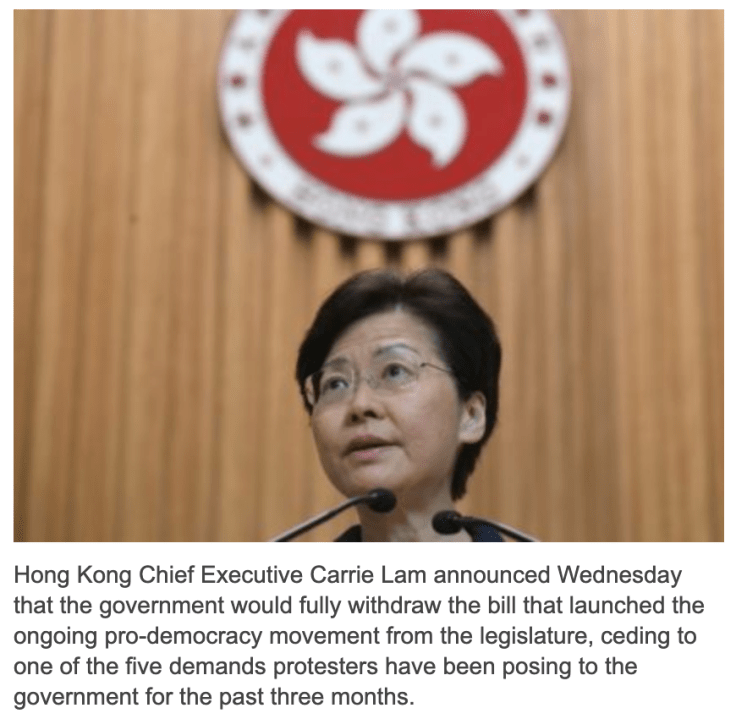
Hong Kong Chief Executive Carrie Lam announced Wednesday that the government would fully withdraw the bill that launched the ongoing pro-democracy movement from the legislature, ceding to one of the five demands protesters have been posing to the government for the past three months.
The bill in question would have allowed the Communist Party of China to extradite anyone present in Hong Kong, not just Hong Kong residents or Chinese citizens, into the Chinese prison system if accused of violating communist “crimes.” China has notoriously “disappeared” thousands of political dissidents into its prison system and severely restricts free speech and religious activity. Multiple investigations have found that China uses its political prisoners as forced organ donors, cutting them open and taking their organs alive to fuel a million-dollar industry.
Hong Kong residents naturally feared that exercising their rights to speech, assembly, or religion in what is ostensibly a free territory would result in being the victims of gross human rights violations and took to the streets this June.
In a public address Wednesday, Lam said the Legislative Council would fully withdraw the bill “in order to fully allay public concerns” and lamented the mostly police-driven violence her government has plunged the city into, though she appeared to equally blamed the peaceful protest movement.
“Our citizens, police and reporters have been injured during violent incidents. There have been chaotic scenes at the airport and MTR stations; roads and tunnels have been suddenly blocked, causing delay and inconvenience to daily life,” Lam narrated. “For many people, Hong Kong has become an unfamiliar place.”
Lam also announced that she would modify the membership of the existing police oversight organization, the Independent Police Complaints Commission. This is a nod to one of the remaining four demands – an independent inquiry on police brutality against protesters – but does not address concerns that the police would exonerate itself of human rights crimes if it conducts the investigation.
“The government believes that matters relating to police enforcement actions are best handled by the existing and well-established [IPCC], which was set up for exactly this purpose,” Lam insisted.
The Global Times, a Chinese regime propaganda outlet, was quick to applaud Lam and threaten protesters out of celebrating her moves as a win.
“Though the move is meant to show the SAR [Hong Kong Special Administrative Region] government’s sincerity in addressing the political crisis, it should not be seen as a concession by Lam that could lead to a slippery slope,” the Global Times warned, “and radical forces should not have any illusion of winning ground on matters related to the ‘one country, two system’ [sic] principle that governs Hong Kong and China’s sovereignty.”
The Global Times reported that Beijing supported Lam’s decision.
The protesters have made five demands on Hong Kong’s government: a withdrawal of the extradition bill, the independent inquiry on police brutality, freedom for political prisoners, direct election of lawmakers, and an apology for calling the June 12 protest a “riot.” Currently, Hongkongers are allowed to election only half of lawmakers in the Legislative Council, while the others are appointed by a small group of special interests representatives controlled by China. Similarly, only 1,200 Hong Kong residents, part of a special committee, can vote for their chief executive, and even then only among a list of candidates handpicked by China.
Prior to Wednesday, Lam had adamantly refused to withdraw the extradition bill, noting that legislators had tabled it and declaring it “dead” in July. Tabling a bill keeps it alive and allows lawmakers to revive it at any time.
“I have almost immediately put a stop to the [bill] amendment exercise, but there are still lingering doubts about the government’s sincerity, or worries, whether the government will restart the process in the legislative council, so I reiterate here: There is no such plan, the bill is dead,” she said in July.
Protest movement leaders responded to this declaration by asserting that “dead” is not a legal term for a bill and that she gave no guarantees lawmakers would not bring it back to life.
Her statement followed the destruction of the Legislative Council floor and much of the building it uses as its headquarters. Protesters meticulously destroyed all the technology and every facility used to pass laws, but left historical documents, the building’s cafeteria, and other irrelevant areas untouched.
Lam’s concession follows the publication of a bombshell report this week by Reuters, revealing audio of the chief executive saying she would like to resign from the post, but she is not allowed.
“For a chief executive to have caused this huge havoc to Hong Kong is unforgivable. It’s just unforgivable,” she said in the audio. “If I have a choice, the first thing is to quit, having made a deep apology, is to step down.”
Lam conceded on Tuesday that the audio is real, but claimed that her choice of words was taken out of context, and that she meant only that quitting was the easiest thing to do. Despite Lam admitting the audio was, indeed, of her voice, the Global Times called the Reuters report “fake,” without elaborating.
Protest leaders have called Lam’s withdrawal of the bill “too little and too late,” insisting they will continue their struggle for freedom from China.
REPORT: Tech Elite Building ‘Social Credit’ System Masters of The Universe to Track Everything You Do Zuckerscore: Points Control Your Freedom?

By Allum Bokhari
Fast Company has caught on to what Breitbart News has been highlighting for some time: that the Big Tech Masters of the Universe are developing systems to monitor and regulate personal behavior that closely resemble China’s totalitarian “social credit” system.
The “social credit” system assigns all Chinese citizens a “social credit score.” A citizen’s score drops if he engages in a range of disfavored activities, ranging from littering to supporting political dissidents.
Citizens whose score drops low enough can find themselves subject to strict punishment, including bans from the use of public transport, exclusion from top jobs, and prohibitions on their children attending top-rated schools.
This may sound alien and Orwellian, but as Fast Company notes, Silicon Valley is bringing a version of this grim reality to America.
Many Westerners are disturbed by what they read about China’s social credit system. But such systems, it turns out, are not unique to China. A parallel system is developing in the United States, in part as the result of Silicon Valley and technology-industry user policies, and in part by surveillance of social media activity by private companies.
The articles goes on to note a range of ways in which western citizens are being systematically rated, and in some cases excluded, by corporate America. These include insurance companies scanning the social media feeds of applicants, an app called “PatronScan,” that logs the face and name of troublesome bar and restaurant clientele, and the growing tendency of services like Airbnb, Uber, and WhatsApp to ban users for arbitrary reasons.
The comparison to China’s social credit system is similar to the one this reporter made on Breitbart News Daily in June:
In China, they have what’s called a “social credit system” — in which, if you engage in behavior that the regime doesn’t like, they’ll assign you a score, and when it drops below a certain point, they’ll exclude you from certain basic services, like transportation, they might not let your kids go to good schools — all sorts of basic services, they’ll cut you off from.
We have a corporate version of this already evolving. So if you don’t do the things that Facebook approves of, they’re going to cut you off from their platform, which is now essential for maintaining a social network, building a business, running for office. We rely on Facebook and other social media platforms for so many things. Uber and Lyft will also ban you now — they’ve started to ban people for political viewpoints, so you think China is the only one that’s going to cut you off from transportation for having the wrong opinions — well, Western corporations are now doing that, too. Airbnb, Amazon, they’re all doing it.
One other comparison from the Fast Company article deserves note — the Chinese communist government’s partnership with tech platforms like Weibo, the Chinese version of Twitter. Far from aiding dissidents, Chinese social media companies like Weibo and WeChat aid and abet the government in the persecution of its citizens.
That too, has eerie parallels with the West, where social media platforms have become a means of extra-judicial censorship for politicians. Because America has the First Amendment, politicians can’t pass laws suppressing speech or punishing dissidents against the established order — but they can, and frequently do, bully tech companies into doing their dirty work for them.
IS THERE A HIDDEN POLITICAL AGENDA? THE MAINSTREAM MEDIA IS SUDDENLY FULL OF STORIES ABOUT THE COMING RECESSION

For those on the left that would like to see Trump voted out in 2020, the timing of the next recession will be key
AUGUST 16, 2019
All of a sudden, it seems like the mainstream media just can’t stop talking about “the coming recession”.
If you go to Google News and type in the word “recession”, you will literally get dozens of articles from the last couple of days with “recession” in the headline. And of course it is true that there are signs of global economic trouble all around us, and I have been documenting them on my website all throughout 2019. So we don’t want to criticize the mainstream media when they actually decide to tell the truth, because a recession is definitely coming, but could it be possible that there is also a hidden political agenda at work? The economy is generally regarded to be one of the bright spots for President Trump, and political operatives on the left clearly understand that a major economic downturn now would spell almost certain doom for Trump’s chances of winning the 2020 election. And when mainstream reporters talk about the possibility of a recession as we approach the next election, many of them almost seem gleeful as they describe how it could hurt Trump politically. Ultimately, when things start to really get bad it is inevitable that the mainstream media will place the blame directly at the feet of Trump. It is easy to imagine a narrative along the lines of “Trump’s handling of the economy has plunged the nation into a recession” being relentlessly pounded into the heads of American voters over the next year. And if the end result is Trump being voted out of office, more than 90 percent of those that work for the big news companies will be just fine with that.
This week, we have seen an absolute explosion in the number of stories about the possibility of an imminent recession. The following are just a few of the stories I came across while doing research earlier today…
–A global recession may be coming a lot sooner than anyone thought
–Recession watch: 6 financial moves to make when the economy slows down
–Trump 2020 can’t afford a recession
–The recession question we should be asking isn’t ‘when’ but ‘how bad?’
–Recession fears explained in one simple sentence
–Recession ahead? Dow, stocks tank on fears that bond market signals a downturn
–Recession indicator with perfect track record flashing red
–Recession signs are flashing, but Americans are still shopping at Walmart
–Worried about a recession? Don’t panic, but be prepared
Of course many of these stories were sparked by a major event that we just witnessed on Wall Street. The following comes from Fox Business…
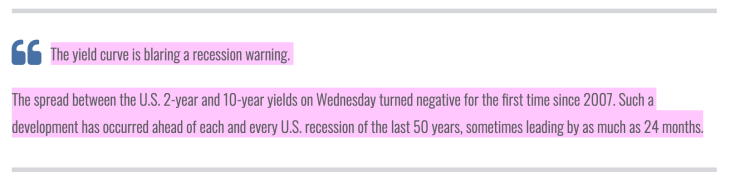
Yes, it is possible that the yield curve could be wrong this time, but I wouldn’t bet on it.
And the economic news that is coming in from all over the world just continues to confirm that conditions are deteriorating. On Thursday, we learned that U.S. manufacturing has slumped back into contraction territory, and earlier this week we got some really troubling news from Germany and China…
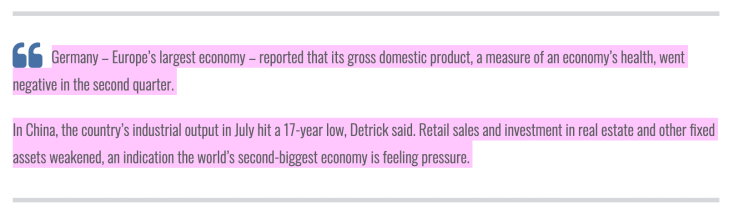
So it isn’t as if the mainstream media is being dishonest with us in this case. Global economic activity is most definitely slowing down, and many believe that things will get much worse during the second half of this year.
And a global economic slowdown would be terrible news for the Trump campaign, because their entire narrative depends on President Trump making the economy great again. A substantial percentage of American voters are convinced that since he is a billionaire, Trump must really understand the economy very well. And according to a CNN poll from earlier this year, the performance of the economy is one of the main reasons for his current level of support…
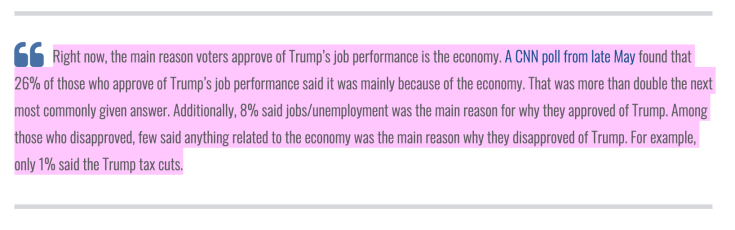
But if the U.S. economy plunges into a painful recession, the game completely changes.
For those on the left that would like to see Trump voted out in 2020, the timing of the next recession will be key. If the next recession doesn’t begin until the second half of 2020, there may not be enough economic pain before November to swing the election in the favor of the Democratic candidate. So what the left really needs is for a recession to begin during the second half of 2019 or the first half of 2020 so that Americans are really suffering by the time election day rolls around.
I know that is a very sick way to think, but these are the sorts of conversations that these people actually have. For example, on his own television show Bill Maher publicly stated that a recession would be “worth it” if Trump is voted out in 2020. As we approach the next election, many on the left will be so desperate to see Trump gone that they will be willing to pay just about any price to see that happen.
And to be honest, the U.S. economy is definitely way overdue for a major downturn, and so it is only prudent to get prepared for rough times ahead. At this point, even USA Today is providing us with “recession survival tips”…
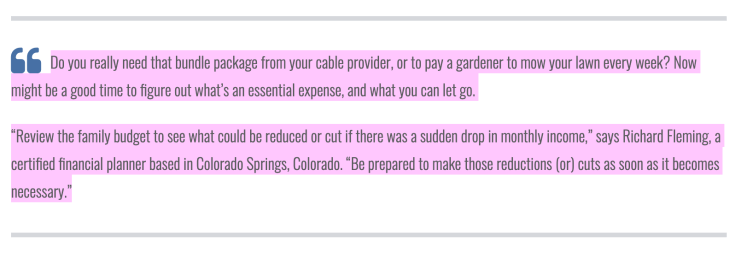
That is actually really good advice.
Now is a time to cut costs, get out of debt and build up your emergency fund.
The coming year promises to be quite chaotic, and those that hate President Trump are likely to pull out all the stops in an all-out attempt to get him voted out in 2020.
Senate Probes Biden-Linked, Chinese Military-Boosting Tech Sale Grassley Compares to Uranium One

By Haris Alic
The Senate Finance Committee is probing the Obama administration’s 2015 decision to approve the sale of a U.S. company with insight into “military applications” to the Chinese government and an investment firm run by former Vice President Joe Biden’s youngest son, Hunter Biden.
Sen. Chuck Grassley (R-IA), the committee’s chairman, sent a letter to the Treasury Secretary Steve Mnuchin on Thursday requesting documents relating to the sale of Henniges, a Michigan-based automotive company, to Aviation Industry Corporation of China (AVIC) and Bohai Harvest RST (BHR). The latter was formed in 2013 by a merger between a subsidiary of the Bank of China and Rosemont Seneca, a firm started by Hunter Biden and Chris Heinz, the stepson of former Secretary of State John Kerry.
Since AVIC was a subsidiary of the Chinese government and Henniges, the producer of “dual-use” anti-vibration technology with military application, the deal required approval from the Obama administration’s Committee on Foreign Investment in the United States (CFIUS). The panel — made up of representatives from 16 different federal bodies, including the departments of State, Treasury, and Defense — is required to review any transaction that could lead to a foreign person gaining control of an American business.
In question is whether CIFUS was influenced by Obama administration officials, most notedly Joe Biden and John Kerry, who had an interest in seeing the deal move forward.
“The direct involvement of Mr. Hunter Biden and Mr. Heinz in the acquisition of Henniges by the Chinese government creates a potential conflict of interest,” Grassley wrote.
The senator noted in his letter that AVIC’s bid for Henniges should have immediately set off alarm bells in the Obama White House. In 2007, AVIC “reportedly involved in stealing sensitive data regarding the Joint Strike Fighter program,” which it later “reportedly incorporated … into China’s J-20 and J‑31 aircraft.”
Even more troubling, however, is that bid was facilitated at the same time China was staking out a more adversarial role in global affairs. At the time, Beijing was suspected of undermining U.S. cybersecurity by underwriting hackers stealing governmental data. There was also simmering tension over disputes in the South China Sea.
Despite the threat to national security, the $600 million deal was approved by CIFUS, with AVIC purchasing 51 percent of the company and BHR taking ownership of the other 49 percent. Upon purchase, an industry newsletter stated the deal was the “biggest Chinese investment into US automotive manufacturing assets to date.”
In his letter to Mnuchin, Grassley compared the deal to the Uranium One scandal, which arose when former Secretary of State Hillary Clinton approved the sale of a Canadian mining company to Rosatom, the state-owned Russian nuclear energy conglomerate. It later emerged that both investors in the company and Russian energy officials had donated heavily to the Clinton Foundation.
“As with the Uranium One transaction, there is cause for concern that potential conflicts of interest could have influenced CFIUS’ approval of the Henniges transaction,” Grassley wrote. “Accordingly, Congress and the public must fully understand the decision-making process that led to the Henniges approval and the extent to which CFIUS fully considered the transaction’s national security risks.”
This is not the first time that Hunter Biden’s ties to China have caused grief for his father’s political career. As Peter Schweizer, a senior contributor at Breitbart News, revealed in his bestselling book Secret Empires: How the American Political Class Hides Corruption and Enriches Family and Friends, Hunter Biden signed the $1.5 billion deal creating BHR in 2013 only ten days after visiting China aboard Air Force Two with his father.
Violent Chaos Breaks Out In Hong Kong: Police Stations Set On Fire, Triads Beat Protesters, City Paralyzed
By Tyler Durden
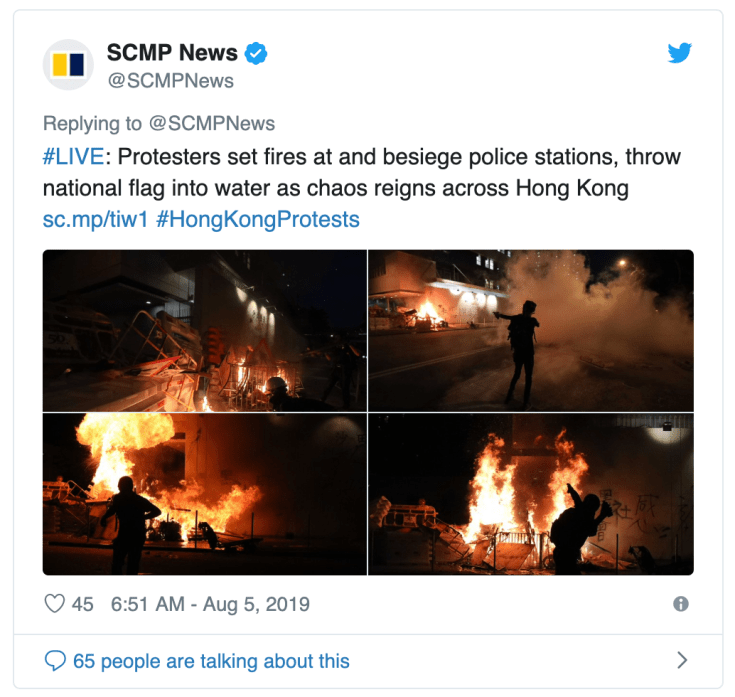
The situation in Hong Kong is rapidly deteriorating, with violence breaking out in seven locations Monday afternoon as the citywide strike crippled transportation.
What were supposed to be peaceful sit-ins in different districts turned into riots, “with Wong Tai Sin and Harcourt Road seeing the most intense confrontations as protesters kneel instead of flee, to shield themselves while tear gas rounds and sponge grenades rain on them,” according to SCMP.
Protesters threw a suspected gasoline bomb at police after first being attacked by bricks.
Riot police used crowd control measures in at least five locations – targeting those filing the streets. 82 people were arrested for offences including rioting, unlawful assembly, assaulting a police officer, obstructing police and possession of offensive weapons.
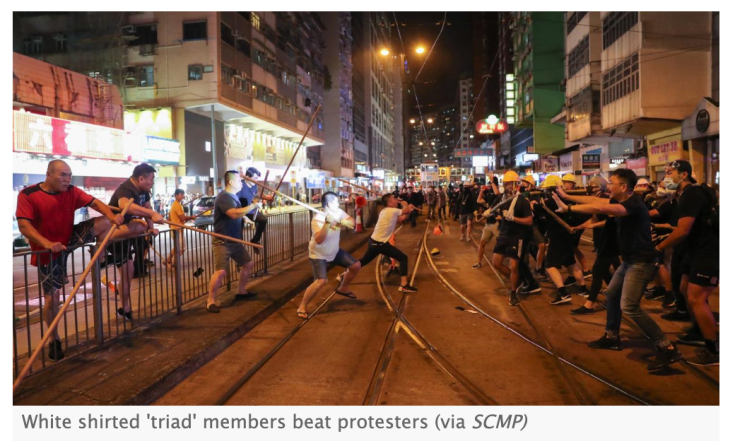
Fighting broke out between protesters and local residents, while reports of ‘white shirted’ men believed to be triad gang members began beating protesters as the evening devolved.

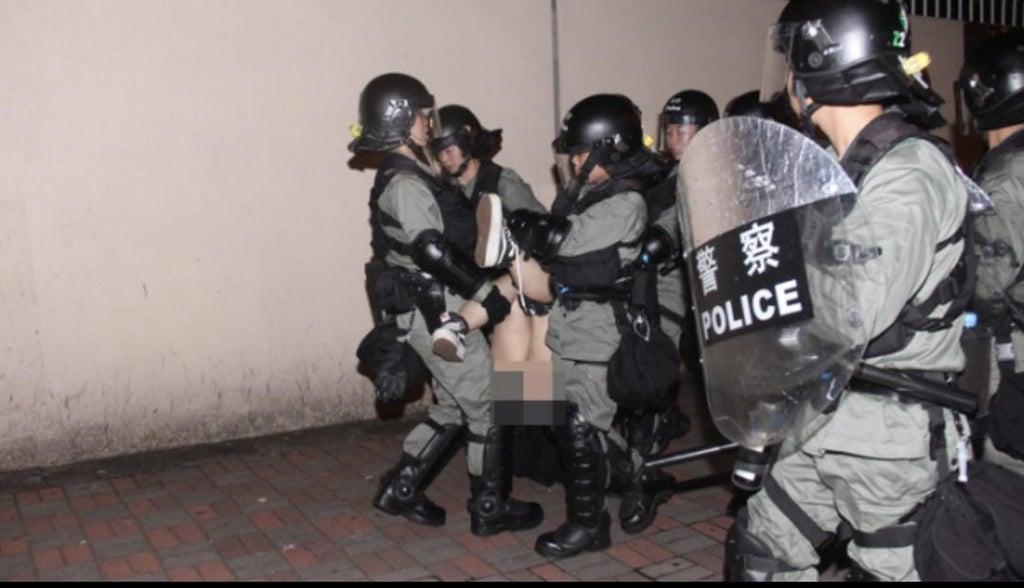
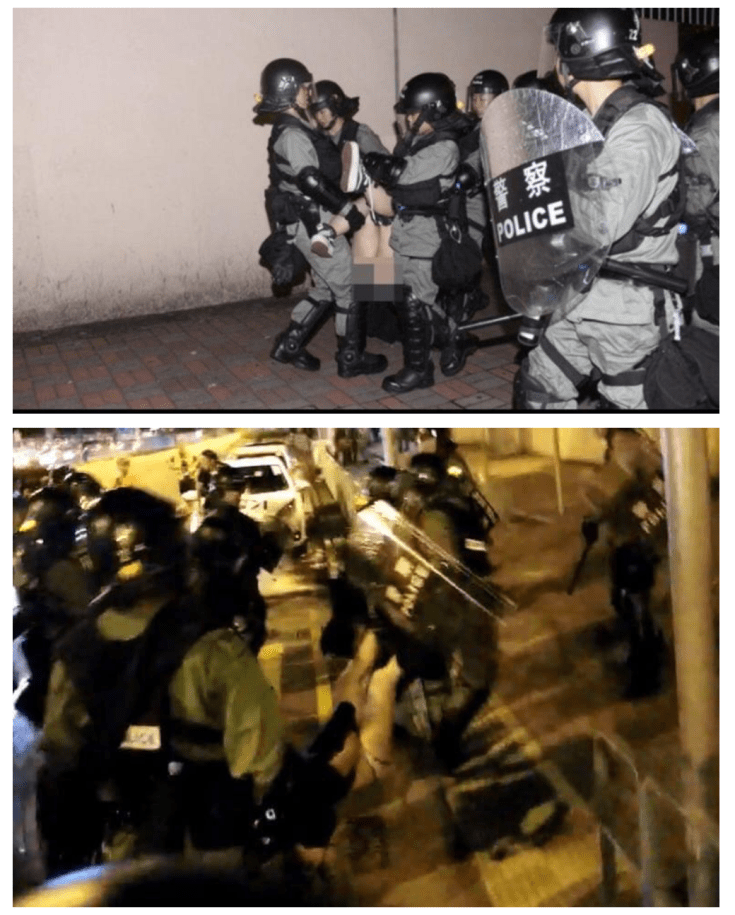
One woman was paraded through the streets after her underwear had been either removed or fallen off during her arrest.
In response to the unrest, Cathay Pacific airlines canceled over 150 flights and urged passengers to postpone non-essential travel according to CNN.
Cathay Pacific urged customers not to fly Monday and Tuesday, and said it would waive fees for rebooking. Shares in Cathay plunged more than 4% during trading Monday.
The airline is the city’s flagship carrier. It flies about 34 million passengers every year and serves nearly 200 cities around the world from its hub at Hong Kong’s international airport.
Hong Kong Airlines, a smaller carrier, said it has canceled 32 flights. United Airlines said its flights were unaffected.
More than 2,300 aviation workers took part in the strike, including 1,200 Cathay cabin crew and pilots, according to the Hong Kong Confederation of Trade Unions.
Service was suspended for more than an hour Monday morning on the Airport Express, which is a line that zips people between the airport and the city center in under 25 minutes. –CNN
Meanwhile:

‘This Is War’: ‘Borat’ Director Encourages Left to Arm Selves Against ‘Maga People’
By Hannah Bleau
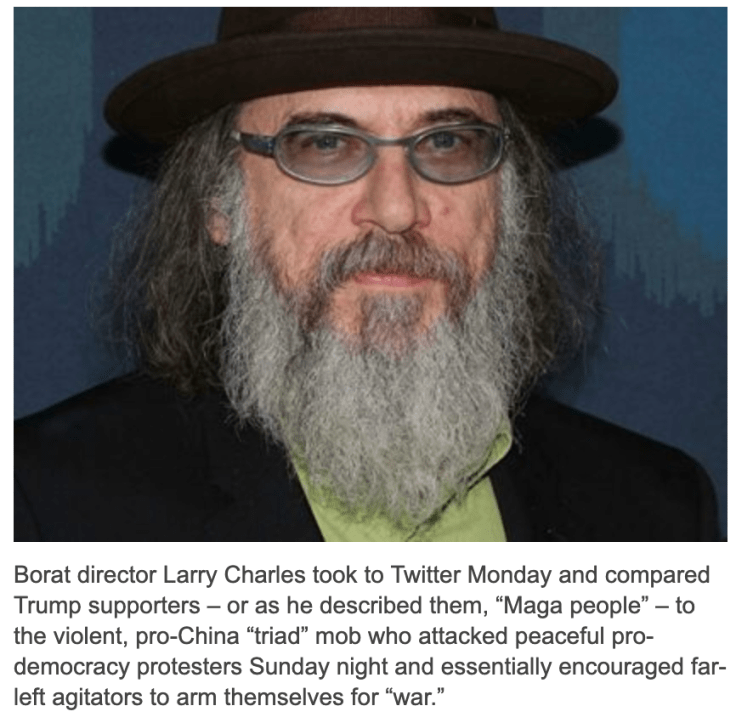
Borat director Larry Charles took to Twitter Monday and compared Trump supporters — or as he described them, “Maga people” — to the violent, pro-China “triad” mob who attackedpeaceful pro-democracy protesters Sunday night and essentially encouraged far-left agitators to arm themselves for “war.”
“After reading about armed #Triad thugs attacking pro-democracy protestors In #HongKong and the white supremacists/Proud Boys/Maga people embracing violence here I’m glad to see the left arming itself. This is war,” the longtime Curb Your Enthusiasm producer declared.
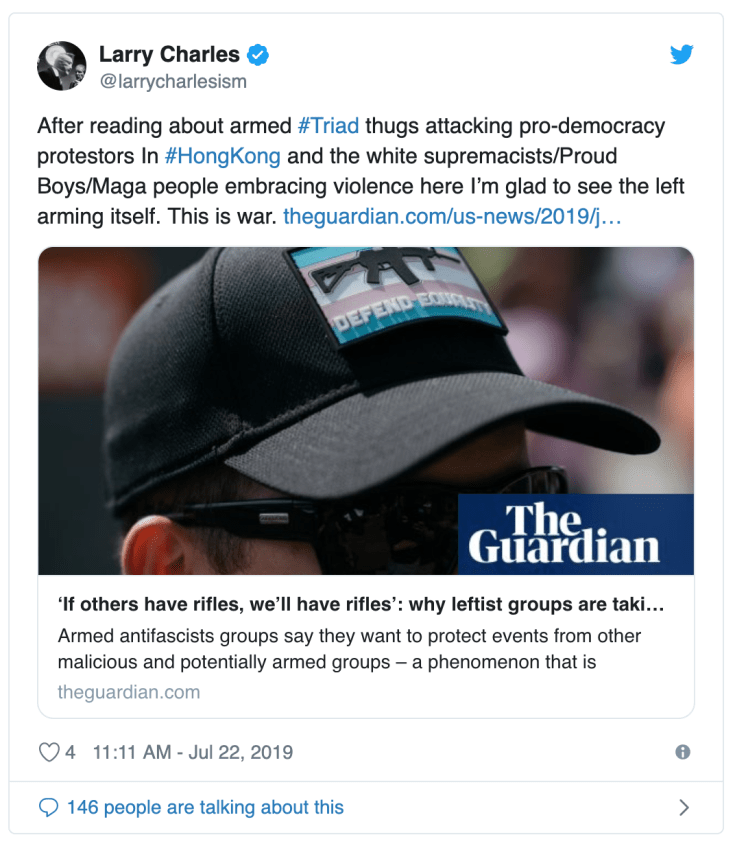
Charles, a prolific producer, writer, and director, linked to a Guardian article that detailed the desires of left-wing groups, like Antifa, to take up arms in order to protect events from “other malicious and potentially armed groups.”
The far-left has largely refused to condemn the violent actions of its extremist groups like Antifa. “Squad” member Rep. Alexandria Ocasio-Cortez (D-NY) failed to condemn the self-described Antifa member who attempted to firebomb a federal detention facility in Tacoma, Washington, earlier this month.
Fellow member, Rep. Ilhan Omar (D-MN) also refused.
The Seattle Antifascist Action took it a step further and actively praised the attacker, calling him a “martyr” in a Facebook post last week.
It read:
When our good friend and comrade Willem Van Spronsen took a stand against the fascist detention center in Tacoma, he became a martyr who gave his life to the struggle against fascism. He was kind and deeply loved by many communities; we cannot let his death go unanswered. Throughout history we idolize figures like John Brown for their courage to take the ultimate stand against oppression, and today we stand strong in our support for yet another martyr in the struggle against fascism. May his death serve as a call to protest and direct action.

Last month, violent leftist protesters in Portland, Oregon, viciously attacked journalist and editor of Quilette, Andy Ngo. Ngo was hospitalized with a brain bleed. Pictures showed cuts and bruises to his face, as well as a torn earlobe.
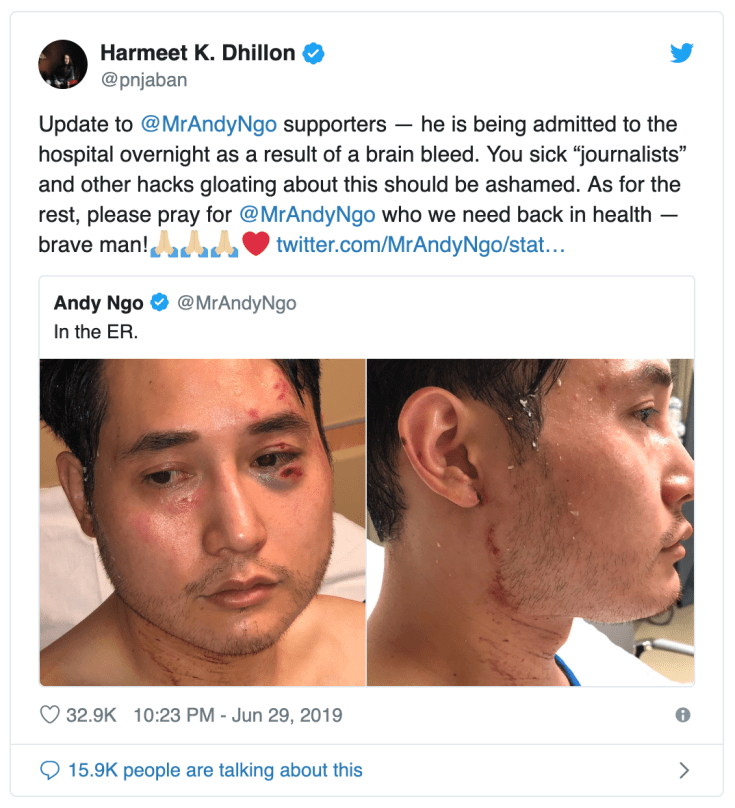
Only three arrests were made that night.
Hell freezes over? New York Times wants closer relationship with Russia, congratulates Trump
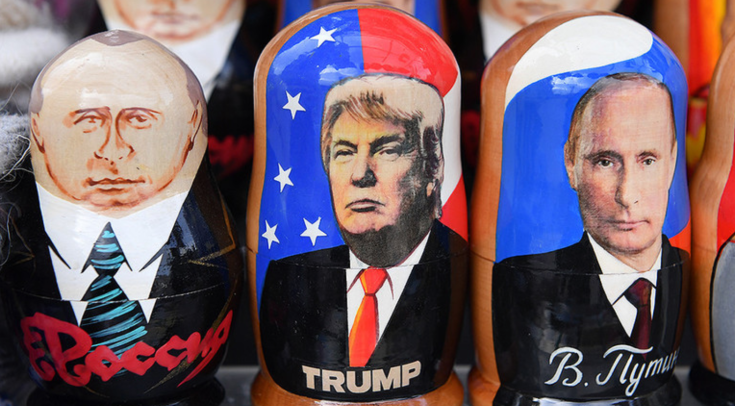
The New York Times’ editorial board, fresh from peddling anti-Russia conspiracies for two years, has made a remarkable about-turn. Now the paper wants closer relations with the Kremlin, all to thwart China’s ambitions.
‘Russiagate’ has maintained an iron grip on American political discourse for two years now, even after Special Counsel Robert Mueller’s report cleared President Donald Trump of conspiring with the Kremlin to steal the 2016 US election. In the media, the public has been treated to nightly conspiracy theories and bizarre connect-the-dots articles claiming to prove collusion; and lawmakers have crafted ever more draconian sanctions bills against Russia and have slotted opposition to Russia into their campaign messages.
Meanwhile, Moscow and Beijing have looked to each other, holding joint military exercises and upping their trade volume to more than $100 billion in 2018. Russian Prime Minister Dmitry Medvedev recently announced plans to build a new, 2,000km-long highway linking Europe and China, while President Vladimir Putin has been mulling connecting Russia’s Northern Sea Route with China’s Maritime Silk Road, an ambitious global trade route linking China with ports in Southeast Asia, Africa, Europe, and the Middle East.
The idea of closer Moscow/Beijing cooperation clearly worries the New York Times’ editorial board. In an op-edpublished on Sunday, the board wrote that “President Trump is correct to try to establish a sounder relationship with Russia and peel it away from China” – itself a remarkable compliment from a paper that ran op-eds titled “Donald Trump Hates America,” and “Trump is Racist to the Bone” in the last five days.
The board then suggested that the US could strengthen its cooperation with Russia in space exploration and Arctic cleanup – areas untainted by ‘Russiagate’. In addition, new arms control treaties could be a step towards geopolitical cooperation between the two rival superpowers.
All valid and worthy points, but from the New York Times? Yes, we’re talking about the same newspaper that last year called Trump a “treasonous traitor” ahead of his meeting with Putin in Helsinki. Instead of seeking rapprochement then, the paper argued that Trump should “be directing all resources at his disposal to punish Russia.”
We’re talking about the same New York Times that dubbed Trump “Putin’s Lackey” and released a mocking videodetailing a ‘love story’ between Trump and Putin, laden with homoerotic overtones and culminating in a tongue-locking kiss between the two leaders. It’s funny because they’re gay, see?
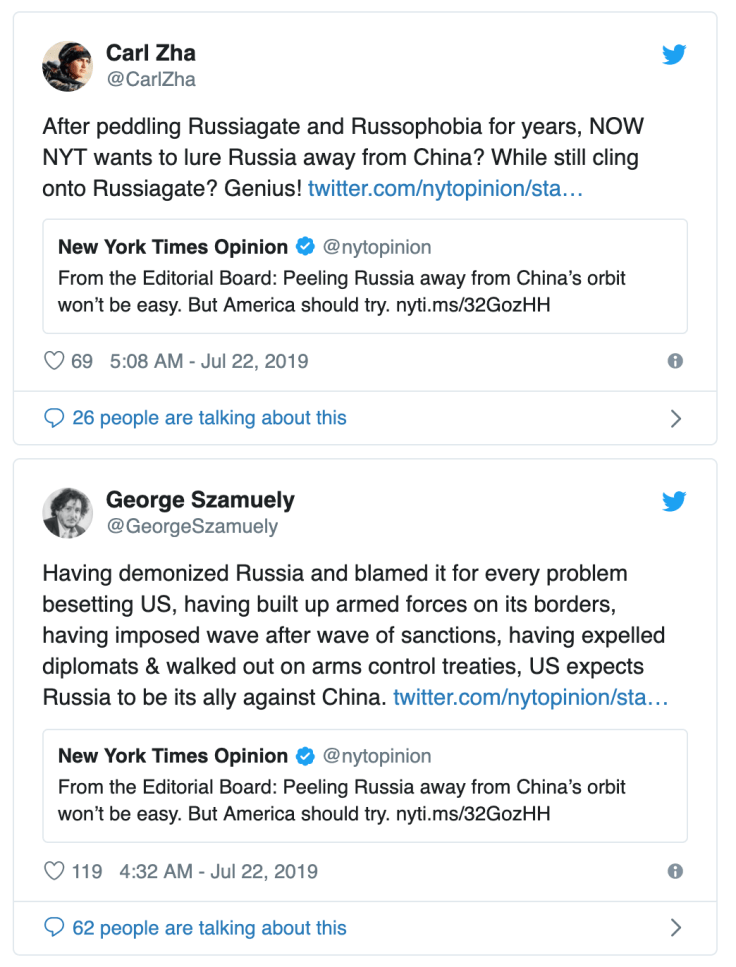
The piece surprised many, like pundit George Szamuely, who wrote that Washington has “demonized Russia and blamed it for every problem besetting [the] US,” while the Times “has for years berated Trump for advocating this perfectly sensible policy, at times suggesting that he was doing so only because he was Putin’s agent and a traitor to the United States.”
Bear in mind that the Times’ editorial board does not hold the same opinions as its revolving cast of op-ed writers. Still, for a newspaper whose writers almost unanimously despise the US president, Sunday’s op-ed represents a shocking repudiation of two years of anti-Russia, anti-Trump static.
Perhaps the outlet that often voiced the ideas of the American establishment has finally realized that the ‘Russiagate’ horse is too long dead for another flogging? Or maybe the Times saw it’s time for a new kind of politics: the politics of Detente. Either way, the change is a surprising one.
Soros and Koch funding new ‘anti-war’ think tank— and we should probably be a little bit suspicious
By Danielle Ryan
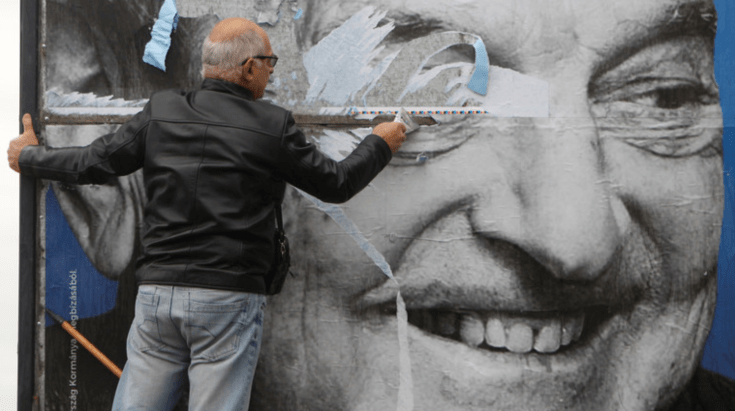
There’s a new “anti-war” think tank coming to town. It will promote a new US foreign policy — one based on diplomacy instead of sanctions and war. Sounds great, until you hear it’s being funded by Soros and Koch.
The ‘Quincy Institute for Responsible Statecraft’ will oppose Washington’s “endless wars” and will “challenge the basis of American foreign policy in a way that has not been done in at least the last quarter-century,” according to co-founder Trita Parsi.
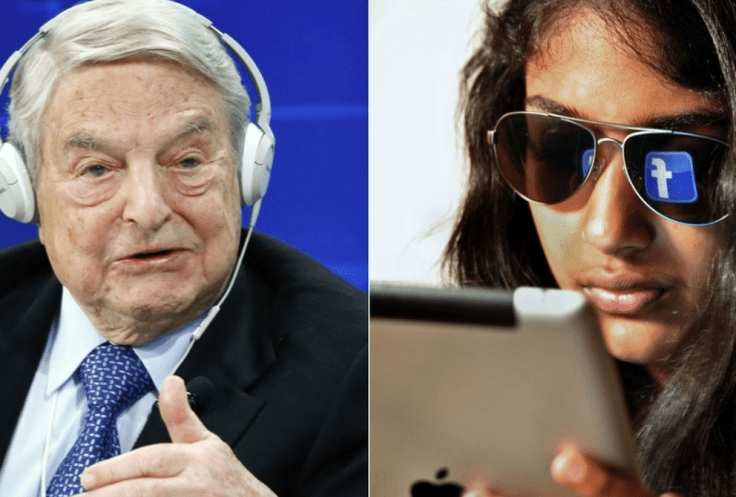
With financier George Soros coming from the left (though he’s hardly a real leftist) and industrialist Charles Koch coming from the right, everyone is supposed to applaud the bipartisan nature of the initiative. The Boston Globe called it “one of the most remarkable partnerships in modern American political history” as though the two billionaire businessmen come from alternate universes.
The Globe notes that promoting an anti-war message is “radical notion,” given that nearly every major think tank in Washington currently promotes “some variant of neocon militarism or liberal interventionism.”
To give credit where it’s due, this really is a radical notion — and the more the anti-war narrative begins to trickle into the mainstream, the better. If the Quincy Institute does what it says on the tin, most genuine anti-war activists and readers won’t quibble too much about where the think tank got its start-up cash. Soros and Koch have thrown $500,000 each into the pot.
Who checks the fact-checkers? Facebook leaves verification to groups funded by Soros, US Congress
Named after John Quincy Adams, who declared in 1821 that the US “goes not abroad in search of monsters to destroy” but is the “well-wisher to the freedom and independence of all” and the “champion and vindicator only of her own,” the think tank will offer a platform to both progressive voices and anti-interventionist conservatives.
The Globe writes that this will mean its writers will “likely” advocate for things like pulling US troops out of Afghanistan and Syria, putting an end to regime change wars and “less confrontational” policies toward China and Russia.
The problem here is not the concept. It’s just a question of whether or not the venture can actually be taken seriously when Soros and Koch’s fingerprints are already all over the world’s current endless wars, conflicts and regime changes.
Take some well-known Soros-funded think tanks; the Center for American Progress and the Atlantic Council, for example. They haven’t exactly been the biggest peace-pushers in the think tank world. The AC also received funding from a slew of arms manufacturers, so you’d be hard-pressed to find any anti-war sentiment there. Soros has also been linked to the “pro-democracy” European group Avaaz, which has advocated for no-fly zones in Libya and agitated for regime change in Venezuela and Iran.
In 2017, the Soros-funded ‘European Values’ think tank smeared 2,327 people as “useful idiots” for Russia for merely appearing on RT, in a McCarthyist-style attack on anyone deemed not to be sufficiently compliant with prevailing Western narratives.
Koch too has been linked to havoc-wreaking policies everywhere from Iraq to Venezuela. Despite supposedly opposing the Iraq war, independent journalist Caitlin Johnstone notes that Koch has been a major donor to the neoconservative American Enterprise Institute, whose members are considered leading architects of the invasion.
The Quincy Institute is slated to launch in September and until it gets off the ground, it will be impossible to declare a final judgement on its work — but given that organizations funded by Soros and Koch have spouted war-promoting propaganda to serve the US imperialist agenda for years, it’s a little difficult to see this sudden change of heart as entirely genuine.
 Tom's Blog