Hungary will not soften laws to allow Soros college to stay in the country

See the source image

By 

Hungary will not relax rules for international universities despite pressure from the EU and offers from Germany to mediate in a row over a college founded by US billionaire George Soros, a government spokesman said.

*
Prime Minister Viktor Orbán, a nationalist who has often clashed with the European Union, has been accused of restricting academic freedom with his new higher education rules, which the Central European University said forced it out of the country.
*
“There is no change in our core view”, government spokesman Zoltan Kovacs told Reuters.
*
“We will not change the laws and regulations that govern higher education in Hungary. We still operate on that basis.”
*
Central European University, set up by Soros, will move part of its operations to Austria from September because of rules forbidding it to issue US degrees.
See the source image
The dispute, often seen as a proxy for disagreements between Soros and Orbán on migration, is one of the main issues that caused the European Peoples’ Party to suspend Orbán’s Fidesz before European Parliament elections.
*
At the initiative of Manfred Weber, the EPP’s lead candidate to head the EU executive after the May elections, the government of the German state of Bavaria and the Technical University of Munich stepped in to help.
*
Offering three new professorships and new courses to augment CEU’s teaching, they said they would open a way for CEU to issue international degrees.
*
A Hungarian government official told an opposition member of the Budapest parliament that Hungary considered Bavarian participation in the Hungarian higher education sector “a step that builds trust”.
*
And Balazs Orbán, a state secretary on the prime minister’s staff, said the government was “ready to examine the possibility for issuing diplomas recognized in the United States and Germany as well as in Hungary”.
*
However, he reiterated that all universities had to comply with Hungarian law, and Zoltan Kovacs also made it clear that Bavarian participation, while welcome, would lead to no legal amendments.

HUNGARY OFFICIAL: “SOROS PULLS THE STRINGS IN BRUSSELS”

Hungary Official: "Soros Pulls the Strings in Brussels"

MEP demands an explanation

Hungary Journal – JANUARY 14, 2019

Fidesz believes George Soros’s people “are pulling the strings of the European Commission’s leading politicians” and demands an explanation, Fidesz MEP Tamas Deutsch said at a press conference on an unrelated topic in Budapest on Saturday.

Deutsch noted that daily Magyar Idok learned that U.S. billionaire Soros had met for talks with the EU leaders on at least 20 occasions. Soros held talks with Jean-Claude Juncker, Frans Timmermans, Emmanuel Macron and Dimitris Avramopoulos, he added.

A poster slamming George Soros in Szekesfehervar, Hungary (Photo by Attila Kisbenedek / Contributor via Getty Images)

Deutsch said it was “absurd” that a person claiming to be a philanthropist who represents the official viewpoint of not a single country can meet with EU leaders more frequently than the prime minister or head of state of any EU member state.

Fidesz will ask for explanations, in writing, on the subject matter of all of these meetings, he added.

Hungary can be proud that it was the first country to prove that migration can be stopped – PM

By   

Prime Minister Viktor Orban 

Addressing an international press conference on Thursday, Prime Minister Viktor Orban said Hungary’s goal is to have “anti-immigration forces” in the majority in every European Union institution.

Hungary wants to see an anti-immigration majority first in the European Parliament, then the European Commission and eventually, through member states’ national elections, in the European Council as well, Orban said.

The prime minister said May’s European parliamentary elections would be historic because Europeans would finally get to have their say on the issue of migration. Hungary so far has been the only member state where the people have been given the chance to express their views on migration, he said. Orban added that his Fidesz party’s aim for the elections was “to be the most successful party” in Europe and in the European People’s Party.

Migration is not simply an issue that will be in the focus of the European parliamentary elections but one that is profoundly transforming European policies, Orban said. The traditional division of parties into left wing and right wing is being replaced by a new division based on either being pro-migration or anti-migration, he said.

The migration debate also has bearing on attitudes to Christianity, making the protection of Christian culture a political duty, Orban said. It also has a bearing on the debate about sovereignty because migration advocates disrespect the decisions of those against taking in migrants, he added.

The prime minister said that migration would be Europe’s defining issue in next 15-20 years, arguing that the population growth rates of Africa and Asia were higher than their population retention rates.

Hungary can be proud that it was the first country to prove that migration can be stopped on land, and for a long time not even countries with maritime borders attempted to achieve such a feat, the prime minister said. Italian Interior Minister Matteo Salvini was the first to say that this could be done, Orban said, adding that this had made Salvini a “hero” in his eyes.

The prime minister said the Polish-Italian axis was “one of the best things to happen” and great hope was set in store for this development.

Orban noted that Fidesz is a member of the EPP and added that “loyalty in Hungary is a political value”. “As long as we are [in the EPP]— hopefully for a long time — we will always be loyal to our party family”.

At the same time, he added, the issue of migration “does not recognise party borders” and requires the cooperation of governments. The prime minister said he was always ready to meet Salvini if the migration issue justified doing so and as long as Salvini was responsible for migration issues in Italy.

Migration has already brought about significant changes in terms of Europe’s future, Orban said. In some countries it is already clear that their civilisations will be mixed going forward, and it is only a question of how the people will coexist, he added.

Migration in western Europe is a question of coexistence, Orban said. But in central Europe the debate is centred on “how we can prevent a situation like the one that can already be seen in western Europe”, he added.

Orban said migration had driven western and central Europe far apart, adding that the question was how they can remain united “now that they’ve chosen such different futures”.

homogeneous European civilization is being replaced by two civilizations: one that builds its future on the coexistence of Islam and Christianity, and the central European model which continues to conceive Europe “as a Christian civilization”, Orban said.

He said the issue of migration was dismantling the EU’s structure and was also behind Brexit. All liberal democrats, he said, were pro-migration, he added.

EU politicians to join anti-Hungarian Government protests ‘to serve interests of George Soros’

By HUNGARY JOURNAL 8 January 2019

screen shot 2019-01-08 at 11.03.25 am

The left-wing RED movement – founded by Socialist MEP Istvan Ujhelyi – holds a protest on Tuesday in Brussels’ Schuman Square.

The Hungarian speakers – MEP Istvan Ujhelyi (MSZP/S&D), Barnabas Mester (RED), MEP Benedek Javor (Parbeszed/Greens-EFA), Balazs Nemeth (Momentum), Janos Kendernay (LMP) and MEP Csaba Molnar (DK/S&D) – will be joined by Dutch Green MEP Judith Sargentini, the rapporteur of the report about the rule of law in Hungary.

According to Fidesz MEP Tamas Deutsch, left-liberal opposition parties want to form a joint, pro-immigration list for the elections. He accused them of serving George Soros’s interests and questioned Sargentini’s objectivity and motivations.


Europe’s patriots on course to win European elections as globalist Macron has lost control

By 

Capture

The European Parliamentary elections are in May 2019. This year, more than previous MEP elections is likely to be profoundly consequential with a turnout that has not been previously seen.

According to the Financial Times, it will be a showdown between the beleaguered French President Emmanuel Macron and the man voted by his own people as the most trusted and popular politician in history, Italy’s Deputy Premier and Interior Minister Matteo Salvini. A battle between Globalists and Populists.

Mr. Salvini was already popular with Italian voters, but when he stood up to Brussels over his ‘Italian’s first’ budget, the people of Italy only grew to love him more. In fact, in recent polls the Italian people said they see him as the real leader of Italy, even over the Prime Minister.

The populist Minister Salvini has challenged the outgoing French President Emmanuel Macron’s pro-European agenda which interferes with individual countries’ sovereignty.

Many people in Italy now see Emmanuel Macron as the enemy of their country, as he embodies all that is imperialist about the EU.

Some of Macron’s advisors have warned against a political showdown with Salvini because his own popularity has bottomed out in his own country, weakening his position. As Salvini’s influence strengthens, Macron’s influence weakens.

As one of the Yellow Vest protesters summed up Macron’s ‘leadership’: “Our elites are talking about the end of world when we are talking about the end of the month.”

If the parties on the right can form a unified front potentially under Salvini, the elections could be the biggest overhaul of the EU since its founding.

The Financial Times states that “according to an aggregation of surveys by Pollofpolls.eu, Mr. Salvini’s League will surge from six per cent of the vote and five of Italy’s seats in the European Parliament in 2014, to 33 per cent and 29 seats.

France’s right is on course to win 21 per cent, pushing Mr Macron’s La République En Marche! centrist party into second place, and giving Ms Le Pen a chance of redemption EUROafter a disappointing presidential election campaign in 2017.

Viktor Orban’s right-wing Fidesz party is almost certain to confirm its dominance in Hungary. The Eurosceptic Alternative for Germany looks likely to double its tally of seven per cent and seven seats.

Poland’s conservative Law and Justice party is expected to win 41 per cent and 24 seats, up from 32 per cent and 19 seats.”

It is no wonder, given Mr. Macron’s tarnished image due to the Yellow Vests in his country, that Salvini is not expecting much of a challenge from the French President.

As he told Politico this month, “Macron is not a problem for me. He is a problem for the French people”.

We don’t want to mix Islam with our culture, it’s not good – Hungarian Prime Minister

By   

Capture

Hungarian Prime Minister Viktor Orban has criticised countries that “mix two cultures” and think it will “create something new and good”.

“There are countries that think that mixing two cultures, Christianity and Islam, creates something new and good. We see it differently.

“If the others want to mix their cultures, then they have a right to this attempt. But we do not want to start any trials in Hungary.

“We do not want to mix our Christianity-based culture, values, attitude to life with other cultures,” the Hungarian Prime Minister said.

With his eyes on the upcoming European election in May, Orban hopes voters “want to retain and protect their national identity, as well as their Christian customs” as they are being threatened by increased migration flows.

Earlier the Hungarian Prime Minister said about Islam:

“We caution all against harbouring the idea that Islam is part of any European country. It is good to know the answers about Islam. And we Hungarians know them. For example, if we say that Islam is part of Germany, ‘in Islam’ it means that Germany is part of Islam.”

Orban’s Fidesz party has increased it’s lead since the elections and is now supported by 54 per cent of voters.

Hungary Demands EU Explain ‘Prepaid Bank Cards For Migrants’ Scheme

See the source image

By Dan Lyman

Hungarian officials want an explanation from the European Commission regarding a scheme to provide prepaid bank cards to thousands of migrants currently pushing their way into Europe.

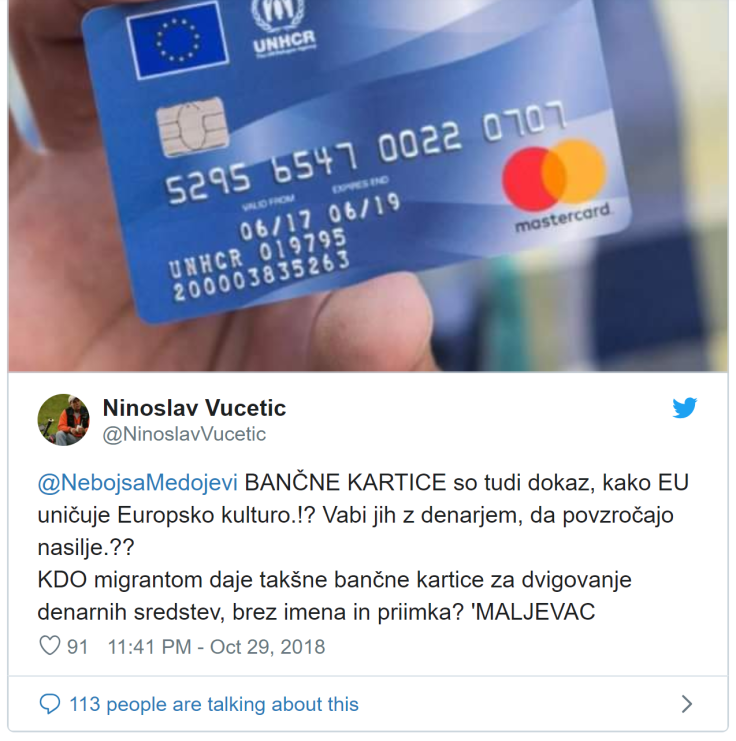
Infowars Europe was one of the first English-language media outlets to report revelations emerging from the Balkans, where shopkeepers and law enforcement officers claimed that migrants amassing in Bosnia were using nameless bank cards embossed with MasterCard, UNHCR, and EU logos.

See the source image

Those assertions were later reinforced by Austrian intelligence officials in statements provided to Kronen Zeitung last week.

The Hungarian goverment has apparently taken notice of these reports and is now demanding answers, contending that the program may be facilitating funding for terrorism.

“The ruling Fidesz and Christian Democrat parties have called on the European Commission to explain the reasoning behind prepaid debit cards issued to migrants,” the ruling coalition announced via state media outlet About Hungary.

“Earlier this week, Lajos Kósa, head of parliament’s defence and law enforcement committee, cited recent reports surrounding tens of thousands of prepaid debit cards made available to migrants by the European Commission and the United Nations Refugee Agency UNHCR.”

Coalition spokesman István Hollik says, “the EC should explain the origins of the cards, the amounts deposited on them, and the reasons why the scheme was kept in secret.”

“The cards are said to be funded by moneys from the EU, the UN and US financier George Soros . . . raising the question whether member states have agreed to a scheme like that.”

In our original report, we detailed Soros’ likely ties to the scheme upon discovery of a 2017 MasterCard press release publicizing the launch of a partnership program with Soros called “Humanity Ventures,” which aimed to “catalyze and accelerate economic and social development for vulnerable communities around the world, especially refugees and migrants.”

George Soros announced that he is earmarking up to $500 million for private investments that will improve capacity to address the challenges that migrants, including refugees, and their host communities face around the world. Humanity Ventures would be part of that initiative,” Mastercard revealed in the release.

Capture
“Bank cards are also evidence of how the EU is destroying European culture?” tweeted Montenegran TV director Ninoslav Vucetic, including an image of the type of card aforementioned. “Inviting them with money to cause violence? Who gives migrants such a bank card in order to access cash, without the first and last names?”

Blog at WordPress.com.

Up ↑