5/13/2020
This bill is not about American citizens. When someone shows me and tells me how much they hate me I want nothing to do with them.
5/13/2020
Dubbed “Project Nightingale,” the secretive program brought together Google and healthcare giant Ascension in an effort to collect medical records on patients across 21 states, according to a report in the Wall Street Journal. The data sharing began last year, and has only accelerated in recent months.
At least 150 employees at Google’s Cloud division now have access to the bulk of the data, which amounts to information on tens of millions of patients, according to a source familiar with the records. The details shared include patient names and dates of birth, hospitalization records, lab results and doctor diagnoses, which together provide a complete medical history for many of the patients – all without their consent.

Google says it hopes to use the data to develop an application employing AI and machine learning to track patients and recommend treatments, and ultimately has its eye on creating a search engine that can aggregate disparate patient data in one place. While Google is carrying out its research totally free of charge, presumably for the greater good, the multi-billion dollar corporation is unlikely to miss its chance to monetize the service once health providers around the world are hooked up. Many found Google’s initiative disconcerting, even more so due to the guise of noble and altruistic intentions.
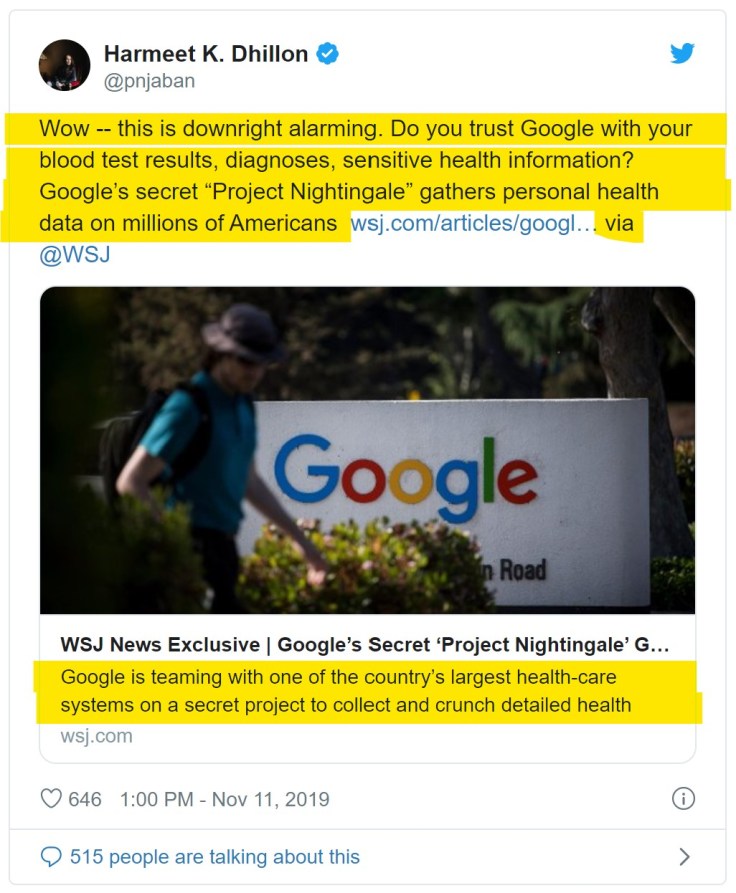
“Wow – this is downright alarming. Do you trust Google with your blood test results, diagnoses, sensitive health information?” asked attorney and Republican National Committee member Harmeet K. Dhillon in a tweet. “Google’s secret ‘Project Nightingale’ gathers personal health data on millions of Americans.”
The company launched Google Health in 2008, but shuttered it less than four years later after failing to persuade enough users to hand over their medical records willingly, perhaps uncomfortable with the firm having access to such sensitive information. The tech giant has since cut individual consent out of its quest to amass healthcare data, going over the heads of patients to make deals with health providers instead.
In September, the company allied with the Minnesota-based Mayo Clinic to provide cloud services and data analytics in a 10-year “strategic partnership,” which will give Google access to data on up to 1 million patients at the clinic each year.
In another mass data grab earlier this month, the company purchased the maker of the fitness tracking device Fitbit, gobbling up the data of some 28 million active users of the gadget. The data goes beyond simple fitness tracking, such as the number of steps one takes per day, as some users opt to link the device to additional medical or insurance records. While Google vowed to never hand out the Fitbit information to third parties, customers may still have reason to be skeptical about the integrity of their data.
Over the summer, Google and another partnered healthcare facility, the University of Chicago Medical Center, came under fire in a lawsuit alleging the hospital gave Google medical records on hundreds of thousands of patients without stripping them of identifying information. The case mirrored a similar mishap across the pond in 2017, in which the UK’s National Health Service passed the company data on 1.6 million patients in violation of privacy laws.
The secretive data sharing between Ascension and Google is absolutely legal under US federal law, both companies said, insisting that all necessary safeguards to protect patient privacy are in place – as if it ever stopped data leaks. The 1996 Health Insurance Portability and Accountability (HIPA) Act allows hospitals and other healthcare providers to pass data to business partners without informing patients so long as it “help[s] the covered entity carry out its health care functions.”
Ascension – a network of some 2,600 hospitals, doctors’ offices and other medical facilities – says it’s doing just that, seeking to use the data to improve care and identify additional tests patients might need. However, documents reviewed by the Journal also suggest the company, like Google, has its bottom line in mind, hoping to use the data-mining to generate more revenue as well.

By
Jackson Kernion is a graduate student at UC-Berkeley who teaches philosophy courses to undergrads. He made himself a target for criticism, some of which came from other left-leaning academics, when he came out with his surprisingly bigoted views against rural Americans.

Perhaps most shockingly, the elite-university philosophy academic went on to actually call for increased health care costs for rural Americans.
“Rural Healthcare Should be expensive! And that expense should be borne by those who choose rural America!”
It’s unclear what the young punk thinks that eroding rural healthcare programs is going to accomplish, but it’s more than likely that his desire to do so is more firmly rooted in prejudiced rancor than a real, coherent worldview.
Rural Americans are often left with a lack of decent health insurance options under the current American system. Some on the left, such as Bernie Sanders, have sought to offer policy solutions to this problem, but it appears that at least some coastal elitists such as Kernion actually don’t think rural Americans should even have healthcare.
Kernion ended up deleting his Twitter shortly after his tweetstorm, being widely rebuked for his prejudice. However, he did apologize shortly before for his remarks, admitting that his remarks came across as “crass and mean,” leaving open a chance that he could possibly learn and grow from the incident that revealed his starkly bigoted views. It does go without saying that an entire geographic demographic of Americans don’t even deserve healthcare is a bit more than “crass and mean,” though.
Ironically, many of the rural Americans who Kernion has voiced his dislike of would be quick to forgive the elite university student for his slighting of them. The men and women who he speaks of are instrumental in growing the food of urban America, and extracting the natural gas and oil used to power their cars, buses, trains and planes.

By Tyler Durden – 11/04/2019
Authored by Mike Shedlock via MishTalk,
The Wall Street Journal Editorial Board blasts Chicago Mayor Lori Lightfoot for her deal with the Chicago Teachers Union (CTU). The deal will further wreak havoc on the already insolvent school system.
Who will be hurt most?
The WSJ answers the question this way: Union Routs Students in Chicago.
The WSJ commented “Michelle Obama the other day complained that white people were leaving the city to escape minorities who are moving in. No, they’re fleeing Chicago’s high taxes and lousy schools—and so are minorities.”

You can kiss those positive and stable outlooks goodbye. The system is insolvent and this contract will further weaken the outlook.
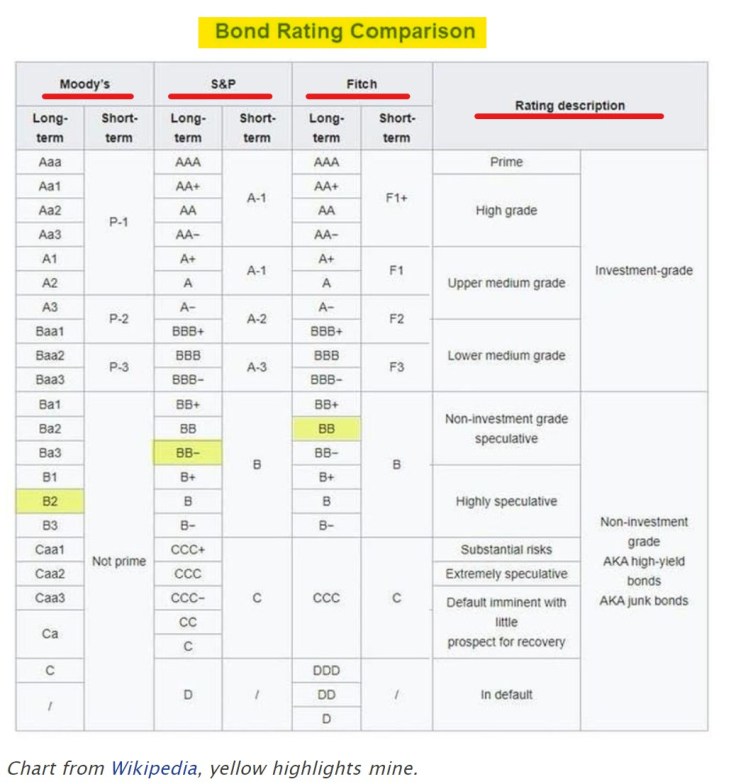
S&P already has CPS bonds in the “highly” speculative area, five steps into its junk ratings.
A Chicago Teacher’s Pension is based on your years of service and a pension percentage (up to 75%), multiplied by your final average salary. Their union notes “There are ways to increase these factors to enhance your pension or meet eligibility requirements.”
Wirepoints asks Chicago Teachers Strike: Why is No One Talking About Pensions?
The average retired CPS teacher already receives a pension of nearly $55,000 a year, according to a 2019 FOIA request to the Chicago Teachers’ Pension Fund.
However, looking at the pension of an average teacher far understates the true size of CPS pensions. The “average” benefit includes teachers who only worked a few years for CPS, which brings down the average.
To get a more accurate picture of what pensions are really worth, look at career teachers. Over half of all currently retired CPS teachers worked 30 years or more. On average, they receive a $72,000 annual pension and began drawing benefits at age 61.
In comparison, the average annual Social Security payment in Chicago is just $16,000 and the maximum benefit for someone retiring at age 62 is $26,500.

The average career CPS pension will grow by 3 percent, compounded annually, due to the COLA benefits teachers get. That will double a teacher’s annual benefit to over $140,000 in 25 years.
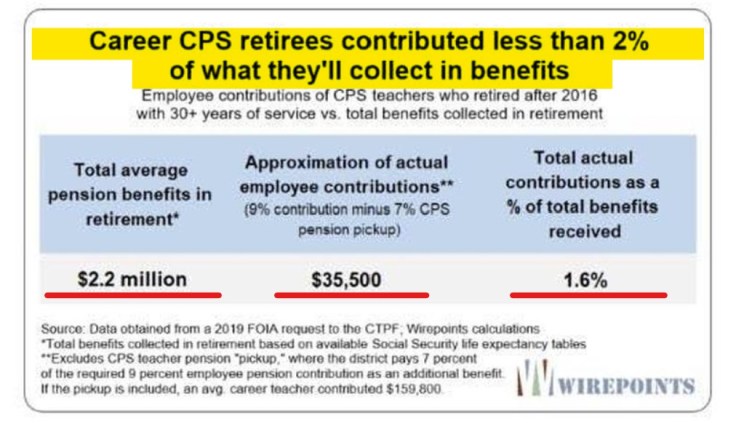
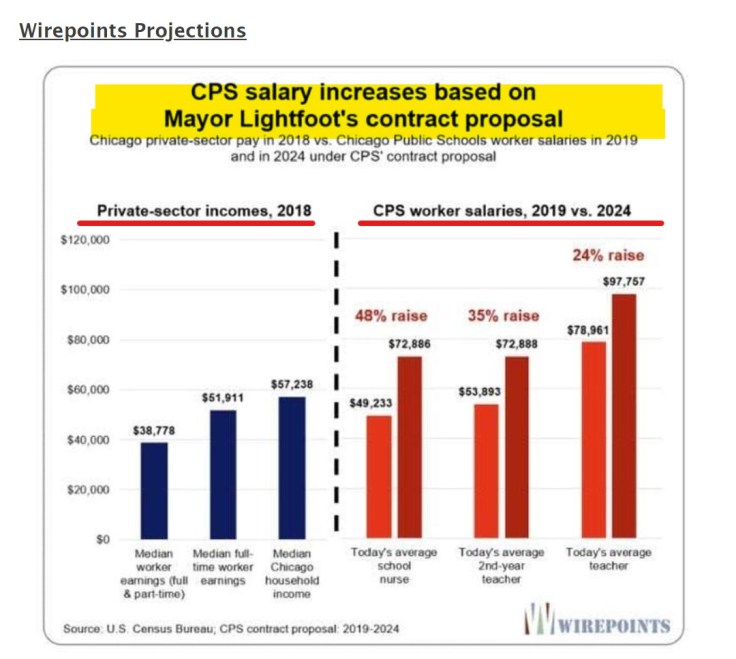
Those projections were based on the proposed contract. The CTU held out for even more benefits and got them.
The Chicago Tribune notes that the end of 2018, City Hall’s pension funds had only 23% of what they should have.
By 2023, Lightfoot must find an additional $989 million a year for pensions, according to the Tribune’s Hal Dardick and Juan Perez Jr. Thank you, former mayors and aldermen, for promising more pension benefits than Chicagoans could afford.
That one is easy.
On October 5, I commented Escape Illinois: Get The Hell Out Now, We Are
Goodbye Illinois. Hello Utah. See my reasons for Utah above.
If you can’t get out of Illinois, do the second best thing, Get the Hell Out of Chicago.
By the way, Chicago is not “headed” for insolvency, it’s already there, but it is just not recognized yet.

JANUARY 8, 2019
Zuckerberg San Francisco General reportedly billed a bike rider over $20,000 for a broken arm after her private insurance paid nearly $4000 to the hospital, an amount the insurer thought was reasonable for an arm splint.

“A spokesperson for the hospital confirmed that ZSFG does not accept any private health insurance, describing this as a normal billing practice,” according to a report by left-leaning Vox News. “He said the hospital’s focus is on serving those with public health coverage — even if that means offsetting those costs with high bills for the privately insured.”
On its web site, ZSFG declares that “everyone is welcome here” regardless of their financial situation or immigration status:
Everyone is welcome here, no matter your ability to pay, lack of insurance, or immigration status. We’re much more than a medical facility; we’re a health care community promoting good health for all San Franciscans.
We’re part of a large group of neighborhood clinics and healthcare providers, the San Francisco Health Network. In partnership, we provide primary care for all ages, specialty care, dentistry, emergency and trauma care, and acute care for the people of San Francisco.
Because the Zuckerberg hospital doesn’t participate in the negotiated-cost networks of private health insurers, privately-insured patients are charged tens of thousands more for services that are significantly less at other hospitals.
“Our mission is to serve people who are underserved because of their financial needs,” the spokesperson also stated. “We have to be attuned to that population.”
Unfortunately for the bike rider, she didn’t have much choice in what hospital to go to while riding semi-conscious in the back of an ambulance.
Mark Zuckerberg donated $75 million to the hospital in 2015.


 Tom's Blog