President Donald Trump announced Friday a plan to end the partial government shutdown, by temporarily caving to Democrat demands to reopen the government.
Trump agreed to reopen the government for three weeks while negotiations continued — with no apparent wall funding concessions from Democrats.
The president warned that if Congress could not successfully negotiate a deal including wall funding in three weeks, he would be forced to announce a State of Emergency, which would allow him to shift funds to build border structures without Congress.
“If we don’t get a fair deal from Congress, the government either shuts down on February 15th again or I will use the powers afforded to me under the laws and the Constitution of the United States to address this emergency,” he said.
He argued that he had heard from enough Democrats during the shutdown who were willing to support border security including physical barriers as part of the solution, allowing him to reopen the government temporarily.
“Many disagree, but I really feel that working with Democrats and Republicans, we can make a truly great and secure deal happen for everyone,” he said.
The president announced a bipartisan congressional committee to review border patrol requests for security and asked them to come up with a compromise deal.
“They will put together a homeland security package for me to shortly sign into law,”Trump said. He urged both parties to work together to solve the problems at the border. He defended the idea of a wall or a physical barrier as part of the negotiations.
“Walls should not be controversial,” Trump said.
The president delivered his remarks in the Rose Garden at the White House. Vice President Mike Pence together with several members of Trump’s cabinet attended the speech including Secretary of Homeland Security Kirstjen Nielsen and Secretary of State Mike Pompeo. Other White House staff including senior adviser Jared Kushner watched the speech. They clapped as Trump announced his decision.
Trump announced his decision as Federal workers face a second missed paycheck as the government shutdown enters its 35th day.
The president thanked federal workers who suffered financial difficulties as a result of the shutdown, vowing that they would receive back pay.
“You are very, very special people. I am so proud that you are citizens of our country,” he said. “When I say ‘Make America Great Again,’ it could never be done without you.”
Trump made his announcement after Congress reached an impasse on a bill to reopen the government. Both Senate measures failed to meet the necessary 60-vote threshold needed to move a bill forward. Speaker Nancy Pelosi refused to compromise with Trump on any wall funding, demanding unconditionally that the government be reopened first.
The White House finally caved to Democrats demands, despite Trump’s repeated assertions this week that he would not do so.
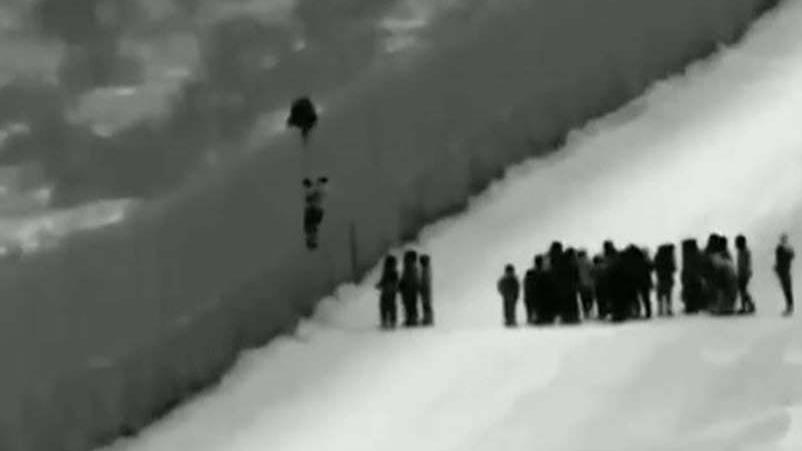
During the crossing, which happened near Yuma, Arizona, on Monday, the migrants climbed over a 18-foot, bollard-style border fence using a ladder you can see a smuggler running away with at the end of the video.
“It shows how brazen these smugglers are and the fact that they’re unafraid,”said Jose Garibay, the Border Patrol’s Yuma Sector spokesman. “They know that we’re not gonna go into Mexico to apprehend them.”
“So once he puts up that ladder, gets his commodity — in which he looks at these humans — in the United States, then he takes down his ladder, and as you saw in the video, just walks back to wherever he hid the ladder and continues on with his day.”
“It’s presumable that this individual has done it more than once,” he added.
Last week, Customs and Border Patrol also apprehended around 375 migrants who dug short, shallow holes under barriers that were not concrete reinforced at several spots east of San Luis, Ariz., which is near Yuma.
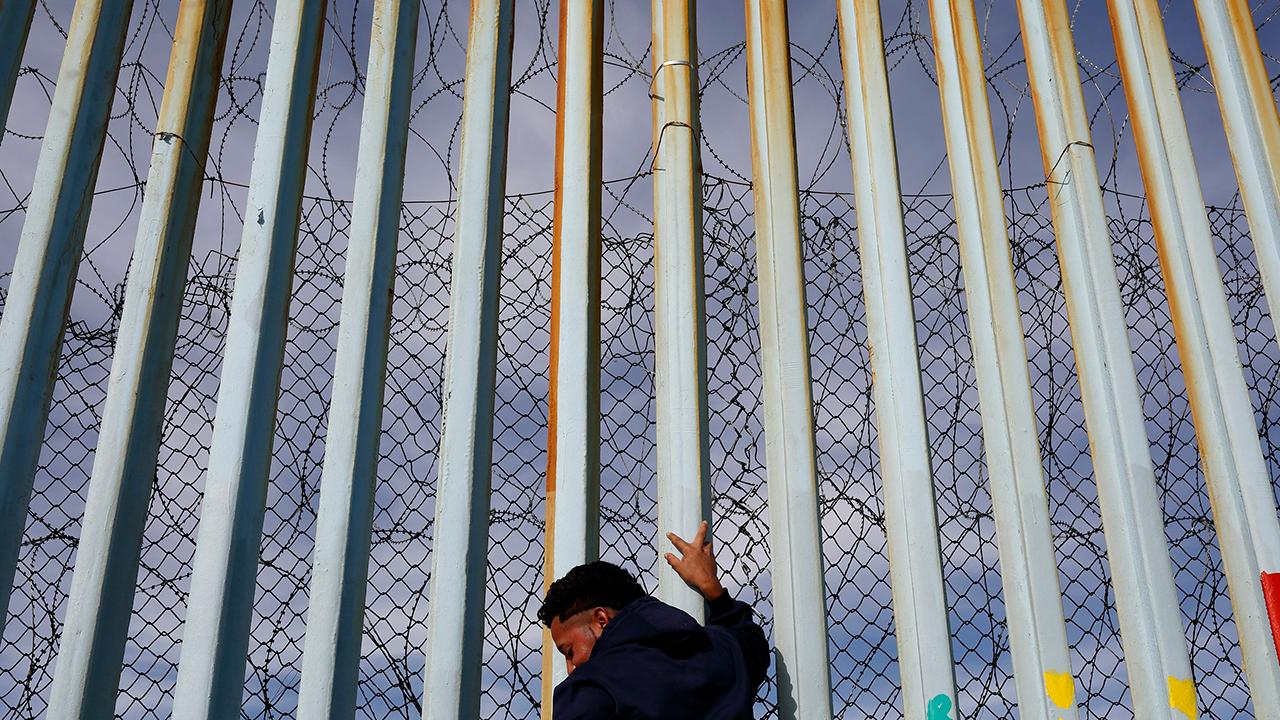
“The area became a major corridor for illegal crossings in the mid-2000s, prompting the federal government to weld steel plates to a barrier made of steel bollards that had been designed to stop people in vehicles, not on foot, Border Patrol spokesman Jose Garibay III said,” reported KTLA. “In those spots, there is no concrete footing to prevent digging.”
The Democrats are pushing the narrative that securing the border should not be a priority. Alex Jones has a message for the president about using his authority to do the right thing.
A fascinating report from News Australia published Jan. 20 reveals a startling fact about some of Mexico’s most notorious drug cartels: they rip out the hearts of their murder victims and eat them.
“But some barbaric factions of the gangs are believed to have even turned cannibal and actually eaten parts of their rivals,”the report said. “And in a particularly twisted initiation ritual, young members of the Jalisco New Generation cartel were forced to eat the hearts of murder victims. Local prosecutors claimed two teenagers, aged 16 and 17, remained unrepentant after they were drugged with crack then forced to eat human flesh by senior cartel bosses.”
Even with hundreds of stories about illegal aliens brutally killing Americans, (here) raping children, (here and here) and selling drugs en masse, (here) some Americans still support open borders.
Is a culture that cannibalizes its murder victims a bridge too far? Likely not for the Democrats, who will oppose President Donald J. Trump and his border wall at all costs.
“A similar event took place in 2015 when hopefuls of La Familia Michoacana were forced to eat their rivals after torturing them and cutting them up while alive,” the report continued.
The report continued:EL BLOG DEL NARCO,LO
Los Zetas cocaine kingpin Heriberto Lazcano, who was killed in a shootout with Mexican Marines in 2012, was notorious for feeding victims to the lions and tigers he kept on his ranch.
But it was his practice of eating human flesh that thrust him into international headlines two years ago.
A reporter who spent time with him told El Blog del Narco, “After sentencing him (the victim) to death, he orders him to bathe, and even to shave his whole body and let him de-stress for two or three hours, even better sometimes he gave them a bottle of whisky to relax, then he ordered a very quick death so there is no adrenaline in the meat to prevent it getting bitter or hard.”
He would then devour the man’s buttock flesh in tamales after it had been cooked in lemon and served on toast.
The Senate on Thursday rejected both the Democratic and GOP proposals to end theongoing partial federal government shutdown, with both measures falling far short of the 60-vote threshold needed to pass.
Although each of the dueling measures was expected to fail even before Thursday, it was hoped twin defeats might spur the two sides into a more serious effort to strike a compromise. Almost every proposal needs 60 votes to advance in the Senate, which is under 53-47 Republican control.
The final vote on the GOP bill was 50-47. West Virginia Democrat Joe Manchin was the lone Democrat to cross over and support the GOP package, which would have provided $5.7 billion for President Trump’s proposed border wall while also offering several immigration-related concessions and tightening asylum rules. GOP Sens. Tom Cotton and Mike Lee voted against the Republican measure.
“If this had been a vote to begin debate on a deal to end the shutdown, I would have happily voted yes,”Lee told Fox News. “But this was a vote to end debate on a bill that I believe is fundamentally flawed. In fact, after specifically asking for assurances that we would be allowed to offer amendments, no assurances were given. This bill as is simply does not do enough to reform our immigration system or address the crisis at our southern border.”
The Democrats’ plan would have reopened agency doors through Feb. 8 while bargainers seek a budget accord, but included no wall funding. The vote was 52-44 on the Democratic bill, with all Democrats voting yes and several Republicans crossing over, including Utah Sen. Mitt Romney, Maine Sen. Susan Collins, Alaska Sen. Lisa Murkowski, Colorado Sen. Cory Gardner, Georgia Sen. Johnny Isakson, and Tennessee Sen. Lamar Alexander. Not voting on the bill were Sens. Richard Burr, Rand Paul, James Risch, and Jacky Rosen.
Both the GOP and Democratic measures would have reopened federal agencies and pay 800,000 federal workers who are about to miss yet another paycheck amid the shutdown, now in its 34th day.
In the wake of the failed votes, a bipartisan colloquy was underway on the Senate floor between senators trying to forge a bipartisan solution to reopen the government.
Several House Democratic representatives, including Reps. John Lewis, Bobby Scott, Gregory Meeks, and Jamie Raskin, were gathered in the back of the Senate chamber during the vote, apparently to protest the Senate’s failure to consider several bills to end the shutdown that passed the Democratic-controlled House.
Border Patrol agents in Yuma, Arizona apprehend a group of over 100 Central Americans who illegally scaled the border wall.
Alaska Republican Sen. Lisa Murkowski, a moderate, told Fox News before the votes that she would support both of the proposals, and that Congress has an obligation to work on further negotiations through the weekend.
“I personally think both of them are flawed, but having said that, I’m going to vote for both of them,” Murkowski said. “We’re going to have two show votes, and my hope is that after that, it will allow us to really get down to work.”
Murkowski continued: “So to my colleagues on the other side of the aisle, if you don’t like the provisions that have been laid down, then let’s let’s work them through. Let’s get to yes here. I don’t like the asylum provision, quite honestly, that the president laid out there. So let’s talk about it. Let’s talk about this. But if we do these two votes this afternoon and then everybody skedaddles for the weekend –Wow. What kind of a message is that?”
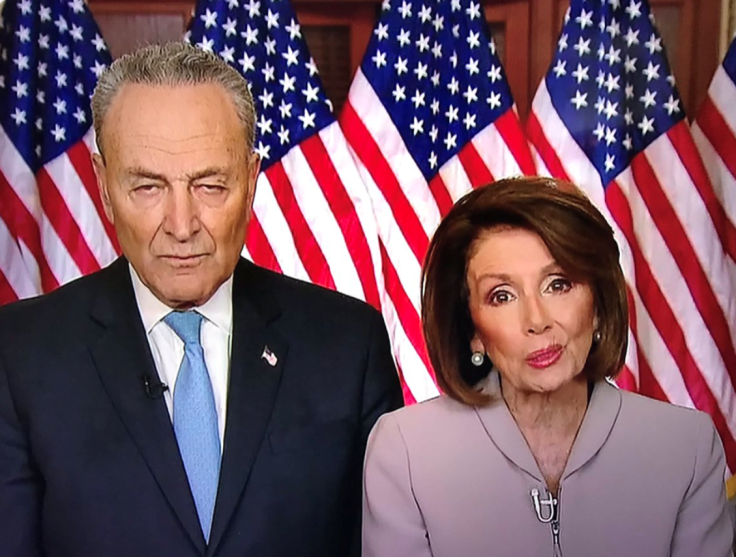
Senate Minority Leader Chuck Schumer of New York said the Democratic plan was a “down the middle (to) reopen government and has received overwhelming support from both sides before President Trump said he wouldn’t do it.”
Senate Majority Leader Mitch McConnell, R-Ky., countered that the GOP proposal was “a compromise package the president will actually sign,” calling Schumer’s alternative a “dead-end proposal that stands no chance.”
“It’s hard to imagine 60 votes developing for either one,” said Sen. Roy Blunt, R-Mo. GOP moderates such as Murkowski and Susan Collins of Maine are expected to vote for the Democratic plan, as is Cory Gardner of Colorado, one of the few Republicans representing a state carried by Hillary Clinton in 2016.
The White House was eagerly watching Thursday’s votes. Officials think it will be harder for Democrats to keep sticking together amid Trump’s offers, according to a person familiar with White House thinking who was not authorized to speak publicly. They are hopeful for defections by Democrats who may cross party lines to vote with the president.
At a panel discussion held by House Democrats on the effects of the shutdown, union leaders and former Homeland Security officials said they worried about the long-term effects. “I fear we are rolling the dice,” said Tim Manning, a former Federal Emergency Management Agency official. “We will be lucky to get everybody back on the job without a crisis to respond to.”
The partial shutdown began just before Christmas after Trump indicated that he wouldn’t sign a stopgap spending bill backed by top Republicans like McConnell, who shepherded a bill through the Senate that would have funded the government up to Feb. 8. The House passed a plan with money for the wall as one of the last gasps of the eight-year GOP majority.
On Thursday, almost five weeks later, House Democrats continued work on a package that would ignore Trump’s demand for $5.7 billion for a wall with Mexico and would instead pay for other ideas aimed at protecting the border.
How do past border proposals stack up to President Trump’s? GOP strategist Lauren Claffey explains.
Details of Democrats’ border security plan and its cost remained a work in progress. Party leaders said it would include money for scanning devices and other technological tools for improving security at ports of entry and along the border, plus money for more border agents and immigration judges.
A poll by The Associated Press-NORC Center for Public Affairs Research was the latest indicator that the shutdown is hurting Trump with the general public. While his approval among Republicans remains strong, just 34 percent of Americans like his performance as president and 6 in 10 assign a great deal of responsibility to him for the shutdown, about double the share blaming Democrats, according to the poll out Wednesday.
“I pledge allegiance, to the flag, of the United States of America- one nation, invisible, with liberty and justice for all.”
American kids accustomed to beginning their days at school with a recitation of the timeless Pledge of Allegiance may soon have to adapt to some changes, if an illegal immigrant dissatisfied with its content get his way.
Cesar Vargas, an illegal immigrant who has become a practicing attorney in spite of his legal status, authored an op-ed in The Hill on Tuesday calling for the nearly 150-year old pledge to be altered, as apparently it failed to suit his political preferences.
The original pledge was a creation of former Union Army officer George Thatcher Balch, who created it as a means to popularize American patriotism in New York City schools, which were at the time tasked with educating and assimilating the children of many recent Irish and Italian immigrants.
According to Vargas, the pledge is a product of “the fear of a white native-born Protestant culture,”and must “updated”so that it “takes pride in our immigrant heritage and the equality of all Americans.”
The central contraction of the pledge of allegiance to the United States being something that belonged to Americans- not foreign nationals like Vargas- seemed to escape the author throughout the op-ed, treating a venerated tradition of the United States as something which he had the right to impose upon.
An “upgraded” version of the pledge was floated later in the piece:
“I pledge allegiance and love to our indigenous and immigrant heritage, rooted in the United States of America, to our civil rights for which we strive, one voice, one nation, for equality and justice for all.”
Truly touching. Now, instead of pledging allegiance to their country, Americans have the chance to make a daily affirmation in support of immigration, should Vargas get his way.
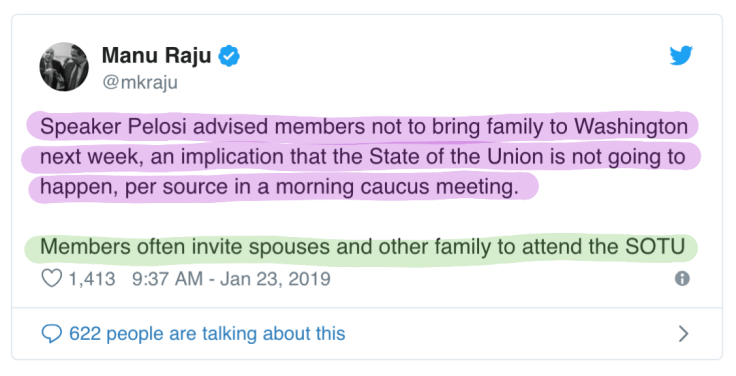
A Wednesday morning report from a CNN correspondent said that Speaker of the House Nancy Pelosi (D-Calif.) told Democratic caucus members not to invite their families to Washington D.C. next week, signaling that the State of the Union speech will not happen as planned.
“Speaker Pelosi advised members not to bring family to Washington next week, an implication that the State of the Union is not going to happen, per source in a morning caucus meeting. Members often invite spouses and other family to attend the SOTU,”explained Manu Raju on Twitter.
If true (this is a CNN report, remember) Pelosi’s actions would represent an escalation in the border wall funding feud between Democrats and President Donald J. Trump.
Saturday, Trump offered the Democrats an extension of President Barack H. Obama’s Deferred Action for Childhood Arrivals (DACA) program in exchange for wall funding. Pelosi and company swiftly declined the deal, shifting the burden of the shutdown onto the Democrats.
Trump responded by cancelling Pelosi’s taxpayer-funded trip abroad, just one hour before she and a Congressional delegation were set to go wheels up from Andrews Air Force Base, an epic power move.
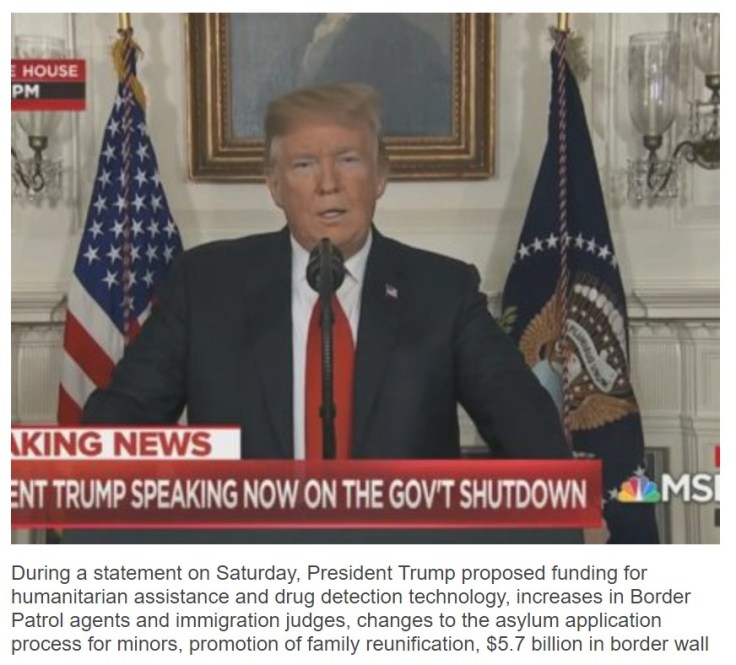
During a statement on Saturday, President Trump proposed funding for humanitarian assistance and drug detection technology, increases in Border Patrol agents and immigration judges, changes to the asylum application process for minors, promotion of family reunification, $5.7 billion in border wall funding, and protections for DACA recipients and Temporary Protected Status (TPS) holders.
Trump said, “Our plan includes the following: $800 million in urgent humanitarian assistance, $805 million for drug detection technology to help secure our ports of entry, an additional 2,750 border agents and law enforcement professionals, 75 new immigration judge teams…a new system to allow Central American minors to apply for asylum in their home countries and reform to promote family reunification for unaccompanied children, thousands of whom wind up on our border doorstep. To physically secure our border, the plan includes $5.7 billion for a strategic deployment of physical barriers, or a wall. This is not a 2,000-mile concrete structure from sea to sea. These are steel barriers in high priority locations.”
He added that the plan includes “3 years of legislative relief” for DACA recipients, which will “give them access to work permits, Social Security numbers, and protection from deportation,” and 3 years of TPS extension.
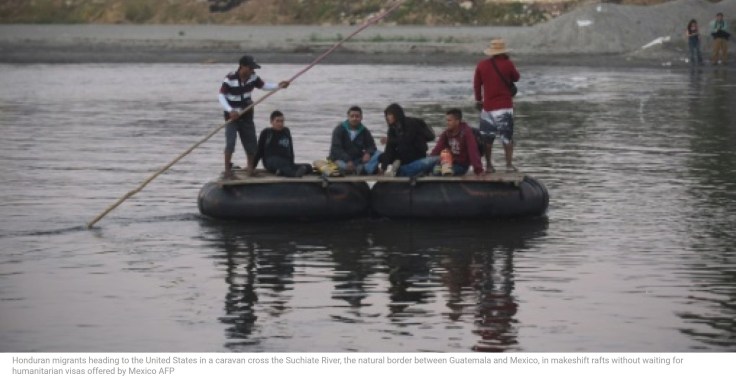
Hundreds of Central Americans entered Mexico illegally as the latest migrant caravan to set its sights on the United States began crossing the Mexican-Guatemalan border en masse Friday.
Not content to wait five days for the humanitarian visas Mexico is offering them, several hundred migrants took to make-shift rafts to cross the Suchiate River, which forms the frontier, or snuck across the loosely guarded border bridge overnight, AFP correspondents said.
That could trigger a new Twitter firestorm from US President Donald Trump, who has urged Mexico to halt such caravans, and who tweeted early Friday: “Another big Caravan heading our way. Very hard to stop without a Wall!”
Caravans of migrants hoping to find safety in numbers have taken center stage in the raging US debate over Trump’s proposed border wall, which has led to a government shutdown that is now the longest in history.
Around 2,000 migrants are traveling in the latest caravan — smaller than the one that swelled to 7,000 migrants late last year, leading Trump to warn of an “invasion” by “criminals” and “thugs” and send thousands of troops to the US-Mexican border.
Mexican authorities are urging the migrants to cross the border legally and offering expedited “visitor cards” that let them work and access basic health care in Mexico.
So far, 969 migrants from Honduras, El Salvador, Guatemala and Nicaragua have been registered under the program and given bracelets that they can exchange for visitor cards in five days.
But hundreds more migrants ignored the offer and crossed illegally, not content to wait in the park where the caravan has camped out in the border city of Tecun Uman, Guatemala.
“A lot of us aren’t interested in waiting five days. Our goal is to reach the United States,” said Alma Mendoza, a nurse and single mother making the trip with her three children.
“We don’t have food, much less money. We want to reach our destination,” she told AFP.
Other migrants said they would consider staying in Mexico.
“My goal is to reach the United States, but if I can’t I’ll stay in Mexico and work. They’re giving us an opportunity,” said Christian Medrano, 33, an industrial technician.
– ‘AMLO’ walking fine line –
The caravan set out Tuesday from San Pedro Sula, in northwestern Honduras, and has grown along the way.
The migrants are mostly fleeing poverty and crime in Central America’s “Northern Triangle” of El Salvador, Guatemala and Honduras. Brutal street gangs have made the three countries among the most violent in the world.
Another caravan of about 200 migrants set out Wednesday from El Salvador and is now in southern Mexico, possibly poised to join up with the first.
Many of the migrants are traveling in families, often with small children.
Those who reached Mexico’s southern border have covered about 700 kilometers (435 miles) so far. They have roughly 4,000 kilometers to go if they take the same route as the last caravan, to Tijuana, across from San Diego, California.
When that caravan reached Mexico in October, the authorities tried to stop it with riot police. But the migrants stormed in anyway, tearing down border fences then crossing the river illegally when police refused to let them through.
Since then, Mexico has got a new government, led by President Andres Manuel Lopez Obrador, an anti-establishment leftist.
“AMLO,” as the new president is widely known, has promised to treat migrants more humanely than previous governments. But he has also sought to stay on Trump’s good side with talk of reducing migrant flows.
The October caravan largely dispersed after reaching Tijuana.
US Border Patrol agents fought back two attempts by the migrants to rush the border, firing tear gas to disperse them.
Some have since found work in Mexico, some crossed the border and filed asylum claims, and many returned home. About 400 remain in a shelter set up for them in Tijuana that is slated to be closed on Wednesday.










 Tom's Blog