6/11/2020
They only good communist is a dead one. I don’t care who it is.
By Adam Beam and Don Thompson
SACRAMENTO, Calif. – It’s likely “few if any” California schools will reopen before summer break, Gov. Gavin Newsom said Tuesday as he provided a stark assessment of the implications from the spreading coronavirus that threatens to overwhelm the state’s hospitals and drain its spending reserves.
While urging Californians to stay united and promising “we will get back to the life that we have lived,” Newsom also acknowledged much is unknown and so the state is preparing for frightening worst-case scenarios. He put the California National Guard on alert for duties that include humanitarian missions like ensuring proper food distribution and public safety as some grocery stores resorted to rationing to control panic buying.
He said the state is acquiring two vacant hospitals to beef up capacity as it faces the possibility of a surge of hospital patients. California also is negotiating with about 900 hotels to acquire tens of thousands of rooms that could be used for hospital patients and for the homeless, a group particularly susceptible to coronavirus, which is spread by coughs and sneezes.
The virus is affecting every aspect of life in California and is devastating many of the state’s key industries.
With the state’s reserves approaching $21 billion, Newsom said the state has more money in its savings account than ever before. But he warned that “the magnitude of this moment may exceed those reserves.”
The state Legislature approved $1.1 billion in emergency spending Monday and then voted to suspend its session in what is believed to be the first unexpected work stoppage in 158 years. Lawmakers went one step further Tuesday by closing both the Capitol and the Legislative Office Building to the public “until further notice.”
It’s all part of a rapidly escalating reaction that saw three more Northern California counties on Tuesday follow the example of those in the San Francisco Bay Area that told residents to stay at home and go outside only for food, medicine and other essential needs.
At a news conference, Newsom did not announce a similar requirement statewide, but previously told bars, restaurants, movie theaters, fitness centers and other gathering places to shut their doors as the death toll crept to 12 and the number of confirmed cases neared 500. All people 65 and older and those with underlying health conditions have been encouraged to stay indoors.
In readying the National Guard for action, Newsom’s office emphasized that it’s for duties routinely performed during natural disasters and other emergencies. But Newsom grimly added that “we have the ability to do martial law … if we feel the necessity.”
Imposing martial law would take the extraordinary step of replacing the usual laws with military authority, with the possible suspension of civil liberties like freedom of association and movement.
U.S. and California health officials have repeatedly warned that the virus could have a devastating impact and that the timetable for controlling it isn’t known. President Donald Trump on Monday said the crisis could last until August.
California’s 415 hospitals have been planning for a surge of patients. They have about 88,000 beds and Newsom said health officials are running models to determine needs based on various infection rates and resulting hospitalizations. Under worst-case scenarios, California could be short 20,000 beds, he said.
“So we had a very candid and a sober if not sobering conversation about where we may be and where we need to go together,” he said after the meeting with hospital officials. “The good news is none of it surprised any of us. We as a state, working with our system, anticipated much of these needs and have been running plans to address them.”
He said the state should have the two large hospitals in its possession as early as Friday and will use money from the emergency authorization to get them ready for service.
Meantime, on the education front, Newsom said nearly 99% of the state’s K-12 schools are shuttered for periods generally ranging from two to five weeks. Newsom, a father of four young children, said his family is among those that have started home-schooling.
“It is unlikely that many of these schools, few if any, will open before the summer break,” he said, urging the more than 6 million schoolchildren and their families to make long-term plans.
The state has applied for a federal waiver that means children would not have to face academic tests once they eventually return to school, said Newsom, a first-term Democrat.
“We think it is totally inappropriate for kids to worry about coming back and being tested,” he said.
Newsom also shared a personal story that influenced his decision to tell the public to prepare for longer-than-expected closures.
He said he returned home late Monday after a hectic day to find one of his two daughters, 6-year-old Brooklynn, in her room, her stuffed bunny and most of her bedding on the floor. She was crying and upset about her school being closed and not seeing her friends.
“I told her, ‘Honey, I don’t think the schools are going to open again,’” Newsom said. “If I can tell my daughter that and not tell your daughter … then I’m not being honest and true to the people of the state of California. Boy I hope I’m wrong, but I believe that to be the case.”
California education and health officials late Tuesday offered guidelines for teachers to assist children with online learning, while offering free access to learning tools. It also offered guidelines for how to distribute free meals.
Many of the shuttered schools may be used to provide meals to lower-income students and for child care, Newsom said.
Providing child care at a time when residents are supposed to remain well separated to avoid spreading the disease brings its own challenges, Newsom said. Those caregivers “will want to have personally protective gear, make sure social distancing is practiced, make sure that we not just secure the sites but make sure that they’re healthy,” he said.
He said some of the money approved by state lawmakers on Monday could go to help with that effort.
___
Associated Press journalists Kathleen Ronayne and Cuneyt Dil contributed to this story.

The seemingly unstoppable spread of coronavirus has already led the government to declare a national emergency over the deadly disease that has so far claimed 41 lives nationwide, and infected more than 1,600 people across the country, according to the Centers for Disease Control and Prevention (CDC).
However, certain unsavory characters apparently decided to exploit the already tense situation to stoke more fear in the hearts of Americans and provoke real panic. People across the US received text messages claiming the president is about to impose martial law in a day or two, while urging people to stockpile supplies. This comes as many shops have already reportedly run out of toilet paper among other things.

The messages, citing insider information from “military friends up in DC,” and warning of nothing less than a “two week mandatory quarantine for the nation,” fell on fertile ground. It immediately became a hot topic on social media as people posted thousands of messages on the topic.
Some rushed to break the “bad news” or to wonder if anyone else received the disturbing message. Others said that many of their friends forwarded the messages to them.
More attentive readers noticed, however, that the messages, which were fake, referred to Trump’s plan to invoke the Stafford Act as the reason for claiming martial law is coming.
In fact, the president already invoked the law two days ago when he declared a national emergency. The government unlocked additional powers and funding for disaster response and involved the Federal Emergency Management Agency (FEMA) in the fight against coronavirus – but nothing close to martial law was imposed.
Still, the impact of the hoax apparently reached such proportions that the National Security Council decided it was time to intervene, posting a statement on Twitter saying the text message rumors were fake.
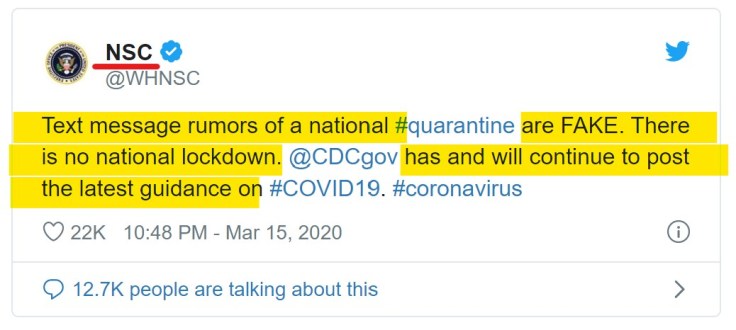
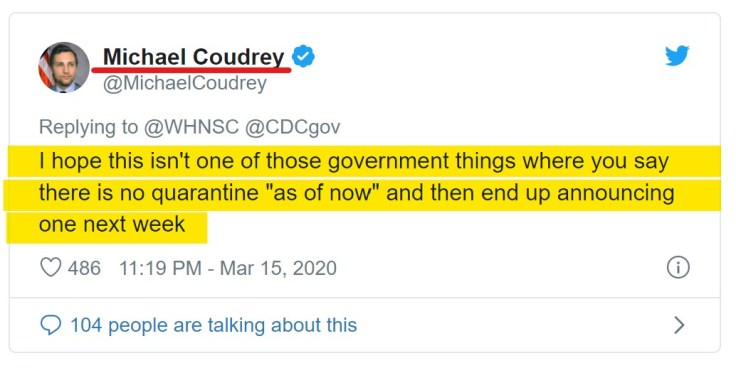
However, this was not enough to convince everyone that there is no possibility of martial law being imposed in a week or two.

“September is preparedness month. Emergencies can happen at any time and it’s recommended to have a #GrabBag ready containing essential items including medication, copies of important documents, food/water, torch, radio and other personal items,” the police tweeted as part of their ‘30 days 30 ways’ campaign.

The anxiety-inducing advice proposed packing a bag with food, water, and medication, as well as a pen and notepad, phone charger, whistle, and first aid kit. However, a Sunday morning may not have been the best time to urge people to prepare for some undisclosed disaster headed their way, judging by the reactions online, most of which centered around a single theme: “Do they know something we don’t?”
“What emergencies do you envisage? Brexit? War? Civil disturbance? Flood? Pestilence? Nuclear accident? Martial Law?”wrote one user, while another offered a variety of betting odds on what the impending doom might be: “Asteroid 4/1 Tsunami 8/1 Nuclear war 14/1 Alien invasion 22/1 Zombie Apocalypse 33/1 No deal Brexit 1000/1.”
Others adopted a more tongue-in-cheek approach.
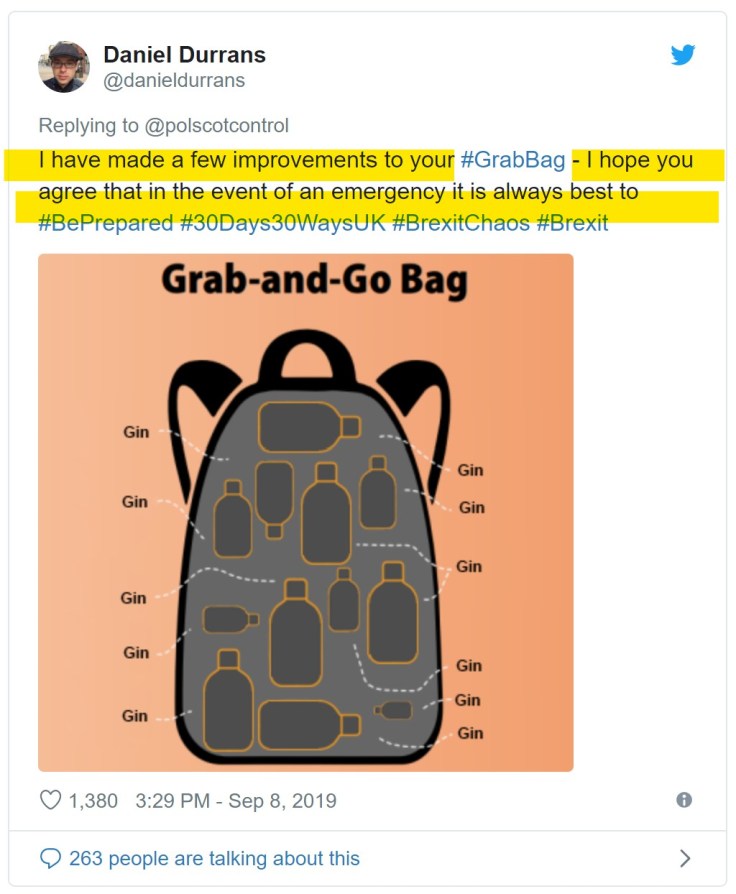
One commenter quipped: “Some advice please on #grabbag regarding ‘seasonal clothing’. I have packed some fancy dress for Hallowe’en and then a Santa suit for Christmas. Will that be enough do you think?”
Alien invasion, zombie apocalypse, and calamity in the form a Boris Johnson-led Brexit were all recurring themes as Scots piled on the police for such a needlessly panic-inducing tweet.
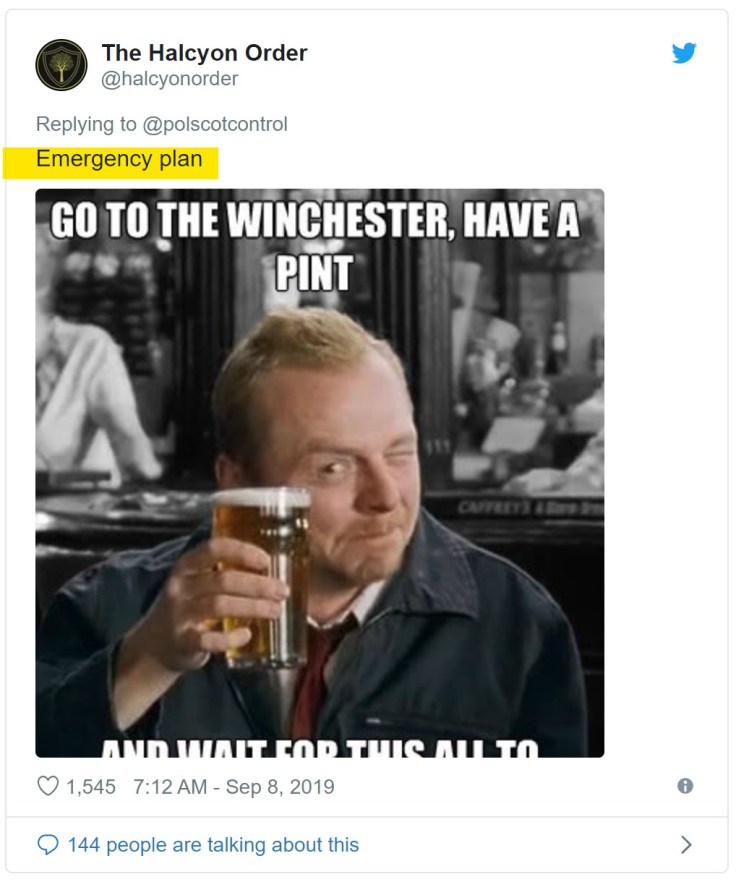
Some, however, called for calm (sincerely) and claimed not to see the big fuss while humble-bragging about their multitude of emergency preparedness plans.
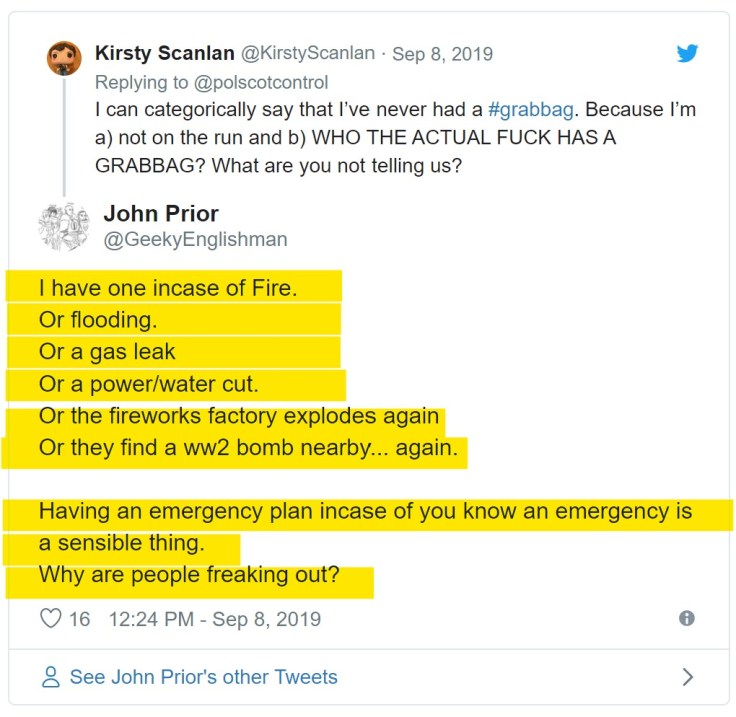
The whole kerfuffle reportedly stems from an initiative initially introduced by the US Department of Homeland Security that has been widely picked up by various institutions and public bodies across the UK.
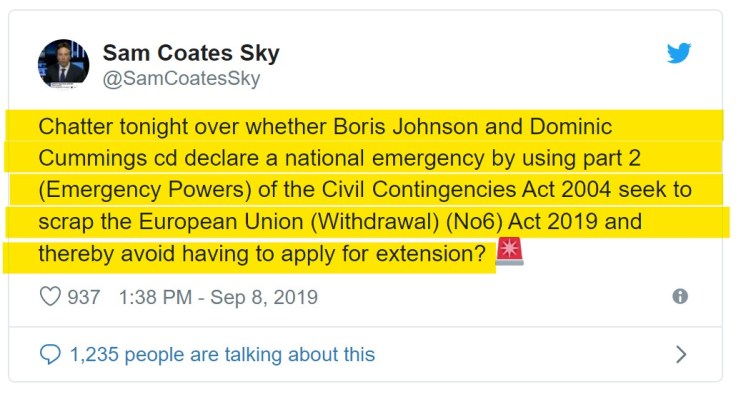
The timing couldn’t be worse, however, as the tweet only added to online speculation that British Prime Minister Boris Johnson might declare a national emergency in order to force through a no-deal Brexit, effectively weaponizing the Civil Contingencies Act of 2004 against his political opponents.
 Tom's Blog