ENVIRONMENTALIST GROUP: “CORONA IS THE CURE – HUMANS ARE THE DISEASE”

Environmentalist Group: "Corona is the Cure - Humans are the Disease"

The mask slips.

By Paul Joseph Watson- March 25, 2020

A climate change group that aligns itself with Extinction Rebellion posted stickers claiming that coronavirus is a “cure” for the “disease” that is humanity.

“Earth is healing. The air and water is clearing,” tweeted Extinction Rebellion East Midlands. “Corona is the cure. Humans are the disease!”

The post shows stickers with the same message and the Extinction Rebellion logo plastered on lamp posts.

Screen Shot 2020-03-25 at 2.31.04 PM

When another branch of Extinction Rebellion challenged that this “does not follows XR’s principles,” the East Midlands chapter doubled down.

“We are pointing out that from the perspective of the Earth, humans behave like a disease. The idea is not to be,” they responded.

While Extinction Rebellion East Midlands may represent little more than the ravings of one idiot, the notion that humanity somehow deserved coronavirus and that it’s good for the planet has been widely shared by environmentalists and celebrities.

After actor Idris Elba tested positive for coronavirus, he claimed that COVID-19 was the planet “reacting to the human race” as revenge for climate change.

Despite numerous claims that nature is ‘flourishing’ and animals are thriving thanks to coronavirus, it turns out that most of those stories are fake news.

Man Charged with Terroristic Threat for Allegedly Coughing on Grocery Store Worker

The police state is growing because of the coronavirus pandemic.

By Shane Trejo

A man has been charged with a terroristic threat after allegedly coughing on a grocery store employee while saying that he had the coronavirus over the weekend.

This individual reportedly committed this assault at a Wegman’s in New Jersey. 50-year-old George Falcone of Freehold, N.J. is the suspect. He is also being charged with obstructing administration of law or other governmental function and harassment following the incident.

The incident took place on Sunday after a Wegman’s employee allegedly requested for Falcone to stand further away from her while she was preparing food. This reportedly offended Falcone, who leaned into her and purposefully coughed while facetiously saying that he had coronavirus while laughing. He faces up to seven years in prison and a fine up to $26,000 for his alleged actions.

Trending: SHOCK VIDEO: Chinese People Repeatedly Attempt to Spread Coronavirus in Public

“These are extremely difficult times in which all of us are called upon to be considerate of each other — not to engage in intimidation and spread fear, as alleged in this case,” said far-left New Jersey Attorney General Gurbir Grewal.

“We must do everything we can to deter this type of conduct and any similar conduct that harms others during this emergency,” he added.

Grewal, who opened the flood gates for illegal immigrants in his state, has used coronavirus pandemic as an excuse to crack down on supposed hate speech related to the origin of the virus.

Big League Politics has reported on Grewal’s proposed diversity gestapo:

New Jersey Attorney General Gurbir Grewal issued a “guidance” on Thursday telling employers that they may be guilty of illegal discrimination if they allow workers to call the COVID-19 coronavirus “the Chinese virus.”

“Among the guidance’s keynotes are that employers may be in violation of the LAD’s prohibition on disability discrimination if they fire an employee for exhibiting possible COVID-19 symptoms,” Grewal explained in his press release.

He added: “The guidance also states that employers must take reasonable action to stop harassment of one employee by another employee if the employer knows or should have known about it: for example, if one employee has east-Asian heritage and a coworker repeatedly harasses her by claiming that Asian people caused COVID-19 or calling this ‘the Chinese virus.’”

Grewal claims that noting the virus originated from China is a violation of the New Jersey’s Law Against Discrimination (LAD). During a time in which resources are being stretched in an unprecedented crisis, this is what Grewal is concerned about.

“COVID-19 is no excuse for racism, xenophobia, or hate,”Grewal said. “Discrimination and harassment in violation of New Jersey law remains illegal even if it occurs against the backdrop of a global pandemic. Now, more than ever, we should recognize that we’re all in this together. Words and actions that divide us won’t make any of us safer or stronger.”

He is urging citizens to snitch on their fellow man during the coronavirus crisis in case someone’s feelings get hurt.

When the coronavirus pandemic ends, it is not likely that Americans will regain the many liberties they have lost throughout the crisis.


MAN WHO LICKED PRODUCTS AT WALMART CHARGED WITH MAKING TERRORIST THREAT

Man Who Licked Products at Walmart Charged with Making Terrorist Threat

Missouri man asked, ‘Who’s afraid of the coronavirus?’ before licking various items on Walmart shelf

By Adan Salazar – March 25, 2020

A Missouri man who filmed himself licking products at a retail store was reportedly charged with making terrorist threats.

In the video which went viral on social media, Cody Pfister, 26, asks, “Who’s afraid of the coronavirus?” before proceeding to lick several items at a Walmart in Warrenton.

According to police, Pfister’s antics prompted anger across the globe, with people from several countries in Europe calling into the Warrenton Police Department to report the heinous act.

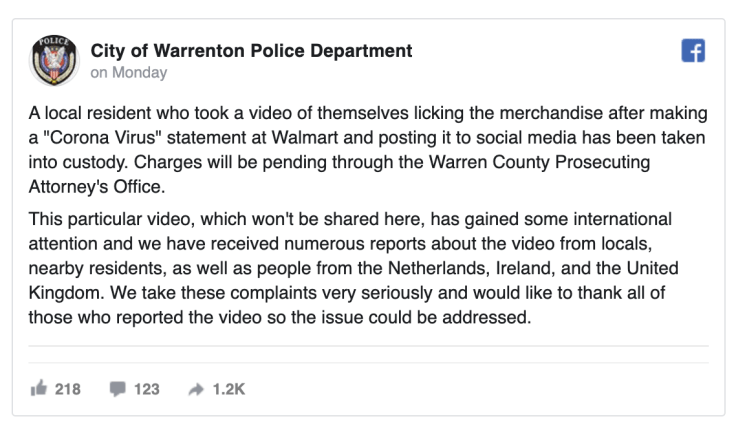
“A local resident who took a video of themselves licking the merchandise after making a ‘Corona Virus’ statement at Walmart and posting it to social media has been taken into custody,” Warrenton police wrote in a Facebook post.

Screen Shot 2020-03-25 at 11.32.47 AM

“This particular video, which won’t be shared here, has gained some international attention and we have received numerous reports about the video from locals, nearby residents, as well as people from the Netherlands, Ireland, and the United Kingdom.”

“We take these complaints very seriously and would like to thank all of those who reported the video so the issue could be addressed,” they added.

The Riverfront Times reports Pfister, who made the video on March 11 and has previously been convicted of burglary and firearm theft, was charged with making a terrorist threat, according to court documents obtained by the media outlet.

“Pfister was taken into custody this week, and Warren County prosecutors charged him today. The charge is a low-level felony,” reports The Times’ Doyle Murphy.

“Pfister was booked into the Warren County jail without bond.”

Pfister was possibly making the video in relation to the new coronavirus social media challenge, which had people licking objects such as toilet seats for social media clout.

One YouTuber who took part in the challenge and posted a video of him licking the rim of a public toilet seat reportedly contracted coronavirus following the stunt.

EU left Italy ‘practically alone’ to fight coronavirus, so Rome looked for help elsewhere, incl Russia

Screen Shot 2020-03-25 at 10.48.08 AM

The EU’s initial response to the massive outbreak of coronavirus in Italy was largely “inadequate,” and a lack of European solidarity opened the doors for Russia and China, former Italian Foreign Minister Franco Frattini told RT.

The new epicenter of the dreaded pandemic, Italy, has been struggling to stop the spread of Covid-19 for weeks now. The disease has already killed more than six thousand people in the country, with over 60 thousand people infected.

EU tried to pin the blame on Italy

The EU clearly underestimated the virus, blaming the outbreak in Italy on its national healthcare system flaws, according to the two-time foreign minister and OSCE representative. As a result, Brussels, which preaches pan-European solidarity, failed to act when this solidarity was needed in the face of a crisis that eventually affected the entire bloc.

Frankly speaking, Brussels is not doing enough. At the very first moment, Italy was practically alone against the virus. Many said it was all because of the Italian habits, because Italians do not respect the rules. Suddenly, they realized all the other countries were equally affected.

The situation in other major EU states like Germany and France deteriorated rapidly, forcing them to deal with thousands of infected on their own soil.

“Everyone just focused on the situation at home before even thinking about helping others,” Andrea Giannotti, the executive director of the Italian Institute of Eurasian Studies, told RT.

European solidarity doesn’t exist, only China can help us: Serbia goes full emergency over coronavirus

Screen Shot 2020-03-25 at 10.52.06 AM

The lack of solidarity was recently noted from outside of the bloc – Serbian President Aleksandar Vucic decried European solidarity as a myth, while praising Beijing for its assistance. His remarks came after Serbia received five million masks from China, which it could not get in Europe.

The EU is now trying “to do more” and somehow “make up” for its initial poor execution of a coordinated response, former Italian MP Dario Rivolta said.

Brussels has indeed ramped up its efforts, suspending the bloc’s strict Stability and Growth Pact regulating budgetary policy among others. Frattini particularly hailed this decision, which allows Rome to act freely in terms of budgetary spending, as “very important.” But this came only after Europe “realized its [measures] were inadequate to give a united response.”

Still, it is not enough, Rivolta told RT, adding that “for the moment,” there are no major changes. And while financial relief is necessary, there are other things to be considered, such as medical assistance.

“As for the medical aspects, the only thing that the EU did up to now was to put barriers between Italy and other countries.”

Huge support in terms of expertise

At one point, requests for help were sent out all over the world, according to Giannotti.

“Some Italian embassies were tasked with negotiating with local governments in order to find any opportunities to receive assistance from abroad, including help with equipment, which Italy lacks.” Russia and China were among those who responded.

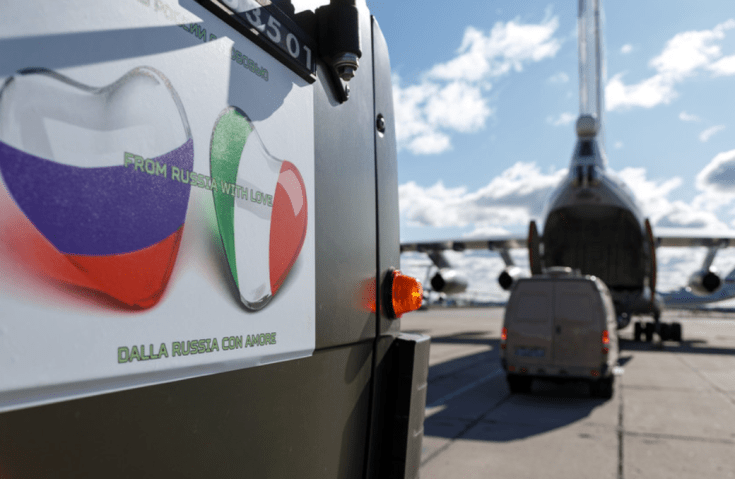
In total, Moscow prepared nine cargo planes with emergency aid, delivering vital medical equipment and supplies, as well as bringing experienced specialists in infectious diseases and military doctors to Italy. Now they will be deployed to the most affected regions in the country’s north.

Frattini said the help was of the utmost importance: “What Russia has done is not comparable to what other countries have done, including China because China also sent something but not comparable with the support provided by Russia.”

The specialists have provided “very huge support in terms of expertise… in terms of virology.” 

With united Europe MIA in its Covid-19 response, worst-hit nations turn to ‘evil’ Russia & China for help

Screen Shot 2020-03-25 at 10.55.59 AM

The assistance serves as a gesture of solidarity in times of European sanctions on Moscow and the counter-measures, Giannotti said. Sending help “despite [the fact] the situation in Russia itself may also worsen” means it is a clear message that Moscow is ready to talk and settle issues with Europe when there is a greater need for cooperation.

Speaking to RT, the Italian ambassador to Russia, Pasquale Terracciano, agreed that a joint approach is the best way to put an end to the pandemic.

Thanking Moscow for the contribution, he said: “It will be crucial to recover from this tragic situation, hopefully soon.”

Homeland Security warns terrorists may exploit COVID-19 pandemic

By Alexander Mallin and Josh Margolin – 3/25/2020

A Department of Homeland Security memo sent to law enforcement officials around the country warns that violent extremists could seek to take advantage of the COVID-19 pandemic by carrying out attacks against the U.S.

“Violent extremists probably are seeking to exploit public fears associated with the spread of COVID-19 to incite violence, intimidate targets and promote their ideologies, and we assess these efforts will intensify in the coming months,” according to the intelligence bulletin, compiled by the agency’s Counterterrorism Mission Center and Countering Weapons of Mass Destruction Office.

At this time, DHS said it has “no information indicating any active plotting is underway,” but that it has observed certain extremist groups, both foreign and domestic, looking to spread misinformation about the coronavirus.

The memo, which was circulated on Monday, comes after assurances from FBI Director Chris Wray in a video message that agents would be even more vigilant in monitoring threats to the U.S. as the virus spreads.

“With all the worry and uncertainty out there, we want the public to know that there are still things they can count on: We’re here, and we’re going to stay here, to protect them, no matter what,” Wray said. “Because our criminal and national security adversaries sure aren’t going to take a day off — whether that’s for the coronavirus or, for that matter, anything else.”

Among the activities by extremist organizations cited in the DHS bulletin is a clipping from a weekly ISIS newsletter, which called for supporters to carry out attacks against overburdened health care systems in various Western countries.

Another portion of the bulletin singles out activity by white supremacists online who the DHS says have “advocated for violence against a range of targets, including critical infrastructure and faith-based and minority communities — including Asian Americans in response to the COVID outbreak.”

ABC News reported on Monday on an alert from the FBI’s New York field office that showed intelligence gathered on racist extremist groups, including neo-Nazis, that were encouraging followers who contract COVID-19 to spread the disease to Jewish people and police officers.

Countries are starting to hoard food, threatening global trade

Screen Shot 2020-03-25 at 9.58.06 AM

By Isis Almeida and Agnieszka de Sousa

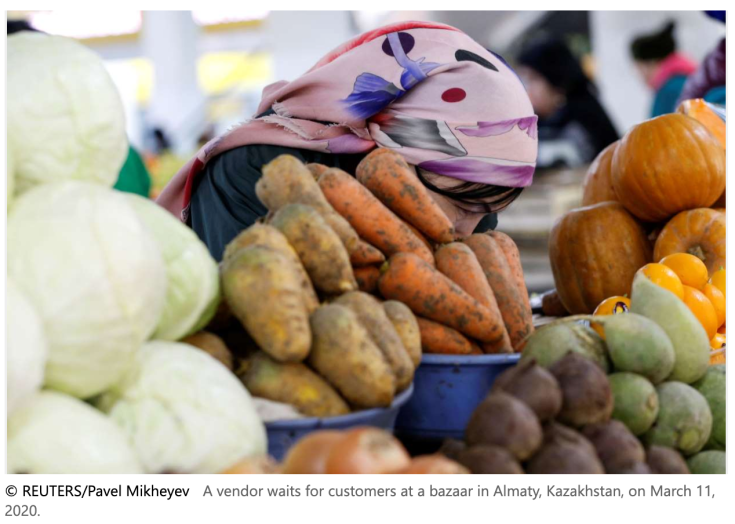
Kazakhstan, one of the world’s biggest shippers of wheat flour, banned exports of that product along with others, including carrots, sugar and potatoes. Serbia has stopped the flow of its sunflower oil and other goods. Russia is leaving the door open to shipment bans and said it’s assessing the situation weekly.
To be perfectly clear, there have been just a handful of moves and no sure signs that much more is on the horizon. Still, what’s been happening has raised a question: Is this the start of a wave of food nationalism that will further disrupt supply chains and trade flows?

“We’re starting to see this happening already — and all we can see is that the lockdown is going to get worse,” said Tim Benton, research director in emerging risks at think tank Chatham House in London.

Though food supplies are ample, logistical hurdles are making it harder to get products where they need to be as the coronavirus unleashes unprecedented measures, panic buying and the threat of labor crunches.

Consumers across the globe are still loading their pantries — and the economic fallout from the virus is just starting. The specter of more trade restrictions is stirring memories of how protectionism can often end up causing more harm than good. That adage rings especially true now as the moves would be driven by anxiety and not made in response to crop failures or other supply problems.

Related video: Food supply is not where it’s needed

As it is, many governments have employed extreme measures, setting curfews and limits on crowds or even on people venturing out for anything but to acquire essentials. That could spill over to food policy, said Ann Berg, an independent consultant and veteran agricultural trader who started her career at Louis Dreyfus Co. in 1974.

“You could see wartime rationing, price controls and domestic stockpiling,” she said.

Some nations are adding to their strategic reserves. China, the biggest rice grower and consumer, pledged to buy more than ever before from its domestic harvest, even though the government already holds massive stockpiles of rice and wheat, enough for one year of consumption.

Key wheat importers including Algeria and Turkey have also issued new tenders, and Morocco said a suspension on wheat-import duties would last through mid-June.

a close up of a map: Food Dependence© Bloomberg Food Dependence

As governments take nationalistic approaches, they risk disrupting an international system that has become increasingly interconnected in recent decades.

Kazakhstan had already stopped exports of other food staples, like buckwheat and onions, before the move this week to cut off wheat-flour shipments. That latest action was a much bigger step, with the potential to affect companies around the world that rely on the supplies to make bread.

For some commodities, a handful of countries, or even fewer, make up the bulk of exportable supplies. Disruptions to those shipments would have major global ramifications. Take, for example, Russia, which has emerged as the world’s top wheat exporter and a key supplier to North Africa.

“If governments are not working collectively and cooperatively to ensure there is a global supply, if they’re just putting their nations first, you can end up in a situation where things get worse,” said Benton of Chatham House.

He warned that frenzied shopping coupled with protectionist policies could eventually lead to higher food prices — a cycle that could end up perpetuating itself.

“If you’re panic buying on the market for next year’s harvest, then prices will go up, and as prices go up, policy makers will panic more,” he said.

And higher grocery bills can have major ramifications. Bread costs have a long history of kick-starting unrest and political instability. During the food price spikes of 2011 and 2008, there were food riots in more than 30 nations across Africa, Asia and the Middle East.

“Without the food supply, societies just totally break,” Benton said.

Ample supplies have kept prices relatively low since the 2011 spike© Bloomberg Ample supplies have kept prices relatively low since the 2011 spike

Unlike previous periods of rampant food inflation, global inventories of staple crops like corn, wheat, soybeans and rice are plentiful, said Dan Kowalski, vice president of research at CoBank, a $145 billion lender to the agriculture industry, adding he doesn’t expect “dramatic” gains for prices now.

While the spikes of the last decade were initially caused by climate problems for crops, policies exacerbated the consequences. In 2010, Russia experienced a record heat wave that damaged the wheat crop. The government responded by banning exports to make sure domestic consumers had enough.

The United Nations’ measure of global food prices reached a record high by February 2011.

“Given the problem that we are facing now, it’s not the moment to put these types of policies into place,” said Maximo Torero, chief economist at the UN’s Food and Agriculture Organization. “On the contrary, it’s the moment to cooperate and coordinate.”

Read More on Food Issues in Virus Era:

There’s Plenty of Food in the World, Just Not Where It’s Needed

Americans Drop Kale and Quinoa to Lock Down With Chips and Oreos

Cargill Says China Offers Hope for Meat Markets Hit by Virus 

Of course, the few bans in place may not last, and signs of a return to normal could prevent countries from taking drastic measures. Once consumers start to see more products on shelves, they may stop hoarding, in turn allowing governments to back off. X5 Retail, Russia’s biggest grocer, said demand for staple foods is starting to stabilize. In the U.S., major stores like Walmart Inc. have cut store hours to allow workers to restock.

In the meantime, some food prices have already started going up because of the spike in buying.

Wheat futures in Chicago, the global benchmark, have climbed more than 6% in March as consumers buy up flour. U.S. wholesale beef has shot up to the highest since 2015, and egg prices are higher.

At the same time, the U.S. dollar is surging against a host of emerging-market currencies. That reduces purchasing power for countries that ship in commodities, which are usually priced in greenbacks.

n the end, whenever there’s a disruption for whatever reason, Berg said, “it’s the least-developed countries with weak currencies that get hurt the most.”

“I Don’t Care! I Don’t Care! I Don’t Care!” Pelosi Snaps at CNN’s Dana Bash For Asking About Trump’s Plans to Put America Back to Work (VIDEO)

By Cristina Laila – March 24, 2020

House Speaker Nancy Pelosi snapped at CNN’s Dana Bash Tuesday afternoon when the host brought up Trump’s recent remarks suggesting bringing Americans out of quarantine and back to work.

“I don’t have time to follow people’s twits…tweets, Twitters, whatever, tweets — so don’t expect me to comment on that,” Pelosi said.

“Well, even beyond Twitter, the President of the United States is signaling that he could open it up,” Bash said.

“What is your opinion on that?” Bash said pressing Pelosi.

“I don’t care! I don’t care! I don’t care!” Pelosi said as CNN’s Dana Bash brought up Trump’s plans to open America back up for business soon.

“It is not scientific based — he’s notion mongering,” Pelosi slurred.

Of course Pelosi doesn’t care about Americans going back to work. She wants America shut down while she holds the country hostage and tries to shove her Socialist wish list through Congress.

President Trump on Tuesday appeared on Fox News for a town hall to discuss his administration’s ongoing efforts to combat the Coronavirus.

Trump said he would likely open the country back up by Easter (April 12).

“I would love to have [the country] open by Easter,” Trump said. “It’s such an important day for other reasons.”

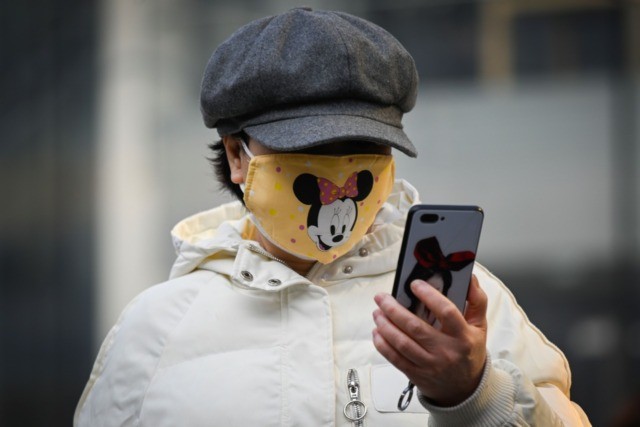
21 Million Chinese Cellphone Users Disappear in Three Months of Pandemic

A woman wearing a Minnie Mouse face mask looks at her mobile phone in Beijing on February 11, 2020. - The death toll from a new coronavirus outbreak surged past 1,000 on February 11 as the World Health Organization warned infected people who have not travelled to China could be …

By John Hayward – 3/24/2020

The opacity of the Chinese Communist government obliges responsible outside observers to look for clues to the truth of the coronavirus epidemic, instead of merely repeating official information without question.

The official count from China is 3,277 fatalities from 81,171 infections as of Tuesday, but the Epoch Times noted the troubling disappearance of some 21 million cell phone accounts in China over the past three months – an unprecedented decline that hints at more fatalities than Beijing is prepared to admit.

It should be stated at the outset that we should not be forced to read tea leaves to figure out what really happened in China, especially in the virus epicenter of Hubei province and the city of Wuhan, where Chinese officials are currently making claims of zero new infections that no one seriously believes. While more responsible governments issue troubling warnings of a second wave of infections, severe enough to prompt the re-imposition of quarantine procedures that were only recently lifted, China claims it has no second wave and all of its new coronavirus cases are imported.

With that in mind, the Epoch Times thought it was a bit odd for 21 million Chinese cell phones to abruptly disappear, given that cell phone usage has been increasing constantly in China for years, and phones have been touted as an important tool for containing the coronavirus epidemic:

China’s Ministry of Industry and Information Technology (MIIT) announced on March 19 the number of phone users in each province in February. Compared with the previous announcement, which was released on Dec. 18, 2019, for November 2019 data, both cellphone and landline users dropped dramatically. In the same period the year before, the number of users increased.

The number of cellphone users decreased from 1.600957 billion to 1.579927 billion, a drop of 21.03 million. The number of landline users decreased from 190.83 million to 189.99 million, a drop of 840,000.

In the previous February, the number increased. According to MIIT, the number of cellphone users increased in February 2019 from 1.5591 billion to 1.5835 billion, which is 24.37 million more. The number of landline users increased from 183.477 million to 190.118 million, which is 6.641 million more.

According to China’s National Bureau of Statistics, the country’s population at the end of 2019 was 4.67 million larger than in 2018, reaching 1.40005 billion.

The article went on to postulate that some of the landlines might have been shut down as a consequence of the coronavirus quarantines, particularly lines used by shuttered business operations, but the sheer magnitude of the cell phone user decline makes it more difficult to explain. China Mobile, the nation’s largest carrier, reported gaining 3.7 million new accounts in December but then losing over 8 million in January and February, months in which it posted gains of 3.5 million users the previous year.

The Epoch Times considered several explanations for the loss of users, such as migrant workers who kept different cell phones for their home and work cities – necessary due to some of China’s regulations on phone service – abandoning the work phone because it was not needed during the quarantine period, or people generally canceling their phone service because they wanted to save money during the hard months.

On the other hand, the government is currently requiring citizens to use their cell phones to generate “health codes” so their movements can be tracked and permission to travel can be restricted to healthy individuals, so as U.S.-based commentator Tang Jiangyuan put it, it is effectively “impossible for a person to cancel his cellphone.”

“Dealing with the government for pensions and social security, buying train tickets, shopping … no matter what people want to do, they are required to use cell phones,” Tang noted.

The New York Times explained just how heavily Chinese authorities are leaning on those cell phones to monitor their population, and not just for coronavirus infections:

The Times’s analysis found that as soon as a user grants the software access to personal data, a piece of the program labeled “reportInfoAndLocationToPolice” sends the person’s location, city name and an identifying code number to a server. The software does not make clear to users its connection to the police. But according to China’s state-run Xinhua news agency and an official police social media account, law enforcement authorities were a crucial partner in the system’s development.

While Chinese internet companies often share data with the government, the process is rarely so direct. In the United States, it would be akin to the Centers for Disease Control and Prevention using apps from Amazon and Facebook to track the coronavirus, then quietly sharing user information with the local sheriff’s office.

The system, which relies on a unit of the immense Chinese e-commerce company Alibaba, assigns users a green, yellow, or red “health code” in the style of a traffic light. Predictably, Chinese citizens find the opaque system cryptic and frightening, since the government has not explained exactly how it works.

“In some cities, residents now have to register their phone numbers with an app to take public transportation,” the Times added.

At the beginning of March, the so-called Alipay Health Code system had been launched in the city of Hangzhou, expanded to 200 other cities, and was on its way to a complete nationwide rollout. The rollout ran into some hitches over the following weeks, from technical glitches to confusion caused by local governments adding their own health codes to the already intimidating system.

A correspondent writing for Bloomberg News on March 18 reported using the system and said it was in the process of being “rolled out nationwide at railway stations, restaurants, pharmacies, and more.” Other reports in China have noted how cell phones are ubiquitous there and are employed for everything from accessing public and commercial resources to telecommuting to school during the coronavirus lockdown.

With this in mind, it might not be completely impossible to get by in Chinese cities without a cell phone at the moment, but it seems unlikely that a huge number of citizens would choose this moment to get rid of their phones.

“Lacking data, the real death toll in China is a mystery. The cancellation of 21 million cellphones provides a data point that suggests the real number may be far higher than the official number,” the Epoch Times concluded.


Blog at WordPress.com.

Up ↑