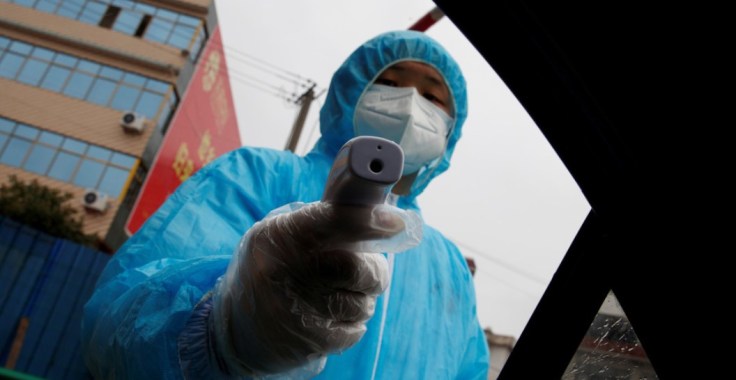
Infection-free taxi: Hazmat-suit-wearing cab driver helps passengers to laugh off coronavirus hysteria (VIDEO)

https://www.rt.com/russia/480447-taxi-hazmat-suit-coronavirus/

<div style=”position: relative;padding-bottom: 56.25%; padding-top: 25px; height: 0;”>https://www.rt.com/russia/480447-taxi-hazmat-suit-coronavirus/video/5e40182885f5402b7567d40b</div>

Passengers in the Siberian city of Omsk were shocked to see their taxi driver wearing a gas mask and a hazmat suit. But it turned out to be a prank to lighten the mood amid scary reports of the coronavirus reaching Russia.

Laughter is known to prolong human life, but cabbie Andrey Gonchar believes it’s also effective against the world’s newest virus or, at least, the negative psychological effect that news about the disease has on people.

That’s why he greets all his passengers while sporting full protective gear, and strictly questioning them if they’ve recently been to China.

Andrey told RT’s Ruptly video agency that initially he wasn’t sure how the people would react, but “everyone considered it to be funny, positive; they laughed at it, everyone liked it.” Many also took selfies with the man.

I cheered people up; as people got out of the car they thanked me for making their day, for their good mood in the morning.

The driver understands that the coronavirus, which has already taken more than 800 lives, is a serious matter, but he believes it’s still no reason to put your life on hold, especially in Omsk, located more than 4,000 kilometers away from Wuhan, the epicenter of the current outbreak.

Only two cases of coronavirus have been so far recorded in Russia, with both patients being Chinese citizens who’d recently arrived in the country. The infected persons, who are said to have a moderate form of the disease, and those in close contact with them, have all been quarantined at specialized hospitals.

However, media reports about the coronavirus still sent many Russians into a frenzy, with face masks becoming a scarce commodity and prices on anti-viral drugs spiking so harshly that the government decided to intervene.

Andrey the cabbie said his masquerade is needed to “distract people from the coronavirus theme, from the huge amount of information about it… because lately there has been too much negativity around this theme, so much that everyone is afraid of the virus.”

Pope Francis endorses wealth redistribution, calls for an end to tax cuts for the ‘richest people’

CAP

Pope Francis blasted the practice of tax cuts for the rich as part of a “structure of sin” and lamented the fact that “billions of dollars” end up in “tax haven accounts” instead of funding “healthcare and education.”

Speaking at the seminar set up by the Pontifical Academy for Social Sciences  the Pope criticized “the richest people” for receiving “repeated tax cuts” in the name of “investment and development.” These “tax haven accounts” impede “the possibility of the dignified and sustained development of all social agents,” claims the Pope.

He added that “the poor increase around us” as poverty is rising around the world. This poverty can be ended if the wealthiest gave more.

“The 50 richest people in the world have an equity equivalent to 2.2 billion dollars. Those fifty people alone could finance the medical care and education of every poor child in the world, whether through taxes, philanthropic initiatives or both. Those fifty people could save millions of lives every year,” the Pope said.

Though Pope Francis believes poverty is a major current issue, something he has spoken about before, he tried to remain hopeful by saying the world’s problems today are “solvable.”

“The main message of hope I want to share with you is precisely this: these are solvable problems, not ones from a lack of resources. There is no determinism that condemns us to universal inequity. Let me repeat: we are not condemned to universal inequity,” he said.

Though the Pope spoke of the dangers of “extreme poverty” in his economic speech, reports suggest that extreme poverty is falling every year around the globe.

Still, a higher tax rate for wealthier individuals is a popular idea with some parties in both the US and UK, and the gap between rich and poor is certainly widening. A recent Oxfam report indicated the richest one percent of the world’s population has twice as much wealth as the remaining 90 percent, or 6.9 billion people.

EXPERTS WARN CORONAVIRUS SPREADING UNDETECTED IN INDONESIA, THAILAND

Experts Warn Coronavirus Spreading Undetected in Indonesia, Thailand

Reports of confirmed cases oddly low in some Asian countries

Steve Baragona | Voice of America – FEBRUARY 7, 2020

The number of coronavirus cases reported in Indonesia and Thailand is well below what scientists would expect, given how closely connected the countries are to the Chinese city of Wuhan, the epicenter of the outbreak.

That raises concerns that the virus may be spreading undetected in those countries, potentially adding fuel to the epidemic that has so far killed over 600 people and sickened over 31,000.

“Indonesia has reported zero cases, and you would expect to have seen several already,” said epidemiologist Marc Lipsitch at the Harvard T.H. Chan School of Public Health, co-author of a new study posted on medRxiv.

Thailand has reported 25 cases, “but you would expect more,” he added.

Cambodia has reported just one case, which Lipsitch said is “not very likely,” but “not completely beyond what you would expect.”

The research is based on estimates of the average number of airline passengers flying from Wuhan to other cities around the world. More passengers would presumably mean more cases.

Going undetected?

Health systems in Indonesia and Thailand may not be catching cases, Lipsitch said, which could create problems for the rest of the world.

“Undetected cases in any country will potentially seed epidemics in those countries,” he added, which can spread beyond their borders.

Lipsitch’s group’s research is one of three recent studies to say that the virus was likely to reach Indonesia.

None of these studies has gone through the normal scientific process of review by outside experts, however. During this fast-moving outbreak, researchers have been posting findings online and on preprint servers to share what they hope will be helpful information. Experts caution that these publications should be taken with an extra grain of salt.

But researchers contacted by VOA said the findings were plausible and help address some lingering questions.

In China, the number of people infected has been climbing daily. But outside China, the outbreak has barely budged. That has puzzled health experts.

Where are they?

“This [study] does get at, I think, a significant question that a number of us have, which is: Where are these cases?” said virologist Christopher Mores at George Washington University’s Milken Institute School of Public Health, who was not involved with the research.

“It’s either that transmission is demonstrably different outside of the main outbreak zone for some reason that has not yet been described,” Mores said, “or we’re just not capturing it and counting it, and there’s a failure to detect.”

This study suggests the latter, he added.

Indonesia, Thailand and Cambodia are screening travelers from China at the border.

“Indonesia is doing what is possible to be prepared for and defend against the novel coronavirus,” the World Health Organization’s Indonesia representative, Dr. Navaratnasamy Paranietharan, told the Sydney Morning Herald.

However, he added, “there is still more work to do in the areas of surveillance and active case detection.”

‘Beef things up’

These countries are not the only places with shortcomings in their public health systems, said epidemiologist Art Reingold at the University of California-Berkeley’s School of Public Health.

“I wouldn’t want people to think everyone else is doing a great job. We need to beef things up in a lot of places,” he added, and not just in the developing world.

“We think we’re doing a good job,” he said. “People think they’re doing a good job in France or whatever, but I don’t think we can afford to make that assumption.”

While some countries start to cut connections with China in hopes of keeping out the disease, Mores said, those measures may not help if the virus is spreading under the radar in countries that don’t.

“There’s certainly plenty of places, especially in the developing world, that are not going to be able to shut down their economies because of this coronavirus outbreak,” he said. “And the danger there is that those countries are even more susceptible” because of weaker public health systems.

And that puts the world at risk, Mores added.

Coronavirus infections TRIPLE on cruise liner quarantined in Japan with thousands of passengers stuck in ‘floating prison’

CAP

Dozens of additional passengers aboard a cruise liner in Japan have tested positive for coronavirus, bringing the total number of infections on the ship to 61 as 3,700 people remain trapped on the quarantined vessel.

Stuck at the port of Yokohama since earlier this week, the ship’s 3,700 passengers and crew face weeks of quarantine as medical workers test for signs of the deadly contagion. The ship is now like a “floating prison,” one passenger said on social media, where haunting images have emerged showing its abandoned halls, once bustling with activity.

Of the thousands of passengers on board, 273 have shown symptoms of illness, such as cough and fever, or came in contact with those who have. All of those passengers have now been tested, Japan’s Health Ministry said, noting the 41 new patients will be transferred to medical facilities in Tokyo, Saitama, Chiba and Shizuoka prefectures, as well as Kanagawa.

10 MORE people diagnosed with coronavirus aboard cruise ship quarantined off Japan with 3,700 passengers & crew

CAP

It remains unclear whether additional cases could arise on the ship, as the novel coronavirus has been found to spread person-to-person, even among those not yet showing symptoms, with a long incubation period. Some passengers already expressed fear that they could eventually end up stuck on the vessel for much longer than 14 days if new infections occur.

With the number of infections on the ship tripling on Thursday as health screenings continue, Japan now counts at least 86 cases of the lethal coronavirus nationwide, which originated in the Chinese city of Wuhan in December. The illness has since spread to 25 other countries, infecting over 30,000 and claiming 635 lives in total, most of them in China.

Coronavirus kills 69 more people in China’s Hubei as total cases soar beyond 31,000

CAP

Republicans are ‘actual demons,’ ‘zombies,’ says New York Times Nobel Prize-winning columnist

CAP

New York Times columnist and Nobel laureate Paul Krugman has doubled down on denouncing the Republican Party as “bad people,” insisting that there’s nothing wrong with “demonizing” opponents who “actually are demons.”

Krugman refused to budge from his declaration that “Republicans are bad people” during an interview with PBS’ Firing Line on Thursday. When interviewer Margaret Hoover pressed the Nobel Prize-winning economist on the risks inherent in “demonizing” political opponents, he only doubled down, taking his ad hominems into the mythical realm.

Is it demonizing if they already actually are demons?

While Krugman stressed he was referring to “professional Republicans,” and not “someone I might meet over lunch who declares herself a Republican [who] can perfectly well be a perfectly nice person,” he stood firm in his attacks on a party he described as “irredeemable, devoid of principle or shame” in a Times opinion column last month.

Nor were demons the only horror-movie monster Krugman saw in the GOP. He likened debating Republicans to “arguing with zombies,” declaring that “zombie ideas about fiscal policy, about climate change, about a whole range of ideas – healthcare policy – have completely taken over official Republican discourse.”

While he admitted the party’s calcified platform “doesn’t mean that every Republican in America is like that,” he maintained that “to be a serving Republican member of Congress right now” supporting the Trump administration “makes you a bad person.”

Krugman has been wearing his hatred for Republicans on his sleeve for years. Regular readers of his column will recall that he has blamed Republicans for everything from climate change to antisemitism, and has insisted that “good people can’t be good Republicans” since at least 2018.

NYT columnist ‘finds’ child porn on his computer – and rushes to the Times to save him

CAP

Eventually, however, even an Ivy League intellectual runs out of names to call one’s enemy, which is perhaps why Krugman called for the party to be “dismantled and replaced with something better” in last month’s ‘Republicans have no shame’ oped.

For someone so passionate about Republicans, Krugman had little interest in who would win the Democratic presidential nomination, telling Hoover it made “almost no difference” who ended up running against Trump. At the same time, he praised candidate Elizabeth Warren, his personal friend, as a “progressive.” Warren was a Republican until two decades ago. Hoover neglected to ask the Princeton economist if he makes the sign of the cross before meeting Warren for lunch.

Blog at WordPress.com.

Up ↑