
Rapper Cardi B Melts Down: Slams Government Shutdown, Calls Trump Supporters ‘F**king Racist Rednecks’

By Justin Caruso
Rapper Cardi B lashed out at President Trump again Wednesday, criticizing the government shutdown and calling supporters of the president “f**king racist rednecks.”
In a series of videos posted to Instagram, Cardi B attacked the president and his supporters in vulgar terms.
“I don’t want to hear any of y’all motherfuckers talkin’ ’bout, ‘Oh, but Obama shut down the government for 17 days.’ Yeah, bitch, for healthcare!” she said. “So your grandma could check her blood pressure and you bitches could go check y’all pussy at the gynecologist with no mother fuckin’ problem!”
“This shit is really fucking serious bro. This shit is crazy. Our country is in a hellhole right now. All for a fucking wall.”
In a previous video, the “Bodak Yellow” rapper said, “You promised these fucking racist rednecks that you was gonna build the wall, but you know that was impossible.”
“But they voted for you and you promised them this shit so now you have to do it,” she said.
In another video posted to her social media this week, the 26-year-old fantasized about beating up the president.
“Like I swear to God, if I was there, I would have punched the motherfuckin’–I would have motherfuckin’ punched the wig out of Trump, bro,” the New York rapper said in response to Trump serving McDonald’s to Clemson football players.
US media intensify pretext for ousting Trump
By Finian Cunningham
It’s no secret that since his election in 2016, powerful elements in the US political and media establishment have been running a non-stop campaign to remove Trump from the White House. Lately, the stakes have been raised.
Spearheading the media effort to defenestrate Trump are the New York Times and Washington Post. Both have been prominent purveyors of the “Russiagate” narrative over the past two years, claiming that Republican candidate colluded with Russian state intelligence, or at least was a beneficiary of alleged Russian interference, to win the presidency against Democratic rival Hillary Clinton.
Congressional investigations and a probe by a Special Counsel Robert Mueller, along with relentless media innuendo, have failed to produce any evidence to support the Russiagate narrative.
Now, the anti-Trump media in alliance with the Democratic leadership, the foreign policy establishment and senior ranks of the state intelligence agencies appear to have come up with a new angle on President Trump – he is a national security risk.
Ingeniously, the latest media effort lessens the burden of proof required against Trump. No longer has it to be proven that he deliberately collaborated with Russian President Vladimir Putin. Trump could have done it “unwittingly,” the media are now claiming, because he is a buffoon and reckless. But the upshot, for them, is he’s still a national security risk. The only conclusion, therefore, is that he should be removed from office. In short, a coup.
Over the past couple of weeks, the supposed media bastions have been full of it against Trump. An op-ed in the New York Times on January 5 by David Leonhardt could not have made more plain the absolute disdain. “He is demonstrably unfit for office. What are we waiting for?”
Follow-up editorials and reports have piled on the pressure. The Times reported how the Federal Bureau of Investigation – the state’s internal security agency – opened a counterintelligence file on Trump back in 2017 out of concern that he was “working for Russia against US interests.”

That unprecedented move was prompted partly because of Trump’s comments during the election campaign in 2016 when he jokingly called on Russia to release Hillary Clinton’s incriminating emails. Never mind the fact that Russian hackers were not the culprits for Clinton’s email breach.
Then the Washington Post reported former US officials were concerned about what they said was Trump’s “extraordinary lengths” to keep secret his private conversations with Russia’s Putin when the pair met on the sidelines of conferences or during their one-on-one summit in Helsinki last July.
The Post claimed that Trump confiscated the notes of his interpreter after one meeting with Putin, allegedly admonishing the aide to not tell other officials in the administration about the notes being sequestered. The inference is Trump was allegedly in cahoots with the Kremlin.
This week, in response to the media speculation, Trump was obliged to strenuously deny such claims, saying: “I have never worked for Russia… it’s a big fat hoax.”
What’s going on here is a staggering abuse of power by the US’ top internal state intelligence agency to fatally undermine a sitting president based on the flimsiest of pretexts. Moreover, the nation’s most prominent news media outlets – supposedly the Fourth Estate defenders of democracy – are complacently giving their assent, indeed encouragement, to this abuse of power.
The Times in the above report admitted, in a buried one-line disclaimer, that there was no evidence linking Trump to Russia.
Nevertheless, the media campaign doubled down to paint Trump as a national security risk.
The Times reported on January 14 about deep “concerns” among Pentagon officials over Trump’s repeated threats to withdraw the US from the North Atlantic Treaty Organization (NATO). The reporting portrays Trump as incompetent, ignorant of policy details and habitually rude to American allies. His capricious temper tantrums could result in the US walking away from NATO at any time, the newspaper contends.
Such a move would collapse the transatlantic partnership between the US and Europe which has “deterred Soviet and Russian aggression for 70 years,” claimed the Times.

The paper quotes US Admiral James Stavridis, the former supreme allied commander of NATO, calling Trump’s withdrawal whims “a geopolitical mistake of epic proportion.”
“Even discussing the idea of leaving NATO — let alone actually doing so — would be the gift of the century for Putin,” added Stavridis.
The Times goes on to divulge the media campaign coordination when it editorialized: “Now, the president’s repeatedly stated desire to withdraw from NATO is raising new worries among national security officials amid growing concern about Mr Trump’s efforts to keep his meetings with Mr Putin secret from even his own aides, and an FBI investigation into the administration’s Russia ties.”
Still another Times report this week reinforced the theme of Trump being a national security risk when it claimed that the president’s Middle East policy of pulling troops out of Syria was “losing leverage” in the region. It again quoted Pentagon officials “voicing deepening fears” that Trump and his hawkish National Security Advisor John Bolton “could precipitate a conflict with Iran”.
That’s a bit hard to stomach: the Pentagon being presented as a voice of sanity and peace, keeping vigilance over a wrecking-ball president and his administration.
READ MORE: Twitter erupts after NYT reveals FBI probe into Trump-Russia links that lead… nowhere
But the New York Times, Washington Post and other anti-Trump corporate media have long been extolling the military generals who were formerly in the administration as “the adults in the room.”
Generals H.R. McMaster, the former national security adviser, John Kelly, Trump’s ex-chief of staff, and James Mattis, the former defense secretary until he was elbowed out last month by the president, were continually valorized in the US media as being a constraining force on Trump’s infantile and impetuous behavior.
The absence of “the adults” seems to have prompted the US media to intensify their efforts to delegitimize Trump’s presidency.
A new House of Representatives controlled by the Democratic Party has also invigorated calls for impeachment of Trump over a range of unsubstantiated accusations, Russian collusion being prime among them. But any impeachment process promises to be long and uncertain of success, according to several US legal and political authorities.
Such a tactic is fraught with risk of failing, no doubt due to the lack of evidence against Trump’s alleged wrongdoing. A failed impeachment effort could backfire politically, increase his popularity, and return him to the White House in 2020.

Given the uncertainty of impeaching Trump, his political enemies, including large sections of the media establishment, seem to be opting for the tactic of characterizing him as a danger to national security, primarily regarding Russia. Trump doesn’t have to be a proven agent of the Kremlin – a preposterous idea. Repeated portrayal of him as an incompetent unwitting president is calculated to be sufficient grounds for his ouster.
When the Washington Post editorial board urges a state of emergency to be invoked because of “Russian meddling in US elections”, then the national mood is being fomented to accept a coup against Trump. The media’s fawning over the Pentagon and state intelligence agencies as some kind of virtuous bastion of democracy is a sinister signal for a military-police state.
Think your friends would be interested? Share this story!
2020 Dem candidate Julian Castro proposes releasing illegals into America with ankle monitors
By Victor Skinner

Obama’s former Housing and Urban Development secretary Julian Castro wants to be America’s next president, and he has some bold new ideas on how to fix the problems plaguing the country.
Castro, a former mayor of San Antonio and youngest member of Obama’s cabinet from 2014 to 2017, announced his intent to run for POTUS in 2020 on Saturday.
The grandson of a Mexican immigrant, Castro told CBS News’ “Face the Nation” he would take a different approach than the Trump administration to folks crossing the southern border illegally, though he’s apparently unaware that his bright idea is already in use.
“What I believe we could do and what the Obama administration did do, I believe, toward the end of its tenure, was to look at things like ankle monitors so that you’re able to monitor where people are in the country,” he told the news station, according to the Washington Examiner.
Rather than detain those who break the law, Castro would treat them as probationers and reward those who cooperate with citizenship.
“We also need to be serious about recognizing the right of people to seek asylum, and the president is playing games with this, blocking people’s right to seek asylum. I would change that,” he said. “I would make sure that we push as hard as possible for comprehensive immigration reform, so that for people who are already here, if they’ve been law abiding, if they pay a fine, that they can get an earned path to citizenship.”
The problem is, ankle monitors aren’t a bold or new idea, and apparently they don’t work.

The Associated Press reported in August that the federal government is issuing thousands of ankle monitors to illegal immigrants and the devices work great to get people to show up to court, until deportation proceedings begin.
After that, many illegal immigrants ditch the devices and run.
According to the AP:
As of early July, there were nearly 84,500 active participants in ICE’s Intensive Supervision Appearance Program, or alternatives to detention — more than triple the number in November 2014. Around 45 percent of those were issued GPS monitors.
ICE spokesman Matthew Bourke said immigration court attendance is strong for immigrants in intensive supervision, but that ankle monitors and other measures are “not an effective tool” after deportation orders are issued. There isn’t reliable information on the number of ankle monitor recipients who remove them and flee, but many say it’s high.
“People can just cut those things off if they want to,” said Sara Ramey, a San Antonio immigration attorney whose asylum-seeking clients are routinely assigned ankle monitors.
LEFT MOCKS TRUMP FAST FOOD FEAST — BUT OBAMA SPENT $65,000 ON HOT DOGS!

WikiLeaks emails reveal Obama used TAXPAYER CASH for private party — Trump paid for burgers himself!
JANUARY 15, 2019
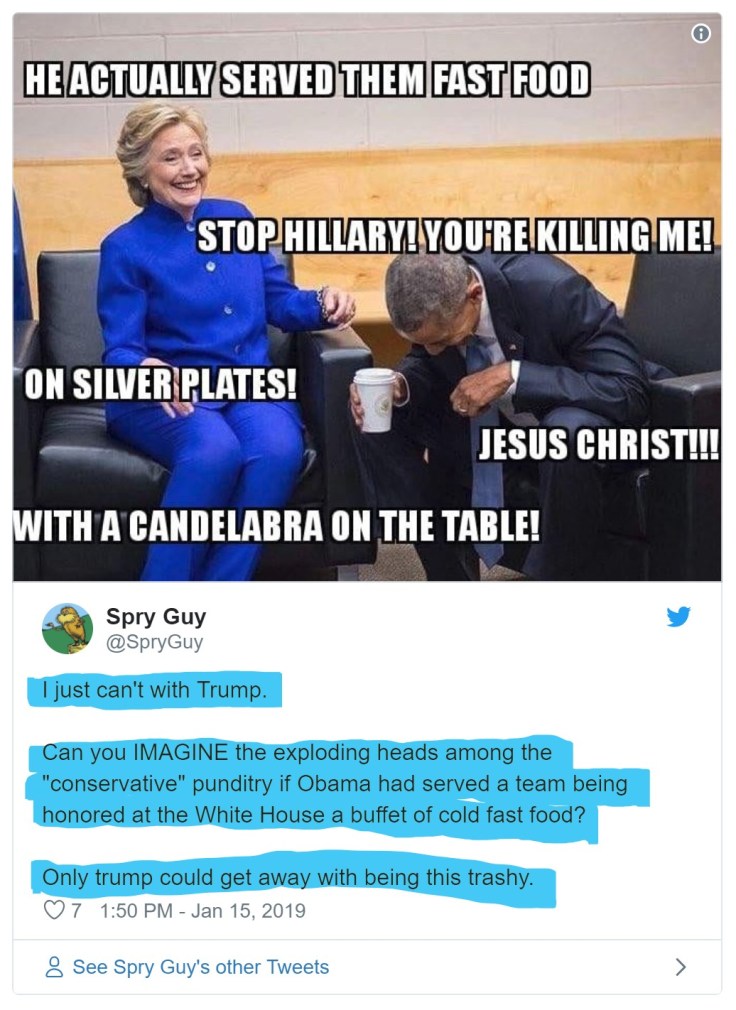
The left is mocking President Trump for providing a fast food buffet to a college football team, but emails obtained by WikiLeaks show that former President Obama flew in $65,000 worth of hotdogs from Chicago – using taxpayer funds – for a private party in 2009.
The haters spared no expense denigrating Trump on social media for serving hearty fast food to the Clemson University football team on Monday.


However, emails from global intelligence firm Stratfor, released by WikiLeaks in 2012, show that the Obama administration spent $65,000 of taxpayer money to fly “hot dogs” to a private dinner party at the White House in 2009.
“RE: Get ready for ‘Chicago Hot Dog Friday,’” said the email’s subject headline sent by Chief Innovation Officer Aaric S. Eisenstein.
“If we get the same ‘waitresses,’ I’m all for it!!!”
Stratfor Vice President Fred Burton replied, asking if they would be “using the same channels.”
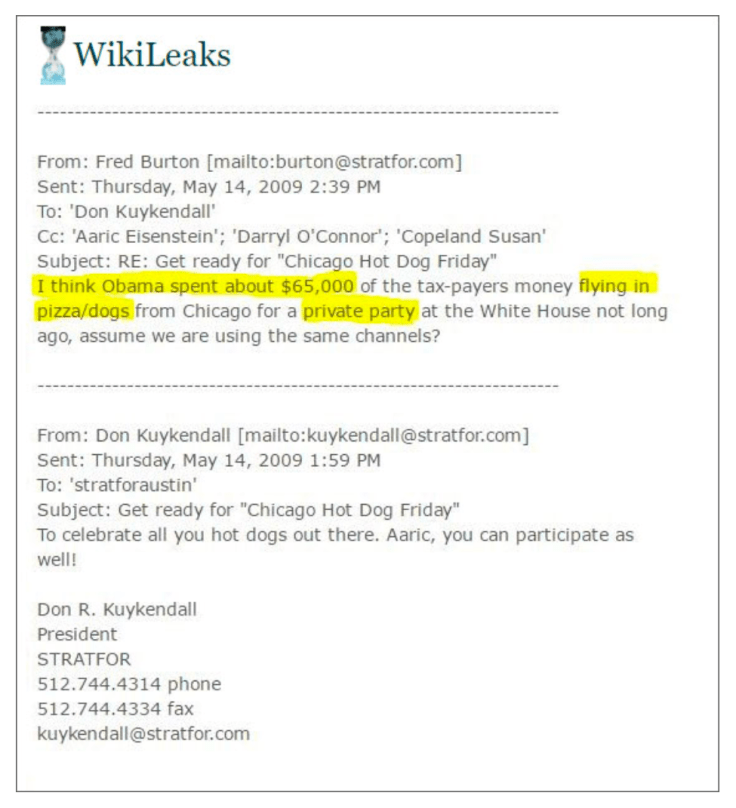
“I think Obama spent about $65,000 of the tax-payers money flying in pizza/dogs from Chicago for a private party at the White House not long ago, assume we are using the same channels?” he said.
The corporate media completely ignored WikiLeaks’ bombshell Global Intelligence Files release highlighting government waste and corruption, but they have time to fact-check every aspect of Trump’s fast food feast, including the true height of the pile of burgers.
Tom Fitton: No evidence Trump is Russia agent
Published on Jan 14, 2019
Twitter erupts after NYT reveals FBI probe into Trump-Russia links that lead… nowhere

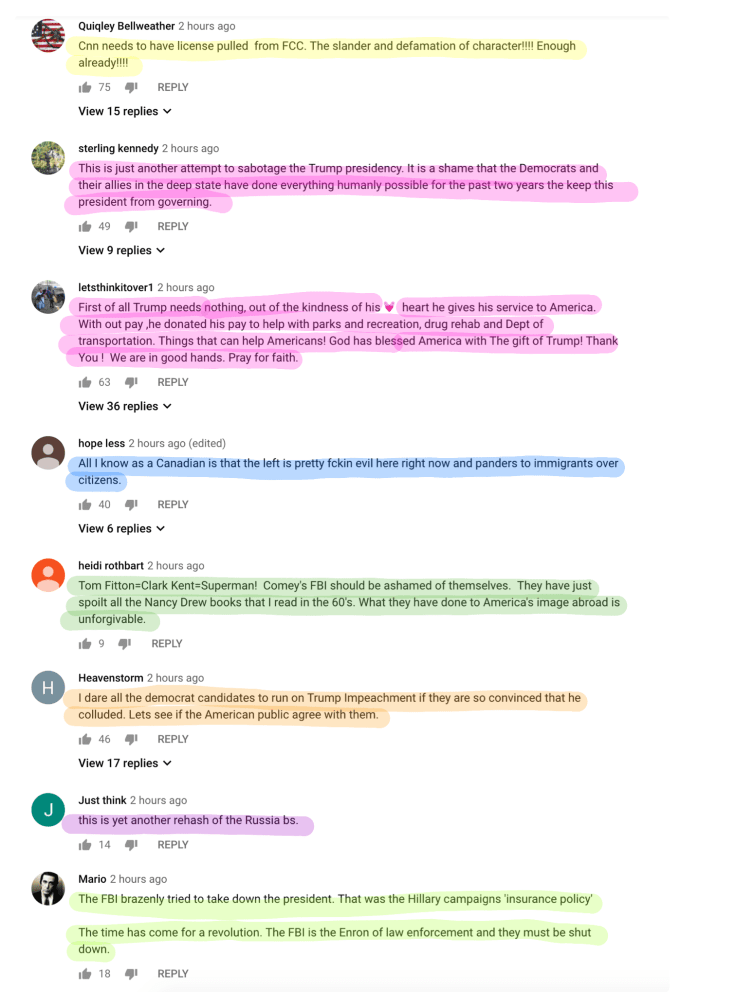
Russiagate disciples are squealing with joy after the New York Times wrote about the FBI apparently probing if Trump was secretly working for the Russians. In fact, the article states there is no evidence to support the theory.
In what appears to be a last-ditch Russiagate Hail Mary, the New York Times breathlessly reported on Friday – of course, citing people ‘familiar with the investigation’ – that the FBI began looking into whether the president was a covert Kremlin agent, after Trump fired then-FBI Director James Comey in May 2017. According to the Times, “agents and senior FBI officials had grown suspicious of Mr. Trump’s ties to Russia during the 2016 campaign,” but were reluctant to launch a formal probe into the matter. This all changed, the Times tells us, after Comey got the boot.
The investigation was quickly handed over to special counsel Robert Mueller, who continues to lead a probe into alleged Russian meddling in the 2016 election and collusion with Trump’s presidential campaign.
According to the Times, counterintelligence investigators “had to consider whether the president’s own actions constituted a possible threat to national security.” Agents were also tasked with determining whether Trump “knowingly work[ed] for Russia or had unwittingly fallen under Moscow’s influence.”
The decision to secretly investigate the president for possibly threatening national security triggered a “vigorous debate” within the Justice Department. The FBI, however, apparently felt vindicated after Trump remarked that Comey’s firing had helped relieve Russia-related political pressure.
Among Russiagate’s devout faithful, the report was treated as an earth-shattering revelation that reinforced their core dogma – i.e., that Donald Trump is a Kremlin agent installed in the White House by Vladimir Putin to destroy democracy.
Unfortunately, even the Times begrudgingly admitted – albeit buried in the ninth paragraph – that “no evidence has emerged publicly that Mr. Trump was secretly in contact with or took direction from Russian government officials.”
Indeed, Twitter was swamped with indignant comments accusing the paper of cooking up a massive nothingburger. One observant netizen pointed out that in October 2016, the New York Times even ran a headline that stated unequivocally: “Investigating Donald Trump, the FBI sees no clear links to Russia.”

Trump himself took to Twitter to mock the report.
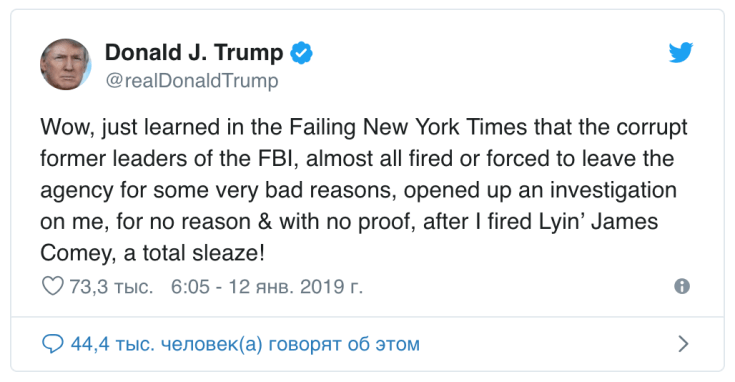
“Wow, just learned in the Failing New York Times that the corrupt former leaders of the FBI, almost all fired or forced to leave the agency for some very bad reasons, opened up an investigation on me, for no reason & with no proof, after I fired Lyin’ James Comey, a total sleaze!” he wrote.
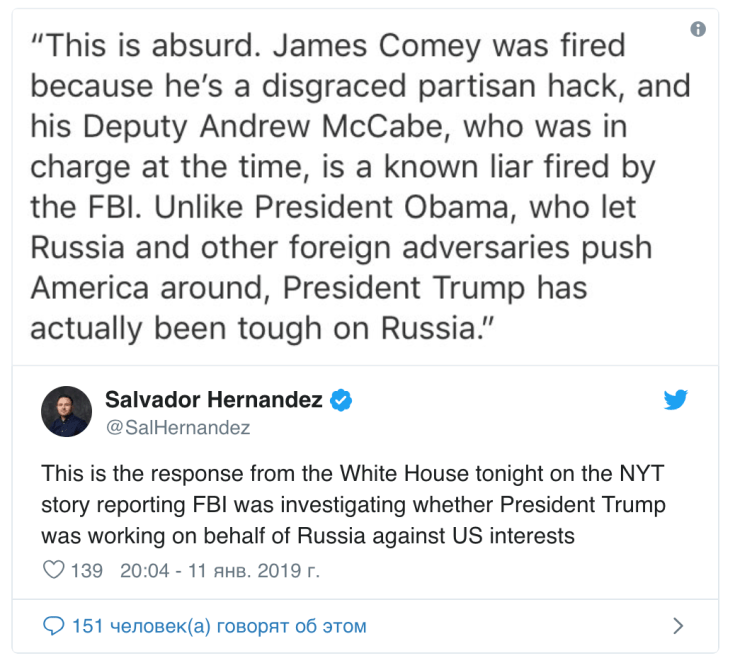
The White House said in a statement that the notion that Trump was in bed with Russia makes little sense, given the administration’s hardline policies directed at Moscow.
“Unlike President Obama, who let Russia and other foreign adversaries push America around, President Trump has actually been tough on Russia.”
The report also raises questions about whether Comey was being entirely truthful when he testified to Congress in December that Trump wasn’t among the “four Americans” targeted by the FBI counterintelligence probe into Russian meddling.
As one political pundit observed, the Times’ story raises more questions about the FBI than it does about Trump and his still unproven ties to Russia.
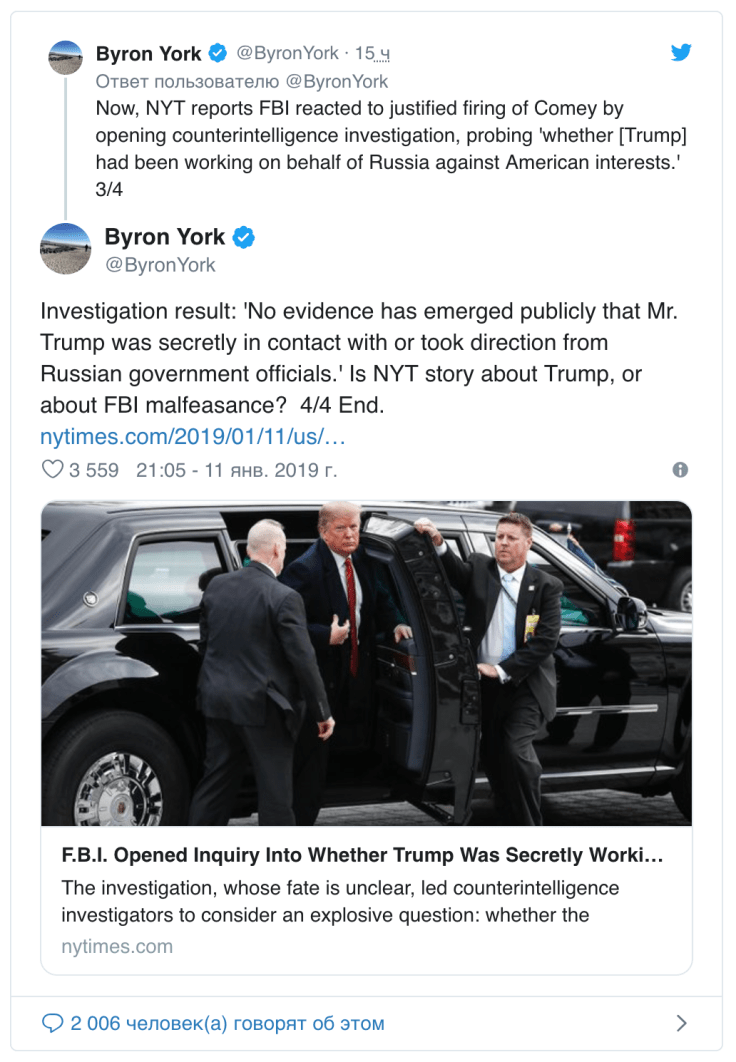
“Is NYT story about Trump, or about FBI malfeasance?” Fox News contributor Byron York asked in a tweet.
Obama Declared 13 National Emergencies — 11 Are Still Active
By Patrick Howley

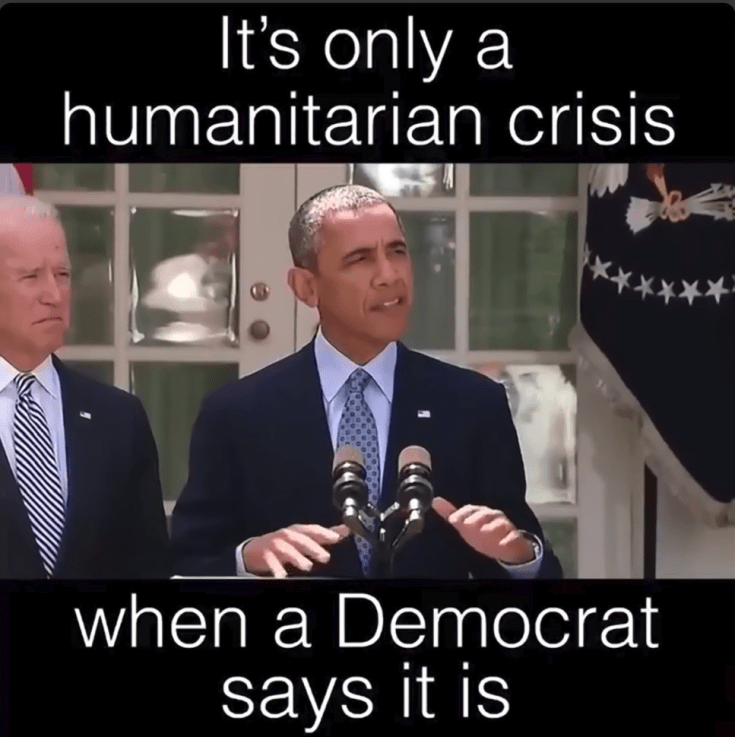
There are a lot of national emergencies going on. In fact, there are 31 active national emergencies declared under the National Emergencies Act.
Bill Clinton used this authority 17 times. President Trump has only used it three times so far.
Sorry Democrats, this “national emergency” business is not quite the work of “dictators.”
Conservative Tribune reports: “Of Obama’s 11 continuing national emergencies, nine of them were focused exclusively on foreign nations, while only one seemed focused on protecting America — a declaration aimed at punishing individuals “engaging in significant malicious cyber-enabled activities.”
Trending: Change.Org Petition To Impeach Rashida Tlaib Is Gaining Momentum
All of the rest of Obama’s national emergencies were focused on blocking property or prohibiting transactions/travel for individuals engaged in various activities in — by order of the date of enactment — Somalia, Libya, transnational criminal organizations, Yemen, Ukraine, South Sudan, Central African Republic, Venezuela and Burundi.
Conservative Tribune passage ends
The American people stand with President Trump following his amazing Oval Office address explaining the human cost of illegal immigration.
If President Donald Trump uses the U.S. military to build the border wall along the United States’ international with Mexico by declaring a national emergency, won’t liberals simply run to a Federal judge whom they believe to be left-wing within the Ninth Circuit and block Trump? Can Congress vote to overturn Trump’s declaration of an emergency?
No. If the federal courts actually follow the law, President Trump cannot be prevented from “reprogramming” funds appropriated for the U.S. Department of Defense and actually using the military (such as the U.S. Army Corps of Engineers) to build the border wall.
As noted in the first installment on this topic, Congress has given a president the power to declare a national emergency by 50 U.S.C. 1621 and 50 U.S.C. 1622. A declaration of an emergency allows the President to reprogram funds in the military budget. See 33 U.S. Code § 2293 “Reprogramming during national emergencies.”
Trump could reprogram funds from other parts of the Department of Defense budget — including from other DoD construction projects such as on bases, military housing, etc. — and engage in construction in areas of need for the national defense. The statute says that explicitly (although statutes are never easy reading).
But Democrats are threatening and commentators are warning that such an action would be challenged in court and in Congress immediately. Can such a plan be blocked?
First, 50 U.S.C. §1622 allows the Congress to over-turn a president’s declaration of an emergency. If both the Senate and the House each pass s resolution terminating the President’s declaration of an emergency, than the emergency status terminates under 50 U.S.C. §1622. But clearly the Republican-controlled U.S. Senate would not join the Democrat-controlled U.S. House of Representatives. Unless a significant number of Republican Senators vote against a border wall built by the U.S. Army Corps of Engineers or contractors with military funds, Congress could not block Trump’s efforts.
(Note, although I argue in the next section that this power has been invalidated by the U.S. Supreme Court, if a court disagrees on that, a legislative veto power should block a lawsuit. Where Congress has provided a specific method for challenging a declaration of an emergency, the federal courts would normally hold that that method becomes the exclusive remedy. A lawsuit would be blocked by the fact that Congress provided a non-litigation remedy.)
Second, however, the Congressional veto process described above has been ruled unconstitutional by the U.S. Supreme Court, in INS v. Chadha, 462 U.S. 919 (1983), finding a legislative veto of Executive Branch action unconstitutional. Congress passed many laws which specifically enabled Congress to veto regulations or actions under that law. The U.S. Supreme Court found a legislative veto violates the structure or architecture of the Constitutional system.
Laws go to the President for signature or veto. Congress cannot reach over and pull a law back. Congress must pass a new law and present it to the President for signature if dissatisfied with how the law is working out. The U.S. Supreme Court had no hesitation finding that the Congress had over-reached, based only on the implied architecture of the Constitution.
In Chadha, 50 U.S.C. 1622 was one of the laws explicitly discussed. The dissenting opinion specifically warned that the Chadha decision invalidated Congress’s ability to overturn a presidential declaration of a national emergency.
Therefore, Congress cannot overturn a declaration by President Trump that the open border is a national emergency. Even if the U.S. Senate were to side with the Democrats, Chadha explicitly ruled the Congressional veto (termination) of a presidential declaration to be an unconstitutional distortion of the familiar “Schoolhouse Rock” means by which laws are passed and signed by presidents. Once a law is signed, there is no “claw back” right by Congress.
Third, of course, critics are discussing whether Trump’s actions would be constitutional. Here, however, Congress passed a specific statute, in fact a series of statutes. So there is no question about the President’s power to do what the Congressional statute has explicitly empowered him to do.
 Tom's Blog