WATCH: Dem Presidential Candidate Julián Castro Favors ‘Reparations’ For Slavery, Though He’s Unsure How To Go About It

By FRANK CAMP

Julian Castro, former secretary of Housing and Urban Development (HUD), listens as a volunteer speaks at the 'Navigating Recovery of the Lakes Region' organization in Laconia, New Hampshire, U.S., on Wednesday, Jan. 16, 2019.

On Sunday, democratic presidential candidate Julián Castro appeared on CNN’s “State of the Union” with Jake Tapper.

During the segment, Tapper spoke with Castro about the issue of reparations for descendants of slavery: “This is also dividing Democrats on the trail. You’ve said that there needs to be some kind of reparations to descendants of slaves to compensate for years of slavery and discrimination against African Americans in this country.”

Tapper then played a clip in which presidential rival Sen. Bernie Sanders (I-VT) talks about Castro’s and Sen. Kamala Harris’ (D-CA) support for reparations:

What do they mean? I’m not sure anyone’s very clear. What I just said is that I think we must do everything that we can to address the massive level of disparity that exists in this country.

Tapper asked Castro: “So, what do you mean? Do you think that there should be actual monetary payments to descendants of slaves? Do support more like what Senator Sanders is talking about, policies such as child care and education that help those who are disadvantaged?”

Castro replied:

Well, you know, what I said was that I’ve long believed that this country should address slavery, the original sin of slavery, including by looking at reparations, and if I’m president, then I’m going to appoint a commission or task force to determine the best way to do that. There’s a tremendous amount of disagreement on how we would do that.

Castro then took a jab at Sanders, saying that he shouldn’t be arguing against an approach to reparations that might include “writing a big check” because that’s been the senator from Vermont’s position on health care and college tuition.

He concluded: “So, if under the Constitution, we compensate people because we take their property, why wouldn’t you compensate people who actually were property?”

The notion of somehow compensating the ancestors of American slaves has long been a topic of discussion among academics and political thinkers. However, the mechanics by which a reparations program would operate have challenged even the most diligent.

On an episode of “Point Taken” on PBS regarding reparations, libertarian commentator Kmele Foster stated bluntly: “I think the important things to consider are, who pays? How much do they pay? And who do they pay it to? These are impossibly difficult questions to actually reconcile and answer in a meaningful and just way.”

Even progressive author Ta-Nehisi Coates, in his 2014 thesis on “the case for reparations” published in The Atlantic, didn’t come to any conclusion as to how reparations should work, writing in part:

Perhaps no number can fully capture the multi-century plunder of black people in America. Perhaps the number is so large that it can’t be imagined, let alone calculated and dispensed. But I believe that wrestling publicly with these questions matters as much as—if not more than—the specific answers that might be produced. An America that asks what it owes its most vulnerable citizens is improved and humane. An America that looks away is ignoring not just the sins of the past but the sins of the present and the certain sins of the future. More important than any single check cut to any African American, the payment of reparations would represent America’s maturation out of the childhood myth of its innocence into a wisdom worthy of its founders.

Coates does refer to a bill from former Rep. John Conyers as the beginning of a potential solution: “A country curious about how reparations might actually work has an easy solution in [John] Conyers’s bill, now called HR 40, the Commission to Study Reparation Proposals for African Americans Act. We would support this bill, submit the question to study, and then assess the possible solutions.”

Former President Obama even commented on the non-feasibility of a reparations program:

As a practical matter, it is hard to think of any society in human history in which a majority population has said that as a consequence of historic wrongs, we are now going to take a big chunk of the nation’s resources over a long period of time to make that right.

Instead, Obama pointed toward progressive redistributionist programs as a means of reparations:

[I am] not so optimistic as to think you would ever be able to garner a majority of the American Congress that would make those kinds of investments above and beyond the kind of investments that could be made in a progressive program for lifting up all people.

As the Democratic presidential candidates gear up for a contentious primary season, they should be prepared to answer questions about reparations. With Julián Castro, Kamala Harris, and Elizabeth Warren already promoting the issue, it’s unlikely that it will fade silently into the night.

READ MORE: BARACK OBAMA  DEMOCRATIC PARTY  JULIAN CASTRO  REPARATIONS  SLAVERY
Warren, Harris Add Reparations to 2020 Campaign Platforms

By

All Democrats have to do is not be insane. And they can’t do it.

Screen Shot 2019-02-21 at 6.10.33 PM

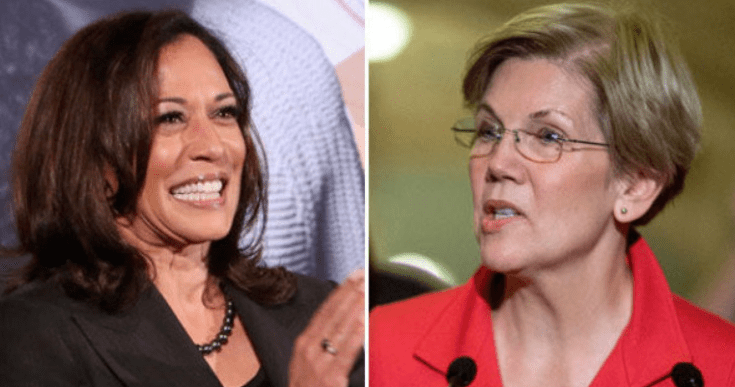
In an effort to pander to black voters, Sens. Kamala Harris (D-Calif.) and Elizabeth Warren (D-Mass.), both presidential candidates, said they will back reparations for black Americans as part of their campaign platforms.

“We have to be honest that people in this country do not start from the same place or have access to the same opportunities,” Harris reportedly said. “I’m serious about taking an approach that would change policies and structures and make real investments in black communities.”

That statement followed a radio interview in which she explicitly agreed with the host when that “government reparations for black Americans were necessary to address the legacies of slavery and discrimination.”

Warren echoed a similar sentiment.

“Ms. Warren also said she supported reparations for black Americans impacted by slavery — a policy that experts say could cost several trillion dollars, and one that Barack Obama, Hillary Clinton, Bernie Sanders and many top Democrats have not supported,” The New York Times said.

The report said that Warren “declined to giver further details” about her reparations plan.

These are the same candidates that also support a “Green New Deal,” which will also cost trillions of dollars at the expense of the American taxpayer.

But there are more questions surrounding reparations than exactly how much they would cost.

Mainly, who would pay them?

Would reparations be paid only by white people who have slave-owning lineages, like Democratic Gov. Ralph Northam of Virginia? Would I, as an Arab American whose family immigrated to the United States through Ellis Island, be required to pay for something in which my ancestors had no part?

Likewise, who exactly would receive them?

Would all blacks receive some form of reparations, regardless of whether their ancestors were slaves? What if someone is half black? Or a quarter? Is that person owed a fraction of the reparations of a fully black American?

And what about poor white people? There are millions of whites who “do not start from the same place or have access to the same opportunities,” as Harris argued. Will they be buried more deeply – will they have to become poorer –  simply to atone for the color of their skin? Is that justice?

Most importantly, would reparations help repair the cultural strife in this country, which is mostly promulgated by the mainstream press for ratings and Democrat politicians for votes? Wouldn’t the Harris/Warren plan cause more strife and racial tension?

Do these loons really believe that – in a perfect world – reparations would be paid and everyone would simply shake hands, walk away, and that the country will be more united than it has ever been?

These are practical questions that remained unanswered by politicians who are race-baiting for votes.

Stacey Abrams will be pushing for Reparations

The flyer touting an event with Stacey Abrams in Atlanta earlier this week read like a left-leaning activist’s fantasy: It’s 2022 and “we’re celebrating Medicare for All and Free College, and next on the agenda is Reparations.”

It invited progressives to hop in a time machine and imagine they are hearing from Abrams, a former Georgia House Democratic leader running for governor, after she “set the course for a new wave of leaders.”

“Because we’re governing with gusto, we’re seeing victories up and down the ballot—including winning a governorship in Texas and putting 38 electoral votes in grasp by 2024,” it read. Abrams said she and other candidates spoke at the Democracy Alliance’s Monday conference, a meeting of progressive activists and financiers that aimed to chart the party’s course. But she said the topic of reparations – payments to the descendants of slaves – did not come up.

See the source image

Instead, her campaign said the event focused broadly on building power for progressives. It also said she didn’t organize or sponsor the event or have any role in making the flyer.

In a statement, Abrams touted her plans to address access to education, criminal justice initiatives and voting rights – “plans which serve all Georgians but also include specific solutions communities need to overcome structural barriers to opportunity.”

Abrams, who is running to be the nation’s first black female governor, faces former state Rep. Stacey Evans in the May 22 primary. The two have clashed on a range of issues, including gun control votes, tax cut plans and competing strategies to win in November.

Neither candidate has talked about reparations on the campaign trail. And neither commented about the debate when asked Wednesday by the AJC. The Democracy Alliance attracted dozens of wealthy donors and leaders of left-leaning organizations to plot out the party’s future.

California billionaire Tom Steyer, who has pumped $20 million into a movement to impeach Donald Trump, was in town during the meeting. And several candidates for state office were seen mingling in the crowd at the InterContinental Buckhead Atlanta, where Planned Parenthood officials announced earlier Monday the group endorsed Abrams.

The Washington Free Beacon first reported about the event.

The “2022 Victory Party” event was organized by a coalition of organizations that include Planned Parenthood, Collective Action PAC and Propel Capital. Several of the groups declined to comment on the flyer.

Blog at WordPress.com.

Up ↑