6/18/2020
“America created slavery” Africa: •__• … uhm, yea they created that…

By Jim Hoft – 6/3/2020

Johnson’s plan will offer a $350,767 one time cash payment to every African American in the US today who are descendants of of slaves.
Johnson says now is the time to go big with his $14 trillion plan.
Johnson says the big leap will solve the problems today in the black community.
Johnson says the $14 trillion will come from redistribution, “Wealth transfer is exactly what’s needed.”
By Joshua Caplan
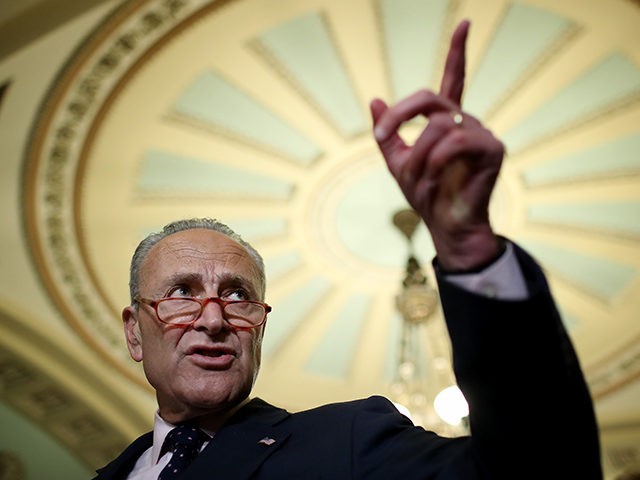
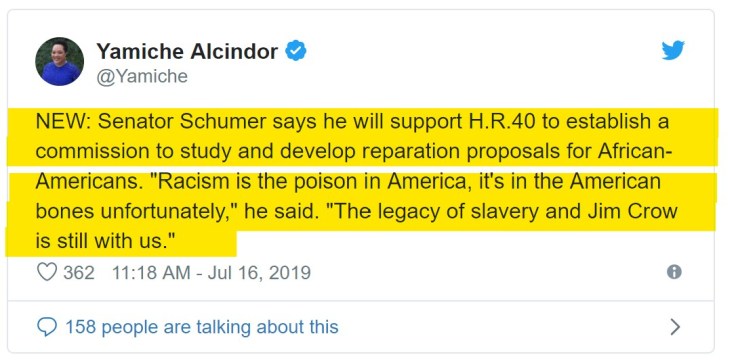
“Racism is the poison in America, it’s in the American bones, unfortunately,” Schumer said as voiced support for H.R 40, a bill championed by Rep. Sheila Jackson Lee (D-TX) that would create a commission to study the issue of reparations. “The legacy of slavery and Jim Crow is still with us,” added Schumer.
The debate over reparations catapulted from the campaign trail to Congress last month when lawmakers heard testimony for and against the idea of providing compensation for slavery. On June 19th, the House Judiciary Subcommittee on Constitution, Civil Rights and Civil Liberties held a hearing on Jackson Lee’s bill. The panel invited 2020 White House hopeful Sen. Cory Booker (D-NJ), Hollywood actor and left-wing activist Danny Glover, author Ta-Nehisi Coates, and others to discuss the measure re-introduced in January.
Booker, who testified first before the panel, said the country has “yet to truly acknowledge and grapple with the racism and white supremacy that tainted this country’s founding and continues to cause persistent and deep racial disparities and inequality.”
“The stain of slavery was not just inked in bloodshed, but in policies that have disadvantaged African Americans for generations,” the lawmaker added.
Earlier this year, Booker introduced a version of Jackson Lee’s measure to the Senate.
Following Booker was Glover, who called establishing a national policy on reparations a “moral, democratic, and economic imperative.”
“Despite much progress over the last centuries, this hearing is yet another important step in the long and heroic struggle of African-Americans to cure the damages inflicted by enslavement, post-emancipation and forced racial exclusionary policies,” Glover told lawmakers
The hearing came amid a growing discussion in the Democrat Party about reparations. Several of the party’s presidential candidates have endorsed looking at the idea.
In a Point Taken-Marist poll conducted in 2016, 68 percent of Americans said the country should not pay cash reparations to African American descendants of slaves to make up for the harm caused by slavery and racial discrimination. About 8 in 10 white Americans said they were opposed to reparations, while about 6 in 10 black Americans said they were in favor.
Senate Majority Leader Mitch McConnell (R-KY) has said that he opposes reparations, telling reporters: “I don’t want reparations for something that happened 150 years ago. We’ve tried to deal with the original sin of slavery by passing civil rights legislation.”
“It would be hard to figure out who to compensate” for slavery, the Kentucky Republican noted. “No one currently alive was responsible for that.”
Last week, McConnell said his family’s history of slave ownership doesn’t change his opposition to reparations.
The Kentucky Republican noted that he and former President Barack Obama have opposed reparations, and “both are the descendants of slave owners.”
The Associated Press contributed to this report.

By Patrick Howley
Kamala Harris’ father Donald Harris wrote an essay entitled “Reflections of a Jamaican Father” for Jamaica Global Online, in which he made a startling admission (emphasis added):
“My roots go back, within my lifetime, to my paternal grandmother Miss Chrishy (née Christiana Brown, descendant of Hamilton Brown who is on record as plantation and slave owner and founder of Brown’s Town) and to my maternal grandmother Miss Iris (née Iris Finegan, farmer and educator, from Aenon Town and Inverness, ancestry unknown to me). The Harris name comes from my paternal grandfather Joseph Alexander Harris, land-owner and agricultural ‘produce’ exporter (mostly pimento or all-spice), who died in 1939 one year after I was born and is buried in the church yard of the magnificent Anglican Church which Hamilton Brown built in Brown’s Town (and where, as a child, I learned the catechism, was baptized and confirmed, and served as an acolyte).”
Harris’ father’s passage ends
Hamilton Brown was not only a slave owner, but also an engineer of mass Irish migration to Jamaica after the British empire abolished slavery in 1834.
Jamaican Family Search recorded: “Hamilton Brown owned several plantations over the years 1817 to about 1845. According to the 1818 Almanac which can be found on this site, (Jamaican Family Search) , he was the owner of Minard (128 slaves) which he must have acquired from its previous owner (John Bailie) in 1815 or later. The number of slaves on this estate approximates the number of slaves in one of the registers attributed to his ownership (124 slaves). The other register (86 slaves) cannot be assigned to any estate, although he is listed in Almanacs for subsequent years as owning several, (Antrim, Grier Park, Colliston, Little River, Retirement and Unity Valley).”
Here is a full accounting of the slaves owned by Hamilton Brown, according to the National Archives in London, as of June 28, 1817 in the parish of St. Ann in Jamaica:
| NAMESNames of all Males to precede names of females
MALES |
Colour | Age | African or creole | Remarks |
| 1 Apollo | Negro | 45 | African | – |
| 2 Jein | Negro | 40 | African | – |
| 3 Sambo | Negro | 40 | African | – |
| 4 Cicero | Negro | 30 | African | – |
| 5 St???e | Negro | 45 | African | – |
| 6 Chance | Negro | 44 | African | – |
| 7 Clendin | Negro | 42 | African | – |
| 8 Jamaica | Negro | 32 | African | – |
| 9 Apollo | Negro | 32 | African | – |
| 10 Montague | Negro | 38 | African | – |
| 11 Jack | Negro | 30 | African | – |
| 12 Mark | Negro | 32 | African | – |
| 13 Ned | Negro | 36 | African | – |
| 14 Sharper | Negro | 40 | African | – |
| 15 Ceasar | Negro | 38 | African | – |
| 16 John | Negro | 30 | African | – |
| 17 Charles | Negro | 35 | African | – |
| 18 Oxford | Negro | 35 | African | – |
| 19 Hannibal | Negro | 32 | African | – |
| 20 ??ill | Negro | 30 | African | – |
| 21 Dick | Negro | 35 | African | – |
| 22 Duke | Negro | 32 | African | – |
| 23 Nelson | Negro | 34 | African | – |
| 24 Robert | Negro | 30 | African | – |
| 25 George | Negro | 35 | African | – |
| 26 Prince | Negro | 40 | African | – |
| 27 Henry | Negro | 38 | African | – |
| 28 Hamilton | Negro | 28 | African | 4 |
| 29 Tom Jack | Negro | 40 | African | – |
| 30 Neal | Negro | 34 | African | – |
| 31 Luke | Negro | 28 | African | – |
| 32 Bel | Negro | 25 | African | – |
| 33 ????? | Negro | 33 | African | – |
| 34-39 missing | – | – | – | – |
| – | – | – | PAGE 89 | – |
| 40 Charles | Negro | 16 | Creole | – |
| 41 London | Negro | 11 | Creole | – |
| 42 Nelson | Negro | 10 | Creole | son of Juddy |
| 43 Jamaica | Negro | 10 | Creole | son of Evey |
| 44 ?Seny | Negro | 8 | Creole | son of Juddy |
| 45 Virgil | Negro | 8 | Creole | son of Love |
| 46 Tom | Negro | 4 | Creole | son of Juddy |
| 47 Joab | Negro | 3 | Creole | son of Lucky |
| 48 Harper | Negro | 3 | Creole | son of Love |
| 49 Jack | Negro | 2 | Creole | son of Lucy |
| 50 James | Negro | 2 | Creole | son of Tamer |
| 51 Sambo | Negro | 2 | Creole | son of Evey |
| 52 Dick | Negro | 1 | Creole | son of Nanny |
| 53 Charles | Negro | 1 | Creole | son of Nelly |
| 54 Hugh | Negro | 5mos | Creole | son of Maria |
| 55 Sam | Negro | 4mos | Creole | son of Gift |
| 56 George | Negro | 6mos | Creole | son of Flance |
| FEMALES | – | – | – | – |
| 1 Pheba | Negro | 50 | African | – |
| 2 Love | Negro | 42 | African | – |
| 3 Juddy | Negro | 40 | African | – |
| 4 ?Floramel ?Meromel | Negro | 40 | African | – |
| 5 Flora | Negro | 38 | African | – |
| 6 Lucy | Negro | 40 | African | – |
| 7 Maria | Negro | 40 | African | – |
| 8 Laura | Negro | 30 | African | – |
| 9 Evey | Negro | 30 | African | 5 |
| 10 Olive | Negro | African | – | |
| 11 Lucky | Negro | 28 | African | – |
| 12 Venus | Negro | 32 | African | – |
| 13 Rachel | Negro | 30 | African | – |
| 14 ?Betsy | Negro | 27 | African | – |
| 15 Juliet | Negro | 48 | African | – |
| 16 Hellen | Negro | 40 | African | – |
| 17 Nanny | Negro | 27 | African | – |
| 18 Nelly | Negro | 28 | African | – |
| 19 Gift | Negro | 25 | African | – |
| 20 Jeane | Negro | 33 | African | – |
| 21 Milly | Negro | 32 | African | – |
| 22 Industry | Negro | 13 | Creole | – |
| 23 Margaret | Negro | 10 | Creole | Daughter of Juddy |
| 24 Nancy | Negro | 4 | Creole | Daughter of Tamer |
| 25 Mary | – | 4 | Creole | Daughter of Evey |
| – | – | – | PAGE 90 | – |
| 26 Peggy | Negro | 3 | Creole | Daughter of Flora |
| 27 Sarah | Negro | 2 | Creole | Daughter of Nanny |
| 28 ? Hanna | Negro | 6mos | Creole | Daughter of Tamer |
| 29 Hellen | Negro | 5mos | Creole | Daughter of Milly |
| 30 Nelly | Negro | 2 | Creole | Daughter of ?Floramel ?Meromel |
Hamilton Brown officially swore to the authenticity of this record, stating:
“I Hamilton Brown do swear that the above list and return consisting of two sheets is a true perfect and complete list and return, to the best of my knowledge and belief in every particular therein mentioned of all and every slaves possessed by me as owner, considered as most permanently settled, worked and employed in the Parish of Saint Ann on the twenty Eight day of June One thousand Eight Hundred and Seventeen without fraud, deceit or evasion So help me God.
Sworn before me this twenty fourth day of September 1817”
Hamilton Brown’s slave owning shows up in other records, as well.
“Hamilton Brown was instrumental in the importing of several hundred labourers and their families from Ireland to Jamaica between 1835 and 1840,” according to University College London’s project “Legacies of British Slave-ownership.” The project describes Hamilton Brown as a “Major attorney and resident slave-owner in Jamaica.”
The Jamaican newspaper The Gleaner reported in July 2012 in a travel piece on Brown’s Town:
“As we struggled to stay on the narrow sidewalk, we noticed an elderly man coming our way. He had an unruly grey beard and wore spectacles with thick frames and cloudy lenses.
“Hallo! Hallo!” he said. We stopped and returned the greeting. The man gave his name as Ferly and he told us a bit about Brown’s Town.
“A good amount of Brown live here, you know,” he said. “People what name Brown pack up the place. It all coming from Hamilton Brown who the town name after. Yes man, dem teach it in school,” said Ferly, nodding.
He told us that Hamilton Brown was buried in the graveyard at the nearby Anglican Church. “But a lot of people don’t even know that. Is only long-time people like me know dem tings,” he said.”
The Gleaner passage ends
Black activist Tariq Nasheed has publicly cast doubt on Kamala Harris’ claim to being “Black.”
Published on Mar 14, 2019

Published on Mar 12, 2019
By FRANK CAMP

During the segment, Tapper spoke with Castro about the issue of reparations for descendants of slavery: “This is also dividing Democrats on the trail. You’ve said that there needs to be some kind of reparations to descendants of slaves to compensate for years of slavery and discrimination against African Americans in this country.”
Tapper then played a clip in which presidential rival Sen. Bernie Sanders (I-VT) talks about Castro’s and Sen. Kamala Harris’ (D-CA) support for reparations:
What do they mean? I’m not sure anyone’s very clear. What I just said is that I think we must do everything that we can to address the massive level of disparity that exists in this country.
Tapper asked Castro: “So, what do you mean? Do you think that there should be actual monetary payments to descendants of slaves? Do support more like what Senator Sanders is talking about, policies such as child care and education that help those who are disadvantaged?”
Castro replied:
Well, you know, what I said was that I’ve long believed that this country should address slavery, the original sin of slavery, including by looking at reparations, and if I’m president, then I’m going to appoint a commission or task force to determine the best way to do that. There’s a tremendous amount of disagreement on how we would do that.
Castro then took a jab at Sanders, saying that he shouldn’t be arguing against an approach to reparations that might include “writing a big check” because that’s been the senator from Vermont’s position on health care and college tuition.
He concluded: “So, if under the Constitution, we compensate people because we take their property, why wouldn’t you compensate people who actually were property?”
The notion of somehow compensating the ancestors of American slaves has long been a topic of discussion among academics and political thinkers. However, the mechanics by which a reparations program would operate have challenged even the most diligent.
On an episode of “Point Taken” on PBS regarding reparations, libertarian commentator Kmele Foster stated bluntly: “I think the important things to consider are, who pays? How much do they pay? And who do they pay it to? These are impossibly difficult questions to actually reconcile and answer in a meaningful and just way.”
Even progressive author Ta-Nehisi Coates, in his 2014 thesis on “the case for reparations” published in The Atlantic, didn’t come to any conclusion as to how reparations should work, writing in part:
Perhaps no number can fully capture the multi-century plunder of black people in America. Perhaps the number is so large that it can’t be imagined, let alone calculated and dispensed. But I believe that wrestling publicly with these questions matters as much as—if not more than—the specific answers that might be produced. An America that asks what it owes its most vulnerable citizens is improved and humane. An America that looks away is ignoring not just the sins of the past but the sins of the present and the certain sins of the future. More important than any single check cut to any African American, the payment of reparations would represent America’s maturation out of the childhood myth of its innocence into a wisdom worthy of its founders.
Coates does refer to a bill from former Rep. John Conyers as the beginning of a potential solution: “A country curious about how reparations might actually work has an easy solution in [John] Conyers’s bill, now called HR 40, the Commission to Study Reparation Proposals for African Americans Act. We would support this bill, submit the question to study, and then assess the possible solutions.”
Former President Obama even commented on the non-feasibility of a reparations program:
As a practical matter, it is hard to think of any society in human history in which a majority population has said that as a consequence of historic wrongs, we are now going to take a big chunk of the nation’s resources over a long period of time to make that right.
Instead, Obama pointed toward progressive redistributionist programs as a means of reparations:
[I am] not so optimistic as to think you would ever be able to garner a majority of the American Congress that would make those kinds of investments above and beyond the kind of investments that could be made in a progressive program for lifting up all people.
As the Democratic presidential candidates gear up for a contentious primary season, they should be prepared to answer questions about reparations. With Julián Castro, Kamala Harris, and Elizabeth Warren already promoting the issue, it’s unlikely that it will fade silently into the night.
READ MORE: BARACK OBAMA DEMOCRATIC PARTY JULIAN CASTRO REPARATIONS SLAVERY





 Tom's Blog