With Clinton & Romney both rumored to be JOINING 2020 race, has politics gone the way of Hollywood?

CAP

Two-time losers Hillary Clinton and Mitt Romney are rumored to be mulling presidential runs in 2020, despite repeated and resounding rejections from the voting public. Why won’t they go away, and is this a sign of a deeper crisis?

It’s not just Clinton and Romney. Democratic frontrunner Joe Biden himself is a two-time loser convinced that third time’s the charm. Even Democratic Socialist Bernie Sanders, whose policy ideas are relatively new, even if he isn’t, has been in politics most of his life. DC has become the east coast version of Hollywood, churning through remake after remake as audiences and interest dwindle, fueled by a zombie economy of donors utterly disconnected from the real world.

Clinton has been ubiquitous on TV for the past few weeks, making the rounds ostensibly to promote a book she co-wrote with her daughter. Yet every single conversation inevitably swings back to 2016, how she was robbed of her rightful place in the Oval Office, and how President Donald Trump is an “illegitimate” leader who “knows” he stole the election.

When Trump opted to pull troops out of northern Syria on Monday, finally fulfilling a campaign promise he’d made in part to counter her warmongering, Clinton was quick to slam the decision as a “sickening betrayal.”

CAP

Her tweet – which seemingly wouldn’t hold much significance now that she’s (supposedly) retired from politics – nevertheless rated entire articles in the Hill and other publications.

Former Trump strategist Steve Bannon claimed last week that Clinton is definitely running – she’s merely looking for an opening.
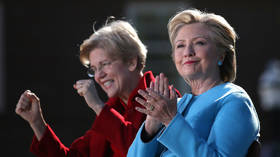
Her impeachment cheerleading could be motivated by the possibility that when the Ukrainegate cards are laid out on the table, frontrunner Biden could easily go down in flames, leaving the field wide open for her to step in – especially now that her 2016 rival, Sanders, has been laid low with a heart attack.

Biden speaks for the Democratic establishment when he promises “nothing would fundamentally change” if he won. His constant name-dropping of Obama – when he can remember his former boss’ name that is – is a naked appeal to amnesiac nostalgia, the Democratic Party platform’s declaration that everything bad in the country has happened because of Trump.

This is not merely a Democratic Party problem, however. Mitt Romney, the Utah Senator who failed to secure his party’s nomination for president in 2008 and failed to beat Barack Obama in 2012, has been complaining to anyone who will listen that Trump’s actions on Ukraine are “wrong and appalling.”

He too leapt onto Twitter following Trump’s announcement of the Syria pullout, calling “the president’s decision to abandon our Kurd allies in the face of an assault by Turkey…a betrayal.” And he too suddenly rates entire articles based on a single tweet.

CAP

Romney is testing the waters for a 2020 run, calling his donors to see who’ll bite, according to the self-described “Republican political operative” Jack Posobiec. Trump Communications Director turned sophomoric insult machine Anthony Scaramucci has already started cheering Romney on, while never-Trump neocon William Kristol’s new outlet The Bulwark posted a fawning paean to the former Massachusetts governor on Monday, just two days after Kristol himself tweeted a poll that showed Trump nearly twice as “respected” as Romney. Perhaps hoping to change those numbers, the warmonger’s journal gushed that Romney has “stepped up at the decisive moments” and “seems focused on the verdict of history.”

CAP

American politics has seemingly fallen prey to the same sickness that plagues Hollywood, where nearly every film seems to be a remake or spinoff of something that came before. Producers argue audiences embrace the familiar; a recent survey found that isn’t the case – that 91 percent of remakes experience steep drop-offs in approval compared to the originals. Movie theater attendance dropped to a 19-year low in 2017. Audiences are sick of being fed pre-chewed entertainment and “woke” takes on beloved classics.

And it’s no different in politics – 42 percent of Americans identified as independents in 2017, suggesting that nearly half the country is utterly disgusted with a two-party system that doesn’t even pretend to represent them, instead pandering to an idealized “middle class” their policies have helped kill. Nevertheless, hoary old has-beens are the only candidates with enough money to make it onto the ballot. As a result, voter turnout plunged to a 20-year low in 2016, with just 55 percent of voting-age citizens casting ballots.

Neither party has learned its lesson from 2016, which saw a dynamic – if, to some, off-putting – character sweep through first the primaries and then the general election by positioning himself as the opposite of the “swamp creatures” that have made a career out of looking busy while ensuring the status quo doesn’t move. Anyone with a flicker of originality is sidelined (Tulsi Gabbard) or mocked (Marianne Williamson). Perhaps both parties really do want four more years of Trump – it gives them an excuse to sit on the sidelines and complain without having to do any governing.

By Helen Buyniski


In America, talk turns to something unspoken for 150 years: Civil war…

By  Greg Jaffe and Jenna Johnson

Screen Shot 2019-03-01 at 3.45.41 PM

At a moment when the country has never seemed angrier, two political commentators from opposite sides of the divide concurred last week on one point, nearly unthinkable until recently: The country is on the verge of “civil war.”

First came former U.S. attorney Joseph diGenova, a Fox News regular and ally of President Trump. “We are in a civil war,” he said. “The suggestion that there’s ever going to be civil discourse in this country for the foreseeable future is over. . . . It’s going to be total war.”

The next day, Nicolle Wallace, a former Republican operative turned MSNBC commentator and Trump critic, played a clip of diGenova’s commentary on her show and agreed with him – although she placed the blame squarely on the president.

Trump, she said, “greenlit a war in this country around race. And if you think about the most dangerous thing he’s done, that might be it.”

With the report by special counsel Robert Mueller reportedly nearly complete, impeachment talk in the air and the 2020 presidential election ramping up, fears that once existed only in fiction or the fevered dreams of conspiracy theorists have become a regular part of the political debate. These days, there’s talk of violence, mayhem and, increasingly, civil war.

A tumultuous couple of weeks in American politics seem to have raised the rhetorical flourishes to a new level and also brought a troubling question to the surface: At what point does all the alarmist talk of civil war actually increase the prospect of violence, riots or domestic terrorism?

Screen Shot 2019-03-01 at 3.47.53 PM

Speaking to conservative pundit Laura Ingraham, diGenova summed up his best advice to friends: “I vote, and I buy guns. And that’s what you should do.”

He was a bit more measured a few days later in an interview with The Washington Post, saying that the United States is in a “civil war of discourse . . . a civil war of conduct,” triggered mostly by liberals and the media’s coverage of the Trump presidency. The former U.S. attorney said he owns guns mostly to make a statement, and not because he fears political insurrection at the hands of his fellow Americans.

The rampant talk of civil war may be hyperbolic, but it does have origins in a real crumbling confidence in the country’s democratic institutions and its paralyzed federal government. With Congress largely deadlocked, governance on the most controversial issues has been left to the Supreme Court or has come through executive or emergency actions, such as Trump’s border wall effort.

Then there’s the persistent worry about the 202o elections. “Given my experience working for Mr. Trump, I fear that if he loses the election in 2020 that there will never be a peaceful transition of power,” Michael Cohen, Trump’s former fixer and personal lawyer, told a congressional committee Wednesday.

On that score, Cohen’s not the only one who is concerned. As far back as 2016, Trump declined to say whether he would concede if he lost to Hillary Clinton, prompting former president Barack Obama to warn that Trump was undermining American democracy. “That is dangerous,” Obama said.

The moment was top of mind for Joshua Geltzer, a former senior Obama administration Justice Department official, when he wrote a recent editorial for CNN urging the country to prepare for the possibility that Trump might not “leave the Oval Office peacefully” if he loses in 2020.

“If he even hints at contesting the election result in 2020 . . . he’d be doing so not as an outsider but as a leader with the vast resources of the U.S. government potentially at his disposal,” Geltzer, now a professor at Georgetown Law School, wrote in his piece in late February.

Geltzer urged both major parties to require their electoral college voters to pledge to respect the outcome of the election, and suggested that it might be necessary to ask the secretary of defense and the chairman of the Joint Chiefs of Staff to reaffirm their loyalty to the Constitution over Trump.

“These are dire thoughts,” Geltzer wrote, “but we live in uncertain and worrying times.”

His speculation drew immediate reaction from the right. Former Alaska governor and Republican vice presidential nominee Sarah Palin tweeted a link to an article that called Geltzer’s warnings “rampant crazy.” News Punch, a far-right site that traffics in conspiracy theories, blared: “Obama Official Urges Civil War Against Trump Administration.”

Said Geltzer: “I don’t think I was being paranoid, but, boy, did I inspire paranoia on the other side.”

The concerns about a civil war, though, extend beyond the pundit class to a sizable segment of the population. An October 2017 poll from the company that makes the game Cards Against Humanity found that 31 percent of Americans believed a civil war was “likely” in the next decade.

More than 40 percent of Democrats described such a conflict as “likely,” compared with about 25 percent of Republicans. The company partnered with Survey Sampling International to conduct the nationally representative poll.

Some historians have sounded a similar alarm. “How, when, and why has the United States now arrived at the brink of a veritable civil war?” Victor Davis Hanson, a historian with Stanford University’s Hoover Institution, asked last summer in an essay in National Review. Hanson prophesied that the United States “was nearing a point comparable to 1860,” about a year before the first shots were fired on Fort Sumter, South Carolina.

Around the same time Hanson was writing, Robert Reich, a former secretary of labor who is now a professor at the University of California at Berkeley, imagined his own new American civil war, in which demands for Trump’s impeachment lead to calls from Fox News commentators for “every honest patriot to take to the streets.”

“The way Mr. Trump and his defenders are behaving, it’s not absurd to imagine serious social unrest,” Reich wrote in the Baltimore Sun. “That’s how low he’s taken us.”

Reich got some unlikely support last week from Stephen K. Bannon, Trump’s former chief strategist. “I think that 2019 is going to be the most vitriolic year in American politics since the Civil War, and I include Vietnam in that,” Bannon said in an interview with CBS’s “Face the Nation.”

All the doom, gloom and divisiveness have caught the attention of experts who evaluate the strength of governments around the world. The Economist Intelligence Unit’s Democracy Index, a measure widely cited by political scientists, demoted the United States from “full democracy” to “flawed democracy” in January 2017, citing a big drop in Americans’ trust for their political institutions.

Similarly, Freedom House, which monitors freedom and democracy around the world, warned in 2018 that the past year has “brought further, faster erosion of American’s own democratic standards than at any other time in memory.”

Those warnings about the state of America’s democratic institutions concern political scientists who study civil wars, which usually take root in countries with high levels of corruption, low trust in institutions and poor governance.

Barbara Walter, a professor of political science at the University of California at San Diego, said her first instinct was to dismiss any talk of civil war in the United States. “But the U.S. is starting to show that it is moving in that direction,” she said. “Countries with bad governance are the ones that experience these wars.”

James Fearon, who researches political violence at Stanford University, called the pundits’ warnings “basically absurd.” But he noted that political polarization and the possibility of a potentially serious constitutional crisis in the near future does “marginally increase the still very low odds” of a stalemate that might require “some kind of action by the military leadership.”

“I can’t believe I’m saying this,” he added, “but I guess it’s not entirely out of the question.”

Less clear in the near term is what kind of effect the inflammatory civil war rhetoric has on a democracy that’s already on edge. There’s some evidence that such heated words could cause people to become more moderate. A 2014 study found that when hard-line Israeli Jews were shown extreme videos promoting the Israeli-Palestinian conflict as essential to Israeli pride, a strong army or national unity, they took a more dovish position.

“Extreme rhetoric can lead some people to pull back from the brink,” said Boaz Hameiri, a professor at the University of Pennsylvania and co-author on the study. But that only happens when people already believe a “more moderate version of the extreme views” and find the more extreme message shocking, he said.

In such cases, people recognize the absurdity of their position, worry it reflects badly on them and reconsider it, he said.

If the extreme messages become a normal part of the political debate, the moderating effect goes away, the study found.

Violence is most likely to occur, Hameiri added, when political leaders use “dehumanizing language” to describe their opponents.

Most experts worried that the talk of conflict here, armed or otherwise, was serving to raise the prospects of unrest and diminish trust in America’s already beleaguered institutions.

Screen Shot 2019-03-01 at 3.59.52 PM

The latest warnings of civil war from diGenova drew an exasperated response from VoteVets, a liberal veterans advocacy group whose members have fought in actual civil wars in Iraq and Afghanistan.

“Amazing we have to say this but: 1. We are NOT in civil war. 2. Do NOT buy guns (or any weapons) to use against your fellow Americans,” Jon Soltz, the group’s chairman, tweeted in response to diGenova. “Trust us, we have seen war.”

‘They’re just bad people’ – NYT columnist on Trump supporters

‘They’re just bad people’ – NYT columnist on Trump supporters

President Trump meets young black Republicans at an event in October © Reuters / Cathal MacNaughton

Why would anyone work for President Donald Trump? Aside from a shared ideological vision, advancing one’s own career, or chasing a sniff of political power, one New York Times columnist has a better explanation: They’re just bad people.

In a failed attempt to understand life outside the morally superior left coast, New York Times columnist Michelle Goldberg argues that many Trump supporters are simply “bad people,” of two kinds: “the immoral and the amoral.”

See the source image

Goldberg wasn’t writing about the MAGA-hat wearing middle-Americans who turn out in droves for Trump’s rallies, nor the conservative-leaning average Joe who would have voted for a kick in the head before Hillary Clinton. Instead, she was talking about the revolving cast of aides, officials, and lawmakers who’ve worked for the Trump administration or lent political support to his policies.

They’re the Steve Bannons (a “quasi-fascist with delusions of grandeur”), and the Anthony Scaramuccis ( a “political cipher who likes to be on TV”), the Ivanka Trumps and the Lindsey Grahams. Out of them all, Goldberg finds the apolitical figures, the ones only in it for the paycheck, the worst.

“Trump is unique as a magnet for grifters, climbers and self-promoters,” she wrote. “In part because decent people won’t associate with him.”

Of course, all of this is predicated on the belief that ‘Orange Man Bad,’ a belief that many of the New York Times’ readers likely share with Goldberg. The columnist ponders out loud how these people could work for Trump without feeling “shame or remorse” at his “belligerent nationalism and racist conspiracy theories.” What exactly these conspiracy theories are, however, Goldberg does not explain. Instead, we’re expected to know instinctively that Trump is, for whatever reason, bad.

See the source image

The idea that anyone who works for Trump is “bad” by association is simplistic and no doubt appealing to many in the media and the #Resistance. However, reality is more complicated. Trump aides and officials have their own careers to advance, their own dreams and ambitions, and their own car payments to make. The institutions of Washington, DC will endure long after Trump leaves office, and many of these bureaucrats will still need work.

Take Mary Kissel, named this month as Secretary of State Mike Pompeo’s new foreign policy adviser. Kissel is a former Wall Street Journal reporter who has been sharply critical of and even openly hostile to Trump’s policies before. Is Kissel’s move to the State Department a surrender of her anti-Trump media credentials, or simply a career upgrade?

What about the officials who served in past administrations? Surely the New York Times fretted over the 29 Google employees who took up jobs in the Obama White House? After all, Obama presided over the largest expansion of mass surveillance in history, and defended the National Security Agency even after it emerged that it gathered vast amounts of call, email and internet data from millions of Americans.

Some moves through the revolving door that existed between Google and the Obama White House were reported, but the morals of the employees themselves were never questioned. Because, while these moves raised questions about the cosy relationship between Washington, DC and the tech industry, they were at an individual level, career moves. Besides, they were working for Obama, who came with a tacit seal of approval from much of the mainstream media.

Things are different in 2018, however. Trump (who Goldberg actually called “the orange emperor” in her previous column) is bad, and anyone who works for him is bad and should feel bad. Life sure is black and white on the pages of the Gray Lady.

Think your friends would be interested? Share this story!

Leader of Spanish populist party aims to become ‘new Trump’

By   

As we’ve reported earlier, something is happening in Spain, a country with a mostly socialist tradition. The VOX political movement, a populist right-wing party, is gaining momentum and has seen rapid growth in Spain.

“We stand for the same law-and-order and social conservative causes as Trump,” Santiago Abascal, the leader of the movement says in an interview.

To adopt Trump’s success and of the populist parties that are sweeping through Europe, Abascal has even consulted Trump’s former campaign strategist Steve Bannon.

By adopting Trump’s policies and consulting his former strategist, Vox could be aiming to become a Trump style party, with a Trump style leader.

Italy’s Interior Minister and leader of the largest party in the polls, Matteo Salvini, has already showed how that can work out really well.

According to the leader of Vox, Bannon’s advice was used to help setting up connections with related parties. An organisation like the Alliance of Conservatives and Reformists was used for that goal.

Spain, which has seen a change of government lately, is one of Europe’s new migrant hotspots. An import factor in that is the country’s socialist government implicitly invites migrants by offering welfare and even voting rights.

Like in most countries, the rise of the right comes with governments that ignore their citizen’s wishes. We will definitely hear more of Vox as it can even gain seats in the European Union’s parliamentary elections next year.


Blog at WordPress.com.

Up ↑