Propaganda 101: The New York Times pumps another ‘evil Russia’ plot

CAP

By Finian Cunningham

The “newspaper of record” New York Times arguably holds the record for peddling anti-Russia scare stories. This week the NY Times delivered yet another classic spook tale dressed as serious news.

Among its splash articles, under the headline ‘Top Secret Russian Unit Seeks to Destabilize Europe, Security Officials Say’, readers were told of an elite Russian spy team which has, allegedly, only recently been discovered.

It’s called “Unit 29155” and purportedly directed by the Kremlin to “destabilize Europe” with “subversion, sabotage and assassination.”

According to the NY Times, this crack squad of Russia’s most ruthless military intelligence agents were involved in an attempted assassination of an arms dealer in Bulgaria in 2015; the destabilization of Moldova; a failed coup against the Montenegrin government; and the alleged poisoning of former double agent Sergei Skripal in England last year.

The article states: “Western security officials have now concluded that these operations, and potentially many others, are part of a coordinated and ongoing campaign to destabilize Europe, executed by an elite unit inside the Russian intelligence system skilled in subversion, sabotage and assassination.”

The NY Times adds: “The purpose of Unit 29155, which has not been previously reported, underscores the degree to which the Russian president, Vladimir V. Putin, is actively fighting the West with his brand of so-called hybrid warfare — a blend of propaganda, hacking attacks and disinformation — as well as open military confrontation.”

This is all because, the readers are told, “The Kremlin sees Russia as being at war with a Western liberal order that it views as an existential threat.”

In response, Kremlin spokesman Dmitry Peskov dismissed it as more of the “pulp fiction category” which Western news media have manufactured with seeming increasing intensity over recent years. Peskov pointed out that Moscow has repeatedly stated its desire to normalize relations with Western states and the European Union in particular, contradicting the theme of the NY Times’ piece.

Indeed, the Russian Embassy in Britain recently published a compilation of false articles peddled by Western media over the past four years. The NY Times features prominently as one of the main purveyors of scare stories about alleged malign Russian activities, from hacking into presidential elections, to targeting American power grids, to covert collusion with President Donald Trump.

For students of Propaganda 101, this week’s tale makes a case study of how disinformation is disseminated in the guise of “news reporting.”

First of all, the NY Times reporter, Michael Schwirtz, gives a meandering account of lurid dirty deeds performed in various international locations allegedly carried out by the supposed “elite” Kremlin hybrid warriors. But tellingly, there are no details evidencing Russian involvement. It’s all lurid speculation spiced with fear-mongering, which reads like a pallid John le Carré spy novel.

Then, the usual giveaway that the NY Times is engaging in disinformation, it quotes anonymous security officials for apparent verification of its claims about “Unit 29155”. This is tacit admission of who the real authors are: Western spooks.

READ MORE: Problem of NYT 1619 Project isn’t that it sees America through slavery, it’s that it tells untruths

Next, a neat effort to give the lame story some legs is to quote named public figures. But these sources don’t confirm the existence of the alleged Kremlin unit; they are merely invited to speculate on its existence and presumed malign purpose. One of those named sources is MI6 chief Alex Younger. Yes, that’s right, the paper of record is quoting British military intelligence as a reliable source for public information. Another named source is Peter Zwack, who is described as a former US military intelligence officer who worked at the American Embassy in Moscow. Zwack is quoted as describing Russians as “organically ruthless” (whatever that means), while the paper actually admits that “he was not aware of the unit’s existence.”

The purpose of throwing a few names into the reporting mix is to lend a veneer of credibility to the nebulous, unverifiable, scary stuff that the anonymous spooks feed the reporter.

A special mention must be given to a third named source quoted by the NY Times. He is Eerik-Niiles Kross, an Estonian lawmaker and former military intelligence chief in Tallinn. He styles himself as “Estonia’s James Bond,” and is known for his salacious Russophobic warnings of “imminent invasion of the Baltic states” – over the past three decades. Kross is quoted to speculate on the existence of the alleged Kremlin hybrid warfare unit. Of course, he dutifully serves up his notorious anti-Russian fear-mongering. But he is not confirming. His speculation is pseudo-validation of information that is essentially fictional.

All in all, the latest installment of anti-Russia propaganda from the NY Times this week is a damp squib among many previous baseless reports of alleged Kremlin malign activity. If it serves any purpose, it is perhaps a choice illustration of how disinformation is sneakily, insidiously presented as ‘news’. The fact that this should appear in a Pulitzer Prize-winning, supposedly premier, American newspaper is the disturbing part.

But it is no surprise to those who have long studied how the US corporate media has been under the control of state intelligence agencies for many decades, especially after the Second World War and during the subsequent Cold War against the Soviet Union.

In a seminal essay in 1977 for Rolling Stone magazine, award-winning journalist Carl Bernstein documented how the CIA systematically cultivated hundreds of reporters, columnists, editors, publishing executives and broadcast networks to function as conduits for disinformation – much of it directed at demonizing the Soviet Union.

“From the outset, the use of journalists was among the CIA’s most sensitive undertakings,” writes Bernstein.

He added: “By far the most valuable of these associations, according to CIA officials, have been with the New York Times, CBS and Time Inc.”

How the CIA goes about planting false stories in the American and European media is outlined in this candid interview by John Stockwell, who was former National Security Council coordinator for the agency during the 1970s. Stockwell also added: “Enemies are necessary for the wheels of the US military machine to turn.”

You may wonder, if the Cold War ended nearly 30 years ago when the Soviet Union dissolved, why then do the NY Times and other Western media outlets continue to pump out anti-Russian propaganda? But that assumes the Cold War was primarily about the US opposing the ideology of communism. It wasn’t. It was, and still is, all about imposing control over the masses so they don’t ever challenge the power structure that deprives them of full democratic rights and decent livelihoods.

In a recent interview, philosopher André Vitchek makes the point that Western politicians and media like the NY Times keep harping on Cold War scare stories about evil foreigners in order “to distract their citizens from thinking about their increasingly limited freedoms and diminishing standards of living.”

The Cold War continues, and anti-Russia hysteria is but a distraction, as was the anti-Soviet hysteria. The aim is to distract the public from the real Cold War which is a war by the elites against democracy ever being actually realized among the masses.


‘Russians killed Epstein’: Go home everyone, Alec Baldwin is on the case

Screen Shot 2019-08-14 at 10.32.31 AM

Alec Baldwin, you are a talented and likeable actor, but why do so many of your political pronouncements sound like you are trying to sabotage your own side?

I mean why in the world would you just tweet, “The Russians killed Epstein. They’re in charge of everything now.”

If so, perhaps you would like to elaborate. You’ve definitely got our attention.

Or is this satire?

I won’t list your numerous comedy credits, you give a funny interview, and do a mean Trump impression.

Maybe, you are inhabiting the role of a paranoid Democratic conspiracy theorist who blames even the most random of unfortunate coincidences on the dark hand of the Kremlin.

If so, this is very convincing.

However, if you wrote this in earnest, and you think that you know this stuff just because you KNOW IT, then I am not just bemused. I am a little disheartened.

By Igor Ogorodnev

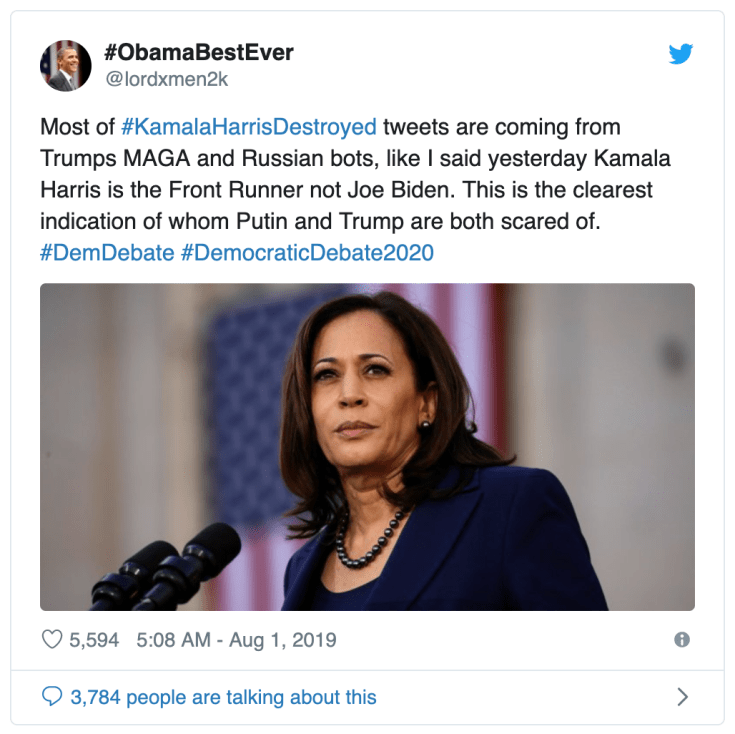
#KamalaHarrisDestroyed trends on Twitter after annihilation by Tulsi Gabbard, ‘Russian bots’ blamed

Screen Shot 2019-08-01 at 11.03.37 AM

Twitter deemed presidential hopeful Kamala Harris utterly “destroyed,” after fellow candidate Tulsi Gabbard landed dizzying verbal haymakers on the former California prosecutor. Naturally, ‘Russian bots’ were swiftly blamed.

Wednesday night’s Democratic debate was not an enjoyable one for Harris, who went into the faceoff as a darling of the media and among the frontrunners for her party’s nomination. On the stage in Detroit, Hawaiian Congresswoman Tulsi Gabbard grilled Harris on her record as California’s attorney general.

In under a minute, Gabbard shredded Harris to pieces for jailing more than 1,500 nonviolent marijuana offenders while admitting in a radio interview that she had smoked marijuana in college, and for her “tough-on-crime” stances. “She blocked evidence that would have freed an innocent man from death row… she kept people in prison beyond their sentences to use them as cheap labor… and she fought to keep the cash bail system in place,” Gabbard continued, leaving Harris unable to counter.

By Thursday morning, “#KamalaHarrisDestroyed” was trending on Twitter in the US.

Screen Shot 2019-08-01 at 11.07.52 AM

Of course, any attack on an establishment Democrat is met with an equal and opposite reaction. Establishment pundits and their supporters responded with a familiar cry: “Russia!” Gabbard, they said, is propped up by Vladimir Putin, and #KamalaHarrisDestroyed is the work of “Putin’s bots and paid for shills.”

Screen Shot 2019-08-01 at 11.09.21 AM

Even Harris’ press secretary, Ian Sams, labeled Gabbard’s supporters part of “the Russian propaganda machine.”

It’s worth noting that nobody shouting “Russian bots” did any data analysis to support their claims. Few noted too that, during the debate, ‘Tulsi Gabbard’ was the most searched for politician in every single US state, according to Google Trends.

But if the nefarious hashtag wasn’t the work of the Kremlin, then it must have been the work of the MAGA-hatted deplorables, some #resistance commenters argued.

Screen Shot 2019-08-01 at 11.10.41 AM

That opponents would default to Russia to attack Gabbard is unsurprising. Running on an anti-interventionist, foreign-policy-focused platform, Gabbard has been accused of cosying up to Syrian leader Bashar al-Assad for her opposition to military action in Syria and for meeting with Assad in Damascus. That stance alone led to accusations that she was more closely aligned with the position of the Kremlin than that of the White House.

At present, Gabbard is a long-shot candidate, and is polling at around one percent.

Hell freezes over? New York Times wants closer relationship with Russia, congratulates Trump

Screen Shot 2019-07-22 at 11.14.18 AM

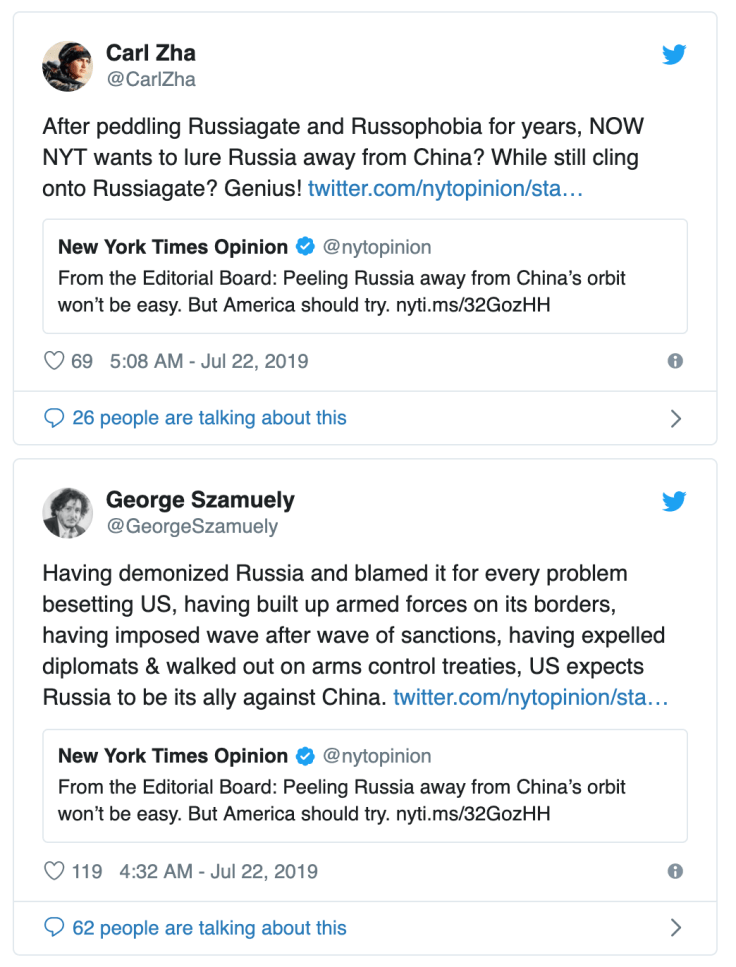
The New York Times’ editorial board, fresh from peddling anti-Russia conspiracies for two years, has made a remarkable about-turn. Now the paper wants closer relations with the Kremlin, all to thwart China’s ambitions.

‘Russiagate’ has maintained an iron grip on American political discourse for two years now, even after Special Counsel Robert Mueller’s report cleared President Donald Trump of conspiring with the Kremlin to steal the 2016 US election. In the media, the public has been treated to nightly conspiracy theories and bizarre connect-the-dots articles claiming to prove collusion; and lawmakers have crafted ever more draconian sanctions bills against Russia and have slotted opposition to Russia into their campaign messages.

Meanwhile, Moscow and Beijing have looked to each other, holding joint military exercises and upping their trade volume to more than $100 billion in 2018. Russian Prime Minister Dmitry Medvedev recently announced plans to build a new, 2,000km-long highway linking Europe and China, while President Vladimir Putin has been mulling connecting Russia’s Northern Sea Route with China’s Maritime Silk Road, an ambitious global trade route linking China with ports in Southeast Asia, Africa, Europe, and the Middle East.

The idea of closer Moscow/Beijing cooperation clearly worries the New York Times’ editorial board. In an op-edpublished on Sunday, the board wrote that “President Trump is correct to try to establish a sounder relationship with Russia and peel it away from China” – itself a remarkable compliment from a paper that ran op-eds titled “Donald Trump Hates America,” and “Trump is Racist to the Bone” in the last five days.

The board then suggested that the US could strengthen its cooperation with Russia in space exploration and Arctic cleanup – areas untainted by ‘Russiagate’. In addition, new arms control treaties could be a step towards geopolitical cooperation between the two rival superpowers.

All valid and worthy points, but from the New York Times? Yes, we’re talking about the same newspaper that last year called Trump a “treasonous traitor” ahead of his meeting with Putin in Helsinki. Instead of seeking rapprochement then, the paper argued that Trump should “be directing all resources at his disposal to punish Russia.” 

We’re talking about the same New York Times that dubbed Trump “Putin’s Lackey” and released a mocking videodetailing a ‘love story’ between Trump and Putin, laden with homoerotic overtones and culminating in a tongue-locking kiss between the two leaders. It’s funny because they’re gay, see?

The piece surprised many, like pundit George Szamuely, who wrote that Washington has demonized Russia and blamed it for every problem besetting [the] US,” while the Times “has for years berated Trump for advocating this perfectly sensible policy, at times suggesting that he was doing so only because he was Putin’s agent and a traitor to the United States.”

Screen Shot 2019-07-22 at 11.19.16 AM

Bear in mind that the Times’ editorial board does not hold the same opinions as its revolving cast of op-ed writers. Still, for a newspaper whose writers almost unanimously despise the US president, Sunday’s op-ed represents a shocking repudiation of two years of anti-Russia, anti-Trump static.

Perhaps the outlet that often voiced the ideas of the American establishment has finally realized that the ‘Russiagate’ horse is too long dead for another flogging? Or maybe the Times saw it’s time for a new kind of politics: the politics of Detente. Either way, the change is a surprising one.

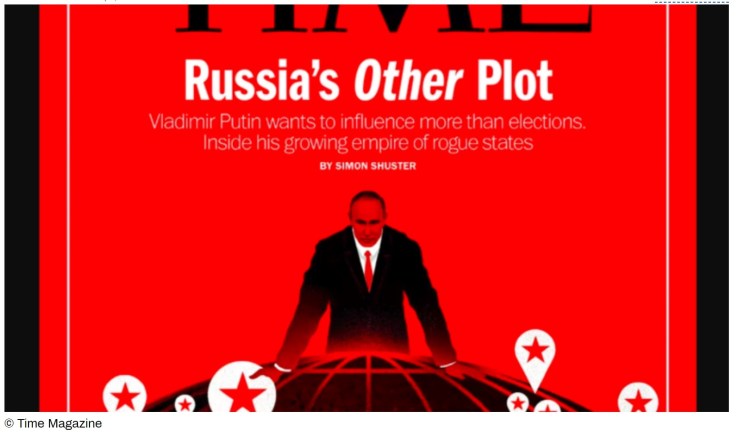
TIME sinks to new depths of hypocrisy and propaganda with latest cover story on scary Russia

CAP

With the Mueller investigation wrapped up and interest in Russia’s alleged misdeeds against the US threatening to wane among the masses, mainstream media has decided to widen the net and refocus Russia’s “other” evil schemes.

TIME magazine has gotten a head start with its latest cover story, authored by journalist Simon Shuster, literally titled “Russia’s other plot” and illustrated with the usual clichéd, Soviet-inspired scary red and black artwork.

The story, ostensibly, is about Russia’s construction of an “empire of rogue states” around the world – but in reality the circular screed is actually just bold propaganda for US foreign policy and regime change wars.

The Kremlin, we are told, has been “scouring the world in search of influence” in an attempt to fill “the void left by an inward-looking West.”This is the point at which alarm bells start ringing for those with even a cursory grasp of US and Western foreign policy, who will be asking themselves, since when has the US – with its constant destructive and unwanted interference in the affairs of other nations – ever been “inward-looking”?

When, soon after, Shuster quotes former NATO Secretary-General Anders Fogh Rasmussen framing international relations as a fight between the noble West and the Russian “bad guys,” we move beyond parody.

On and on the story goes, detailing the activities of Russian mercenaries in Sudan (pro-tip: military mercenaries are only bad if they are Russian) and lamenting the Trump administration’s “new Africa strategy” which cuts aid to African nations that are “tempted into deals with Russia or China.” The great fear is that Russia is offering its allies in Africa “soft-power assistance with state building” that is “typically provided by NGOs and development agencies.”

Former USAID contractor Paul Stronski warns Shuster that the Russians are “learning from us” (the Americans, that is) – but the “key difference” is that, unlike those offered by the well-intentioned US government, the reforms Russia offers to its allies are “mostly cosmetic” and “don’t really address the corruption in the system.” If you didn’t laugh while reading that, you probably don’t know much about US foreign policy.

The claim of “cosmetic” reforms on offer by Russia did spark a memory, though. Readers might recall a 2015 BuzzFeed investigation which revealed that, despite touting education reform as one of its major successes in war-torn Afghanistan, $1 billion allocated to build and staff schools actually enriched warlords and corrupt officials. The schools? Well, many of them were left empty and unused – but it wasn’t a “cosmetic” reform; surely it was just an unfortunate oversight.

Historian Paul Robinson has detailed the “staggering scale” of “waste and incompetence” that has characterized US aid and reform efforts in Afghanistan in particular (highlights include spending half a billion dollars on planes for the Afghan air force which were too dangerous to fly – and $150 million constructing luxury villas for staff at its economic development office).

John Sopko, the man responsible for auditing the billions of dollars the US spends on aid and reform in Afghanistan, worried in 2015 that the US “can’t honestly point to some actual, measurable accomplishments”from its trillion dollar efforts – but okay, let’s pretend it’s Russia that’s the biggest offender when it comes to cosmetic reforms in developing nations.

Next up, we learn that Russia wasn’t always this disobedient. It “did not always advocate” for an end to the “order” defined by the West. In fact, quoting Vladimir Yakunin, “an old friend and colleague” of Putin’s from their KGB days, Shuster tells us that Russia tried hard to fit in with the “globalized world” after the fall of the Soviet Union in 1991. Russia “was naive” however, “to assume that the family of civilized nations would really integrate us.”

Integration was not to be. Russians were to conveniently remain forever in the Western mind as a horde of uncivilized barbarians, so that journalists could keep getting paid to write scare stories and the Pentagon could continue filling its coffers with obscene amounts of cash using the hyped-up Russia “threat” as the perfect excuse.

CAP

In its quest for global domination, the Kremlin has focused on wooing “elites” and “warlords” around the world, Shuster claims, with a stunning lack of self-awareness, given US proclivities for supporting questionable regimes run by tyrants to serve its geopolitical interests; US support for the brutal Saudi regime being one of the most infamous in the present day.

The value Russia prizes above all others, we learn, is sovereignty, and the principle that “each regime has the right to rule its territory without fear of foreign interference.” Casting the very concept of national sovereignty as some dirty Russian idea is just another way of telling the reader: US wars for regime change, no matter how disastrous and bloody, are good and for good causes.

To see Russia’s evil in action, we are told to look to how it uses its veto power at the UN to help its friends and allies –  another laughable and utterly hollow argument, when you consider how the US repeatedly uses its own UN veto power to shield Israel from responsibility for its treatment of Palestinians and civilian casualties in Gaza and the West Bank.

Ultimately, Shuster claims Russia has created “a ragtag empire of pariah autocracies and half-failed states” – but for those of us who inhabit the real world, when it comes to propping up dictators and creating failed or half-failed states (Iraq, Libya, Syria), there is no country more wildly successful than the US.

Unfortunately, however, Shuster appears to have come down with an acute case of projectionitis. While he thinks his argument is ‘how dare Russia lend its support to dubious players around the world?’ — it is actually ‘how dare Russia do anything we do – and think they can get away with it?’

Shuster even has the audacity to quote Elliott Abrams, the Trump administration’s current special envoy to Venezuela – the latest country to find itself in the US’s regime change crosshairs. Russia, he says, is “completely unconcerned by the degree of repression” in Venezuela.

ALSO ON RT.COMThe long history of US-Russian ‘meddling’ (by Stephen Cohen)

Abrams, let us not forget, is the man who was convicted of lying to the US Congress, having used fake humanitarian aid shipments to smuggle weapons to the infamously brutal, US-backed Contras in Nicaragua in the 1980s – but sure, let’s treat him like a respectable source and authority when it comes to moralizing about human rights and democracy.

If Washington was setting an example of admirable behavior around the world; supporting human rights and democracy, refraining from violating the territory and sovereignty of other nations and using diplomacy as its primary weapon, perhaps then we could take Shuster’s piece seriously and trust that Russia’s various real or alleged infractions around the world are the true source of Washington’s irritation with Moscow.

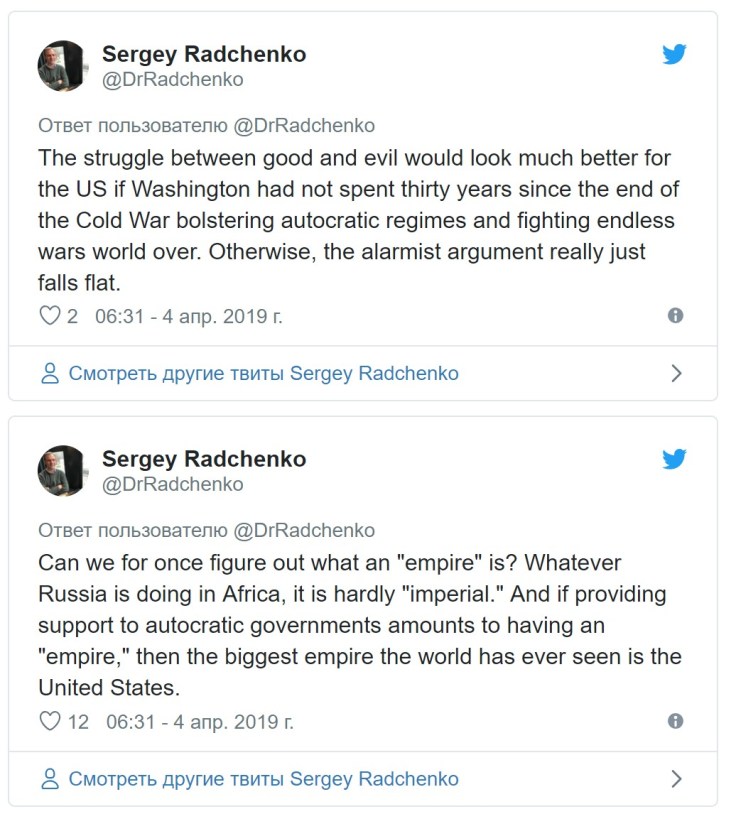
Sergey Radchenko, a Professor of International Relations at Cardiff University put it best when he criticized the “seriously over-the-top” and “alarmist” article on Twitter, taking issue with the framing of Russia’s foreign policy as akin to “empire”building.

CAP

“…If providing support to autocratic governments amounts to having an “empire,” then the biggest empire the world has ever seen is the United States,” he wrote.

TWITTER ADMITS SHADOWBANNING LISA PAGE TWEET BY FEDERALIST CO-FOUNDER “TO KEEP PEOPLE SAFE”

Twitter Admits Shadowbanning Lisa Page Tweet By Federalist Co-Founder "To Keep People Safe"

Sorry citizen, some facts are just too dangerous for your own good

Zero Hedge – MARCH 19, 2019

Twitter has admitted to shadowbanning a tweet by The Federalist co-founder Sean Davis in order to “keep people safe.” 

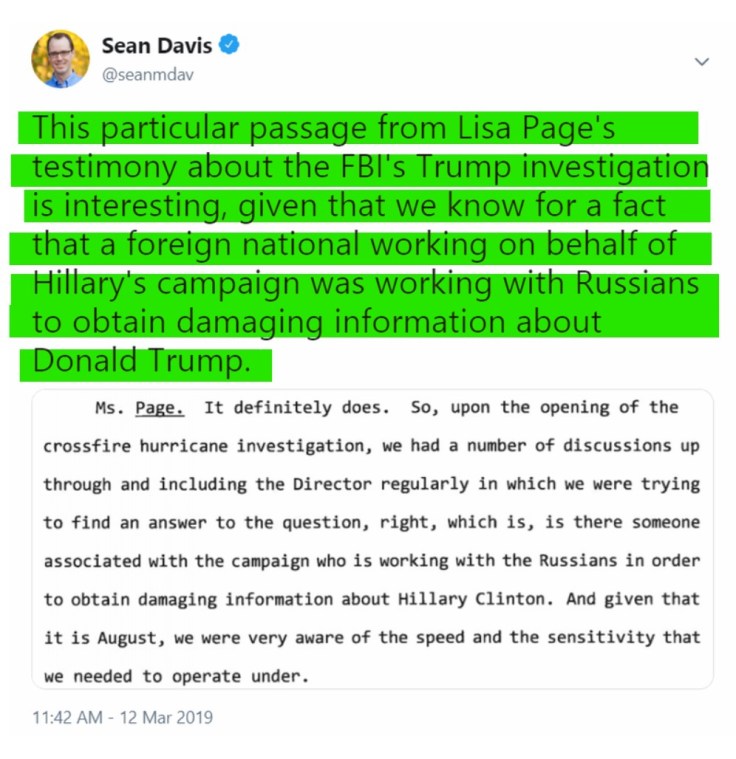
Tweeting a passage last week from former FBI attorney Lisa Page’s Congressional testimony discussing the FBI’s rush to find connections between the Trump campaign and Russia, Davis pointed out the irony of Hillary Clinton’s campaign employing former UK spy Christopher Steele, a foreign national, “working with Russians to obtain damaging information about Donald Trump.” 

CAP

Of note, the dossier Steele compiled which was subsequently used to obtain a warrant to spy on a Trump adviser (and later smear Trump) relied on a “senior Russian Foreign Ministry figure” and “a former top level intelligence officer still active in the Kremlin,” according to Vanity Fair.

CAP

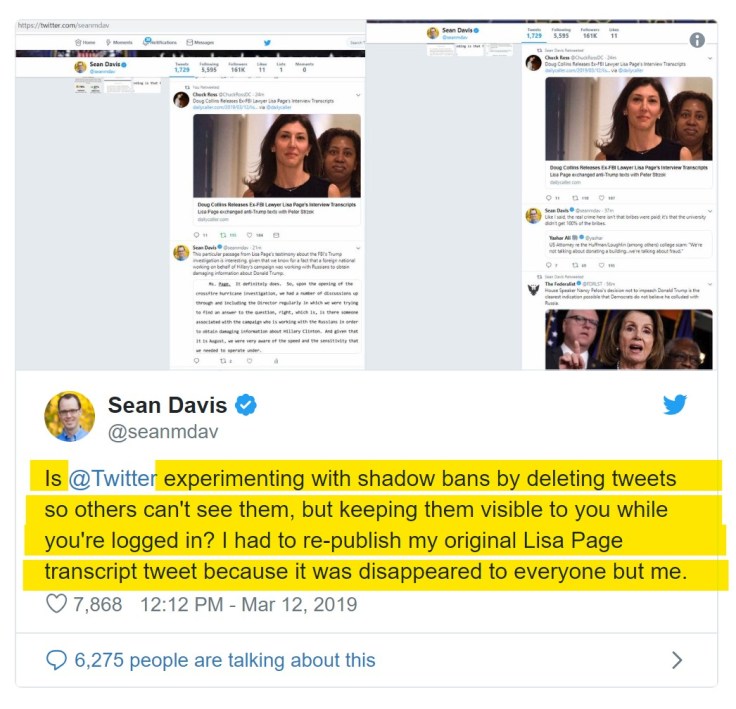
Following his March 12 tweet, Davis wondered if Twitter was experimenting with “shadow bans” – as he could only see his tweet if he was logged in, meaning nobody else could see it.

CAP

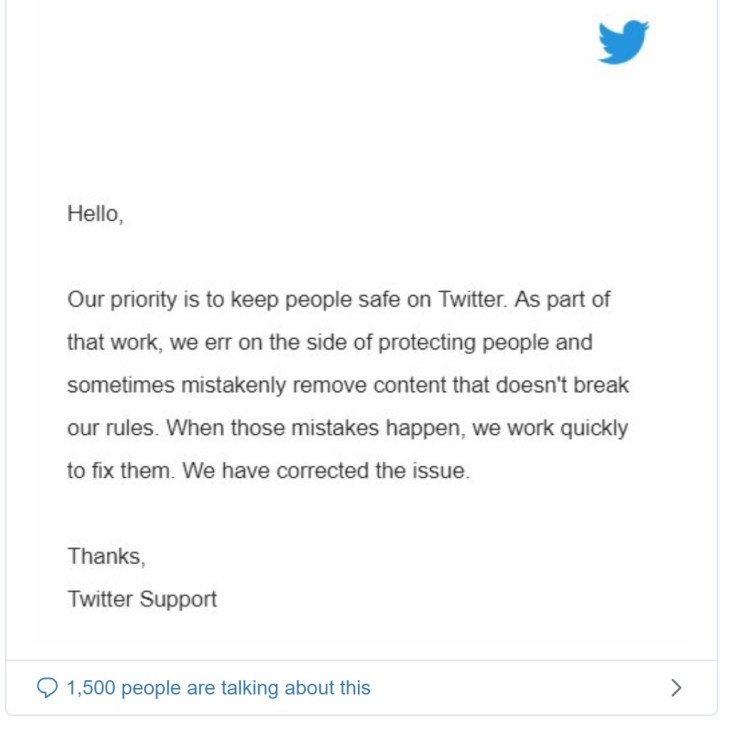
Six days later, Twitter confirmed with Davis that they had deliberately shadow-banned his tweet in order to “keep people safe.”

CAP

“Twitter gave me no notice or explanation when it shadowbanned one of my Tweets about Russian interference in our elections,” wrote Davis, adding “But what’s worse is how Twitter apparently gives its users the fraudulent impression that their tweets, which Twitter secretly bans, are still public.”

In short, Twitter did not want the public to consider the irony of Hillary Clinton’s campaign paying for a foreign national to collude with Russians against Donald Trump, while the FBI scrambled to prove the Trump campaign did.

Unreal.

In other censorship news, ZeroHedge is now banned in New Zealand and much of Australiafollowing our reporting on the Christchurch terror attacks.

Sorry citizen, some facts are just too dangerous for your own good.

(DEMOCRATS) – Priorities? Ahead of 2020 election, US lawmakers introduce bill aimed at determining Putin’s wealth

Screen Shot 2019-02-28 at 5.32.31 PM

As the US saddles up for a contentious 2020 election, lawmakers have shown they can still work together on the nation’s most pressing issues… by drafting a bipartisan bill to find out how much money Vladimir Putin has.

In what may be the most perfect illustration of why Congress boasts a 20 percent approval rating, Democratic Rep. Val Demings of Florida has given birth to the Vladimir Putin Transparency Act, a piece of trailblazing legislation which would require US intelligence agencies to sniff out all assets belonging to Russia’s president.

Co-sponsored by New York Republican Elise Stefanik, the bill serves as a powerful rebuke to the partisan politics that continue to paralyze the legislative branch.

As members of the House Intelligence Committee, the two lawmakers have hinted that the bill is payback for Russia’s alleged meddling in the 2016 election.
“The best way to assail the power of Putin and his enablers is to go after the illegal and secret financial streams that fund their operations,”Demings said in a statement. “It’s time to fight back and protect our democracy.”

Although his salary as Russian president would be peanuts for Jeff Bezos, Putin has been identified by his critics as one of the world’s richest man, although apart from statements no one bothered to provide any proof.

By some particularly creative accounts, the Russian leader may have an eye-watering $200 billion discreetly stashed away, maybe in a shoebox under his bed, or maybe in a PayPal account controlled by a trusted friend – nobody knows and that’s why the Vladimir Putin Transparency Act is so important.

The Kremlin on Thursday dismissed the legislation – which could also involve sanctioning Putin’s “discovered” assets – as a case of transparent Russophobia.

Blog at WordPress.com.

Up ↑