Suspected coronavirus case being treated at University of Chicago Medical Center as four other cases reported in Illinois

CAP

3/3/2020

A person suspected of being infected with the coronavirus is being treated at the University of Chicago Medical Center, the fifth case to be reported in Illinois.

The hospital said it was waiting for lab test results to back up its suspicions. No details were released about the patient.

“We are awaiting lab tests to see whether this patient has COVID-19. Not sure how soon we will get back results,” hospital spokeswoman Lorna Wong wrote in an email Tuesday morning.


On Monday, the third and fourth cases in Illinois were reported: A husband and wife in their 70s both tested positive for coronavirus, but the results still need to be confirmed by the Centers for Disease Control and Prevention. The man was being treated at Northwest Community Hospital and his wife was under quarantine at home, officials said. Two other cases in Illinois have been confirmed by the CDC.

Wong said the hospital has been “preparing for this eventuality” since coronavirus first became a global public health threat in January.


“Senior hospital leadership and leaders from our infectious diseases and infection prevention teams, along with other expert clinicians, are working closely with local, state and federal health officials and continue to apply up to date recommended guidelines,” she said in an emailed statement.

“We have the utmost confidence in the dedicated and highly trained team composed of nurses, physicians and other health care professionals who are providing care for this patient,” it said.


Wong said the hospital wanted to release information as early as was possible, while awaiting official confirmation of the diagnosis from the Centers for Disease Control and Prevention.

“We will continue to update you as this situation develops, but wanted to immediately inform you,” she said.


On Monday, Arlington Heights School District 25 said two staffers and two students would be staying home as a result of possible exposure to a person who is related to a hospital worker who encountered a patient with coronavirus.


At least 15 states have reported confirmed cases of coronavirus. At least six people have died from the disease in Washington state.


The disease has hit at least 70 countries, with 90,000 cases and 3,100 deaths. The vast majority of cases and deaths have been in China. While the number of new cases recorded daily in that epicenter country has declined for weeks, the virus continues to spread fast in South Korea, Iran and Italy, prompting increased travel warnings and restrictions.


In Illinois as of Monday, 102 people are being or have already been tested for the virus, including the four people whose tests have come back positive and 79 people who tests have come back negative, with 19 tests still outstanding, according to state officials. A total of 286 people were being monitored by health officials as of Monday and state health officials are working to create guidelines for those who work with the most vulnerable patients, state officials have said. Several of the cases, and deaths, in Washington state have been among patients at a nursing facility.

The state has a hotline people can call with questions or to report suspected cases, 800-889-3931. They can call the Office of Consumer Health Insurance at 877-527-9431 about their insurance coverage.
Google sucks up & analyzes healthcare data on millions of Americans in secret AI project… after voluntary opt-in flops

CAP

Google has teamed up with one of the largest health providers in the US to gather detailed medical records on millions of patients across the country without their knowledge, in a secret project the firm tried to keep under wraps.

Dubbed “Project Nightingale,” the secretive program brought together Google and healthcare giant Ascension in an effort to collect medical records on patients across 21 states, according to a report in the Wall Street Journal. The data sharing began last year, and has only accelerated in recent months.

At least 150 employees at Google’s Cloud division now have access to the bulk of the data, which amounts to information on tens of millions of patients, according to a source familiar with the records. The details shared include patient names and dates of birth, hospitalization records, lab results and doctor diagnoses, which together provide a complete medical history for many of the patients – all without their consent.

CAP

Google says it hopes to use the data to develop an application employing AI and machine learning to track patients and recommend treatments, and ultimately has its eye on creating a search engine that can aggregate disparate patient data in one place. While Google is carrying out its research totally free of charge, presumably for the greater good, the multi-billion dollar corporation is unlikely to miss its chance to monetize the service once health providers around the world are hooked up. Many found Google’s initiative disconcerting, even more so due to the guise of noble and altruistic intentions.

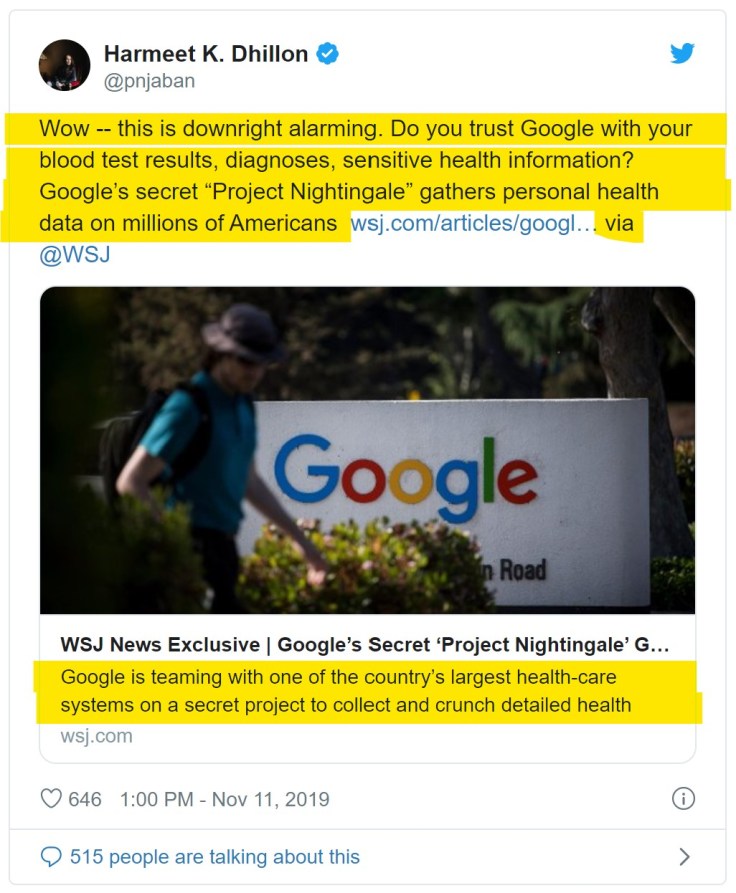
“Wow – this is downright alarming. Do you trust Google with your blood test results, diagnoses, sensitive health information?” asked attorney and Republican National Committee member Harmeet K. Dhillon in a tweet. “Google’s secret ‘Project Nightingale’ gathers personal health data on millions of Americans.”

CAP

The company launched Google Health in 2008, but shuttered it less than four years later after failing to persuade enough users to hand over their medical records willingly, perhaps uncomfortable with the firm having access to such sensitive information. The tech giant has since cut individual consent out of its quest to amass healthcare data, going over the heads of patients to make deals with health providers instead.

In September, the company allied with the Minnesota-based Mayo Clinic to provide cloud services and data analytics in a 10-year “strategic partnership,” which will give Google access to data on up to 1 million patients at the clinic each year.

In another mass data grab earlier this month, the company purchased the maker of the fitness tracking device Fitbit, gobbling up the data of some 28 million active users of the gadget. The data goes beyond simple fitness tracking, such as the number of steps one takes per day, as some users opt to link the device to additional medical or insurance records. While Google vowed to never hand out the Fitbit information to third parties, customers may still have reason to be skeptical about the integrity of their data.

Over the summer, Google and another partnered healthcare facility, the University of Chicago Medical Center, came under fire in a lawsuit alleging the hospital gave Google medical records on hundreds of thousands of patients without stripping them of identifying information. The case mirrored a similar mishap across the pond in 2017, in which the UK’s National Health Service passed the company data on 1.6 million patients in violation of privacy laws.

The secretive data sharing between Ascension and Google is absolutely legal under US federal law, both companies said, insisting that all necessary safeguards to protect patient privacy are in place – as if it ever stopped data leaks. The 1996 Health Insurance Portability and Accountability (HIPA) Act allows hospitals and other healthcare providers to pass data to business partners without informing patients so long as it “help[s] the covered entity carry out its health care functions.”

Ascension – a network of some 2,600 hospitals, doctors’ offices and other medical facilities – says it’s doing just that, seeking to use the data to improve care and identify additional tests patients might need. However, documents reviewed by the Journal also suggest the company, like Google, has its bottom line in mind, hoping to use the data-mining to generate more revenue as well.


Blog at WordPress.com.

Up ↑