Army Asks Retired Soldiers in Health Care Fields to Come Back for COVID-19 Fight

Screen Shot 2020-03-26 at 2.14.52 PM

By Hodge Seck

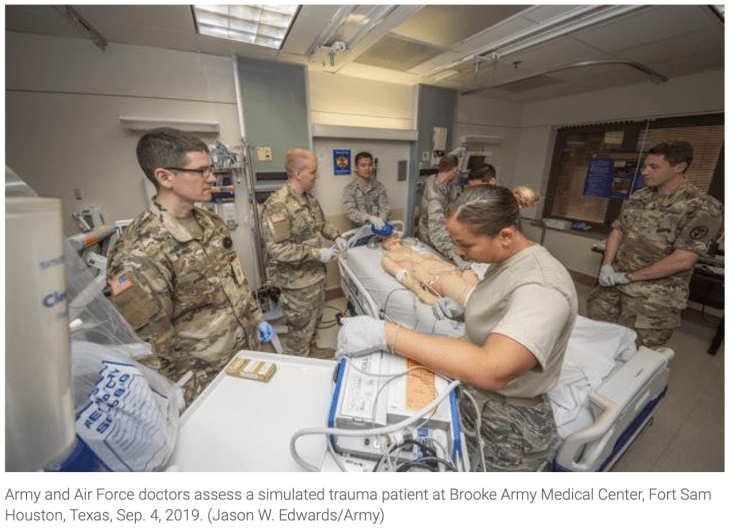
The Army has a message for its retirees: Uncle Sam wants you to help fight the novel coronavirus.

A message sent by Defense Finance and Accounting Services, which processes and dispenses retiree pay, asked troops who had previously served in specific health care specialties to consider “re-joining the team” to address the current pandemic crisis. It’s signed by Lt. Gen. Thomas Seamands, deputy chief of staff for U.S. Army Personnel, G-1.

“We need to hear from you STAT!” reads the message, obtained by Military.com.

The Army, it states, is gauging the interest of retired officers, noncommissioned officers and more junior enlisted soldiers in assisting service efforts to treat the sometimes-deadly disease. The message does not specify whether retired troops would be returned to active status or serve in some other capacity.

“These extraordinary challenges require equally extraordinary solutions and that’s why we’re turning to you — trusted professionals capable of operating under constantly changing conditions,” the message states. “When the Nation called — you answered, and now, that call may come again.”

The call was addressed to retirees from the following health care-specific military occupational specialties:

  • 60F: Critical Care Officer

  • 60N: Anesthesiologist

  • 66F: Nurse Anesthetist

  • 66S: Critical Care Nurse

  • 66P: Nurse Practitioner

  • 66T: ER Nurse

  • 68V: Respiratory Specialist

  • 68W: Medic

The message came with a caveat: retired personnel now working in a civilian capacity in a hospital or other medical facility should make that known. Army officials said they did not want to pull personnel from service they were “providing to the Nation” in that role. They added that former soldiers from a different specialty who were interested in supporting Army efforts should also reach out to communicate that interest.

The call-out directed interested retirees to contact Human Resources Command, Reserve Personnel Management Directorate at Fort Knox, Kentucky, providing contact info and MOS.

As of Wednesday, the Pentagon reported 227 cases of Coronavirus among U.S. troops and 435 total among Defense Department-connected personnel. U.S. cases on Wednesday passed 64,000.

This week, the Pentagon announced that military medical and dental treatment facilities would postpone the majority of elective surgeries, dental procedures and invasive procedures for 60 days as it shifts most resources to fighting the pandemic. A massive relief package moving quickly through Congress Wednesday would triple the number of hospital beds available at these facilities and give the DoD $1.5 billion to open expeditionary military hospitals.

The call to retirees also comes on the heels of a recommendation from the National Commission on Military, National and Public Service for the creation of a “critical skills Individual Ready Reserve” that would serve essentially as a roster of qualified individuals in high-demand fields, likely including health care, on standby to support the Defense Department in times of national emergency. It’s one of 164 recommendations that will be considered by Congress in coming months.

The U.S. Selective Service System also owns a yet-to-be activated standby plan known as the Health Care Personnel Delivery System, colloquially known as the “doctor draft,” that would “provide a fair and equitable draft of doctors, nurses, medical technicians and those with certain other health care skills if, in some future emergency, the military’s existing medical capability proved insufficient and there is a shortage of volunteers.”

That proposed mechanism, however, is designed for use only in wartime and in connection with a broader national mobilization effort, with the approval of Congress and the president.

In a briefing at the Pentagon Wednesday, Air Force Brig. Gen. Paul Friedrichs, Joint Staff surgeon, said he felt generally comfortable that the U.S. military had the resources it needed to continue to fight the virus.

“I’m very comfortable that we’ve analyzed the communities where we have military bases. We’ve looked at what we think their medical requirements would be when an outbreak occurs or if an outbreak occurs in that community,” he said. “Do we have enough health care resources there? Is it the right mix of health care resources? That’s then allowed us to identify what medical capabilities from the military we can offer to help support the whole of government, or to support combatant commands in other parts of the world.”

Interested retirees can contact Human Resources Command, Reserve Personnel Management Directorate, at usarmy.knox.hrc.mbx.g3-retiree-recall@mail.mil or call 502-613-4911.

WATCH: Huge Detroit Gang Fight Occurs in Streets Amidst Coronavirus Lockdown

There was some wildin’ in the Detroit streets on Sunday.

By Shane Trejo – 3/23/2020

A huge fight took place on the streets of Detroit on Sunday with over one hundred residents engaging in the massive skirmish that is the latest stain on the beleaguered and desolate town.

The video of the proceeding can be seen here:

The video has garnered a great deal of shock as Michigan attempts to maintain social distancing and take other precautions to stop the spread of Chinese coronavirus. Even individuals who attended the melee were making exasperated comments about the shameful, violent ordeal.

“What in the corona and boxing is going on here?” the individual shooting the video said.

Everyone seemed befuddled about the reasoning behind the fight, which apparently happened for no good reason.

“This is some kind of rivalry,” a man in the video said. “I mean the whole street.”

“We’re supposed to be quarantined and we’re out here watching a gd*** boxing match on the street … quarantine and fight,” said the videographer.

“This why school needs to be still goin on,” an individual wrote in response to the video on Facebook.

Meanwhile, Democrat Governor Gretchen Whitmer announced a mandatory lock-down throughout the entire state on Monday, with all “non-essential” businesses being forcibly closed. It is expected to be in effect for at least three weeks.

“You can go outside. Get some fresh air, walk your dog. Just be smart about it. Maintain that 6-foot distance,” she said on Monday.

“Let me give you a little perspective here,” she added. “We have about 25,000 acute care beds in Michigan. … That means without aggressive additional measures, more people will get sick, more people will die and our economy will suffer longer.”

Screen Shot 2020-03-26 at 11.32.36 AM

“On a personal note I know the lack of control can be disorienting, so I urge you to focus on what you can control,” Whitmer said while addressing the public. “This crisis can take a toll on your mental health. Check in with family, call your loved ones, go for a walk, read those books on your list, even go outside and put your holiday lights back up.”

“We must keep our wits about us. That means all of us. Be sensitive to how our kids are feeling. They are not immune to the stress of this environment. Check in with them and help them understand, and give them the reassurance that they need,” she added.

These irresponsible Detroit residents, by wildin’ out on the streets during a pandemic, have given the Democrat governor the excuse she needed for another unconstitutional power-grab using coronavirus as the pretense.

‘Data is anonymized’: UK govt accused of ‘fiddling’ Covid-19 death figures amid ‘family consent’ claims

See the source image

The UK government is facing allegations they are manipulating coronavirus death numbers, after revealing they are changing the way the figures are released, claiming family consent is now required.

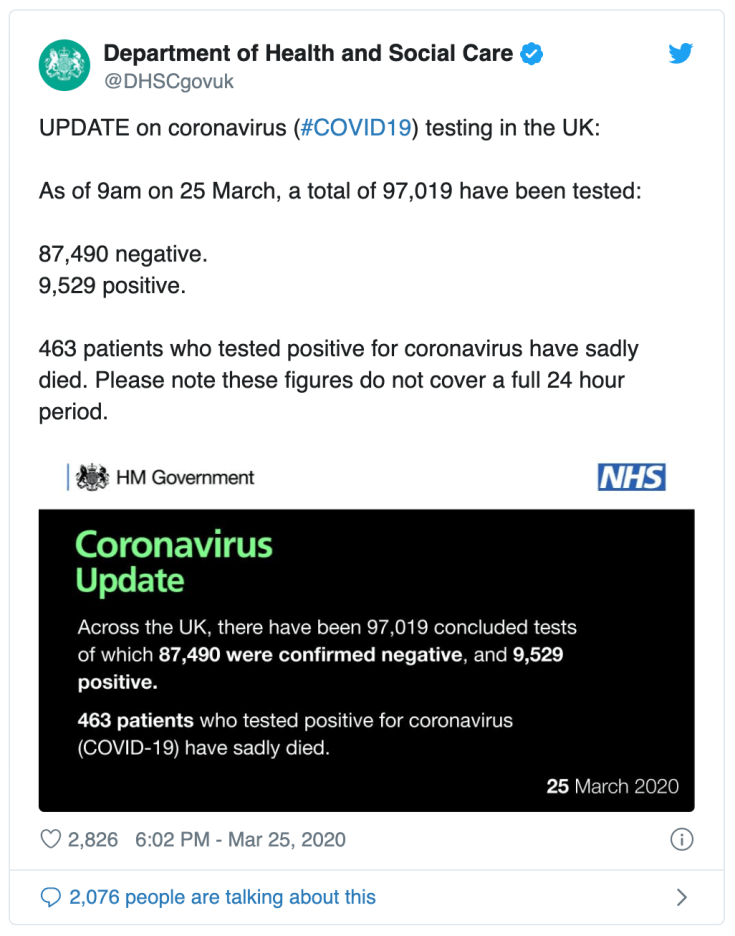
On Wednesday night, the Department for Health and Social Care published the latest Covid-19 figures showing an increase of 43 deaths – less than half the fatalities from the previous day (87).

A positive sign that the number had decreased? At first glance, yes, until it’s revealed those figures“do not cover a full 24 hour period” as usual.

The UK government is facing allegations they are manipulating coronavirus death numbers, after revealing they are changing the way the figures are released, claiming family consent is now required.

On Wednesday night, the Department for Health and Social Care published the latest Covid-19 figures showing an increase of 43 deaths – less than half the fatalities from the previous day (87).

A positive sign that the number had decreased? At first glance, yes, until it’s revealed those figures “do not cover a full 24 hour period” as usual.

Screen Shot 2020-03-26 at 10.45.03 AM

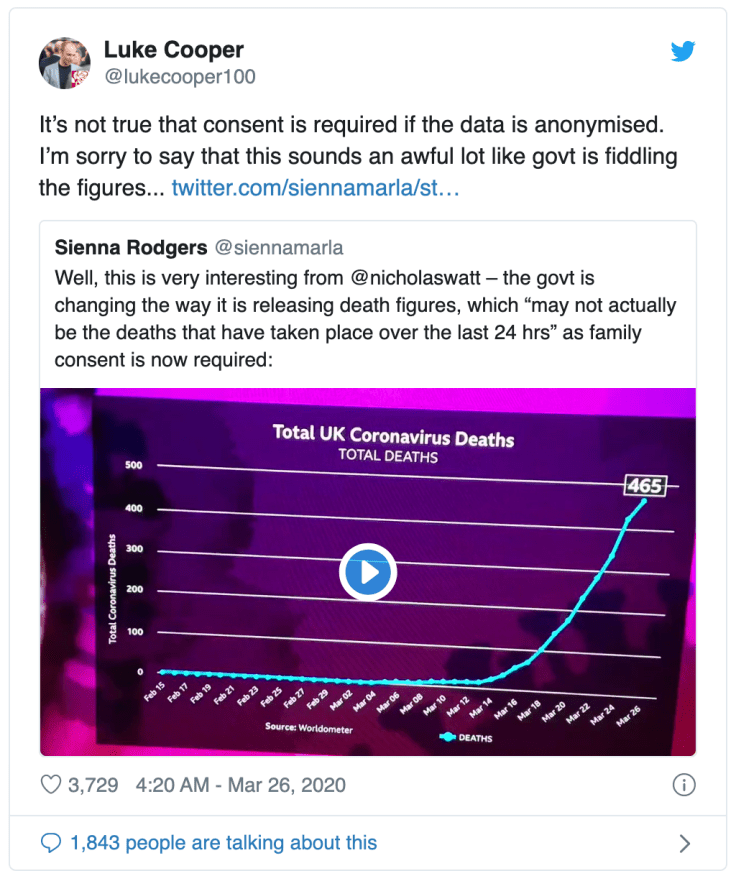
So why? BBC Newsnight’s Nick Watt explained that the government was changing the way it releases Covid-19 death figures, which “may not actually be the deaths that have taken place over the last 24 hrs,” as family consent is now required.

The government’s sudden shift in the criteria of reporting coronavirus numbers has provoked accusations that they are manipulating data without a valid reason. Luke Cooper, an associate researcher at LSE Conflict and Civil society research claimed that it “sounds an awful lot like government is fiddling the figures,” insisting that it is “not true” that consent is required “if data is anonymized.”

Screen Shot 2020-03-26 at 10.47.21 AM

Echoing that sentiment, Dr. Nisreen Alwan – an associate professor in public health at Southampton University – says that as is the case for information from the Office for National Statistics (ONS), “consent is not needed” for anonymized mortality data.

Screen Shot 2020-03-26 at 10.48.42 AM

Sam Fowles, a barrister that advised Another Europe – a pro-EU campaign group – on its GDPR compliance concurred, adding that “even if it were personal data, the government could arguably publish on the basis of overwhelming public interest. But in any case, it isn’t.”

PM Johnson ordered a temporary national lockdown on Monday and advised British people to “stay at home” outside of emergencies, buying essential supplies or getting exercise, otherwise they face the possibility of fines and even arrest.

The number of confirmed UK cases of Covid-19 currently stands at 9,529 – a rise of 1,452 in 24 hours.


ENVIRONMENTALIST GROUP: “CORONA IS THE CURE – HUMANS ARE THE DISEASE”

Environmentalist Group: "Corona is the Cure - Humans are the Disease"

The mask slips.

By Paul Joseph Watson- March 25, 2020

A climate change group that aligns itself with Extinction Rebellion posted stickers claiming that coronavirus is a “cure” for the “disease” that is humanity.

“Earth is healing. The air and water is clearing,” tweeted Extinction Rebellion East Midlands. “Corona is the cure. Humans are the disease!”

The post shows stickers with the same message and the Extinction Rebellion logo plastered on lamp posts.

Screen Shot 2020-03-25 at 2.31.04 PM

When another branch of Extinction Rebellion challenged that this “does not follows XR’s principles,” the East Midlands chapter doubled down.

“We are pointing out that from the perspective of the Earth, humans behave like a disease. The idea is not to be,” they responded.

While Extinction Rebellion East Midlands may represent little more than the ravings of one idiot, the notion that humanity somehow deserved coronavirus and that it’s good for the planet has been widely shared by environmentalists and celebrities.

After actor Idris Elba tested positive for coronavirus, he claimed that COVID-19 was the planet “reacting to the human race” as revenge for climate change.

Despite numerous claims that nature is ‘flourishing’ and animals are thriving thanks to coronavirus, it turns out that most of those stories are fake news.

Man Charged with Terroristic Threat for Allegedly Coughing on Grocery Store Worker

The police state is growing because of the coronavirus pandemic.

By Shane Trejo

A man has been charged with a terroristic threat after allegedly coughing on a grocery store employee while saying that he had the coronavirus over the weekend.

This individual reportedly committed this assault at a Wegman’s in New Jersey. 50-year-old George Falcone of Freehold, N.J. is the suspect. He is also being charged with obstructing administration of law or other governmental function and harassment following the incident.

The incident took place on Sunday after a Wegman’s employee allegedly requested for Falcone to stand further away from her while she was preparing food. This reportedly offended Falcone, who leaned into her and purposefully coughed while facetiously saying that he had coronavirus while laughing. He faces up to seven years in prison and a fine up to $26,000 for his alleged actions.

Trending: SHOCK VIDEO: Chinese People Repeatedly Attempt to Spread Coronavirus in Public

“These are extremely difficult times in which all of us are called upon to be considerate of each other — not to engage in intimidation and spread fear, as alleged in this case,” said far-left New Jersey Attorney General Gurbir Grewal.

“We must do everything we can to deter this type of conduct and any similar conduct that harms others during this emergency,” he added.

Grewal, who opened the flood gates for illegal immigrants in his state, has used coronavirus pandemic as an excuse to crack down on supposed hate speech related to the origin of the virus.

Big League Politics has reported on Grewal’s proposed diversity gestapo:

New Jersey Attorney General Gurbir Grewal issued a “guidance” on Thursday telling employers that they may be guilty of illegal discrimination if they allow workers to call the COVID-19 coronavirus “the Chinese virus.”

“Among the guidance’s keynotes are that employers may be in violation of the LAD’s prohibition on disability discrimination if they fire an employee for exhibiting possible COVID-19 symptoms,” Grewal explained in his press release.

He added: “The guidance also states that employers must take reasonable action to stop harassment of one employee by another employee if the employer knows or should have known about it: for example, if one employee has east-Asian heritage and a coworker repeatedly harasses her by claiming that Asian people caused COVID-19 or calling this ‘the Chinese virus.’”

Grewal claims that noting the virus originated from China is a violation of the New Jersey’s Law Against Discrimination (LAD). During a time in which resources are being stretched in an unprecedented crisis, this is what Grewal is concerned about.

“COVID-19 is no excuse for racism, xenophobia, or hate,”Grewal said. “Discrimination and harassment in violation of New Jersey law remains illegal even if it occurs against the backdrop of a global pandemic. Now, more than ever, we should recognize that we’re all in this together. Words and actions that divide us won’t make any of us safer or stronger.”

He is urging citizens to snitch on their fellow man during the coronavirus crisis in case someone’s feelings get hurt.

When the coronavirus pandemic ends, it is not likely that Americans will regain the many liberties they have lost throughout the crisis.


MAN WHO LICKED PRODUCTS AT WALMART CHARGED WITH MAKING TERRORIST THREAT

Man Who Licked Products at Walmart Charged with Making Terrorist Threat

Missouri man asked, ‘Who’s afraid of the coronavirus?’ before licking various items on Walmart shelf

By Adan Salazar – March 25, 2020

A Missouri man who filmed himself licking products at a retail store was reportedly charged with making terrorist threats.

In the video which went viral on social media, Cody Pfister, 26, asks, “Who’s afraid of the coronavirus?” before proceeding to lick several items at a Walmart in Warrenton.

According to police, Pfister’s antics prompted anger across the globe, with people from several countries in Europe calling into the Warrenton Police Department to report the heinous act.

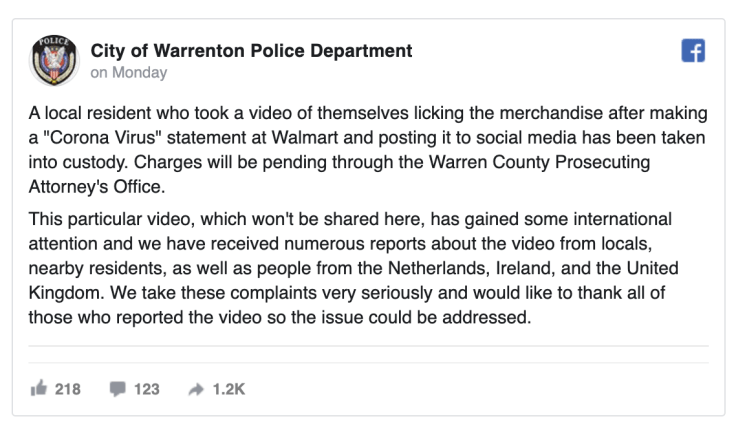
“A local resident who took a video of themselves licking the merchandise after making a ‘Corona Virus’ statement at Walmart and posting it to social media has been taken into custody,” Warrenton police wrote in a Facebook post.

Screen Shot 2020-03-25 at 11.32.47 AM

“This particular video, which won’t be shared here, has gained some international attention and we have received numerous reports about the video from locals, nearby residents, as well as people from the Netherlands, Ireland, and the United Kingdom.”

“We take these complaints very seriously and would like to thank all of those who reported the video so the issue could be addressed,” they added.

The Riverfront Times reports Pfister, who made the video on March 11 and has previously been convicted of burglary and firearm theft, was charged with making a terrorist threat, according to court documents obtained by the media outlet.

“Pfister was taken into custody this week, and Warren County prosecutors charged him today. The charge is a low-level felony,” reports The Times’ Doyle Murphy.

“Pfister was booked into the Warren County jail without bond.”

Pfister was possibly making the video in relation to the new coronavirus social media challenge, which had people licking objects such as toilet seats for social media clout.

One YouTuber who took part in the challenge and posted a video of him licking the rim of a public toilet seat reportedly contracted coronavirus following the stunt.

EU left Italy ‘practically alone’ to fight coronavirus, so Rome looked for help elsewhere, incl Russia

Screen Shot 2020-03-25 at 10.48.08 AM

The EU’s initial response to the massive outbreak of coronavirus in Italy was largely “inadequate,” and a lack of European solidarity opened the doors for Russia and China, former Italian Foreign Minister Franco Frattini told RT.

The new epicenter of the dreaded pandemic, Italy, has been struggling to stop the spread of Covid-19 for weeks now. The disease has already killed more than six thousand people in the country, with over 60 thousand people infected.

EU tried to pin the blame on Italy

The EU clearly underestimated the virus, blaming the outbreak in Italy on its national healthcare system flaws, according to the two-time foreign minister and OSCE representative. As a result, Brussels, which preaches pan-European solidarity, failed to act when this solidarity was needed in the face of a crisis that eventually affected the entire bloc.

Frankly speaking, Brussels is not doing enough. At the very first moment, Italy was practically alone against the virus. Many said it was all because of the Italian habits, because Italians do not respect the rules. Suddenly, they realized all the other countries were equally affected.

The situation in other major EU states like Germany and France deteriorated rapidly, forcing them to deal with thousands of infected on their own soil.

“Everyone just focused on the situation at home before even thinking about helping others,” Andrea Giannotti, the executive director of the Italian Institute of Eurasian Studies, told RT.

European solidarity doesn’t exist, only China can help us: Serbia goes full emergency over coronavirus

Screen Shot 2020-03-25 at 10.52.06 AM

The lack of solidarity was recently noted from outside of the bloc – Serbian President Aleksandar Vucic decried European solidarity as a myth, while praising Beijing for its assistance. His remarks came after Serbia received five million masks from China, which it could not get in Europe.

The EU is now trying “to do more” and somehow “make up” for its initial poor execution of a coordinated response, former Italian MP Dario Rivolta said.

Brussels has indeed ramped up its efforts, suspending the bloc’s strict Stability and Growth Pact regulating budgetary policy among others. Frattini particularly hailed this decision, which allows Rome to act freely in terms of budgetary spending, as “very important.” But this came only after Europe “realized its [measures] were inadequate to give a united response.”

Still, it is not enough, Rivolta told RT, adding that “for the moment,” there are no major changes. And while financial relief is necessary, there are other things to be considered, such as medical assistance.

“As for the medical aspects, the only thing that the EU did up to now was to put barriers between Italy and other countries.”

Huge support in terms of expertise

At one point, requests for help were sent out all over the world, according to Giannotti.

“Some Italian embassies were tasked with negotiating with local governments in order to find any opportunities to receive assistance from abroad, including help with equipment, which Italy lacks.” Russia and China were among those who responded.

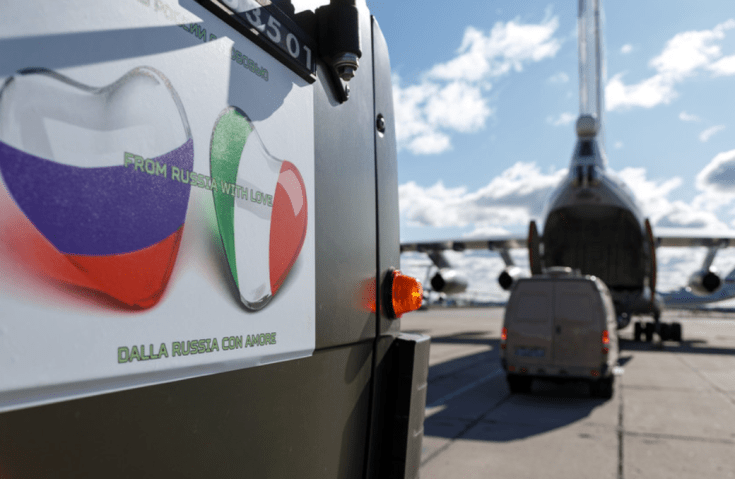
In total, Moscow prepared nine cargo planes with emergency aid, delivering vital medical equipment and supplies, as well as bringing experienced specialists in infectious diseases and military doctors to Italy. Now they will be deployed to the most affected regions in the country’s north.

Frattini said the help was of the utmost importance: “What Russia has done is not comparable to what other countries have done, including China because China also sent something but not comparable with the support provided by Russia.”

The specialists have provided “very huge support in terms of expertise… in terms of virology.” 

With united Europe MIA in its Covid-19 response, worst-hit nations turn to ‘evil’ Russia & China for help

Screen Shot 2020-03-25 at 10.55.59 AM

The assistance serves as a gesture of solidarity in times of European sanctions on Moscow and the counter-measures, Giannotti said. Sending help “despite [the fact] the situation in Russia itself may also worsen” means it is a clear message that Moscow is ready to talk and settle issues with Europe when there is a greater need for cooperation.

Speaking to RT, the Italian ambassador to Russia, Pasquale Terracciano, agreed that a joint approach is the best way to put an end to the pandemic.

Thanking Moscow for the contribution, he said: “It will be crucial to recover from this tragic situation, hopefully soon.”

Countries are starting to hoard food, threatening global trade

Screen Shot 2020-03-25 at 9.58.06 AM

By Isis Almeida and Agnieszka de Sousa

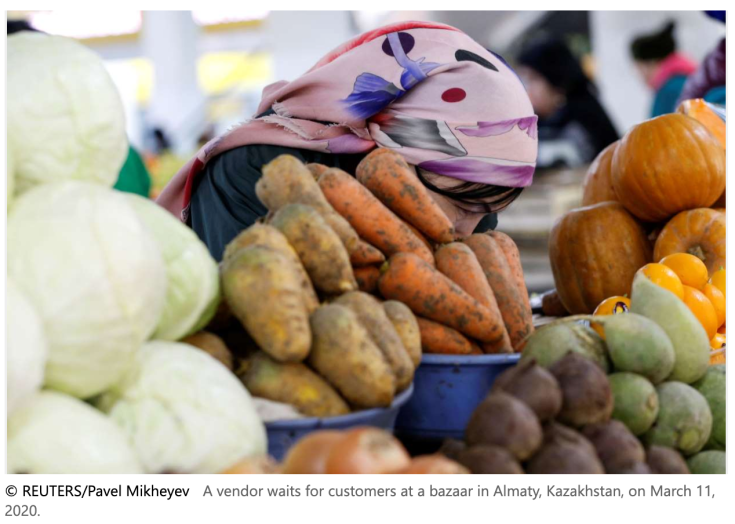
Kazakhstan, one of the world’s biggest shippers of wheat flour, banned exports of that product along with others, including carrots, sugar and potatoes. Serbia has stopped the flow of its sunflower oil and other goods. Russia is leaving the door open to shipment bans and said it’s assessing the situation weekly.
To be perfectly clear, there have been just a handful of moves and no sure signs that much more is on the horizon. Still, what’s been happening has raised a question: Is this the start of a wave of food nationalism that will further disrupt supply chains and trade flows?

“We’re starting to see this happening already — and all we can see is that the lockdown is going to get worse,” said Tim Benton, research director in emerging risks at think tank Chatham House in London.

Though food supplies are ample, logistical hurdles are making it harder to get products where they need to be as the coronavirus unleashes unprecedented measures, panic buying and the threat of labor crunches.

Consumers across the globe are still loading their pantries — and the economic fallout from the virus is just starting. The specter of more trade restrictions is stirring memories of how protectionism can often end up causing more harm than good. That adage rings especially true now as the moves would be driven by anxiety and not made in response to crop failures or other supply problems.

Related video: Food supply is not where it’s needed

As it is, many governments have employed extreme measures, setting curfews and limits on crowds or even on people venturing out for anything but to acquire essentials. That could spill over to food policy, said Ann Berg, an independent consultant and veteran agricultural trader who started her career at Louis Dreyfus Co. in 1974.

“You could see wartime rationing, price controls and domestic stockpiling,” she said.

Some nations are adding to their strategic reserves. China, the biggest rice grower and consumer, pledged to buy more than ever before from its domestic harvest, even though the government already holds massive stockpiles of rice and wheat, enough for one year of consumption.

Key wheat importers including Algeria and Turkey have also issued new tenders, and Morocco said a suspension on wheat-import duties would last through mid-June.

a close up of a map: Food Dependence© Bloomberg Food Dependence

As governments take nationalistic approaches, they risk disrupting an international system that has become increasingly interconnected in recent decades.

Kazakhstan had already stopped exports of other food staples, like buckwheat and onions, before the move this week to cut off wheat-flour shipments. That latest action was a much bigger step, with the potential to affect companies around the world that rely on the supplies to make bread.

For some commodities, a handful of countries, or even fewer, make up the bulk of exportable supplies. Disruptions to those shipments would have major global ramifications. Take, for example, Russia, which has emerged as the world’s top wheat exporter and a key supplier to North Africa.

“If governments are not working collectively and cooperatively to ensure there is a global supply, if they’re just putting their nations first, you can end up in a situation where things get worse,” said Benton of Chatham House.

He warned that frenzied shopping coupled with protectionist policies could eventually lead to higher food prices — a cycle that could end up perpetuating itself.

“If you’re panic buying on the market for next year’s harvest, then prices will go up, and as prices go up, policy makers will panic more,” he said.

And higher grocery bills can have major ramifications. Bread costs have a long history of kick-starting unrest and political instability. During the food price spikes of 2011 and 2008, there were food riots in more than 30 nations across Africa, Asia and the Middle East.

“Without the food supply, societies just totally break,” Benton said.

Ample supplies have kept prices relatively low since the 2011 spike© Bloomberg Ample supplies have kept prices relatively low since the 2011 spike

Unlike previous periods of rampant food inflation, global inventories of staple crops like corn, wheat, soybeans and rice are plentiful, said Dan Kowalski, vice president of research at CoBank, a $145 billion lender to the agriculture industry, adding he doesn’t expect “dramatic” gains for prices now.

While the spikes of the last decade were initially caused by climate problems for crops, policies exacerbated the consequences. In 2010, Russia experienced a record heat wave that damaged the wheat crop. The government responded by banning exports to make sure domestic consumers had enough.

The United Nations’ measure of global food prices reached a record high by February 2011.

“Given the problem that we are facing now, it’s not the moment to put these types of policies into place,” said Maximo Torero, chief economist at the UN’s Food and Agriculture Organization. “On the contrary, it’s the moment to cooperate and coordinate.”

Read More on Food Issues in Virus Era:

There’s Plenty of Food in the World, Just Not Where It’s Needed

Americans Drop Kale and Quinoa to Lock Down With Chips and Oreos

Cargill Says China Offers Hope for Meat Markets Hit by Virus 

Of course, the few bans in place may not last, and signs of a return to normal could prevent countries from taking drastic measures. Once consumers start to see more products on shelves, they may stop hoarding, in turn allowing governments to back off. X5 Retail, Russia’s biggest grocer, said demand for staple foods is starting to stabilize. In the U.S., major stores like Walmart Inc. have cut store hours to allow workers to restock.

In the meantime, some food prices have already started going up because of the spike in buying.

Wheat futures in Chicago, the global benchmark, have climbed more than 6% in March as consumers buy up flour. U.S. wholesale beef has shot up to the highest since 2015, and egg prices are higher.

At the same time, the U.S. dollar is surging against a host of emerging-market currencies. That reduces purchasing power for countries that ship in commodities, which are usually priced in greenbacks.

n the end, whenever there’s a disruption for whatever reason, Berg said, “it’s the least-developed countries with weak currencies that get hurt the most.”

Blog at WordPress.com.

Up ↑