2/17/2020
Journalist Christopher Sign, author of the new book ‘Secret on the Tarmac,’ joins ‘Fox & Friends.’
If this guy digs any deeper he will suicide himself like Epstein.

Mike Bloomberg: All of these costs keep going up. Nobody wants to pay anymore money. And at the rate we’re going healthcare is going to bankrupt us. So not only do we have a problem we’ve got to sit here and say which things we’re going to do and which things we’re not. Nobody wants to do that. If you show up with prostrate cancer and you’re 95 years old, we should say go and enjoy, you’ve had a long life, there’s no cure and we can’t do anything. If you’re a young person, we should do something about it. Society’s not willing to do that, yet.”
Spoken like a true heartless socialist.
How horrible.
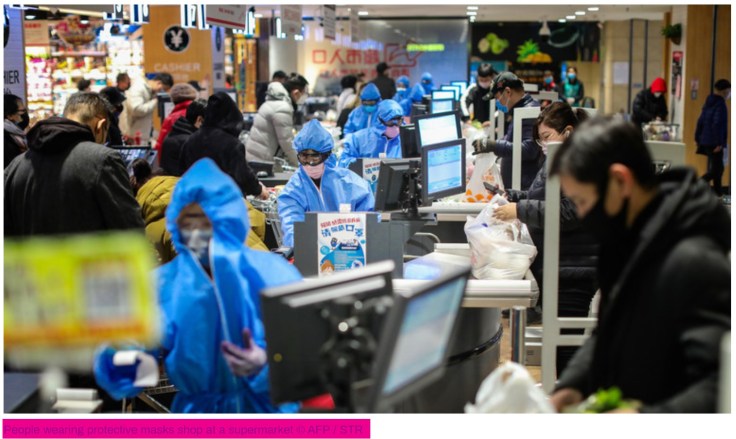
Plummeting iPhone production and a lack of new cars rolling off the assembly line dominated early discussion of coronavirus-induced shortages. But the epidemic currently sweeping China and making determined inroads into over two dozen other countries has forced hundreds of factories to close, affecting dozens of industries. If nothing else, coronavirus has made the world realize that globalization has its downsides.
It’s not just the virus itself that’s causing shortages, of course – rumors about the virus can be equally as devastating. Hong Kong, which is heavily dependent on China for many staples, has seen store aisles stripped of necessities like toilet paper, rice, and pasta in recent weeks as panic-buying ramps up while some factories struggle to reopen. Mere rumors of a toilet paper shortage earlier this month were enough to send thousands of locals pouring into stores to denude the shelves, triggering a rebuke from the government to those people “with evil intentions” spreading falsehoods “leading to panic buying and even chaos.”
At the same time the virus disrupts its exports, China is having a difficult time getting meat into the country, its own pork supply decimated by a recent outbreak of African swine fever. The US, Europe, and Brazil are still shipping meat to China, but the refrigerated containers have to be handled carefully, plugged in as soon as they’re unloaded to keep the meat cold and moved out quickly to make way for other containers.

Citywide quarantines have limited the supply of workers to move meat in Shanghai and Xingang, meaning much never makes it off the ship.
If anyone was hoping to break the monotony of quarantine with a little gym time, they’re out of luck unless they already have the duds. Athletic-wear behemoth UnderArmour revealed that coronavirus-related delays were causing shortages of fabric, packaging and raw materials, potentially reducing first-quarter revenues by up to $60 million.
They’re far from the only clothing brand hit hard by the outbreak – London-based designer Xuzhi Chen lamented that his clothes are manufactured in Shanghai, and he doesn’t know when production will be back online. He’s not alone in his plight – plenty of western brands have clothes made in China.
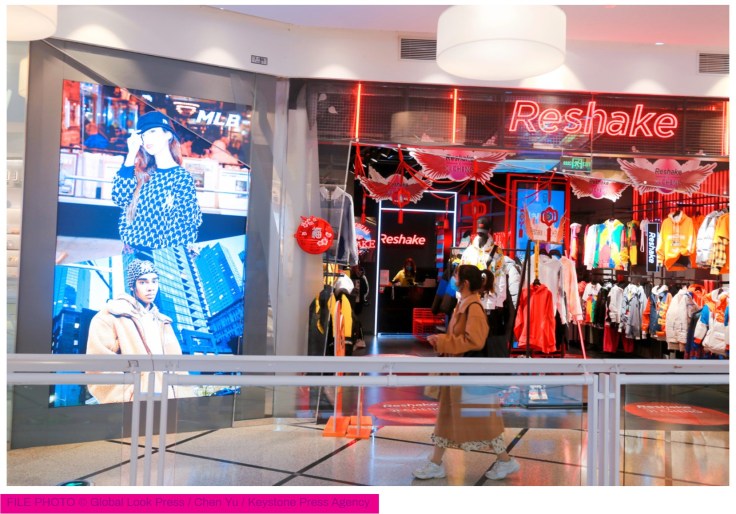
At the same time, Chinese buyers have stayed home from fashion shows in Milan and London, hitting even those Italian, and British brands that do their manufacturing at home hard.
Selling a niche product doesn’t guarantee safety from the ravages of virus-related factory closures, either. The owner of a chain of Russian sex shops revealed he was feeling the coronavirus squeeze in an interview with Gazeta, lamenting that many of the products he sells are either made in China or have major components sourced from China.
Condom shortages in Singapore and Hong Kong would at first seem to suggest that people are using their quarantine time to get hot and heavy, but photos circulating on social media indicate the prophylactics are flying off the shelves for other reasons – to cover for shortages of gloves and masks, to start. About a quarter of the world’s condoms are made in China.
Even sports stars have had to deal with coronavirus-induced shortages, a problem they might have expected their celebrity to insulate them from. Bauer Hockey, which makes custom hockey sticks for elite customers including many NHL players, saw its factory in Tongxiang City in Zhejiang province shut down last month and delay reopening twice.
The issue has apparently caused ripples in the league, leading to players being restricted to a “one-stick limit for practice and maybe two for games.” A player might typically go through several sticks in a single game, so while the shortage is very much a “first world problem,” it has caused much consternation in the hockey world.

Coronavirus’ economic impact is likely to be felt far into the future. A handful of major trade shows have either been put on hold or canceled altogether, most notably the Mobile World Congress, the world’s largest smartphone trade show. Scheduled for later this month in Barcelona, the conference – which typically hosts 100,000 attendees – has been completely called off. Smaller events for brands like Swatch and Cisco have also gotten the axe. Even gatherings still on the calendar, like this week’s Singapore Airshow, will see attendance severely curtailed as over 70 exhibitors have pulled out. Multi-million-dollar deals that might have been sealed at these temples of commerce will fall by the wayside or be postponed until the return of a favorable business climate – and no one knows quite when that will be.
The virus has disrupted next week’s Berlin Film Festival, with over 50 Chinese delegates and several other international execs pulling out because they couldn’t get travel visas. The festival is supposed to include three Chinese features and one short, which presumably will be screened anyway – even if their directors are stuck home in quarantine. But with China an ever larger international market for films, the absence of the executives will be felt.
And the virus has caused behaviors to change even where it hasn’t reached epidemic levels. People are thinking twice before having unnecessary contact with others, and redefining what contact might be “necessary.” Our Lady’s Acomb Church in York has pressed pause on its Communion ritual, which involves drinking wine out of a communal chalice, “until further notice” – lest an infected parishioner sicken others.
Such symbolic attempts to stave off an uncertain, invisible threat exemplify the global response to an epidemic that is still not well understood: a combination of panic and prayer.
By Dustin Nemos – 2/17/2020

The footage shows two men in pink hazmat suits and possibly a third man holding an umbrella conversing on the sidewalk with a couple, on the opposite side of the street from the pickup truck emblazoned with what appear to be government markings.
The man comforts the woman with him, who appears to become increasingly distraught as the conversation unfolds.
A cut in the video then shows the couple entering the cube strapped to the back of the truck, carrying what appears to be hand luggage.
The woman in white still appears very reluctant to enter the cube.
She eventually enters the container, and her luggage is pushed in after her.
The video then registers a very distinct and high-pitched series of agitated screams as the truck drives away to an unknown destination.
The video has since circulated on image boards, YouTube, and Twitter.
Many people are disturbed by the footage.
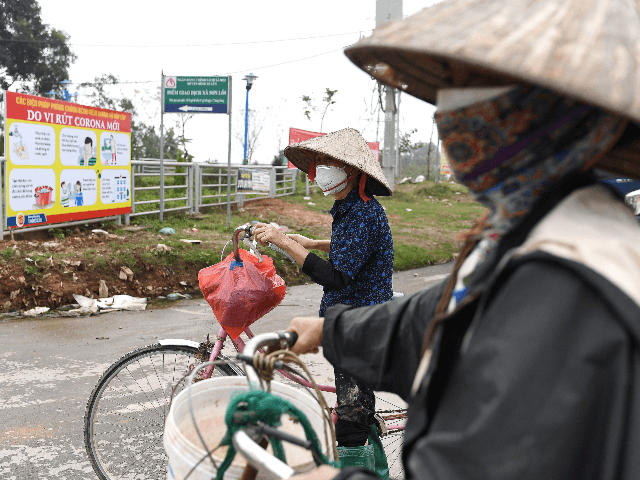
AFP reported on Thursday that six villages in the Son Loi farming region, covering 2,500 acres about 25 miles from Hanoi, have been quarantined and surrounded by security checkpoints:
Health officials wearing protective suits sprayed disinfectant on vehicles. Police warned people wanting to enter the quarantined area that while they would be allowed in, they would not be able to leave.
The order comes after the health ministry reported that five people have been infected with the virus. It later announced a sixth case.
They all originated from a female worker who was sent to Wuhan in central China — where the virus originated — for training.
The disease then spread to her family and her neighbors, including a three-month-old baby.So far, only the female worker has fully recovered and been discharged from the hospital, according to updates from the ministry, while the others remain in a “stable” condition.
The disease was reportedly spread by celebrations of the Lunar New Year, a holiday known as Tet in Vietnam. Villagers said they have been told to avoid large gatherings for the duration of the crisis. Residents of the area said they are having trouble getting work in the vital construction industry because clients are suddenly reluctant to hire anyone from Son Loi.
Vietnam has reported a total of 16 coronavirus infections to date. Although the Vietnamese government banned air travel to China, the land border has proven difficult to lock down.
Vietnam rejected docking requests from two cruise ships this week due to coronavirus concerns. A local official explained that forbidding cruise passengers to disembark was “just a temporary solution to prevent the intrusion of diseases.”
The captain of one ship, the Norwegian Jade, shot back that Vietnamese port officials have been “unreasonable during this process” and refused to allow his ship to dock despite having no signs of illness aboard and no passengers who had visited China recently.
The Norwegian Jade ultimately headed for Thailand, which is believed to have given it permission to dock at the port of Laem Chabang.
Reuters noted that Vietnam is planning to quarantine hundreds of its own citizens at military camps and temporary facilities along the border as they return from China.

FEBRUARY 14, 2020
The employees, who appear to be mostly women, stay frozen in place, some ducking low and covering their heads as the suit-clad man barges unceremoniously through the office.
A male employee standing by a doorway, seemingly unaware, is caught off guard when the spray cannon-wielding juggernaut shoots him the face with the liquid blast.
The employee recoils and ducks away as the hazmat guy storms past into the next hallway, brushing another woman aside with the spray cannon.
The video surfaces as China moves to “disinfect” Wuhan with fleets of rolling trucks and platoons of men in hazmat suits wielding spray cannons like the one seen above.
Chinese government-owned newspaper The People’s Daily released video of the “disinfection” of the city of Wuhan featuring fire trucks and platoons of men in hazmat gear roaming the streets and spraying chemicals in the air.
The People’s Daily, which is the official newspaper of the Central Committee of the Communist Party of China, posted the video to Twitter.
“Full-front disinfection work has started in #Wuhan, an effort to contain the spread of #coronavirus,” the tweet caption read.
In the footage, fleets of fire trucks can be seen rolling down the streets of Wuhan spraying some type of chemicals, presumably disinfectant, into the air.
The flashing emergency lights and clouds of mist create an interesting scene on what appear to be otherwise deserted streets.
In another clip, men in hazmat suits run while rolling a wheeled liquid cannon down a street, covering storefronts in a white mist.
Another man-portable variant of the “disinfectant” cannon is seen carried by several members of the hazmat crew. This version has a set of twin gas canisters that are mounted to the back of the user.
The measures being taken by Chinese authorities to fight the coronavirus stand at odds with previous reports that the coronavirus was no more harmful than the common flu.

FEBRUARY 14, 2020
Tomeka Hart, former congressional candidate and member of the Memphis school board, has recently worked for the Bill and Melinda Gates Foundation. She tweeted anti-Trump and pro-Hillary Clinton material while the Stone trial was in progress, and she also previously re-tweeted a hateful comment about Stone from CNN’s Bakari Sellers, which referred to Stone’s arrest. (READ: Court Transcripts Show Russian Set-Up Agent Who Met With Stone Was A Mueller FBI Informant).
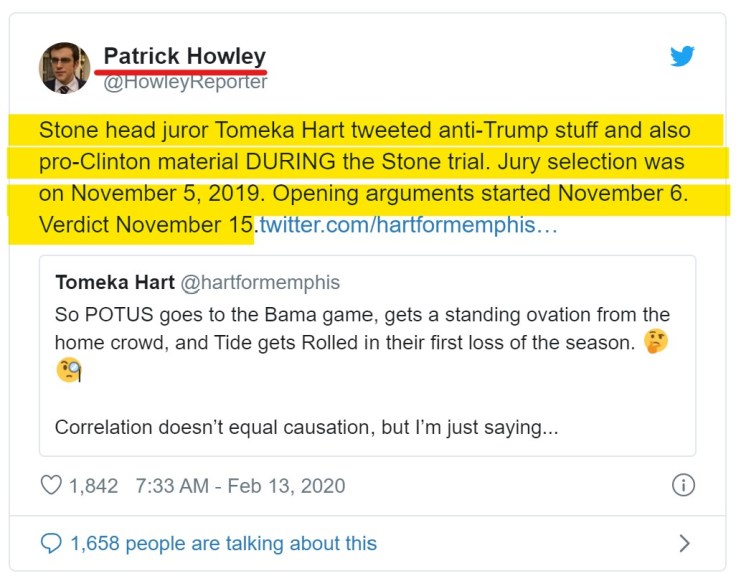
Tomeka Hart lied to get selected to the Stone jury.
“So nothing that I can recall specifically. I do watch sometimes paying attention and sometimes in the background CNN. So I recall just hearing about him being part of the campaign and some belief and reporting around interaction with the Russian probe and interaction with him and people in the country, but I don’t have a whole lot of details. I don’t pay that close attention or watch C-Span,” said Tomeka Hart, identified by her life details matching a juror who was interviewed, according to a transcript of the jury selection process.
But Tomeka Hart does watch C-Span. She said so herself on Twitter.
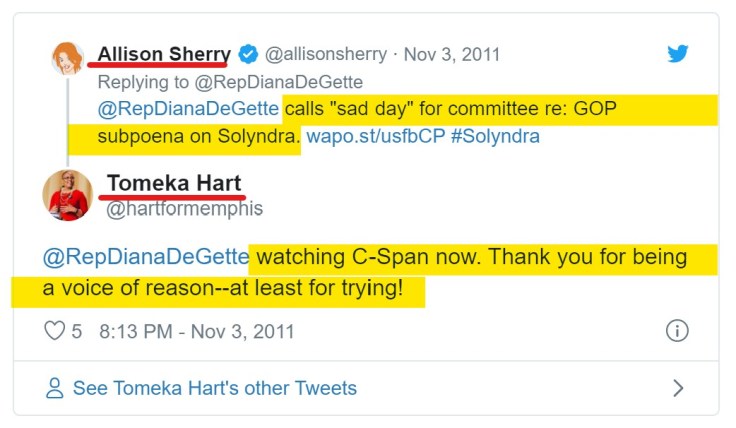
Tomeka Hart, who has been photographed with former DNC acting chairwoman Donna Brazile, is a political activist.
The Wall Street Journal reported in 2012: “An Arkansas jury found Erickson Dimas-Martinez guilty of murder in March 2010. This past December, the conviction was thrown out. The reason: A juror had been tweeting during the trial. This case and others across the country show how the use of social media is disrupting the jury trial. While juror misbehavior is nothing new, social media have made it extremely easy—and tempting—to break the rules, and lawyers are increasingly using that as a reason for appeals, legal experts say.”

February 14, 2020
You couldn’t make this up.
The Washington Free Beacon reports:
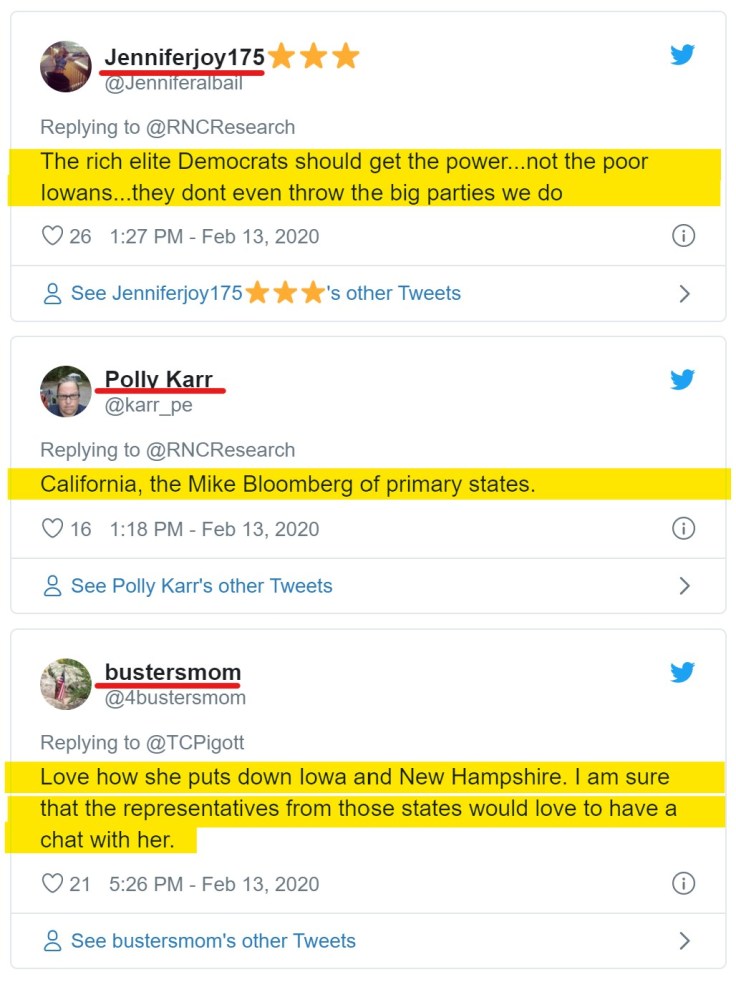
Maxine Waters: California Should Have More Say Over Primary Process Because of Its Rich Donors and Fancy Parties
Rep. Maxine Waters (D., Calif.) said that California should have more influence over the Democratic primary process because the state has so many wealthy donors.
“We have candidates who fly out to Los Angeles from everywhere to raise money,” Waters said Thursday on CNBC. “You would have two, three, four at a time in Beverly Hills having dinners and some of our contributors, who are very rich, were holding fancy parties, trying to accommodate the requests for donations and contributions.”
“The thinking is that if we are supplying tremendous dollars to candidates, we ought to have more say,” she added.
Watch the video below:
Does Waters have any idea how awful this sounds? Apparently not.


By Jose Nino – 2/14/2020
Defense News listed the items that are expected to be cut:
A mass of aircraft purchases including F-35 joint strike fighters, C-130J cargo aircraft, MQ-9 Reaper drones and P-8 maritime surveillance planes, as well as ground vehicles and
In sum, the plan would take $2.202 billion in FY20 defense appropriations and $1.629 billion in FY20 overseas contingency operations funding and direct it towards the wall. The wall on the southern border is a crucial plank of President Donald Trump’s campaign.
Air Force and Navy aviation spending make up the bulk of the Pentagon’s cuts, with aircraft procurement being slashed by $558 million for Navy and Marine Corps and $861 million for the Air Force.
In the Navy’s case, the Pentagon plans on cutting two of the six F-35B short takeoff and landing aircraft that Congress tacked on to the FY20 budget. It will also slash two MV-22 Ospreys, claiming that “current funding is more than sufficient to keep the production line open.” Further, the Navy plans on eliminating funding for one of the nine P-8A Poseidon surveillance aircraft funded in FY20, declaring that the additional aircraft is “[in] excess to the 117 aircraft required.”
As far as the Air Force’s budget is concerned, the Pentagon cut funding for four of the eight C-130Js that Congress added for the Reserve and Air National Guard. The department said that funding for those aircrafts can be re-allocated for fiscal year 2021.
The request would get rid of eight MQ-9 Reaper drones, cutting off most of the funding Congress added for an increase of 12 MQ-9s. “The program is currently undergoing a strategic review,” the department noted in a written justification. “Procurement, if necessary, can be rescheduled to a later fiscal year.”
It additionally peels off $156 million for advanced procurement for the F-35A and cuts $180 million for light attack aircraft for the Air Force.
The Army expects to lose $100 million in funding for National Guard Humvee modernization and $194.5 million in Heavy Expanded Mobility Tactical Truck funding.
The reprogramming request also implements cutbacks of $650 million in advanced procurement funding for an America-class Amphibious Assault Ship, LHA-9. This ship is currently being built in Mississippi at Ingalls Shipbuilding. According its website, Huntington Ingalls Industries claims that the advanced funding Congress provided, “enables a hot production line and a supplier base of 457 companies in 39 states to build this powerful warship.”
The reprogramming also reduces funding for one expeditionary fast transport ship, which is built in Alabama at Austal USA. The Republican Chairman of the Senate Appropriations Committee, Alabama Senator Richard Shelby has taken a particular interest in this project. According to the reprogramming document, the ship was viewed as “excess to current programmatic need.”
“The procurement exceeds the program-of-record requirement,” the document highlighted. “This is a congressional special interest item.”
Furthermore, the National Guard and reserves are set to lose approximately $1.3 billion in what the reprogramming request views as unnecessary funding. This decision was made due to historic under-execution of the previous year’s funds.
This is a solid win for America First and big blow against neoconservatives, neoliberals, and other factions that suck up the military-industrial complex.
The quicker that Trump’s wall can be built, the better.
 Tom's Blog