Los Angeles County Sheriff Alex Villanueva has announced that they will be closing all gun retailers as they are “not an essential function.”
Sheriff Villanueva also added 1,300 more deputies to patrol the county and released 1,700 “nonviolent” inmates from county jails since Governor Gavin Newson issued a stay-at-home order in the state.
Speaking to Fox 11, Villanueva claimed to support the Second Amendment, but spewed anti-gun talking points while announcing the gun store shut down.
“We will be closing them, they are not an essential function,” Villanueva said. “I’m a supporter of the 2nd amendment, I’m a gun owner myself, but now you have the mixture of people that are not formerly gun owners and you have a lot more people at home and anytime you introduce a firearm in a home, from what I understand from CDC studies, it increases fourfold the chance that someone is gonna get shot.”
The station reports that he also freed 10% of the inmate population from county jails — nonviolent offenders with misdemeanor sentences that were up within 30 days.
“We’re gonna keep violent felony suspects who are a threat to the community in the jail no matter what,” Villanueva said. “Anybody who has an idea that somehow we’re not going to be hard on crooks out there on the streets, they’re tragically mistaken, there’s twice as many deputies on the street now so the odds of you getting caught are a lot higher.”
Though he has doubled the police patrol, he claims that the National Guard is not active in the county, despite photos posted to social media that show large amounts of military vehicles.
“If we start losing major portions of our sworn personnel, that impacts our ability to man jails or our patrol obligations, and were running out of people to do that, if were in that position typically our counterparts in LAPD they’ll be in the same boat, then we can use the National Guard to start assigning them to security operations,” Villanueva said.
On Monday, the Pennsylvania Supreme Court denied an emergency request that would have blocked the governor’s order to close all gun retailers in the state in response to the coronavirus pandemic.
The court ruled on Sunday evening that the gun shops could be closed down, letting the order go into effect on Monday.
The gun shop shut down was part of an order by Democrat Governor Tom Wolf that closed all businesses that are not considered to be “life sustaining.” Gun rights groups argued before the Supreme Court that this should include weapons retailers, but they were denied.
The order shut down the stores on Monday without any timeline for when they can reopen.
The opacity of the Chinese Communist government obliges responsible outside observers to look for clues to the truth of the coronavirus epidemic, instead of merely repeating official information without question.
The official count from China is 3,277 fatalities from 81,171 infections as of Tuesday, but the Epoch Times noted the troubling disappearance of some 21 million cell phone accounts in China over the past three months – an unprecedented decline that hints at more fatalities than Beijing is prepared to admit.
It should be stated at the outset that we should not be forced to read tea leaves to figure out what really happened in China, especially in the virus epicenter of Hubei province and the city of Wuhan, where Chinese officials are currently making claims of zero new infections that no one seriously believes. While more responsible governments issue troubling warnings of a second wave of infections, severe enough to prompt the re-imposition of quarantine procedures that were only recently lifted, China claims it has no second wave and all of its new coronavirus cases are imported.
With that in mind, the Epoch Times thought it was a bit odd for 21 million Chinese cell phones to abruptly disappear, given that cell phone usage has been increasing constantly in China for years, and phones have been touted as an important tool for containing the coronavirus epidemic:
China’s Ministry of Industry and Information Technology (MIIT) announced on March 19 the number of phone users in each province in February. Compared with the previous announcement, which was released on Dec. 18, 2019, for November 2019 data, both cellphone and landline users dropped dramatically. In the same period the year before, the number of users increased.
The number of cellphone users decreased from 1.600957 billion to 1.579927 billion, a drop of 21.03 million. The number of landline users decreased from 190.83 million to 189.99 million, a drop of 840,000.
In the previous February, the number increased. According to MIIT, the number of cellphone users increased in February 2019 from 1.5591 billion to 1.5835 billion, which is 24.37 million more. The number of landline users increased from 183.477 million to 190.118 million, which is 6.641 million more.
According to China’s National Bureau of Statistics, the country’s population at the end of 2019 was 4.67 million larger than in 2018, reaching 1.40005 billion.
The article went on to postulate that some of the landlines might have been shut down as a consequence of the coronavirus quarantines, particularly lines used by shuttered business operations, but the sheer magnitude of the cell phone user decline makes it more difficult to explain. China Mobile, the nation’s largest carrier, reported gaining 3.7 million new accounts in December but then losing over 8 million in January and February, months in which it posted gains of 3.5 million users the previous year.
The Epoch Times considered several explanations for the loss of users, such as migrant workers who kept different cell phones for their home and work cities – necessary due to some of China’s regulations on phone service – abandoning the work phone because it was not needed during the quarantine period, or people generally canceling their phone service because they wanted to save money during the hard months.
On the other hand, the government is currently requiring citizens to use their cell phones to generate “health codes” so their movements can be tracked and permission to travel can be restricted to healthy individuals, so as U.S.-based commentator Tang Jiangyuan put it, it is effectively “impossible for a person to cancel his cellphone.”
“Dealing with the government for pensions and social security, buying train tickets, shopping … no matter what people want to do, they are required to use cell phones,” Tang noted.
The New York Times explained just how heavily Chinese authorities are leaning on those cell phones to monitor their population, and not just for coronavirus infections:
The Times’s analysis found that as soon as a user grants the software access to personal data, a piece of the program labeled “reportInfoAndLocationToPolice” sends the person’s location, city name and an identifying code number to a server. The software does not make clear to users its connection to the police. But according to China’s state-run Xinhua news agency and an official police social media account, law enforcement authorities were a crucial partner in the system’s development.
While Chinese internet companies often share data with the government, the process is rarely so direct. In the United States, it would be akin to the Centers for Disease Control and Prevention using apps from Amazon and Facebook to track the coronavirus, then quietly sharing user information with the local sheriff’s office.
The system, which relies on a unit of the immense Chinese e-commerce company Alibaba, assigns users a green, yellow, or red “health code” in the style of a traffic light. Predictably, Chinese citizens find the opaque system cryptic and frightening, since the government has not explained exactly how it works.
“In some cities, residents now have to register their phone numbers with an app to take public transportation,” the Times added.
At the beginning of March, the so-called Alipay Health Code system had been launched in the city of Hangzhou, expanded to 200 other cities, and was on its way to a complete nationwide rollout. The rollout ran into some hitches over the following weeks, from technical glitches to confusion caused by local governments adding their own health codes to the already intimidating system.
A correspondent writing for Bloomberg News on March 18 reported using the system and said it was in the process of being “rolled out nationwide at railway stations, restaurants, pharmacies, and more.” Other reports in China have noted how cell phones are ubiquitous there and are employed for everything from accessing public and commercial resources to telecommuting to school during the coronavirus lockdown.
With this in mind, it might not be completely impossible to get by in Chinese cities without a cell phone at the moment, but it seems unlikely that a huge number of citizens would choose this moment to get rid of their phones.
“Lacking data, the real death toll in China is a mystery. The cancellation of 21 million cellphones provides a data point that suggests the real number may be far higher than the official number,” the Epoch Times concluded.
The number of Covid-19 cases in Italy is probably ten times higher than official numbers, according to Italy’s civil protection chief Angelo Borrelli, who said that as many as 640,000 people could be infected in the country.
“It is credible to estimate that there are 10 positive cases for every one officially reported,” Borrelli told La Repubblica newspaper on Monday.
The latest figures show almost 64,000 people have been infected and 6,077 have died from the infection in barely a month, making Italy the worst-affected country in the world, with close to double the number of fatalities in China, where the virus emerged last year.
Medical experts confirm that Italy has focused its testing only on people showing severe symptoms in areas with high epidemic intensity like Lombardy, Emilia-Romagna and Veneto in the north of the country, thus it is difficult to say the real numbers.
“This causes an increase in the fatality rate because it is based on the most severe cases and not on the totality of those infected,”says Massimo Galli, head of the infectious disease unit at Sacco Hospital in Milan.
Italy reported 602 new deaths from the coronavirus on Monday. The number of fatalities dropped for a second day in a row, after reaching an all-time high of 793 on Saturday.
Democratic legislation “uses the words diverse or diversity more than 60 times”
Steve Watson – MARCH 24, 2020
Fox News anchor Tucker Carlson slammed Democrats for holding up the coronavirus relief legislation, urging that they are “indulging their creepy ideological obsessions” by inserting stuff that has absolutely “nothing to do with fighting the pandemic.”
Carlson highlighted several parts of the 1,400 page House Democratic bill, which is stuffed with pork, and noted that most of it is about being ‘woke’ rather than fighting the killer virus.
“The bill would require every corporation that receives coronavirus aid to have officers and a budget dedicated to diversity and inclusion initiatives for a minimum of five years after they get the money,” Carlson noted.
“Because that is going to keep America healthy and prosperous, just like it has,” Carlson sarcastically emphasised.
“Companies would also have to produce elaborate racial reports for the government listing the skin color and the sex of their officers and boards of directors. They have to prove they give enough money to firms owned by women and nonwhites, and of course how much they spend on diversity initiatives,” he continued, pointing to the relevant sections of the bill.
Carlson noted that the bill “uses the words diverse or diversity more than 60 times.”
“What does that have to do with the pandemic that might kill you?” he asserted, adding “Not one thing. Just more ugly race politics, the kind they specialize in.”
“This is insanity, it’s dangerous insanity,” he proclaimed, adding “Who cares what color your scientists are?”
While ordinary Americans deal with the coronavirus pandemic and the many anxieties that accompany the unprecedented crisis, the super rich areretreating to state-of-the-art bunkersfeaturing bowling alleys, swimming pools, and other amenities.
The providers of these doomsday bunkers are reporting a drastic increase in business, with coronavirus hysteria causing at least one economic sector to boom.
“As unpopular as coronavirus is, it’s getting the publicity of a Backstreet Boys hit in the ‘90s,” said Gary Lynch, general manager of Texas-based Rising S Bunkers. “People have an infatuation with it.”
Business is good for Lynch and other bunker manufacturers, as the ultra rich scramble to use their remaining wealth to seclude themselves. There is no limit to the luxuries that can be provided in a modern bunker, with many of these bunker models resembling mansions.
“Movie theaters are common,” Lynch said. “We built one in California that has a shooting range, swimming pool and bowling alley.”
Lynch offers 24 different options for individuals wishing to purchase a bunker. The smallest model costs $39,500and includes a custom air filtration system, bunk beds, a functioning toilet, and a kitchen counter. A more decadent set-up is the Fortress, which costs $1.009 million, including 15 private bedrooms, 42 bunk beds, a panic room, and a room to house guns.
The most garish model of all is the Aristocrat, which features a sauna, hot tub, swimming pool, gym, greenhouse, billiards room and garage. It costs an incredible $8.35 million to construct and is off limits to all but the super rich. Coronavirus is causing a run on these types of shelters, Lynch explains, as high-class Americans realize the necessity of extreme preparedness.
“In 2008, I talked to a guy for four-five months who was thinking about purchasing a shelter. I think he probably used the coronavirus to convince his wife, because he finally just bought one,” Lynch said. “That’s how most buyers are; they’re not in it for one single reason.”
The providers of these bunkers feel they are supplying a much-needed service in the market to alleviate the authentic fears of families in an increasingly topsy-turvy world.
“We don’t create fear. We resolve it. The true elite all have backdoor plans. They’re jumping on planes and flying to islands,” said Robert Vicino, who is CEO of the shelter-building company Vivos. “We give people the peace of mind that they have their own backdoor solution for when it’s time to take shelter.”
Vicino noted that his clientele has moved from middle class to upper class in recent months, as the wealthy no longer feel insulated from the rest of society from their gated neighborhoods. He reports that interest in his bunkers are up 1,000 percent year-over-year, and sales are up 400 percent, as doomsday fever sweeps throughout America.
“As long as time permits, we will continue to build bunkers. This world won’t be safer tomorrow,” he added.
For the Americans without the wealth to retreat from society, they will have to deal with a tumultuous and dangerous reality for their loved ones as the coronavirus pandemic continues without any sign of slowing.
Time to buckle up: economists believe the looming Covid-19 crash will throw millions out of work and bankrupt thousands of businesses across the globe in a downturn that might even surpass the Great Depression of the 1930s.
Economics is the study of choices, and never more so than now. It’s now clear that, with the coronavirus pandemic causing widespread chaos that economists believe will cause a prolonged economic depression, the choices that each person makes have the power to affect their country’s and the world’s economy over the coming weeks and months. With the caveat that much depends on those individual choices and the actions of governments, here is our current assessment of which places are likely to be worst-hit economically, as well as a few that might come out rosier than most.
THE GOOD (ISH)
Singapore
Singapore might be the perfect recipe for coronavirus containment. A rich city-state with a world class universal healthcare system, a pandemic response plan in place ever since they were badly hit by the SARS virus in 2003, and healthy lashings of state-enforced social control mean they quickly knew exactly how and where 100 of their first 112 confirmed cases became infected. Astonishingly, their non-oil exports grew in February, owing mostly to an increase in shipments of pharmaceuticals and various manufactured goods to America, Japan and the EU. Their regional trade with China and the rest of Southeast Asia will suffer, though, and their economy is a trade-based one. Therefore, they are likely to enter a recession this year, along with the rest of the world. But the early signs suggest they may be better off than a lot of places, though.
Sometimes, it pays to be a totalitarian state. And to go first. China’s stifling of the contagion that started the trail of devastation has been miraculous, albeit achieved through the sort of state enforcement other countries would find difficult to enact. For the most populous country on Earth to go into a state of universal lockdown, with meetings or gatherings of any kind forbidden and essentially no individual movement outside of one’s own home permitted, requires a strong level of police enforcement, and the end of all but the most rudimentary personal freedoms. But it sure is working. China has been seeing the number of new cases decline, with none being home-grown — all their new infections — it reported 39 today — are from people returning home from abroad.
In the early days of the pandemic, economists were predicting a sharp decline in China’s economy followed by a sharp bounce back, a so-called V-shaped curve. But as the crisis has worsened experts are now forecasting a longer, deeper downturn, one that will take longer to escape from. But, having been the first to suffer, they will be the first to emerge from it. After the Communist Party has held the entire population of the country in its grip for the duration of this lockdown, without any major public unrest, they will come out the other side poorer, but arguably with even more political control than before. Which Beijing will use to help make a swift economic recovery, using its technological and manufacturing muscle.
THE BAD
America
Donald Trump has spent much of his presidency tweeting and boasting about how strong the US economy has been… and he’s been right. The economy has been steadily growing ever since the last global crisis in 2009, and in 2019 the period became the longest global expansion on record. But that expansion will become yet another victim of coronavirus before the summer is out. And there appears not to really be a reference for how bad things could get. Bill Ackman, the CEO of Pershing Square Capital Management, has begged President Trump on CNBC to beg to shut down the American economy for 30 days and put the country in a nationwide lockdown. “America will end as we know it unless we take this option”, he said. When hedge fund managers are praying for the economy to be SHUT DOWN in order to protect it, you know things are bad.
Comparisons to the Great Depression of the 1930s are common, with the majority consensus leaning towards the Covid-19 Depression of the 2020s being worse. JP Morgan is predicting a 14% slash in the US economy this quarter (alongside an eye-watering 22% in the Eurozone) while another forecast yesterday warned US unemployment could rise to 30% and overall GDP could decline by a staggering 50% in the second quarter. Depending on how quickly the Federal Reserve can pump money out to businesses at the same time as stemming the contagion as much as they can, then this could be anything between a gigantic global recession for at least six months, to the worst economic crisis in history, with depths as yet unplumbed. America, as the centre of the Western world’s economy, is going to feel the pain most.
Italy
No prizes for predicting that Italy will have suffered more than most when the dust settles on this crisis. A middle-sized country with a small economy, they find themselves overtaking patient zero China in numbers of active cases and dead. Italy has everything working against it. An elderly population more susceptible to the disease. An economy heavily reliant on tourism which will be decimated. And huge debts.
They were already a heavily indebted country that had suffered possibly more than any other European country through their membership of the Eurozone. And they were hardly a united cohesive society either, with the poorer south harboring ancient resentments against the richer north, which has experienced the centre of the outbreak. Footage of Italians singing from their balconies has been inspiring, and perhaps this crisis will bring them closer together as a country, as only tragedy can. But any other silver linings are hard to see for The Boot of Europe.
The Korean Republic is exerting a similarly strong defensive action to Singapore against the virus. They also have huge Big Data capabilities for mass testing and contact tracing, utilising citizens’ mobile phone and credit card data to decide who to test in the first place. They are no strangers to outbreaks either, as the 2015 MERS outbreak taught them lessons about how to minimize the impact on the health services. As for their economy, though, it was not in great shape leading up to this, and the damage to trade links within Asia will hurt them badly. The epicenter of their coronavirus outbreak is in the manufacturing region, and a Hyundai factory has already closed its doors there. But if it spreads to Seoul they will be in even bigger trouble, as that could shut down the business and finance sectors.
Australia
Australia is another country highly dependent on trade with China, and is predicted to be the hardest hit economy in the world outside of China itself and Hong Kong. China is also Australia’s biggest source of tourism revenue, and that twin-pronged attack on their economy is sure to do major lasting damage. This could not have come at a worse time for them either, straight off the back of a summer of rampant bushfires that did huge economic and reputational damage. Already, the Australian dollar is trading at very low values. Worrying times for Aussie people and politicians alike.
THE UGLY
Africa
OK, Africa is obviously not a country, but there’s no point in trying to predict which of the already-fragile economies in that vast and troubled continent will be worst affected by coronavirus, when it does spread widely there. Africa has more than enough problems without yet another killer virus, but it has been largely ignored in discussions about global impacts of Covid-19 thus far. Frighteningly, most African countries are acutely vulnerable: many have fewer than 10 hospital beds per 10,000 people; they have many crowded, impoverished townships where there’s a lack of water to wash hands and little space to self-isolate; and few have any contingency plans or resources to cope with such an outbreak. According to NKC African Economics, Angola, Gabon, Ethiopia, Ghana, Tunisia, Zambia and Kenya are the African countries most at risk of debt distress in the likely event of a global recession. Slowdowns in the rest of the world pose a grave threat to African countries’ already precarious trade links to Europe and Asia.
Lockdown paradox
Damage to a country’s economy is a direct product of steps taken to hinder the spread of the virus itself. If absolutely no measures were taken by a country, and companies remained open and everything was business as usual, their economy would be unaffected. With the exception, that is, of the untenable pressure that would soon be brought on the health services in that scenario. With a high peak in Covid-19 cases, the health services would quickly be overwhelmed, and people would start dying on the streets or at home without the slightest hope of even the most basic medical intervention. Clearly, this is not an acceptable state of affairs, which is why such drastic, possibly recession-triggering measures are being taken, all in an effort to save as many lives as possible.
Governments are doing what they can, which is essentially throwing huge, unprecedented sums of money to try to avert a prolonged crash and to keep their economies running. Most commentators cite wartime measures as the only comparable action. And the world is at war, against an enemy that, if left to run amok, will cripple the economy, ruin livelihoods and perhaps kill hundreds of thousands, perhaps millions, of people. How well we combat it will determine all of our futures.
Hong Kong reports largest daily jump in cases on record as travelers revive outbreak
NY rolls out restrictive new measures
NY case total tops 7k
Italy says Army will help enforce lockdown, effectively declaring martial law; might extend lockdown through early May
Spain death toll cracks 1,000
Italy reports another 627 deaths
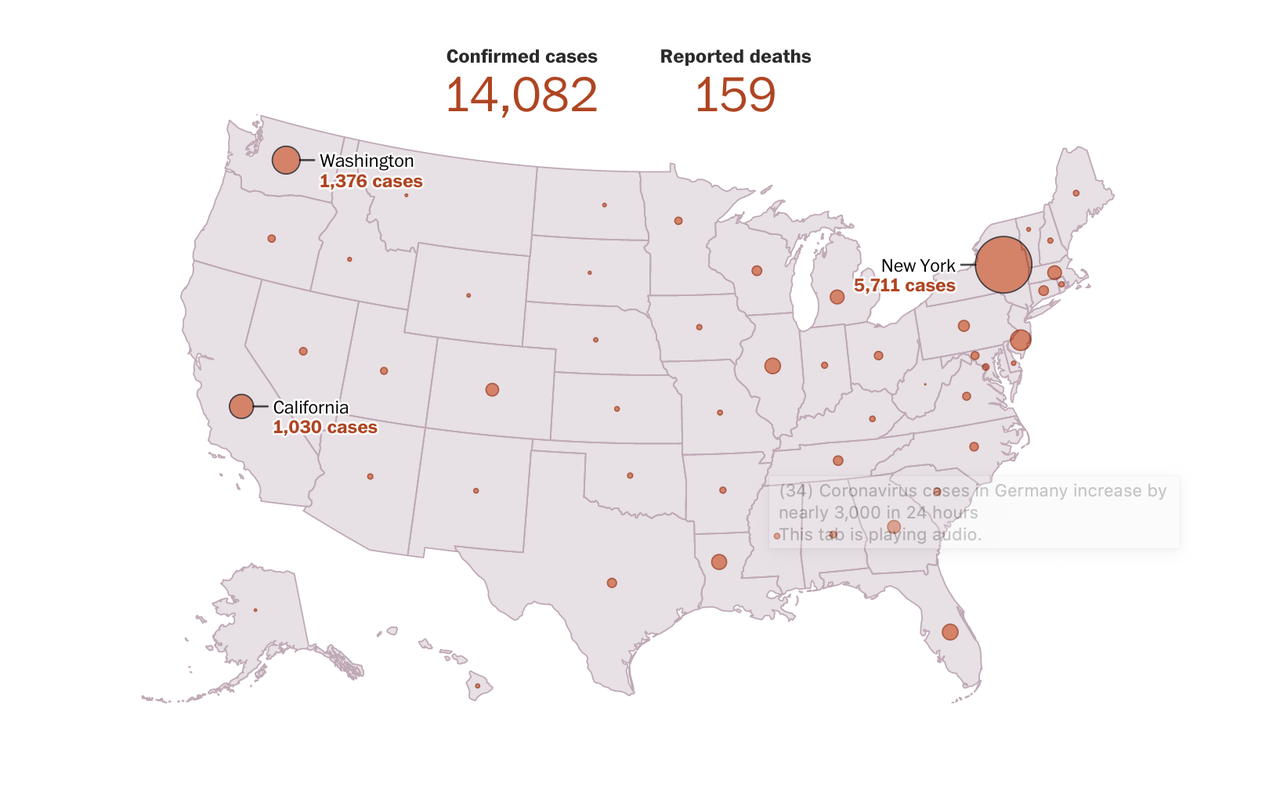
Confirmed cases in US pass 14k
Drive thru testing site in NJ’s Bergen County has a line that’s over 1,000+ cars long
Switzerland bars all gatherings of more than 5 people
Trump says no plans for national lockdown
Germany to pass ‘shadow’ budget on Monday
EU suspends budget rules
Bavaria becomes first German state to impose ‘lockdown’
Johnson says UK can defeat virus in 12 weeks if ‘we work together’
Treasury now moving back both filing & payment deadlines for 2019
Novartis will donate up to 130 million doses of hydroxychloroquine to support global response
NBC News employee succumbs to virus
Dr. Fauci says social distancing should continue for several weeks
MTA confirms it has 23 sick workers
US, Mexico agree to shut southern border
China makes first purchase under ‘Phase 1’ trade deal
Altria chairman & CEO tests positive
Military confirms 35 American troops infected in Europe
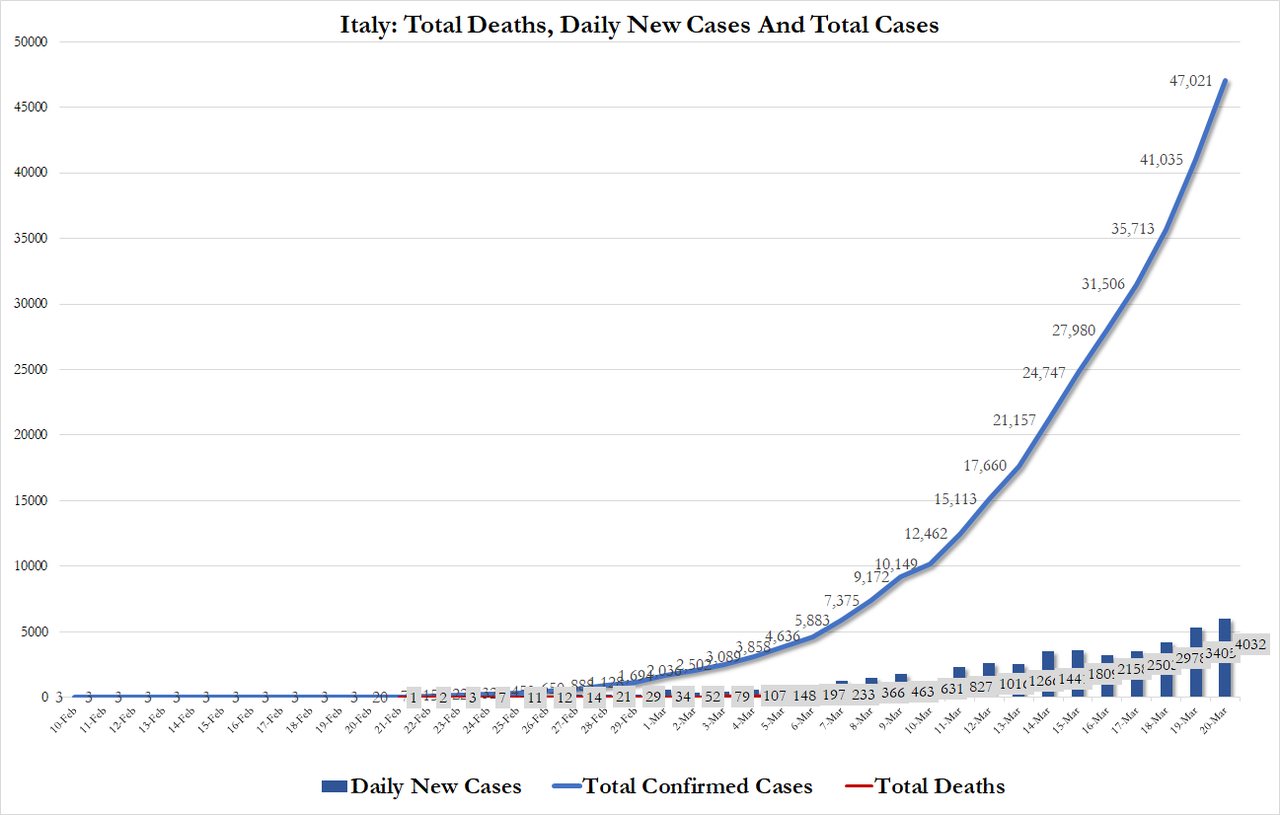
Update (1320ET):As Italy’s worst outbreak spirals further and further out of control, Italy is reporting 5,986 new cases of coronavirus and 627 new deaths on Friday, raising the countrywide total to 47,021 cases and 4,032 dead, as the total number of cases in Europe surpasses the total ‘officially’ confirmed in China.
If you’re curious about how things are looking on the ground in Italy, this Channel 4 report is chilling.
* * *
Update (1240ET):In an alarming video that shows just how huge demand is for COVID-19 tests, a drive-thru testing site in Bergen County has a line that’s “several thousand cars long”.
Here’s a closer look at the drive-through testing site in Bergen County New Jersey. National Guard and medical professionals in full gowns and masks. Line for testing is several thousand cars long. @CBSNewYork#covid19pic.twitter.com/6F7es4Eq2S
Update (1220ET): As President Trump and the White House task force (with Dr. Fauci making an appearance today) update the country on the federal government’s efforts, Sec. of State Pompeo said that the US and Mexico had agreed to shut the southern border with Mexico..
In other news, drug company Novartis will donate up to 130 million doses of hydroxychloroquine to support the global virus response, according to a statement.
Trump also said that he probably won’t ever institute a national lockdown, feeling that decisions like that are better left up to the states. Across the Atlantic, the EU on Friday confirmed that it would expand its budget rules to open the floodgates to fiscal stimulus, as expected.
* * *
Update (1120ET):The morning after California laid out the most restrictive measures to combat the virus in the US, NY Gov. Andrew Cuomo on Friday laid out new measures for New York State to combat the coronavirus outbreak, imposing new restrictions like ordering “100% of the workforce” to stay home.
During this time, Cuomo is order all businesses in the state that aren’t deemed “essential” to close, and added that though public transit will remain open for people who need it to travel to their ‘essential’ jobs, and to get to places like hospitals and doctors offices and grocery stores and pharmacies, he urged New Yorkers to only take the trains if absolutely necessary. Cuomo also clarified that bank ATMs are an ‘essential’ service.
All non-essential businesses must close, Cuomo and NYC Mayor de Blasio have said that the state will find better ways to accommodate essential employees who need childcare or other things. But Cuomo threatened to fine businesses and individuals caught breaking the rules.
“These are not helpful hints…they will be enforced. There will be a civil fine and mandatory closure for any business that is not in compliance.Again, your actions can affect my health, that’s where we are. There is a social compact that we have…we must make society safe for everyone,” Cuomo said about the executive action that he’s preparing to sign.
New York reported 2,950 new cases on Friday, bringing the state-wide total to 7,102 cases, with 4,408 cases in NYC.
As he chided the public for not taking the outbreak seriously enough, Cuomo declared that young people saying they can’t get the virus is “simply wrong,” claiming that 25% of cases are people ages 20-44.
When it comes to exercise, though gyms will be closed, Cuomo said New Yorkers can engage in ‘solitary’ activities like jogging, but said games of pickup basketball and team sports like that won’t be permitted.
During the press conference, Cuomo confirmed that the state had reached the capacity to test 10,000 New Yorkers a day, becoming perhaps the only state in the country to overshoot on its daily testing target of 6k tests. Along with these new ‘dramatic actions’, Cuomo announced more confirmed cases and deaths.
Cuomo told a story about how the city governments of St. Louis and Philadelphia during the Spanish Flu epidemic dramatically impacted the outcomes for their local populations, and that Cuomo was trying to follow the better example, before bringing up the issue of mental health and the fact that his daughter was forced to isolate for 2 weeks.
At any rate, looking at the case curve, the number of cases expected could triple the state’s capacity of beds and ventilators needed to save the lives of the sickest of patients.
The governor, who urged New Yorkers to “blame me” if things go badly with these measures, claiming that this decision was his after careful consideration and consultation with experts. “I did everything we could do…this is about saving lives…if everything we do saves just one life, I’ll be happy,” Cuomo said.
Moving on, Cuomo declared that he was banning evictions during the crisis, building on measures prohibiting banks from engaging in foreclosure, another unprecedented step.
In keeping with Cuomo’s coordination with the governors of New Jersey and Connecticut, Cuomo said he would be speaking with Phil Murphy and Ned Lamont, the governors of NJ & CT, later in the day to discuss his measures and whatever can be done to continue coordinating their states’ responses. Rumors have circulated in recent days that a similar lockdown might be declared in CT.
Asked by reporters how long to expect these circumstances to remain in place, Cuomo declared that “this could go on for months”, one day after saying researchers projected that the outbreak would peak in 45 days.
Watch the rest of the press conference here:
From the sound of it, Cuomo’s actions are still being well-received by New Yorkers and the country.
Elsewhere, in Switzerland, public health officials barred all gatherings of more than 5, possibly the most strict gathering ban instituted anywhere around the world.
* * *
Update (1055ET): Meanwhile, in London…
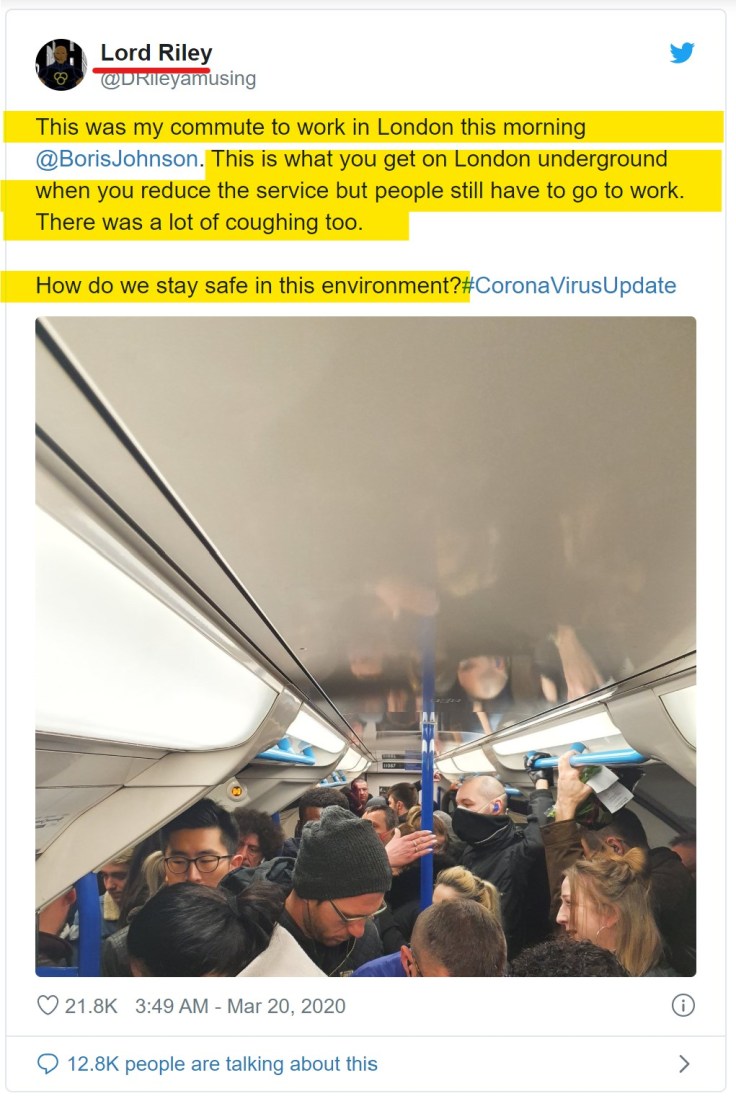
Boris Johnson‘s government has continued to deny reports about an impending ‘lockdown’ of London. But with 10k troops on standby, we suspect that Italy might soon have some company in the ‘martial law’ department.
* * *
Update (1015ET):The Treasury has officially moved back ‘Tax Day’, by postponing both the payment deadline (which it announced earlier) and the filing deadline (which it just announced Friday morning).
In other news, an NBC News employee has died from COVID-19.
As an update: Confirmed cases in the US passed 14,000 Friday morning, while the number of confirmed deaths hit 160.
* * *
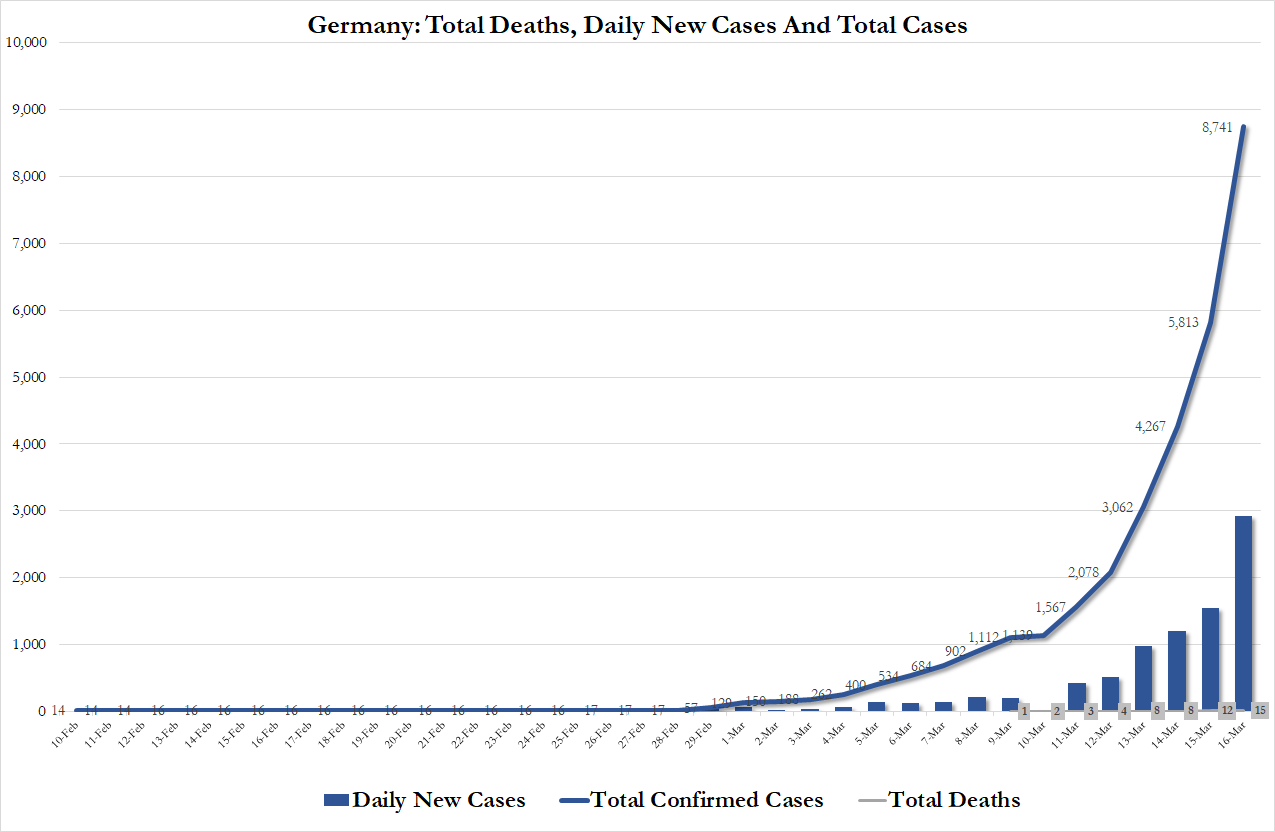
Update (0950ET):The market didn’t seem to care all that much, but Handelsblatt reported Friday that the German government is planning to pass a planned €200 billion budget to combat the crisis, as Berlin continues to facilitate mass testing and triaging that has kept its mortality rate among the lowest in Europe.
This comes after Germany car companies said they would close more factories.
Barely a day has gone by over the past two new weeks that there hasn’t been some report about Germany suspending its ‘debt brake’ due to the crisis and boost fiscal spending, as Christine Lagarde and the ECB have called on them to do. Even before the outbreak, reports about Germany passing a ‘shadow budget’ to boost tepid economic growth date back to at least the fall.
Germany’s outbreak began in the state of Bavaria, still its worst-hit region. And as governments around the world tighten restrictions on movement, Bavaria on Friday imposed new “fundamental restrictions” on public life to aid the fight against COVID-19, DW reports. The move, of course, comes less than 12 hours after the governor of California imposed similar measures.
“We’re shutting down public life almost completely,” Bavarian Minister President Markus Söder said.
People will only be allowed to leave their homes for necessary purposes, such as going to work or the doctor and buying groceries or medicine.
“It’s not easy to take these decisions,” Söder said. “We take these decisions according to the best of our knowledge and conscience. There will be a Bavaria after corona, but it will be a stronger one if we don’t look away.”
The measures will go into effect for two weeks starting Friday evening.
In other news, the German state of Saarland wants to shut down restaurants and restrict people from going out in public, moves that are similar, though somewhat less restrictive, than Bavaria. Saarland State Premier Tobias Hans will recommend the move to his cabinet this afternoon, the state chancellery confirmed.
* * *
Update (0945ET):Six weeks ago, many branded us ‘alarmists’ for publishing warnings by credible epidemiologists and virologists about the infectious potential of the novel coronavirus.
If you still believe those warnings were ‘alarmist’, we wish you the best of luck during the coming weeks. You’re going to need it.
* * *
Update (0928ET): The US military just confirmed that 35 American troops in Europe have tested positive.
Meanwhile, the FCA in the UK warned banks to ease up on repossessions and the like, issuing a statement claiming that “no responsible lender should be considering repossession as an ‘appropriate measure’ at this time. This comes after BoE Governor Bailey warned that banks should suspend foreclosures and repossessions.
Though it’s faded into the background, tensions over whether China would be able to keep up with its ‘Phase 1’ trade deal commitments have slackened somewhat now that Beijing has made its first expected purchase of US agricultural goods.
CHINA BUYS 756,000 METRIC TONS OF U.S. CORN, FIRST MAJOR PURCHASE UNDER PHASE ONE TRADE DEAL
* * *
Update (0850ET): Prime Minister Giuseppe Conte blamed the Italian people earlier this week when he said he would extend Italy’s nationwide lockdown until April 3, claiming that too many were still violating the lockdown despite stiff penalties.
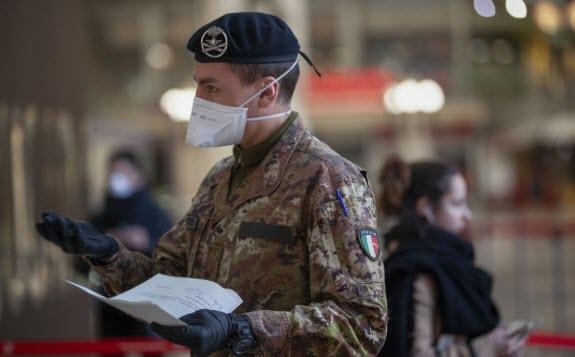
As the country’s death toll passes the death toll from mainland China (or the ‘official’ death toll at least), whispers about even restrictive measures appear to have just been validated: Prime Minister Giuseppe Conte on Friday effectively declared martial law Friday morning in Italy’s worst-hit region of Lombardy, claiming that he will now be bringing in the Army to enforce the lockdown, something that the region’s governor swiftly confirmed.
As many members of the Italian public continue to act with no respect for protecting the public health and the massive effort underway to contain the outbreak, for the first time, many are about to learn the meaning of discipline.
According to media reports, Conte is considering extending the lockdown until at least early May.
ITALY’S LOMBARDY REGIONAL HEAD SAYS GOVERNMENT HAS AGREED TO USE ARMY TO IMPOSE LOCKDOWN IN HIS REGION
Ultimately, whether the government decides to extend the lockdown will depend on factors like the continuing spread of the virus, as well as the public’s response, and whether Italians finally start taking this seriously.
At this point, many expect that schools will not reopen before the summer break, the that the further tightening may not only include a ban on outdoor, but might also prohibit Italians from the cherished “passeggiate,” leisurely strolls around town that allow one time to think and digest.
While the Italian outbreak still has no end in sight, over in the US, Dr. Anthony Fauci said Friday morning that social distancing in the US should continue for ‘several’ more weeks, as officials scramble to try and discern exactly how far the virus has penetrated, as hundreds of thousands of tests arrive at labs. Last night, during an appearance on Facebook live, Dr. Fauci confirmed that more tests are being shipped as private partnerships with firms like Thermo Fisher.
Reports claimed Friday that the Italian Treasury now expects the country’s economy to contract by 3% this year, largely because of the lockdown.
Soldiers have already been deployed in some places to help enforce the lockdown and help with the crisis response.
New York’s MTA on Thursday announced that 23 workers have tested positive for the virus, this is up from just 1 worker as of early Thursday. The workers didn’t display symptoms at work and were described as being of low risk to riders.
In other central bank news, the SNB has announced more measures, while Sweden has expanded a loan guarantee program.
Meanwhile, as Boris Johnson’s government facilitates a policy u-turn to fight the virus, his former Chancellor is chiding the public on twitter.
At this point, it’s almost like the more you yell at them to stop, the more panicked they become.
* * *
When historians look back at this time, we suspect that California Gov. Gavin Newsom’s landmark decision to order more than 40 million Californians to remain at home on Thursday night will be remembered as an important demarcation point – the beginning of a more heavy handed response as it becomes increasingly clear that too many Americans are simply ignoring the government.
So far, NY Gov. Andrew Cuomo and President Trump have insisted that they have no plans to issue lockdown orders. But with the number of confirmed cases expected to soar in the coming days and over the weekend, the situation is certainly evolving rapidly, and rumors about other states considering preemptive lockdowns (remember, the whole point is to stay “ahead of the curve”) continue to circulate.
Over the past week, central bankers around the world have slashed rates, stepped up bond buying programs, promised to expand their back-stopping of credit markets and – most importantly – urged the politicians in charge to do their part and pass massive fiscal stimulus. Late last night, the Senate unveiled a $1 trillion package that will feature direct transfers to many Americans.
In the US, futures are pointing higher amid mounting hopes for a second straight close in the green. The improved sentiment is ostensibly due to the latest wave of central bank interventions. But that didn’t stop a team of economists at Bank of America from releasing a new note calling for a global recession, with GDP growth dropping to 0% for the year in 2020. Explaining the shift in their thinking, the team wrote: “Our first piece on the virus shock was titled ‘Bad or worse’; now we amend that to ‘Really bad or much worse.'”
The World breathed a sigh of relief Thursday night when China reported no new domestically-transmitted cases of the coronavirus for a second straight day. Meanwhile, Reuters just reported that the foreign ministers of South Korea, China and Japan have held a video conference on Friday to discuss cooperation on the coronavirus pandemic as concerns grow about the number of infected people arriving in their countries from overseas, threatening to set off a second wave of infection. The State Department is doing its part: It issued a ‘Level 4’ travel warning last night advising Americans not to travel abroad, and for any Americans still outside of the country to either come home, or ‘shelter in place’.
In the UK, Prime Minister Boris Johnson said last night that the UK could quash the virus in 12 weeks if Britons simply cooperate with the government’s new efforts.
Unfortunately, it appears the dreaded ‘second wave’ of infections is already looming over Hong Kong.
After reporting 14 new cases in a single day earlier this week, a surprisingly large jump for a city that was widely praised for its swift and heavy handed response to the outbreak (proving that the city had retained the hard-learned lessons of SARS), Hong Kong on Friday reported a record jump in new cases as the city-state braces for a wave of new illnesses, many involving travelers from abroad and the HK residents they’ve infected.
Friday’s surge of 48 cases is the largest daily jump since the outbreak began; it’s equivalent to roughly a quarter of all cases confirmed in the city previously, according to the SCMP.
Even as the virus swept through parts of China and elsewhere in the region, Hong Kong managed to largely control its outbreak. Now, as life in the financial center had begun to return somewhat to normal, the wave of new cases is worrying experts who say it could lead to widespread community transmission. The city now has more than 250 confirmed infections.
The new confirmed cases take the city’s total number to 256, and a top microbiologist said Hong Kong might be on the edge of an all-out “war” against an explosion in infections.
The Centre for Health Protection said 36 of the latest round of infected people, aged between four and 69, had a travel history. One of the local cases is a taxi driver who had picked up passengers from the airport.
When asked whether the government should ban non-locals from entering the city, Dr Chuang Shuk-kwan, head of the centre’s communicable disease branch, said all the fresh infections were residents, except one – an Australian who had been to the United States and Portugal. He was transiting at the airport and sent to hospital after feeling unwell.
As SCMP explained, 1,000s of people returned to the city this week, with new asymptomatic spreaders evading checks and spreading the virus inside the city. The spike in new cases prompted the city’s government to announce new quarantine measures requiring anyone arriving from abroad to self-isolate for 14 days, measures that have also been implemented by China. Also in China, the People’s Daily reports that catering halls and shopping malls are reopening in Beijing.
Whether you trust the Chinese numbers or not, there’s no question that the CCP leadership has reason to be cautious, now that it appears President Xi has evaded a historic embarrassment. According to Johns Hopkins, the number of confirmed cases ROW is now 2x the number from mainland China. Mandatory quarantines and outright bans for foreigners probably aren’t bad ideas.
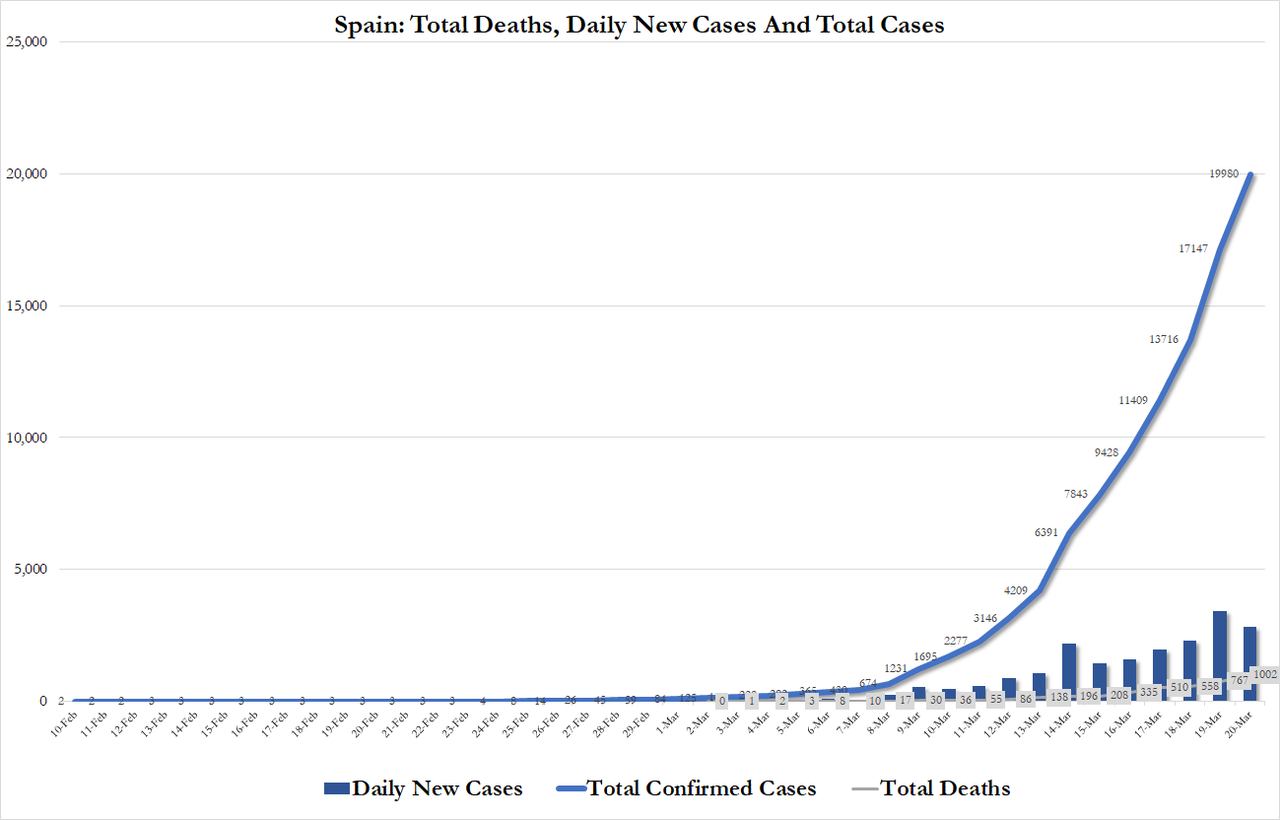
Meanwhile, Spanish authorities announced Friday morning that the death toll in the country has broken above 1,000 as citizens near the end of their first full week under an enforced lockdown.
The country reported 1,903 new cases, and 169 new deaths, raising its total to 19,980 cases and 1,002 dead.
Meanwhile, on social media, snippets of video have circulated offering glimpses into the life on lockdown in Madrid and elsewhere around Spain.
Since the first case of COVID-19 was confirmed in the US, there has been no shortage of bitterly ironic headlines during this outbreak (remember when Rudy Gobert licked all those microphones?). But overnight, Altria Group – one of the largest tobacco companies in the world (it was better known as Phillip Morris before it rebranded a few years back) – said Howard A. Willard III, its Chairman and CEO, has tested positive for COVID-19.
The same guy has previously called for Trump’s assassination
Steve Watson – MARCH 20, 2020
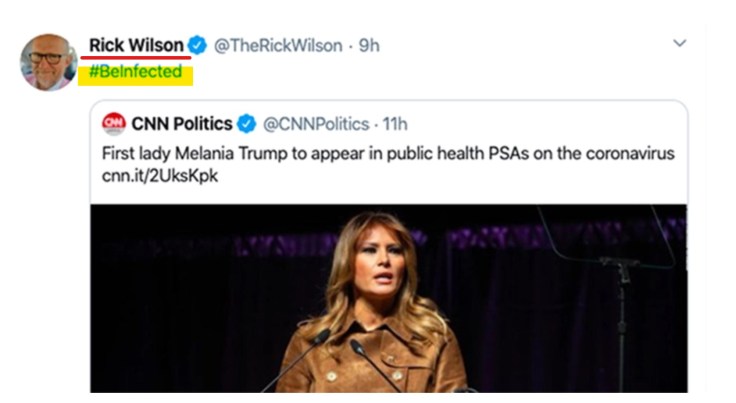
Twisted talking head Rick Wilson sent out a tweet Wednesday expressing a desire to see the First Lady get infected with the killer coronavirus.
Wilson, who regularly appears on CNN and MSNBC programming to bash the President, was reposing to the announcement that Melania Trump will appear in coronavirus PSAs.
Wilson tweeted simply “#BeInfected”:
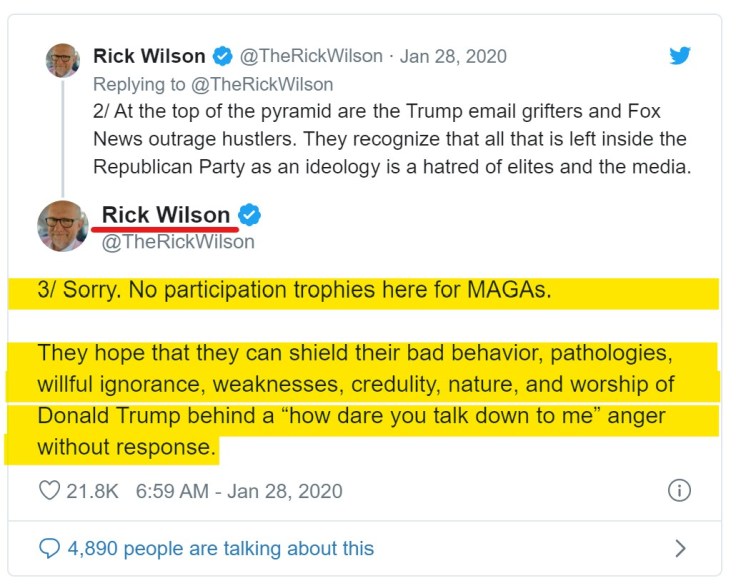
Wilson, a former GOP strategist, was most recently in the news when he and CNN’s Don Lemon, along with New York Times op-ed writer Wajahat Ali, traded impressions of ‘dumb redneck’ Trump supporters on air.
The arrogance, the dismissiveness, the smug cackling, the accents.
If Donald Trump wins re-election this year, I’ll remember this brief CNN segment late one Saturday night in January as the perfect encapsulation for why it happened. pic.twitter.com/8kQ6zN9AZV
Following backlash, Wilson doubled down, calling the response “contrived phony bullshit outrage,” and using the attention to advertise his anti-Trump book titled ‘Running Against the Devil.’
The most beautiful part of this entirely contrived phony bullshit outrage about that segment isn’t that I insulted the Maga demo.
Wilson has also previously called for the donor class to “put a bullet in”Donald Trump, and has also suggested that anti-vaxxers should be put in re-education camps and have their children taken away.













 Tom's Blog