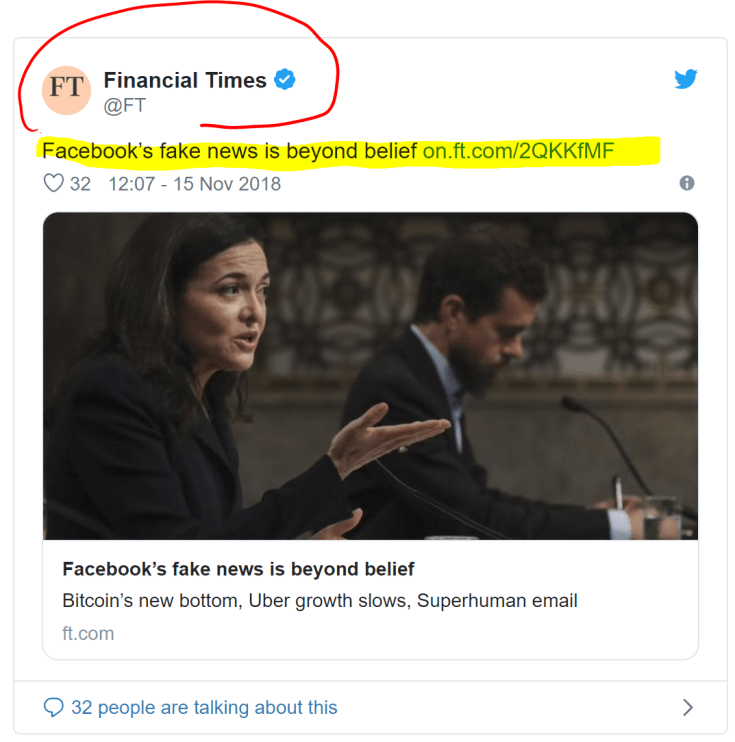
Big Tech & Big Brother meet at Facebook HQ to discuss how to ‘secure’ US elections

Screen Shot 2019-09-05 at 11.14.15 AM

Security teams for Facebook, Google, Twitter and Microsoft met with the FBI, the Department of Homeland Security and the Director of National Intelligence’s office to coordinate a strategy to secure the 2020 elections.

The tech platforms met with government officials at Facebook’s Menlo Park headquarters on Wednesday, the company has confirmed, boasting that Big Tech and Big Brother have developed a “comprehensive strategy” to get control of previous election-related “vulnerabilities” while “analyzing and getting ahead of new threats.”

Facebook has scrambled to get in front of the 2020 election after being blamed for Trump’s 2016 electoral victory over merely allowing the “Russian trolls” to buy a bunch of ads, most of which appeared after the vote and had nothing to do with the election. But the company insisted last week it had tightened its rules for verifying purchasers of “political” ads, for real this time, after the 2018 contest showed they could still be duped into running obviously-fake ads “paid for by” the Islamic State terror group and Cambridge Analytica.

Big election business: Democratic candidates, even critical of Facebook, pour millions into platform

Screen Shot 2019-09-05 at 11.19.53 AM

Aside from the occasional purge of accounts accused of being linked to countries like Russia, Iran, and China on the US’ ever-lengthening enemies’ list, however, it’s hard to tell what exactly any platform has done to make itself immune to ‘manipulation’. Twitter banned state-owned media from buying ads on its platform last month, holding the move up as a victory against the dreaded “foreign meddling,” but its own founder’s account was hacked last week, suggesting it has bigger security issues than a few wrongthink-prone advertisers.

And Google’s potential to sway elections has been the subject of Senate hearings – yet the company has remained silent on addressing the problem, suggesting it doesn’t see it as a bug at all, but a feature. Subsidiary YouTube, meanwhile, conducted another round of deplatforming last month even while declaring it was an open platform for controversial ideas.

The electoral meeting of the minds came less than a week after the Pentagon’s Defense Advanced Projects Research Agency (DARPA) declared war on deepfakes and other potentially discord-sowing information, promising to neutralize all “malicious” content within four years – if not for this election, then certainly for the next.

Until then, there’s Microsoft’s ElectionGuard software, which the company announced in July it would provide to all the nation’s voting machines, free of charge, out of the goodness of its (and the Pentagon-owned contractor that helped develop the program’s) heart. And if Microsoft’s act of selfless charity doesn’t convince a district their democracy is worth protecting, there’s always Cyberdome, the election security nonprofit advised by half a dozen former intel agency heads who want what’s best for your vote (when they’re not authorizing torture or warrantless wiretapping).

Getting the DHS involved was a nice touch, too, after that agency was accused of attempting to hack electoral systems in multiple states thousands of times during the period surrounding the 2016 election. Unlike the “Russian hacking” allegations that remain unproven, multiple officials from Idaho, Georgia, Indiana, West Virginia, and Kentucky claim the agency attempted to access their systems after they opposed its efforts to “secure” those systems. After initially denying any involvement, the DHS claimed the attempted breach alarms were set off accidentally, during routine “legitimate work.”
 

Companies people love to hate: World’s most despised corporations

Screen Shot 2019-07-30 at 10.07.14 AM

Issues of privacy, user manipulation, and tax avoidance have turned public sentiment against big tech firms, once the darlings in the otherwise hated corporate world. But how quickly things change, as RT Business finds out.

Facebook

Screen Shot 2019-07-30 at 10.09.15 AM

One of the big five tech companies, Facebook has been buried by numerous scandals, from hacking to misappropriating user data and spreading hate speech. The company has agreed to pay a record-breaking $5 billion fine over privacy violations after allowing as many as 87 million users’ data to fall into the possession of political consulting firm Cambridge Analytica. Facebook, along with other technology companies, has also been accused of unlawfully stifling competition in its rise to power.

Facebook agrees to pay record $5bn fine over privacy violations, critics call it a ‘parking ticket’

Bayer/Monsanto

Screen Shot 2019-07-30 at 10.10.46 AM

Dubbed ‘a marriage made in hell,’ the mega-merger between German drug company Bayer and US GMO seeds and pesticides maker Monsanto created one of the most powerful agribusinesses in the world. Following the multibillion-dollar takeover, Bayer is now the target of some 18,400 lawsuits over Monsanto’s Roundup weed killer and its active ingredient glyphosate. The herbicide has allegedly caused grave illnesses such as cancer.

US judge cuts Monsanto cancer victims’ award from $2 billion to $86 million

Google

Screen Shot 2019-07-30 at 10.11.37 AM

Another former Silicon Valley darling from the ‘Gang of Four’ (Google, Amazon, Facebook, Apple), Google has also been engulfed in massive scandals. These include accusations of tax avoidance, misuse and manipulation of search results, unauthorized use people’s intellectual property, and the compilation of data which could violate user privacy.

Big Tech ‘monopolies’ targeted in sweeping new antitrust probe by US Justice Department

The tech giant has also been accused of trying to cover up a sexual misconduct scandal in the company. As the global hunt for tax avoiding firms intensifies, Google and other Big Tech companies are being targeted by countries including Spain and France, seeking to force the digital companies to pay more taxes in the markets where they operate.

Johnson & Johnson

Screen Shot 2019-07-30 at 10.12.59 AM

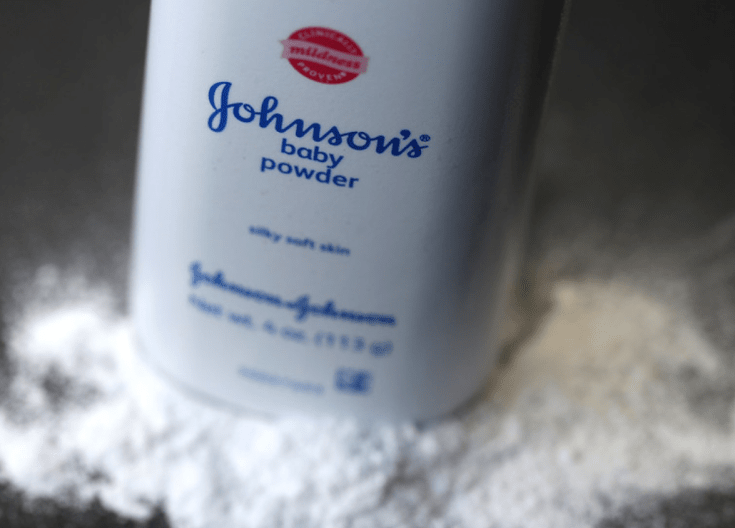
In the healthcare industry there are few brands better known than the US drug company Johnson & Johnson. The maker of consumer staples ranging from Band-Aid bandages to baby shampoo has faced a number of controversies in its 133-year history. J&J knew about asbestos in its baby products since the 1970s and worked to conceal it from federal regulators and the public, investigations show.

Hidden ‘for decades’: Johnson & Johnson may have known about ‘carcinogens’ in baby powder since 1971

The pharmaceutical giant is facing thousands of lawsuits alleging that its baby powder product caused cancer, but it has always denied the allegations and insisted that the product is safe. After the latest revelations, the firm is now contesting claims that it has contributed to the opioid epidemic in the US.

JP Morgan

Despite the relatively low standards of the banking industry and the unpopularity of banks in general, JP Morgan has managed to outdo the competition to become the most despised. The largest financial institution in the US, with operations worldwide, the Wall Street bank is facing an onslaught of endless investigations and scandals.

READ MORE: JP Morgan, Barclays, RBS among big banks facing UK class action over Forex rigging

It is among the major global banks being sued by investors for rigging the global forex exchange (Forex) market. Its chief executive Jamie Dimon was awarded with $31 million in total compensation for his work in 2018. The pay exceeded his record compensation of $30 million in 2007 before the financial crisis.

JP Morgan cargo ship released, minus the $1.3 billion worth of cocaine found onboard

But the climax to all of this was last month’s unprecedented drugs bust after US federal authorities seized a cargo ship at the Port of Philadelphia belonging to a fund run by JP Morgan. After confiscating nearly 20 tons of cocaine on board worth $1.3 billion, authorities later released the vessel.

Other notable mentions:

Amazon

Nestle

Big Tobacco

Big Oil

Big Pharma

‘Largest scam in history’: HALF of Facebook accounts fake, says Zuckerberg’s Harvard classmate

cap

As many as half of Facebook‘s two billion accounts are fake or duplicates, according to a new report from a former classmate of CEO Mark Zuckerberg. He has highlighted how the fakes defraud users, advertisers and investors alike.

Rocked by a major privacy scandal last year, Facebook has been trying to create an image of a company with high community standards, striving to curb the illicit behavior of users. But the company may be deliberately understating the amount of fake accounts, a new report says.

The firm’s own quarterly investment reports reveal that the its much-vaunted account base, which is supposedly has over 2 billion monthly active users, is packed with fake accounts communicating with just enough randomness to trick the social network’s algorithms, according to Zuckerberg’s former classmate at Harvard, Aaron Greenspan.

Greenspan claimed that he had originally come up with the idea for Facebook and worked on the future network, before Zuckerberg eventually founded the company. That claim was the basis of the trademark dispute between Facebook and Greenspan’s company, Think Computer Corporation, settled in 2009.

In a report, published by his legal data nonprofit PlainSite, Greenspan alleges that Facebook “has been lying to the public about the scale of its problem with fake accounts, which likely exceed 50 percent of its network.”

The fake accounts are particularly dangerous because they “often defraud other users on Facebook, through scams, fake news, extortion, and other forms of deception” and often “involve governments,” he writes.

He further accused the company of “selling” ads to “hundreds of millions of phantom buyers – users who do not actually exist.” 

cap

According to Greenspan, Facebook has attempted to obscure and downplay the actual number of fake accounts and their prevalence by employing “cleverly worded disclaimers” in its official reporting as well as dropping “many” of the important metrics from quarterly reports altogether.

In his report, citing the social network’s own estimates, Greenspan concludes that since the end of 2017 Facebook has deleted at least 2.8 billion fake accounts, which is more that the amount of its monthly active users and more than a half of “all accounts ever created.” 

Facebook outright denied Greenspan’s claims. “This report is completely wrong and not based on any facts or research,”the company told RT, adding that Facebook files its fake account estimates with the Securities and Exchange Commission every quarter. “This is unequivocally wrong and responsible reporting means reporting facts, even if it’s about fake accounts,” the statement continued.

Still, an entire industry has sprung up to supply convincingly “aged” fake Facebook accounts, often bundled by the hundred and boasting less than 1 percent detection rate.

Facebook attracts advertisers by flaunting the access to its billion-plus users, sorted and categorized by a marketer’s dream of individual data. However, some reports claim that in reality a sizeable amount of traffic online is generated by fake-clicking’ done by bots and humans working on specially-organized ‘click farms,’ as the company reached the market saturation or simply ‘ran out of humans.’

Small advertisers sued the social media giant last year, claiming it overstated the amount of time users spent watching videos by up to 900 percent. According to Marketing Land, the alleged fraud is far from an isolated event: Facebook misreported the reach of Facebook Page posts, the proportion of users who watch ad videos all the way through, the average time users spend reading “instant articles,” the number of referrals to external websites, and the number of mobile views, as claimed in the reports the outlet collected.

Facebook’s role in global ads is expected to grow. Digital publishing agency Polar estimated that the tech giant, together with Google and several other ‘digital goliaths’ like Amazon, will control 80 percent of all digital advertising in 2019.

In recent years, the social network had been entrenched in high-profile controversies over users’ data protection, privacy issues, and the spread of misinformation online. To make matters worse, Facebook’s market value has been slidingdownwards since July, when it lost almost $120 billion in a single day of trading – the largest-ever drop in company valuation in stock market history.

Following the Cambridge Analytica data-mining scandal, the company’s CEO Mark Zuckerberg admitted that Facebook didn’t do enough to safeguard its users’ interests and apologized. In response to mounting criticism, he vowed to step up commitments to privacy protection.

In an effort to combat disinformation, the company experimented with its algorithms to detect ‘fake news’ and broughtthird-party fact-checkers on board for help.

ALSO ON RT.COMFacebook may face a record fine over privacy lapses – reports

In the first six months of 2018 alone Facebook said it removed around 1.5 billion fake accounts. Last year, the company also reported removing fake accounts linked to either Russia or Iran, and although the numbers were minute on the overall scale, measuring from under 100 to several hundred, the news received wide coverage.

Facebook’s model of operations “can feel opaque” and be hard to understand for outsiders, Mark Zuckerberg wrote in an op-ed for Wall Street Journal on Thursday.

“Sometimes this means people assume we do things that we don’t do. For example, we don’t sell people’s data, even though it’s often reported that we do.”

The company’s CEO reiterated that the network has “strong incentive” to protect users’ data and selling off such information is against the company’s business interests.

Think your friends would be interested? Share this story!

Irony alert: Firm that warned Americans of Russian bots…was running an army of fake Russian bots

See the source image

By Danielle Ryan

The co-founders of cybersecurity firm New Knowledge warned Americans in November to “remain vigilant” in the face of “Russian efforts” to meddle in US elections. This month, they have been exposed for doing just that themselves.

Ryan Fox and Jonathan Morgan, who run the New Knowledge cybersecurity company which claims to “monitor disinformation” online, penned a foreboding op-ed in the New York Times on November 6, about “the Russians” and their nefarious efforts to influence American elections.

At the time, it struck me that Fox and Morgan’s reasoning seemed a little far-fetched. For example, one of the pieces of evidence presented to prove that Russia had targeted American elections was that lots of people had posted links to RT’s content online. Hardly a smoking gun worthy of a Times oped.

ALSO ON RT.COMThe only ‘Russian bots’ to meddle in US elections belonged to Democrat-linked ‘experts’Morgan and Fox, intrepid cyber sleuths that they are, claimed in the article they had detected more “overall activity” from ongoing Russian influence campaigns than social media companies like Facebook and Twitter had yet revealed — or that other researchers had been able to identify.

See the source image

The New Knowledge guys even authored a Senate Intelligence Committee report on Russia’s alleged efforts to mess with American democracy. They called it a “propaganda war against American citizens.” Impressive stuff. They must be really good at their job, right?

This week, however, we learned that New Knowledge was running its own disinformation campaign (or “propaganda war against Americans,”you could say), complete with fake Russian bots designed to discredit Republican candidate Roy Moore as a Russia-preferred candidate when he was running for the US senate in Alabama in 2017.

The scheme was exposed by the New York Times — the paper that just over a month earlier published that aforementioned oped, in which Fox and Morgan pontificated about Russian interference online.

New Knowledge created a mini-army of fake Russian bots and fake Facebook groups. The accounts, which had Russian names, were made to follow Moore. An internal company memo boasted that New Knowledge had “orchestrated an elaborate ‘false flag’ operation that planted the idea that the Moore campaign was amplified on social media by a Russian botnet.”

Moore lost the race by 1.5 percent. To be fair, accusations published by the Washington Post that he pursued underage girls back in the 1980s may have had something to do with it as well, but that’s a different story.

Of course, New Knowledge and even the New York Times, which blew the lid of the operation, are trying to spin this as some kind of “small experiment” during which they “imitated Russian tactics” online to see how they worked. Just for research, of course. They have also both claimed that the scheme, dubbed ‘Project Birmingham’ had almost no effect on the outcome of the race.

The money for the so-called research project came from Reid Hoffman, the billionaire co-founder of LinkedIn, who contributed $750,000 to American Engagement Technologies (AET), which then spent $100,000 on the New Knowledge experiment. After the scheme was exposed, Hoffman offered a public apology, saying he didn’t know exactly how the money had been used and admitting that the tactics were “highly disturbing.”

ALSO ON RT.COMLinkedIn billionaire ‘sorry’ for funding ‘Russian bot’ disinformation campaign against Roy MooreIf people like Fox and Morgan actually cared about so-called Russian meddling or the integrity of American elections, they would not have run the deceptive campaign against Moore, no matter how undesirable he was as a candidate. Their sneaky and deceitful methods are in total contrast to the public profile they have cultivated for themselves as a firm fighting the good fight for the public good. But is it really that much of a surprise?

You would think that a newspaper like the New York Times would have cottoned on to the fact that guys like Fox and Morgan, with their histories in the US military and intelligence agencies, have clear agendas and are not exactly squeaky clean or the most credible sources of information when it comes to anything to do with Russia. But that kind of insight or circumspection might be too much to ask for in the age of Russiagate.

Facebook removed Morgan’s account on Saturday for “engaging in coordinated inauthentic behavior” around the Alabama election. Three days after publishing its initial article on the scandal (the one in which it played down the effects of New Knowledge’s disinfo campaign), the New York Times published a follow-up piece about the Facebook removal, in which it admitted that the controversy would be a “stinging embarrassment” for the social media researcher, noting that he had been a “leading voice” against supposed Russian disinformation campaigns.

In Fox and Morgan’s original NYT oped, they warned of the ubiquitous “Russia-linked social media accounts” and estimated that “at least hundreds of thousands, and perhaps even millions” of US citizens had engaged with them online. One must now wonder, were they including their own fake Russian bots in that count, or were they leaving those ones out?

It’s nearly two years into the Trump presidency and still we have no solid evidence that the Russian “collusion” theory is anything more than a fantasy concocted by Democrats desperate to provide a more palatable reason for Hillary Clinton’s loss than the fact that she simply ran a bad campaign.

In fact, at this point, we actually have more solid and irrefutable evidence of election meddling from the likes of dodgy American and British companies like Cambridge Analytica and New Knowledge than we do of any meddling orchestrated by Russia.

Like this story? Share it with a friend!

Facebook exposed: Docs dumped by UK show FB whitelisted user data collection for cherry-picked firms

Facebook exposed: Docs dumped by UK show FB whitelisted user data collection for cherry-picked firms

The entrance sign to Facebook headquarters. ©Reuters / Elijah Nouvelage

Internal Facebook documents, previously seized by Britain, confirm that the tech giant made a habit of sharing user data with other firms without user consent and tried to avoid bad publicity by obfuscating its data vacuuming.

The British Parliament on Wednesday released a trove of Facebook documents, which it took possession of amid a larger inquiry into Cambridge Analytica, a firm that used Facebook data to profile users for political purposes. MP Damian Collins, who chairs Parliament’s Digital, Culture Media and Sports Committee, said the probe established several key issues.

ALSO ON RT.COMUK MPs seize documents expected to expose Facebook’s covert data harvestingFacebook’s change of platform in 2014-2015 allowed it to enter into “whitelisting” agreements with app developers, giving them access to user data, in particularly how users are linked as friends within the platform. The documents didn’t reveal what policy Facebook used to decide which firms were worthy of the privilege and which were not.

The increased exposure of private data generated more revenue for app developers, and this outcome was the key driver behind the changes made by Facebook. The social network itself received data about how people were using third party apps in return.

The data-hungry mammoth wanted to know how people used their mobile phones, so it changed Facebook’s mobile app to enable it to harvest more information from devices it was installed on. It deliberately made it harder for users to be aware of this happening in order to avoid bad PR, the MP stressed.

Facebook also used its position as user data provider to affect the businesses of its competitors in social media, like Twitter, the report said.

If you like this story, share it with a friend!

Soros foundation takes aim at Facebook, calls for congressional oversight

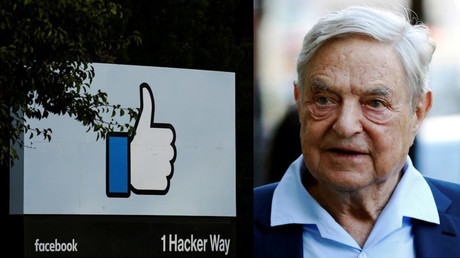
The head of billionaire George Soros’ foundation called for congressional oversight of Facebook, after the social media giant finally took some responsibility for hiring a PR firm to smear its critics as agents of Soros.

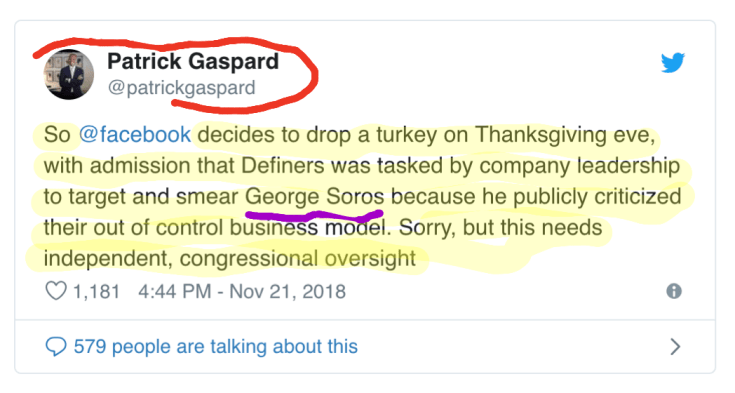
“So @facebook decides to drop a turkey on Thanksgiving eve, with admission that Definers was tasked by company leadership to target and smear George Soros because he publicly criticized their out of control business model. Sorry, but this needs independent, congressional oversight,” Open Society Foundations head Patrick Gaspard tweeted on Wednesday night.

Screen Shot 2018-11-23 at 3.25.50 PM

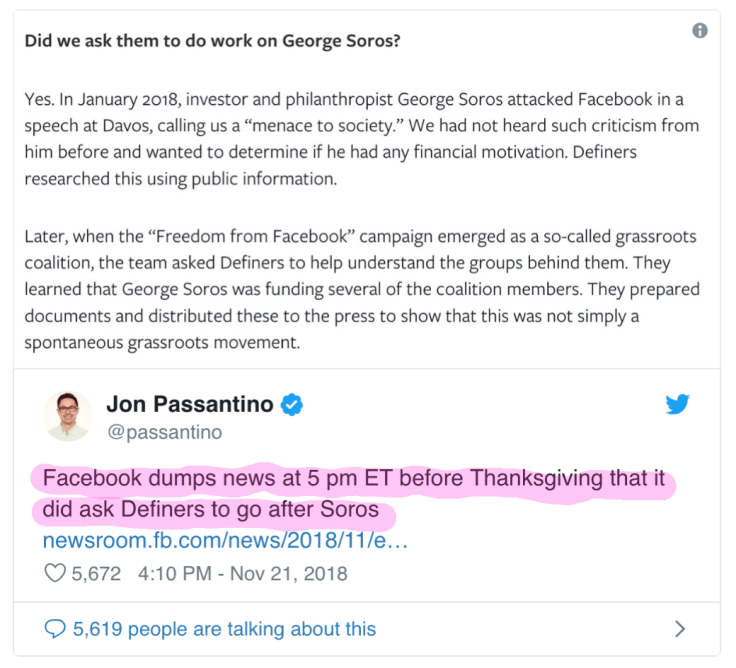
Gaspard was responding to an admission by Facebook’s outgoing Head of Communications and Policy Elliot Schrage, who owned up top hiring a PR firm – Washington, DC-based Definers – to attack Facebook’s critics and label them agents of Soros, a billionaire and prominent liberal donor.

In a blog post, Schrage admitted that he tasked Definers with pushing the Soros angle, namely that the billionaire was funding the activist group ‘Freedom from Facebook.’

After learning that Soros did in fact fund some of the group’s members, Schrage said Definers “prepared documents and distributed these to the press to show that this was not simply a spontaneous grassroots movement.” Schrage maintained that Facebook did not ask Definers to create ‘fake news,’ despite a former employee telling NBC that Definers had its own “in-house fake news shop” to spread its message.

Screen Shot 2018-11-23 at 3.28.41 PM

The relationship was revealed in an explosive New York Times report last week that accused Facebook’s senior leadership of mismanaging a multitude of scandals, from ‘Russian interference’ in the 2016 election to the Cambridge Analytica privacy debacle earlier this year.

Facebook CEO Mark Zuckerberg and COO Sheryl Sandberg both denied any knowledge of the company’s hiring of Definers, despite an official statement describing the relationship between Facebook and Definers as “well known in the media.”

Soros’ associates have been relentless in calling for change at Facebook, even since before the New York Times’ story broke. In January, Soros himself called Facebook and other Silicon Valley tech “monopolies” a “menace” to society whose “days are numbered.” Last week, Michael Vachon, an adviser to the chair at Soros Fund Management, called on Facebook to undertake an audit of all of its lobbying and PR relationships.

Nor were they buying Zuckerberg’s protestations of innocence.

“I find it hard to believe that one would go after someone like George Soros…without some clearance at the highest levels,” Gaspard told CNN on Tuesday night.

Zuckerberg appears to be holding firm, though. In his own interview with CNN on Tuesday, the 34-year-old CEO issued his trademark style of meandering, deflective denial when host Laurie Segall asked if he knew anything about the affair.

“Well…uhh…I learned about this when I read the report as well…I don’t think this point was about a specific PR firm, it was about how we act. That’s why I think it’s not just important what we’re doing with this one firm, but that we go through and look at all of the different PR firms and folks we work with,” Zuckerberg replied.

After spending much of the year apologizing for one privacy screw-up after another, Zuckerberg is once again back in the spotlight. Despite falling stock prices, shareholder moves to oust him, and now Soros’ wealth and influence pushing against him, Zuckerberg was defiant.

Asked whether he’d ever step down as Facebook’s chairman – Zuckerberg is both chairman and CEO of the company – he replied “that’s not the plan.”

“There are certainly going to be issues that we need to work through over time,” Zuckerberg continued. “But I think that while we are doing that, we can’t lose sight of all of the really positive things that are happening here as well.”

Think your friends would be interested? Share this story!

Facebook produces fake news to attack its opponents

By   

The social media giant has been producing a lot of its own fake news lately. After harassing conservative websites with “hate speech” rules and “fake news” rules, Facebook has been producing fake news of its own.

After the Cambridge Analytica scandal, Facebook said it was going to do better in regards to user privacy and fake news.

Capture

What they’ve don’t instead is ban conservative accounts and use a very loose definition of “hate speech” to justify it. The most public example was Alex Jones being banned permanently from Facebook.

With millions of followers, it was very noticeable when his account was gone. George Soros still has multiple pages on Facebook, where his organizations peddle false conspiracy theories about migration, Donald Trump and Fox News.

But Facebook has no problem with that. We all know that Alex Jones is eccentric and a conspiracy theorist, but you can not deny he has broken some of the biggest scoops of the century.

Such as Hillary Clinton’s failing health. Nonetheless to Facebook, they banned him permanently for violating “hate speech” rules.

They have still yet to give a substantive explanation for how “hate speech” is defined to them. It seems to Facebook and other leftist social media giants, that “hate speech” is just anything that doesn’t agree with their worldview.

Blog at WordPress.com.

Up ↑