By Dr. John Campbell
I am a nurse from the US and yes they are being reactive instead of proactive and they really aren’t doing much. Not shutting down anything in WA state where a lot is happening.
By Dr. John Campbell
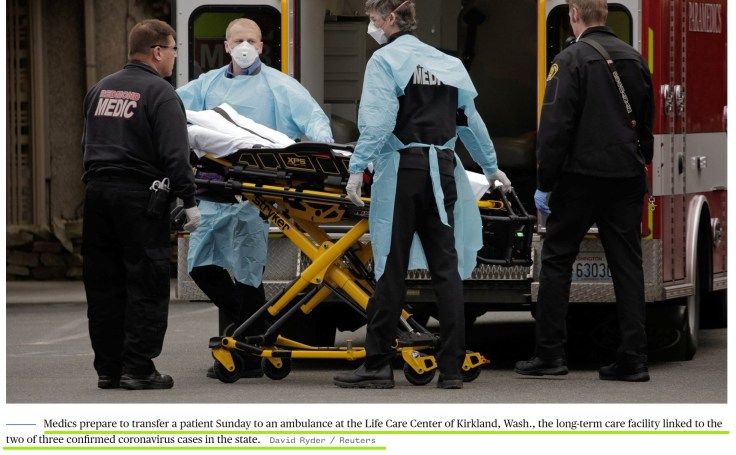
FEMA officials are preparing for an “infectious disease emergency declaration” by the president that would allow the agency to provide disaster relief funding to state and local governments, as well as federal assistance to support the coronavirus response, according to agency planning documents reviewed by NBC News.
The Trump administration would have to use the 1988 Stafford Act to enable FEMA to provide such disaster assistance. Emergency declarations are most often used in the event of natural disasters but can be used to help manage disease outbreaks.
Full coverage of the coronavirus outbreak
“To me this is another indication that the president and the White House are finally aware of the gravity of the situation,” said Michael Coen, who was FEMA chief of staff during the Obama administration. “They need to consider all tools available to them and have contingencies for action.”
“I actually find this reassuring,” said Tim Manning, who was a FEMA deputy administrator under President Barack Obama. “I hope this discussion has been happening continuously over the last couple of months.”
An emergency declaration would allow FEMA to provide disaster medical assistance teams, mobile hospitals and military transport, among other kinds of federal support, Manning said.
FEMA’s disaster relief fund has a current balance of $34 billion, according to the latest agency update. “It’s money that’s sitting there and ready,” said another former FEMA official, who declined to be identified.
FEMA spokesperson Lizzie Litzow said the agency is currently focused on supporting the Department of Health and Human Services (HHS), which separately declared a “public health emergency” on Jan. 31, allowing HHS to access funds and other resources to aid the government’s virus response. “At this time, there isn’t anything additional to the HHS public health emergency,” Litzow said.

It would not be the first time the federal government has used FEMA’s resources to assist in a medical event.
In 2000, President Bill Clinton used a Stafford Act emergency declaration for outbreaks of the West Nile virus in New York and New Jersey, ordering up to $5 million in federal aid to supplement state efforts to combat the mosquito-borne virus.
Emergency declarations are distinct from “major disaster” declarations, which are more far-reaching and are typically used for hurricanes, floods and other natural disasters.
By Dr. John Campbell – 3/2/2020

MARCH 2, 2020
Indeed, the pathogen has become a major topic of discussion in the country – so much so, in fact, that some residents are now stockpiling food out of fear they could be placed under quarantine.
On Friday, a spokeswoman for one of the country’s largest supermarket groups, REWE, told DW that while they didn’t register any panic at the start of the week, the situation quickly changed.
“We have noticed rising foodstuff and canned goods purchases across the entire country to which we are adapting accordingly,” said Kristina Schütz from REWE Group, which is headquartered in Cologne and runs the Penny, REWE and Nahkauf grocery chains.
Discount chain Lidl has recorded a similar spike in purchases, with a spokesperson confirming that “we are noticing a rise in sales in certain regions and stores.”
According to the chains, Germans are stockpiling long-lasting and canned food, pasta as well as toilet paper and disinfectants.

Four years ago, the Bonn-based Federal Office of Civil Protection and Disaster Assistance (BBK) published a checklist of long-lasting foods it recommends stockpiling for emergencies.
The BBK, which is staffed by some 300 civil servants, educates the general population on how to prepare for crises. It advises Germans to stockpile food and drink for about ten days.
Specifically, the checklist states that one person needs 14 liters of liquid a week, and recommends stocking mineral water and fruit juice in particular. Even so, the BBK warns against panic buying, advising Germans to stockpile only foods and drinks “that you and your family would consume anyway.”
The BKK also suggests stocking food that keeps for a long time without needing refrigeration, to pay attention to sell-by dates, and mark when items were purchased, in case they don’t have dates printed on them. It also advises Germans to “store newly bought food items at the back of the cupboard so that you consume older items first.”
This comprehensive emergency checklist hasn’t gone unnoticed abroad. Bulgarian daily 24 Tschassa, for example, praised the advice provided by German authorities, saying that in most cases “consumers just hoard all kinds of products – without a proper idea how long they will come in useful or whether they might need them at all.”
The paper said sticking to the German checklist is a good idea “as it makes no sense to buy excessive amounts of supplies.”
While many pundits in Germany agree the list is useful, they simultaneously warn against stirring hysteria. So far, Germany has confirmed 129 cases of coronavirus, with 16 having already recovered, and no deaths reported. More than half of the cases are in the western state of North Rhine-Westphalia, the country’s most populous state.
The German Journalists Association (DJV) therefore emphasizes that media outlets should avoid stoking fear.
Accordingly, DJV head Frank Überall stated that “people need clear information as well as advice” to make sense of the situation.
He has called on journalists to heed the German press code which calls on them to “avoid an inappropriately sensationalist tone when reporting on medical issues, as this may give rise to unfounded fears or hopes.”
The press code also states that “stoking fear and hysteria is incompatible with responsible journalism.”

March 2, 2020
These numbers are suspect as the regime is not open with its data.
** The Gateway Pundit posted an extensive report from Iran on the coronavirus on Sunday night.
There are currently several videos making the rounds on social media of Muslims licking shrines to prove their faith is greater than the coronavirus.


Steve Watson – 3/2/2020
Politico published an article Friday claiming that Trump called the coronavirus a “hoax” at his rally in South Carolina.
The article claimed that Trump “tried to cast the global outbreak of the coronavirus as a liberal conspiracy intended to undermine his first term.”
In reality, Trump referred to “politicizing” of the coronavirus by Democrats as “their new hoax.”
Even Facebook flagged Politico’s piece as false information:

The President clarified his remarks over the weekend, noting noting that he was “referring to the action that they take to try and pin this on somebody because we’ve done such a good job.”
“The hoax is on them. I’m not talking about what’s happening here. I’m talking what they’re doing. That’s the hoax,” Trump said, according to NBC News.
Mike Bloomberg proved Trump’s exact point by spreading an edited video and claiming that Trump believes the virus isn’t real:
Bloomberg repeated that claim in an interview with CBS, prompting host Scott Pelley to correct him:
“He said that the Democrats making so much of it is a Democratic hoax, not that the virus is a hoax,” Pelley told Bloomberg.
Mini Mike simply ignored Pelley, and argued “This is up to the scientists and the doctors as to whether there is a problem,” adding that Trump’s response to the coronavirus outbreak has been “ignorant and irresponsible.”
Meanwhile, over at CNN, the mental gymnastics went a step further, with Inside Politics host John King saying that “you can read this how you wish” as far as Trump’s ‘hoax’ comments go.
https://www.mrctv.org/videos/cnn-tells-viewers-take-trumps-hoax-comment-how-you-wish
By

FEBRUARY 28, 2020
Frank Wucinski and his family were sent to the quarantine location after returning from Wuhan, China where they were attending a funeral for Wucinski’s father-in-law.
“Fortunately, it is contagious, but the death rate is pretty low,” Wucinski said during the Fox interview, as he stopped to cough while his young daughter sat on his lap.
When the Fox hosts noticed Wucinski was still coughing and asked about it, he responded, “They said I’m fine. I got tested twice. Negative both times. The cough, probably just nerves.”
Wucinski had to take a swig from his daughter’s water bottle just to get through the interview.
As coronavirus fears continue to escalate, stocks worldwide are responding and governments are preparing for worst-case scenarios.
The level of calamity we are facing due to the half measures by states like California to handle the Coronavirus outbreak is enough for any half-conscious person to scramble to get their bug-out survival gear ready.

 Tom's Blog