


Gutfeld on Wednesday’s debate
Political pandering from Democratic 2020 hopefuls at first presidential debate was muy loco.

Julian Castro Says He Would Force Taxpayers to Pay For Trans Peoples’ Abortions
By Chris Menahan
Powerful.

Published on Jun 26, 2019
From National Review:
“All of you on stage support a women’s right to abortion. You all support some version of a government health-care option. Would your plan cover abortion, Mr. Secretary?” asked MSNBC debate moderator Lester Holt.
“Yes it would. I don’t believe only in reproductive freedom, I believe in reproductive justice. And what that means is just because a woman, or let’s also not forget someone in the trans community — a trans female — is poor, doesn’t mean they shouldn’t exercise that right to choose. So I absolutely would cover that right to have an abortion,” Castro said.
Finally someone is talking about the REAL ISSUES!


CIRCUS COMES TO MIAMI!

By Laurie Kellman
WASHINGTON (AP) — Sixty seconds for answers, a television audience of millions and, for some candidates, a first chance to introduce themselves to voters.
The back-to-back Democratic presidential debates beginning Wednesday are exercises in competitive sound bites featuring 20 candidates hoping to oust President Donald Trump in 2020. The hopefuls range widely in age, sex and backgrounds and include a former vice president, six women and a pair of mayors.
The challenge: Convey their plans for the nation, throw a few elbows and sharpen what’s been a blur of a race so far for many Americans.
What to watch Wednesday at 9 p.m. Eastern on NBC, MSNBC and Telemundo:
___
WHAT’S HER PLAN?
Sen. Elizabeth Warren’s task is to harness the recent momentum surrounding her campaign to prove to voters that she has what it takes to defeat Trump. As the sole top-tier candidate on stage Wednesday, she could have the most to lose.
The Massachusetts senator and former Harvard professor is known for her many policy plans and a mastery of classical, orderly debate. But presidential showdowns can be more “Gladiator”-style than the high-minded “Great Debaters.” This is no time for a wonky multipoint case for “Medicare for All,” student debt relief or the Green New Deal.
So, one challenge for Warren, 70, is stylistic. Look for her to try to champion her progressive ideas — and fend off attacks from lesser-known candidates — with gravitas, warmth and the brevity required by the format.
“Preparing for the debates is trying to learn to speak in 60 seconds or less,” she said in Miami, ahead of a visit she live-streamed to a migrant detention center in Homestead, Florida.
Another obstacle is to do so without alienating moderates any Democrat would need in a general election against Trump.
Being the front-runner on stage conveys a possible advantage: If the others pile on Warren, she gets more time to speak because the candidates are allowed 30 extra seconds for responses.
___
WHO’S THAT?
There may be some familiar faces across the rest of the stage, such as New Jersey Sen. Cory Booker, 50, or former Texas congressman Beto O’Rourke, 46. But a few names probably won’t ring any bells at all.
These virtual strangers to most Americans may be enjoying their first — and maybe last — turn on the national stage, so they have the least to lose.
Take John Delaney, 56, a former member of the House from Maryland. Look for him to try to make an impression by keeping up his criticism of Warren’s plans.
Or Ohio Rep. Tim Ryan, 45, who sits on the powerful House Appropriations Committee. He has likened the Democratic primary to “speed dating with the American people.”
BREAKING OUT, GOING VIRAL
For several of the candidates onstage Wednesday, the forum is about finding the breakout moment — a zinger, a burn — that stays in viewers’ minds, is built for social media and generates donations, the lifeblood of campaigns.
In 2015, Carly Fiorina won applause and a short surge for her response to Trump, who had been quoted in Rolling Stone as criticizing Fiorina’s face.
“Look at that face,” Trump was quoted as saying. “Would anyone vote for that?”
Asked on CNN to respond, Fiorina evenly replied: “I think women all over this country heard very clearly what Mr. Trump said.”
For candidates such as O’Rourke, a breakthrough moment on Wednesday is critical to revitalizing a campaign that has faded. The 10 White House contenders have two hours on stage that night and up until the curtain rises on the star-studded second debate the next day to make their mark. Former Vice President Joe Biden, 76, and Vermont Sen. Bernie Sanders, 77, headline Thursday’s debate and are certain to take up much of the spotlight.
___
BREAKING OUT BADLY
An “oops” moment can be politically crippling to any presidential campaign.
Just ask Energy Secretary Rick Perry, the former Texas governor who, in a 2011 debate, blanked on the third agency of government he had said would be “gone” if he became president.
“Commerce, Education and the, uh, what’s the third one there?” Perry said.
“EPA?” fellow Republican Ron Paul offered. Yep, Perry said, the Environmental Protection Agency.
“Oops,” he finished. Perry’s campaign, already struggling, never recovered.
___
WHAT ISSUES?
There’s simply no time for an in-depth discussion of issues. But the migrant crisis would be an apt topic, even in shorthand. Dominating the news in the hours before the showdown were vivid reports and images of the toll of the administration’s policy on children, especially.
Expect at least a mention, or perhaps the appearance, of a bracing photo of the bodies of a migrant father and his 23-month-old daughter face-down along the Rio Grande.
In addition to Warren, other candidates, such as Sen. Amy Klobuchar, were visiting the migrant center.
___
TRUMP
This is the Democrats’ night.
But Trump has dominated the political conversation since that escalator ride four years ago, and he loathes being upstaged. It’s worth asking: Will he tweet during the debates? And if he does, will NBC and the moderators ignore him or respond in real time?
NBC News executive Rashida Jones said the focus will be on the candidates and the issues.
“Beyond that, it has to rise to a certain level,” she said.
During Wednesday’s debate, Trump will be on Air Force One on his way to the Group of 20 summit in Osaka, Japan. The plane’s cable televisions are usually turned to Fox News, which is not hosting the debates. For the second debate, Trump will be beginning meetings at the G-20.
Trump told Fox Business Network on Wednesday that he’d watch because “it’s part of my life” but that “It just seems very boring. … That’s a very unexciting group of people.”
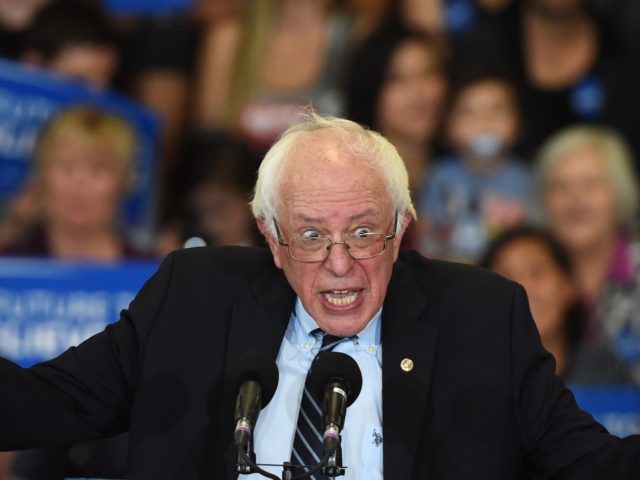
Bernie Sanders Campaign Uses E-mail List to Warn of ICE Raids
By Nate Church
On Saturday, just hours before ICE raids were set to begin, socialist presidential hopeful Bernie Sanders’ campaign used their e-mail network to warn supporters.
“ICE raids targeting 10 cities start Sunday. Know your rights,” the subject read. Appended to the e-mail were two graphics — one in English, the other Spanish — describing immigrant rights via guidance by the American Civil Liberties Union.
“It’s not strictly on point when it comes to building out a presidential campaign [to use campaign data] for the purpose other than running for president,” Ruthie Epstein, the ACLU deputy director of immigration policy, said. She reportedly claimed that the organization “played no role” in the e-mail alert.
The e-mail came from Sanders’ Press Secretary Belén Sisa, an undocumented immigrant through the Deferred Action for Childhood Arrivals program. According to Vox, it read:
Multiple news outlets are reporting that Immigration and Customs Enforcement is planning deportation raids against immigrant families in Atlanta, Baltimore, Chicago, Denver, Houston, Los Angeles, Miami, New Orleans, New York City, and San Francisco starting early Sunday morning.
Whether or not you are an immigrant, please share this “Know Your Rights” information widely to help those who might fall victim to the cruel and inhumane policies of the Trump administration.
Sisa stood by her actions. “It is no longer enough to talk about issues like immigration, but we must take real action to fight back and protect our undocumented community, like we did on Saturday,” she told Vox. “There isn’t much else that anybody can do other than stand up in unity.”
And Sanders has pivoted hard into this issue for his 2020 campaign, though he has deliberately stopped short of advocating for open borders. “What we need is comprehensive immigration reform,” Sanders said at a town hall in Iowa.
“If you open the borders, my God, there’s a lot of poverty in this world, and you’re going to have people from all over the world,” he continued. “And I don’t think that’s something that we can do at this point. Can’t do it. So that is not my position.”
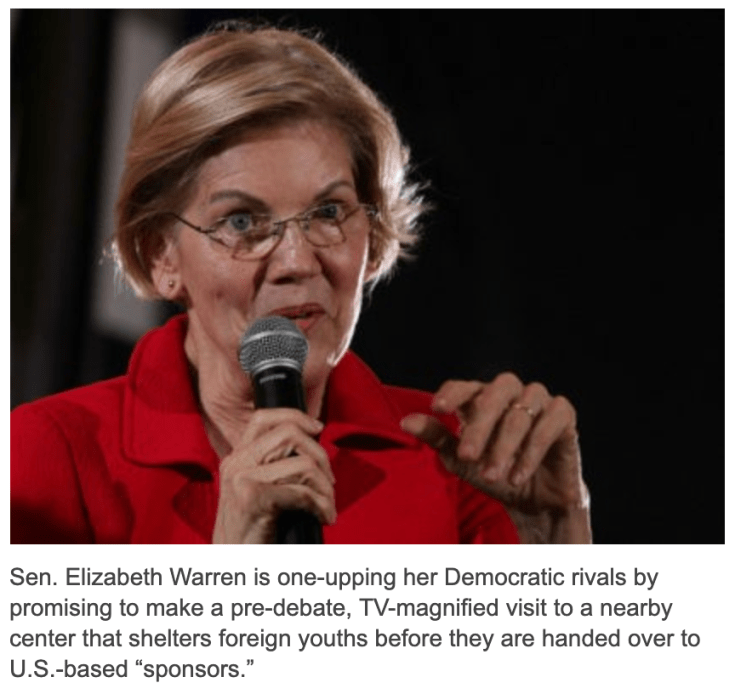
2020: Warren Crashes Migrant Shelter on Day of First Debate
By Neil Munro
Sen. Elizabeth Warren is one-upping her Democratic rivals by promising to make a pre-debate, TV-magnified visit to a nearby center that shelters foreign youths before they are handed over to U.S.-based “sponsors.”
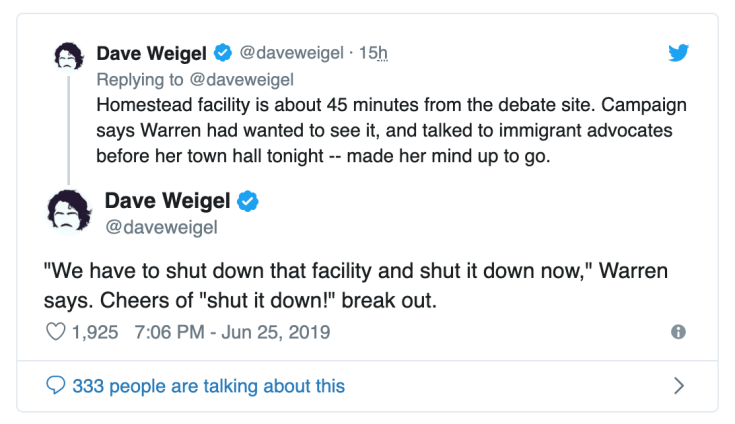
“We have to shut down that facility and shut it down now,” Warren told supporters, according to a tweet by a Washington Post reporter. The crowd enthusiastically chanted, “Shut it down!”
Warren’s gambit highlights the growing number of progressives who emotionally oppose the federal agencies’ efforts to identify — although not actually stop — the huge wave of Central American migrants and their children who are walking into Americans’ blue-collar workplaces, schools, and neighborhoods.
Amid the emotion, and its use by Democratic politicians, only about ten percent of adult migrants are being blocked at the border. The vast majority are quickly being released precisely because they bring young children on the dangerous journey solely to trigger the catch-and-release laws that are supported by Democrats.
Also, another huge wave of more than 56,000 children and teenagers — who claim to be unaccompanied — have surrendered to border officials since October. Roughly 2,500 of those teenagers are being temporarily sheltered at the center in Homestead, Florida, run by the Department of Health and Human Services.
The Washington Post did not report where Warren thinks the Homestead youths should be sent if the HHS center is closed.
These youths at the Homestead shelter are legally dubbed “Unaccompanied Alien Children” (UAC) because they told border agents that they were not traveling with their parents.
Most of the UAC teenagers at the center will be quickly sent to “sponsors” after officials have checked the potential sponsors for possible criminality, such as forced labor, prostitution, drug selling, and MS-13 links. The average stay is just 36 days, according to a June 19 HHS report.
But the vast majority of the sponsors are either the parents or the in-laws of the UAC teenagers, and many sponsors are also illegal migrants who have paid cartel-linked coyotes to deliver their teenagers to the Homestead camp, via the border agencies.
This UAC-smuggling strategy is dubbed the “UAC pipeline,” and it has been used since at least 2013. So far, the cartels earned a fortune by delivering a huge share of the 270,000 children and youths who have passed through the federally-operated pipeline since 2009.
In March, Democrats included a clause in the 2019 spending bill to hinder federal agencies from narrowing the UAC pipeline by deporting sponsors who are illegal migrants

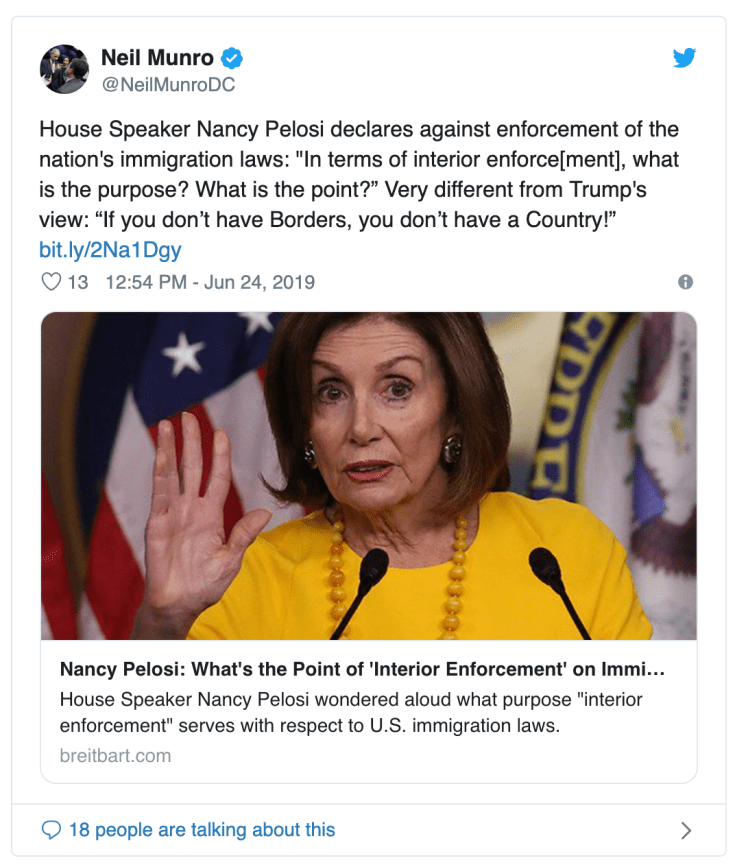
Warren’s TV-ready visit to Homestead will happen the day of the first of two Democratic debates in Miami, Florida. The Homestead center is just 30 miles down the road.
Warren’s promised visit — which will likely be accompanied by a cheering crowd of pro-migration activists — is part of an escalating race by Democrats to out-do each other in promising to open the borders to poor migrants.
For example, Beto O’Rourke pledged to dismantle the border wall, Julian Castro promised to decriminalize illegal migration, and Joe Biden wants to welcome migrants from Venezuela and also “streamline and strengthen” the asylum laws being used by 100,000 economic migrants each month to get into the United States.
Warren, however, is keeping pace.
On June 21, for example, she promised to end the use of company-run prisons for holdingmigrants. That goal has long been sought by pro-migration groups because it would force the border agencies to expand the catch-and-release policy. In turn, the expanded catch-and-release policy would allow the cartel-linked traffickers to quickly recoup the cost of smuggling migrants into the U.S. blue-collar labor market and so stimulate the labor trafficking business that is pressuring down Americans’ salaries.
On June 25, Warren escalated again, saying she prefers to decriminalize illegal migration by letting “mamas and babies” into the United States.
“We should not be criminalizing mamas and babies trying to flee violence at home or trying to build a better future,” Warren told the Huffington Post. “We must pass comprehensive immigration reform that is in line with our values, creates a pathway to citizenship for undocumented immigrants including our DREAMers, and protects our borders.”
A June 19 statement by HHS described operations at the center:
Due to the crisis on the southern border, ORR is facing a dramatic spike in referrals of UAC. As of June 10, DHS has referred over 52,000 UAC to HHS this fiscal year (FY), an increase of over 60 percent from FY 2018. Preliminary information shows over 9,000 referrals in May- one of the highest monthly totals in the history of the program. If these numbers continue, this fiscal year HHS will care for the largest number of UAC in the program’s history. Based on the anticipated growth pattern in referrals of UAC from DHS to HHS, HHS is preparing for the need for high bed capacity to continue.
HHS has expanded bed capacity at the Homestead Temporary Shelter for UAC in Homestead, Florida to 2,470 based on need resulting from a current increase in UAC referrals from DHS. Family separations that resulted from the Zero Tolerance Policy that ended in 2018 are not driving the continuing operation of Homestead. In addition, no children at Homestead are there due to the Zero Tolerance Policy.
Since opening in March 2018 over 13,300 UAC have been placed at the site and more than 10,800 have been discharged to a suitable sponsor.
Immigration by the Numbers
Each year, roughly four million young Americans join the workforce after graduating from high school or university.
But the federal government then imports about 1.1 million legal immigrants and refreshes a resident population of roughly 1.5 million white-collar visa workers — including approximately one million H-1B workers — and approximately 500,000 blue-collar visa workers.
The government also prints out more than one million work permits for foreigners, tolerates about eight million illegal workers, and does not punish companies for employing the hundreds of thousands of illegal migrants who sneak across the border or overstay their legal visas each year.
This policy of inflating the labor supply boosts economic growth for investors because it ensures that employers do not have to compete for American workers by offering higher wages and better working conditions.
Flooding the market with cheap, foreign, white-collar graduates and blue-collar labor also shifts enormous wealth from young employees towards older investors, even as it also widens wealth gaps, reduces high-tech investment, increases state and local tax burdens, and hurts children’s schools and college educations. It also pushes Americans away from high-tech careers and sidelines millions of marginalized Americans, including many who are now struggling with fentanyl addictions. The labor policy also moves business investment and wealth from the Heartland to the coastal cities, explodes rents and housing costs, shrivels real estate values in the Midwest, and rewards investors for creating low-tech, labor-intensive workplaces.
‘Crime Happens:’ Julian Castro Explains Away Illegal Alien Identity Theft, Fraud (VIDEO)

Julian Castro explained away illegal alien crimes.
By Peter D’Abrosca
Sunday night, Fox News hosted a town hall for one of the many Democratic Party primary candidates, wherein the candidate brushed aside a question from a concerned citizen about the crimes of illegal aliens.
“Let me begin the answer to that question by saying – look – all of us know as human beings, regardless of circumstance, whether people are rich or poor, no matter the color of their skin, what their background is, people commit crime: crime happens,” Julian Castro told the audience member who asked the question.
The woman told Castro that she had been the victim of identity theft and fraud at the hands of an illegal alien, who stole her social security number. Apparently, the perpetrator of the crime was released from police custody, “never to be heard from again.” She asked if, as president, Castro would ensure that illegal aliens who commit crimes would be detained, and not simply released.
The woman did not inject race into the question. She never mentioned the skin color of the perpetrator of the crime. But Castro assumed that she was talking about a nonwhite person, and in his answer implied that the woman was racist simply for asking a question about illegal aliens.
House to Hold Hearing on Slavery Reparations

By Tony Lee
A House Judiciary subcommittee will hold hearings on reparations next Wednesday, marking the first time in more than a decade that the House will discuss potentially compensating the descendants of slaves.
“The Case for Reparations” author Ta-Nehisi Coates and actor Danny Glover are reportedly set to testify before the House Judiciary Subcommittee on the Constitution, Civil Rights and Civil Liberties, and the hearing’s stated purpose will be “to examine, through open and constructive discourse, the legacy of the Trans-Atlantic Slave Trade, its continuing impact on the community and the path to restorative justice,” according to a Thursday Associated Press report.
The June 19 hearing also “coincides with Juneteenth, a cultural holiday commemorating the emancipation of enslaved blacks in America.”
Rep. Sheila Jackson Lee (D-TX), who sits on the subcommittee, again introduced H.R. 40 earlier this year to create a reparations commission. Jackson Lee said her bill would create a commission “to study the impact of slavery and continuing discrimination against African-Americans, resulting directly and indirectly from slavery to segregation to the desegregation process and the present day.” She added in January that the “commission would also make recommendations concerning any form of apology and compensation to begin the long delayed process of atonement for slavery.”
“The impact of slavery and its vestiges continues to effect African Americans and indeed all Americans in communities throughout our nation,” Jackson Lee said. “This legislation is intended to examine the institution of slavery in the colonies and the United States from 1619 to the present, and further recommend appropriate remedies. Since the initial introduction of this legislation, its proponents have made substantial progress in elevating the discussion of reparations and reparatory justice at the national level and joining the mainstream international debate on the issues. Though some have tried to deflect the importance of these conversations by focusing on individual monetary compensation, the real issue is whether and how this nation can come to grips with the legacy of slavery that still infects current society. Through legislation, resolutions, news, and litigation, we are moving closer to making more strides in the movement toward reparations.”
Jackson Lee argued that despite the progress of African-Americans in the private sector, education, and the government in addition to “the election of the first American President of African descent, the legacy of slavery lingers heavily in this nation.”
“While we have focused on the social effects of slavery and segregation, its continuing economic implications remain largely ignored by mainstream analysis,” she continued. “These economic issues are the root cause of many critical issues in the African-American community today, such as education, healthcare and criminal justice policy, including policing practices. The call for reparations represents a commitment to entering a constructive dialogue on the role of slavery and racism in shaping present-day conditions in our community and American society.”
In the Senate, Sen. Cory Booker (D-NJ), a 2020 presidential candidate, introduced the companion legislation, saying creating a reparations committee “is a way of addressing head-on the persistence of racism, white supremacy, and implicit racial bias in our country.”
“It will bring together the best minds to study the issue and propose solutions that will finally begin to right the economic scales of past harms and make sure we are a country where all dignity and humanity is affirmed,” Booker said in April.
House Speaker Nancy Pelosi (D-CA), in addition to nearly every Democrat running for president, has endorsed Jackson Lee’s bill.
And though Coates praised Sen. Elizabeth Warren (D-CA) this week on the reparations issue, Warren, like nearly every other 2020 Democrat with the exception of former San Antonio Mayor Julian Castro, has squirrelly dodged questions about whether the United States government should make cash payments to the descendants of slaves.
 Tom's Blog
210