By Peak Prosperity – 3/4/2020
WHO’s PC, “Nothing to see here, move on” attitude clearly points to an agenda that is NOT human friendly!
By Peak Prosperity – 3/4/2020

By Steve Watson – 3/4/2020
“Hitler Never Took A Salary”
The donation of $100,000 is part of Trump’s promise to never take any salary while he is President. He has previously given away his salary to the Surgeon General’s office, border enforcement, and Veterans’ Affairs, to name but a few.

The move was no where near good enough for leftists though, who immediately compared the move to Hitler (an obvious starting point):

This one was furious that the Orange man’s salary would only pay for 50 coronavirus tests:

Presumably she has donated more money?
This one called it a ‘drop in the bucket’ and got angry about Trump owning property:

In an important counterpoint, these leftists want to know how “we” get back money Trump has spent on golfing:


This one flat out denied that Trump is donating anything. The proof? The check is dated January 29th:
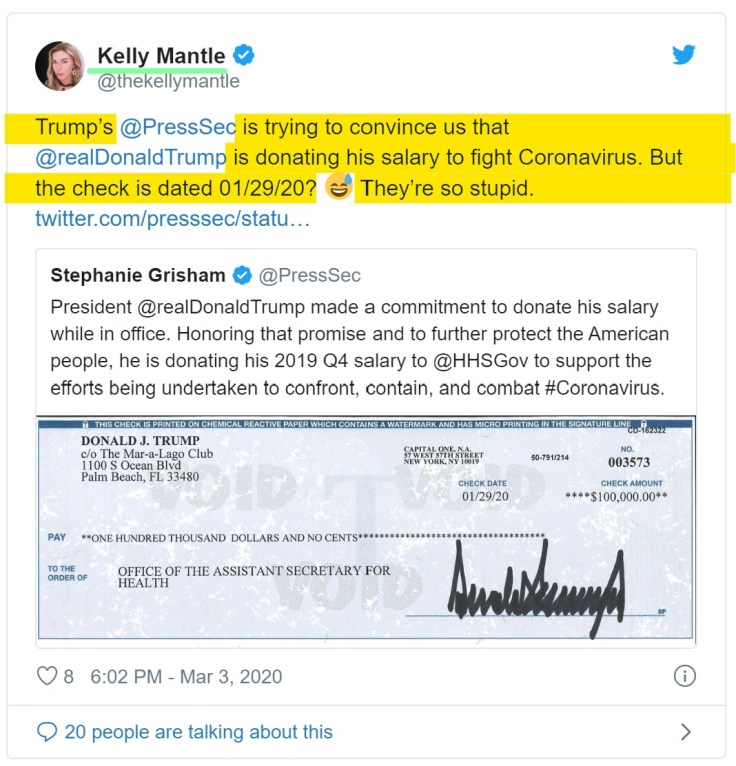
Who’d have thought Trump could do something before announcing it?
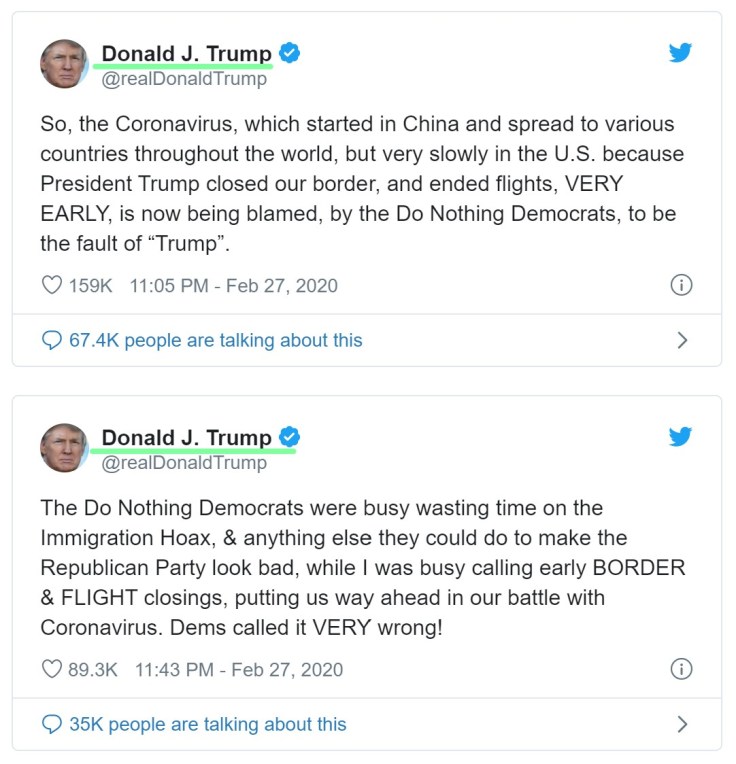
And this one repeated a fake narrative spread by Democrats that Trump defunded pandemic response:


By Noah Higgins-Dunn
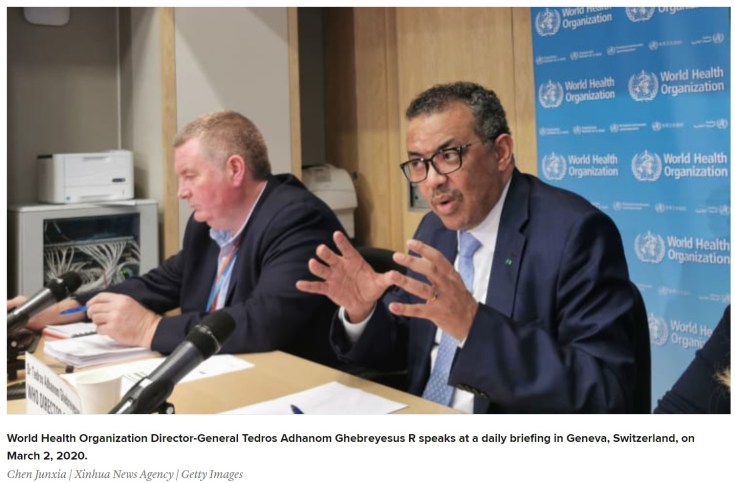
World Health Organization officials called on medical supply manufacturers to “urgently increase production” to meet the global demand that is needed to respond to the COVID-19 outbreak rapidly spreading across the world.
“Supplies are rapidly depleting. WHO estimates that each month 89 million medical masks will be required for the COVID-19 response, 76 million examination gloves and 1.6 million goggles,” Director-General Tedros Adhanom Ghebreyesus told reporters at the organization’s Geneva headquarters.
Tedros said manufacturers need to increase personal protective gear supplies by 40% to meet the needs of the medical community.
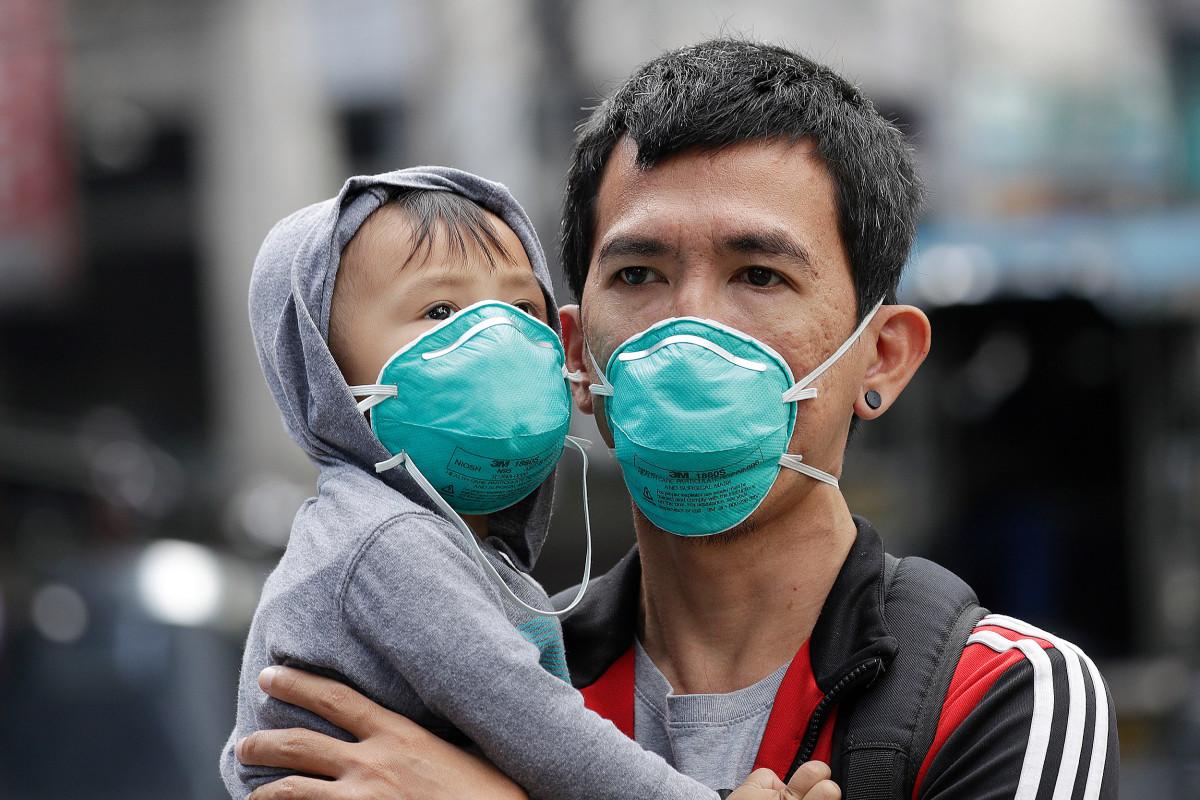
On Capitol Hill in Washington, Health and Human Services’ assistant secretary for preparedness and response, Dr. Robert Kadlec, said the U.S. has about 35 million N95 respirator masks. That’s about 10% of the 3.5 billion he estimates the U.S. will need if COVID-19 erupts into a full-blown pandemic.
World health officials have said that N95 face masks are effective in protecting health-care workers from the infection, prompting global demand for them to surge. In China, demand for face masks has depleted the country’s stockpile where doctors and nurses face shortages, according to the South China Morning Post.
WHO officials announced on Monday that the number of new coronavrius cases outside China was almost nine times higher than that inside the country in the previous 24 hours. They also increased the risk assessment of the coronavirus Friday to “very high” at the global level. In January, it declared the virus a global health emergency, while urging the public against overreacting to the virus.
“As one epidemic looks like ending, one front of the fight closing, another is becoming increasingly complex” Tedros said Tuesday. China reported 120 new cases in the last 24 hours, compared with 1,848 new infections in 48 countries, with most of those cases coming from Italy, Korea and the Islamic Republic of Iran, he said. Emerging from Wuhan, China, more than two months ago, COVID-19 has already spread to more than 91,300 people across at least 73 countries, killing at least 3,110 — including at least six in the U.S.
“Iranian medical doctors and nurses have concerns that they don’t necessarily have enough equipment, supplies, ventilators, respirators, oxygen and all the things you’ve heard spoken about in many of the press conferences,” said Dr. Michael Ryan, who runs WHO’s emergency program. “Those needs are more acute for the Iranian health system than they are most any other health system.”
The organization has yet to classify the virus as a pandemic and has maintained that its attention is on containing the spread, although the virus has substantially moved beyond China and has now been found in nearly 60 countries.
Dr. Anne Schuchat, principal deputy director of the U.S. Centers for Disease Control and Prevention, told Senate lawmakers Tuesday that the current outbreak already meets two of the three main criteria under the technical designation of a pandemic.
“It is a new virus, and it is capable of person-to-person spread,” she said in prepared testimony at a hearing. “If sustained person-to-person spread in the community takes hold outside China, this will increase the likelihood that the WHO will deem it a global pandemic.”
Epidemics have emerged in Iran, Italy, and South Korea, where the number of cases is rapidly increasing. The U.S. recorded its first six deaths from the virus since this weekend, while New York state confirmed a second case earlier Tuesday. Every country should prepare for its first case and no one should assume it won’t get any cases, Tedros said last month.
“This is a unique virus, with unique features. This virus is not influenza,” Tedros said. “We are in uncharted territory.”
Tedros shed more light on the virus Tuesday, saying it spreads similar to influenza, by small droplets of fluid from the nose and mouth of someone who’s sick.
“However, there are some important differences,” he said. “First COVID-19 does not transmit as efficiently as influenza from the data we’ve seen so far. With influenza, people who are infected but not yet sick are major drivers of transmission, which doesn’t appear to be the case with COVID-19.”
Tedros said last week that health officials would not “hesitate” to declare the outbreak a pandemic if “that’s what the evidence suggests.” On Friday at a press briefing, he said that most cases of COVID-19 can still be traced to known contacts or clusters of cases and there isn’t any “evidence as yet that the virus is spreading freely in communities.” That’s one reason why WHO hasn’t declared the outbreak a pandemic, Tedros said Friday.
Ryan said Monday scientists still don’t know exactly how COVID-19 “behaves,” saying it’s not like influenza. “We know it’s not transmitting in exactly the same way that influenza was, and that offers us a glimmer, a chink of light, that this virus can be suppressed and pushed and contained,” he said.
Ryan also said health officials think countries are being transparent, but “it’s very easy to be caught unaware in an epidemic situation.”
WHO officials on Friday increased the risk assessment of the coronavirus to “high” to “very high” at a global level. The world can still avoid “the worst of it,” but the increased risk assessment means the WHO’s “level of concern is at its highest,” Ryan said at the time.
Health officials have said the respiratory disease is capable of spreading through human-to-human contact, droplets carried through sneezing and coughing and germs left on inanimate objects. The virus appears to be particularly troublesome for older people and those with underlying health conditions. Symptoms can include a sore throat, runny nose, fever or pneumonia and can progress all the way to multiple organ failure or death in some severe cases.
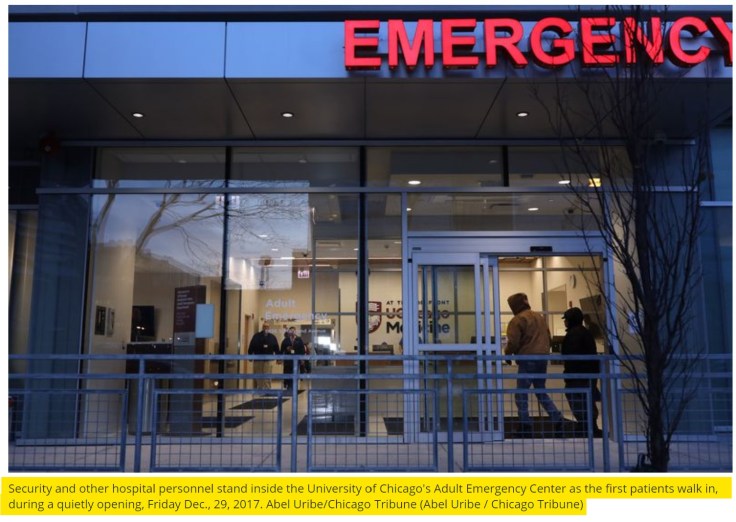
The hospital said it was waiting for lab test results to back up its suspicions. No details were released about the patient.
“We are awaiting lab tests to see whether this patient has COVID-19. Not sure how soon we will get back results,” hospital spokeswoman Lorna Wong wrote in an email Tuesday morning.
On Monday, the third and fourth cases in Illinois were reported: A husband and wife in their 70s both tested positive for coronavirus, but the results still need to be confirmed by the Centers for Disease Control and Prevention. The man was being treated at Northwest Community Hospital and his wife was under quarantine at home, officials said. Two other cases in Illinois have been confirmed by the CDC.
Wong said the hospital has been “preparing for this eventuality” since coronavirus first became a global public health threat in January.
“Senior hospital leadership and leaders from our infectious diseases and infection prevention teams, along with other expert clinicians, are working closely with local, state and federal health officials and continue to apply up to date recommended guidelines,” she said in an emailed statement.
“We have the utmost confidence in the dedicated and highly trained team composed of nurses, physicians and other health care professionals who are providing care for this patient,” it said.
Wong said the hospital wanted to release information as early as was possible, while awaiting official confirmation of the diagnosis from the Centers for Disease Control and Prevention.
“We will continue to update you as this situation develops, but wanted to immediately inform you,” she said.
On Monday, Arlington Heights School District 25 said two staffers and two students would be staying home as a result of possible exposure to a person who is related to a hospital worker who encountered a patient with coronavirus.
At least 15 states have reported confirmed cases of coronavirus. At least six people have died from the disease in Washington state.
The disease has hit at least 70 countries, with 90,000 cases and 3,100 deaths. The vast majority of cases and deaths have been in China. While the number of new cases recorded daily in that epicenter country has declined for weeks, the virus continues to spread fast in South Korea, Iran and Italy, prompting increased travel warnings and restrictions.
In Illinois as of Monday, 102 people are being or have already been tested for the virus, including the four people whose tests have come back positive and 79 people who tests have come back negative, with 19 tests still outstanding, according to state officials. A total of 286 people were being monitored by health officials as of Monday and state health officials are working to create guidelines for those who work with the most vulnerable patients, state officials have said. Several of the cases, and deaths, in Washington state have been among patients at a nursing facility.
The state has a hotline people can call with questions or to report suspected cases, 800-889-3931. They can call the Office of Consumer Health Insurance at 877-527-9431 about their insurance coverage.
By Dr. John Campbell
By Dr. John Campbell – 3/2/2020

Authored by Alvin Powell via The Harvard Gazette,
That announcement comes amid a rush of developments surrounding the outbreak, including: reports of a potential vaccine, a shift in the majority of new cases to nations outside of China for the first time, the emergence of cases in California and Germany with no obvious source of transmission, the monthlong closure of Japanese schools, and the continued decline in global financial markets over economic downturn fears.
The Gazette spoke with Marc Lipsitch an epidemiologist and head of the Harvard T.H. Chan School of Public Health’s Center for Communicable Disease Dynamics, about the course of the epidemic, including the still-unresolved question of its effect on children.
GAZETTE: For the first time, the number of new cases outside of China was higher than those inside of China. Is that due to the daily fluctuation in case numbers or might it represent an inflection point in the course of the epidemic?
LIPSITCH: I don’t know. I would want to see something happening for several days before characterizing it, but the evidence is now pretty strong that China’s approach to very, very intense social distancing has really paid off in terms of reducing transmission. The WHO mission came back confirming that, and, from what I’ve been able to learn, it really is true. That’s encouraging, but at the same time, other countries are discovering that they have lots of cases and don’t have those kinds of measures in place. I also don’t think that China is out of the woods. I don’t think any country can keep that kind of social distancing in place indefinitely. In fact, China, from what I understand, is trying to go slowly back to work, so there’s a risk that it will resurge there. But in many parts of China it seems like, for the moment, it’s really under control.
GAZETTE: What strikes you as the most surprising development in the last week or so?
LIPSITCH: It’s that clusters of new infections have appeared in nations that nobody would have thought were at high risk compared to places that have more direct contact with China — Iran and Italy being examples. Given those appearances, it’s striking that it hasn’t appeared in more countries like the United States on a bigger scale. Part of the reason the United States hasn’t had many detected cases may be because we’re not testing very heavily. But even so, those countries where outbreaks occurred weren’t testing that heavily either. So I’m a little surprised that we haven’t had an outbreak somewhere in the U.S. so dramatic that we couldn’t miss it.
GAZETTE: Would you recommend that testing here be routine?
LIPSITCH: I would recommend that some routine testing start here. I don’t think it makes sense to do it on a large scale until we know that there’s something to find. But to give a sense of what’s happening elsewhere, Hong Kong, for example, is now testing every hospitalized patient who has a cough. They’re also testing every undiagnosed pneumonia case, which is at least hundreds of tests per day. Guangdong, according to the WHO press conference Tuesday, tested more than 300,000 cases of relatively mild respiratory illness or fever in a three- or four-week period. That is the scale at which a serious testing effort would have to happen. I’m not suggesting we scale up to that level now because it doesn’t make sense to, but we need to know whether there’s transmission going on. We’re not going to find that out if we restrict testing to people who are known contacts of those already infected.
GAZETTE: When does an epidemic become a pandemic? We’ve had several sizable outbreaks in countries outside of China.
LIPSITCH: The terminology is almost unhelpful, I think. A pandemic is sustained transmission of an infection in multiple locations around the globe, and with Iran, Italy, China, Japan, and South Korea, we have that. It’s unnecessary to keep debating the name. I wrote a piece in Scientific American last week about three categories of ideas, ranging from hard facts to fact-based inference to speculation and opinion. When I said I thought there was a pandemic going a few weeks ago, that was fact-based inference. Now, I think, it’s a fact.
GAZETTE: You’ve been quoted you as saying you expect between 40 percent and 70 percent of humanity to be infected with this virus within a year. Is that still the case?
LIPSITCH: It is, but an important qualifier is that I expect 40 to 70 percent of adults to be infected. We just don’t understand whether children are getting infected at low rates or just not showing very strong symptoms. So I don’t want to make assumptions about children until we know more. That number also assumes that we don’t put in place effective, long-term countermeasures, like social distancing for months at a time which, I think, is a fair assumption. It may be that a few places like China can sustain it, but even China is beginning to let up.
GAZETTE: You mentioned children having been hit only lightly by this. What about other parts of the population? What do we know about the impact of this from a demographic standpoint?
LIPSITCH: It’s definitely the case that the older you are, the more at risk of getting infected you are and, if you get symptomatic infection, the more at risk of dying you are. Men also seem to be overrepresented among those getting severe illness. The reasons why are a really important research question. One thing that also needs to be looked at is the impact on health-care workers because they are at high risk of getting infected, and I would like to know whether they’re at higher risk of getting severe infection. Some of the anecdotal cases of young physicians dying make me wonder whether they’re exposed to a higher dose and that’s making them sicker.
GAZETTE: A Cambridge company this week, Moderna Inc., delivered a vaccine candidate to the NIH for human testing, which has been hailed as a remarkable development in such a short time. Does that reduce the minimum one-year timetable we’ve discussed as needed to develop and distribute a vaccine to patients?
LIPSITCH: I don’t know how much things can be shortened — that’s in part a regulatory decision. It’s possible that a vaccine could be rolled out without as much clinical-trial evidence as is usually the case, but I would be cautious about doing that because, while licensed vaccines are beneficial, untested experimental vaccines are sometimes not just ineffective, but harmful. That’s why you do the trials. So we need to move as fast as we can while being appropriately cautious. The phrase “all deliberate speed” is probably relevant here. I would not want to see a vaccine rolled out before we have pretty strong evidence that it’s going to be beneficial.
GAZETTE: Officials at the Centers for Disease Control and Prevention yesterday said an outbreak is very likely here in the U.S. and mentioned “social distancing” as a possible tactic. Can social distancing, without a treatment or vaccine, have a significant impact?
LIPSITCH: It remains to be seen what the impact of different measures would be. I think we can slow transmission through social distancing in a way that would be acceptable to Americans. It happened, for example, in 1918 with the flu. And I think it can happen now. The question is how much and for how long? But delaying infection is good — it can reduce the peak burden on health care, reduce the total number infected, and push more of the infections into the future, when we will understand more about how to treat them.
GAZETTE: What do you think of the president’s comments Wednesday evening that the U.S. is adequately prepared to meet this challenge?
LIPSITCH: I came away from the press conference feeling cautiously optimistic. The president repeatedly praised the scientists and public health officials standing beside him and put the vice president in charge of the response, suggesting he was taking it seriously. And Secretary Azar laid out important priorities including expanding state and local response capacity. As is often the case, many of the president’s individual statements were at odds with his actions and with scientific fact, and he seemed to still be in denial. And with the news today that the leadership is shifting again and that federal health and science officials will be muzzled from speaking without clearance, my cautious optimism is gone. It is simply authoritarian and un-American for politicians to tell public health leaders what they can and can’t say about a public health crisis.
GAZETTE: The Olympics are scheduled for July in Japan. Can we say now whether it will be a good idea to stage a major international gathering in a few months, or is it too early yet?
LIPSITCH: The next few weeks will show us a lot about the extent of global transmission. And if it’s everywhere around the globe then it may not be as important to restrict travel, though it will still be important to restrict gatherings like the Olympics. So we’ll see.
GAZETTE: What’s the most important unanswered question to your mind?
LIPSITCH: One of the most important unanswered questions is what role do children play in transmission? The go-to intervention in flu pandemic planning is closing schools, and that may be very effective or it may be totally ineffective. It’s a costly and disruptive thing to do, especially in the United States, because many people rely on school breakfast and lunch for nutrition. So we really need evidence that closing schools would help. We need detailed studies in households of children who are exposed to an infected person. We need to find out if the children get infected, if they shed virus, and if that virus is infectious. The second issue that we should be trying to get ahead of is the extent of infection in communities and in places that aren’t doing extensive testing.
GAZETTE: What do we know about for sure about how children are affected by this virus?
LIPSITCH: We know that the cases of children sick enough to get tested is much lower per capita than those of adults. And we also know that, in China outside of Hubei province, the difference between children and adults is smaller. Children are still underrepresented, but they’re a larger part of the total than inside Hubei province. That would suggest that part of the equation is that they are getting infected but they’re not that sick — it’s easier to identify less-severe cases in a system that’s not overwhelmed as it is in Hubei. But we don’t know whether they’re infected and not as sick or whether there are a lot of kids that aren’t getting infected even when they’re exposed.
By Dr. John Campbell 2/28/2020

By
JOSHUA CAPLAN“Mike Pence literally does not believe in science. It is utterly irresponsible to put him in charge of US coronavirus response as the world sits on the cusp of a pandemic,” the New York Democrat wrote on social media. “This decision could cost people their lives. Pence’s past decisions already have.”

Ocasio-Cortez then shared an article in which Pence is accused of enabling an HIV outbreak in Indiana under his governorship, writing: “As governor, Pence’s science denial contributed to one of the worst HIV outbreaks in Indiana’s history.”
“As governor, Pence’s science denial contributed to one of the worst HIV outbreaks in Indiana’s history,” she added. “He is not a medical doctor. He is not a health expert. He is not qualified nor positioned in any way to protect our public health.”
President Trump announced hours before Ocasio-Cortez’s comments that Pence will lead the U.S.’s response to the virus. During the press briefing, the president said the illness’s spread is not inevitable and that citizens that have been diagnosed with it are doing “very well.”
“Of the 15 people… eight of them have returned to their homes, to stay at their homes until they’re fully recovered. One is in the hospital, five have fully recovered and one we think is in pretty good shape,” he said. “In almost all cases, they’re getting better.”
President Trump also confirmed the U.S. has ordered additional masks to fight the spread of the disease and warned businesses against price gauging on protective products. He then expressed optimism about a bipartisan congressional effort to secure funding to fight the illness after requesting $2.5 billion on Monday.
“We started out by looking at certain things, we’ve been working with the Hill very, very carefully, very strongly and I think that we have very good bipartisan spirt for money,” he stated. “We were asking for $2.5 billion and we think that is a lot. But the Democrats — and I guess Senator Schumer — want us to have more than that.”
To date, the U.S. has nearly 60 confirmed cases, which includes the 42 Americans repatriated from the Diamond Princess cruise ship in Japan earlier this month.

 Tom's Blog