FEMA preparing for possible coronavirus emergency declaration

CAP

By Laura Strickler and Suzy Khimm

WASHINGTON — The Federal Emergency Management Agency is planning for the possibility that President Donald Trump could make an emergency declaration to bring in extra funds and personnel to assist the administration’s coronavirus response, according to internal documents obtained by NBC News.

FEMA officials are preparing for an “infectious disease emergency declaration” by the president that would allow the agency to provide disaster relief funding to state and local governments, as well as federal assistance to support the coronavirus response, according to agency planning documents reviewed by NBC News.

The Trump administration would have to use the 1988 Stafford Act to enable FEMA to provide such disaster assistance. Emergency declarations are most often used in the event of natural disasters but can be used to help manage disease outbreaks.

Full coverage of the coronavirus outbreak

“To me this is another indication that the president and the White House are finally aware of the gravity of the situation,” said Michael Coen, who was FEMA chief of staff during the Obama administration. “They need to consider all tools available to them and have contingencies for action.”

“I actually find this reassuring,” said Tim Manning, who was a FEMA deputy administrator under President Barack Obama. “I hope this discussion has been happening continuously over the last couple of months.”

An emergency declaration would allow FEMA to provide disaster medical assistance teams, mobile hospitals and military transport, among other kinds of federal support, Manning said.

FEMA’s disaster relief fund has a current balance of $34 billion, according to the latest agency update. “It’s money that’s sitting there and ready,” said another former FEMA official, who declined to be identified.

FEMA spokesperson Lizzie Litzow said the agency is currently focused on supporting the Department of Health and Human Services (HHS), which separately declared a “public health emergency” on Jan. 31, allowing HHS to access funds and other resources to aid the government’s virus response. “At this time, there isn’t anything additional to the HHS public health emergency,” Litzow said.

CAP

It would not be the first time the federal government has used FEMA’s resources to assist in a medical event.

In 2000, President Bill Clinton used a Stafford Act emergency declaration for outbreaks of the West Nile virus in New York and New Jersey, ordering up to $5 million in federal aid to supplement state efforts to combat the mosquito-borne virus.

Emergency declarations are distinct from “major disaster” declarations, which are more far-reaching and are typically used for hurricanes, floods and other natural disasters.


A Big Coronavirus Mystery: Where Are The Children?

Profile picture for user Tyler Durden

Authored by Alvin Powell via The Harvard Gazette,

As coronavirus cases continue to spread around the world, American officials acknowledged this week that cases of COVID-19, the illness caused by the virus, are likely to become much more widespread across the nation. 

That announcement comes amid a rush of developments surrounding the outbreak, including: reports of a potential vaccine, a shift in the majority of new cases to nations outside of China for the first time, the emergence of cases in California and Germany with no obvious source of transmission, the monthlong closure of Japanese schools, and the continued decline in global financial markets over economic downturn fears.

Public health officials, however, have expressed cautious optimism over evidence that China’s drastic control measures, such as strict travel restrictions, lockdown of some cities, and the closure of factories, businesses, and schools, seem to have been effective.

The Gazette spoke with Marc Lipsitch an epidemiologist and head of the Harvard T.H. Chan School of Public Health’s Center for Communicable Disease Dynamics, about the course of the epidemic, including the still-unresolved question of its effect on children.

Q&A

Marc Lipsitch

GAZETTE: For the first time, the number of new cases outside of China was higher than those inside of China. Is that due to the daily fluctuation in case numbers or might it represent an inflection point in the course of the epidemic?

LIPSITCH: I don’t know. I would want to see something happening for several days before characterizing it, but the evidence is now pretty strong that China’s approach to very, very intense social distancing has really paid off in terms of reducing transmission. The WHO mission came back confirming that, and, from what I’ve been able to learn, it really is true. That’s encouraging, but at the same time, other countries are discovering that they have lots of cases and don’t have those kinds of measures in place. I also don’t think that China is out of the woods. I don’t think any country can keep that kind of social distancing in place indefinitely. In fact, China, from what I understand, is trying to go slowly back to work, so there’s a risk that it will resurge there. But in many parts of China it seems like, for the moment, it’s really under control.

GAZETTE: What strikes you as the most surprising development in the last week or so?

LIPSITCH: It’s that clusters of new infections have appeared in nations that nobody would have thought were at high risk compared to places that have more direct contact with China — Iran and Italy being examples. Given those appearances, it’s striking that it hasn’t appeared in more countries like the United States on a bigger scale. Part of the reason the United States hasn’t had many detected cases may be because we’re not testing very heavily. But even so, those countries where outbreaks occurred weren’t testing that heavily either. So I’m a little surprised that we haven’t had an outbreak somewhere in the U.S. so dramatic that we couldn’t miss it.

GAZETTE: Would you recommend that testing here be routine?

LIPSITCH: I would recommend that some routine testing start here. I don’t think it makes sense to do it on a large scale until we know that there’s something to find. But to give a sense of what’s happening elsewhere, Hong Kong, for example, is now testing every hospitalized patient who has a cough. They’re also testing every undiagnosed pneumonia case, which is at least hundreds of tests per day. Guangdong, according to the WHO press conference Tuesday, tested more than 300,000 cases of relatively mild respiratory illness or fever in a three- or four-week period. That is the scale at which a serious testing effort would have to happen. I’m not suggesting we scale up to that level now because it doesn’t make sense to, but we need to know whether there’s transmission going on. We’re not going to find that out if we restrict testing to people who are known contacts of those already infected.

GAZETTE: When does an epidemic become a pandemic? We’ve had several sizable outbreaks in countries outside of China.

LIPSITCH: The terminology is almost unhelpful, I think. A pandemic is sustained transmission of an infection in multiple locations around the globe, and with Iran, Italy, China, Japan, and South Korea, we have that. It’s unnecessary to keep debating the name. I wrote a piece in Scientific American last week about three categories of ideas, ranging from hard facts to fact-based inference to speculation and opinion. When I said I thought there was a pandemic going a few weeks ago, that was fact-based inference. Now, I think, it’s a fact.

GAZETTE: You’ve been quoted you as saying you expect between 40 percent and 70 percent of humanity to be infected with this virus within a year. Is that still the case?

LIPSITCH: It is, but an important qualifier is that I expect 40 to 70 percent of adults to be infected. We just don’t understand whether children are getting infected at low rates or just not showing very strong symptoms. So I don’t want to make assumptions about children until we know more. That number also assumes that we don’t put in place effective, long-term countermeasures, like social distancing for months at a time which, I think, is a fair assumption. It may be that a few places like China can sustain it, but even China is beginning to let up.

GAZETTE: You mentioned children having been hit only lightly by this. What about other parts of the population? What do we know about the impact of this from a demographic standpoint?

LIPSITCH: It’s definitely the case that the older you are, the more at risk of getting infected you are and, if you get symptomatic infection, the more at risk of dying you are. Men also seem to be overrepresented among those getting severe illness. The reasons why are a really important research question. One thing that also needs to be looked at is the impact on health-care workers because they are at high risk of getting infected, and I would like to know whether they’re at higher risk of getting severe infection. Some of the anecdotal cases of young physicians dying make me wonder whether they’re exposed to a higher dose and that’s making them sicker.

GAZETTE: A Cambridge company this week, Moderna Inc., delivered a vaccine candidate to the NIH for human testing, which has been hailed as a remarkable development in such a short time. Does that reduce the minimum one-year timetable we’ve discussed as needed to develop and distribute a vaccine to patients?

LIPSITCH: I don’t know how much things can be shortened — that’s in part a regulatory decision. It’s possible that a vaccine could be rolled out without as much clinical-trial evidence as is usually the case, but I would be cautious about doing that because, while licensed vaccines are beneficial, untested experimental vaccines are sometimes not just ineffective, but harmful. That’s why you do the trials. So we need to move as fast as we can while being appropriately cautious. The phrase “all deliberate speed” is probably relevant here. I would not want to see a vaccine rolled out before we have pretty strong evidence that it’s going to be beneficial.

GAZETTE: Officials at the Centers for Disease Control and Prevention yesterday said an outbreak is very likely here in the U.S. and mentioned “social distancing” as a possible tactic. Can social distancing, without a treatment or vaccine, have a significant impact?

LIPSITCH: It remains to be seen what the impact of different measures would be. I think we can slow transmission through social distancing in a way that would be acceptable to Americans. It happened, for example, in 1918 with the flu. And I think it can happen now. The question is how much and for how long? But delaying infection is good — it can reduce the peak burden on health care, reduce the total number infected, and push more of the infections into the future, when we will understand more about how to treat them.

GAZETTE: What do you think of the president’s comments Wednesday evening that the U.S. is adequately prepared to meet this challenge?

LIPSITCH: I came away from the press conference feeling cautiously optimistic. The president repeatedly praised the scientists and public health officials standing beside him and put the vice president in charge of the response, suggesting he was taking it seriously. And Secretary Azar laid out important priorities including expanding state and local response capacity. As is often the case, many of the president’s individual statements were at odds with his actions and with scientific fact, and he seemed to still be in denial.  And with the news today that the leadership is shifting again and that federal health and science officials will be muzzled from speaking without clearance, my cautious optimism is gone. It is simply authoritarian and un-American for politicians to tell public health leaders what they can and can’t say about a public health crisis.

GAZETTE: The Olympics are scheduled for July in Japan. Can we say now whether it will be a good idea to stage a major international gathering in a few months, or is it too early yet?

LIPSITCH: The next few weeks will show us a lot about the extent of global transmission. And if it’s everywhere around the globe then it may not be as important to restrict travel, though it will still be important to restrict gatherings like the Olympics. So we’ll see.

GAZETTE: What’s the most important unanswered question to your mind?

LIPSITCH: One of the most important unanswered questions is what role do children play in transmission? The go-to intervention in flu pandemic planning is closing schools, and that may be very effective or it may be totally ineffective. It’s a costly and disruptive thing to do, especially in the United States, because many people rely on school breakfast and lunch for nutrition. So we really need evidence that closing schools would help. We need detailed studies in households of children who are exposed to an infected person. We need to find out if the children get infected, if they shed virus, and if that virus is infectious. The second issue that we should be trying to get ahead of is the extent of infection in communities and in places that aren’t doing extensive testing.

GAZETTE: What do we know about for sure about how children are affected by this virus?

LIPSITCH: We know that the cases of children sick enough to get tested is much lower per capita than those of adults. And we also know that, in China outside of Hubei province, the difference between children and adults is smaller. Children are still underrepresented, but they’re a larger part of the total than inside Hubei province. That would suggest that part of the equation is that they are getting infected but they’re not that sick — it’s easier to identify less-severe cases in a system that’s not overwhelmed as it is in Hubei. But we don’t know whether they’re infected and not as sick or whether there are a lot of kids that aren’t getting infected even when they’re exposed.

COVID – 19 Friday update 28 Feb

By Dr. John Campbell 2/28/2020

I love how Doc just stares at the camera in silence when he wants show disapproval

I’m so glad you mentioned the comparison with influenza, I’ve been trying to highlight the transmissibility of COVID-19 for weeks compared to flu. Add to that the incubation period, asymptomatic potential and aerosolised transmission!! It’s an incredibly risky virus especially to older and vulnerable populations and the government should have been pouring support into nursing homes and social care support long before now.


Japan, China Close Schools Nationwide As CDC Warns Of Possible “Community Outbreak” In Sonoma County: Live Virus Updates

Summary:

  • WHO says outbreak in Iran likely worse than official numbers suggest; outbreak could go in “any direction”

  • Iran confirms 22 deaths, vice president for women and family affairs infected

  • Lagarde: Not yet time for ECB to intervene to fight economic backlash of outbreak

  • HHS says risk to public remains “low”

  • Starbucks says it has reopened 85% of Chinese restaurants

  • Azar: Sonoma case might be ‘community transmission’

  • Salvini meets with Italian president amid national unity government speculation

  • South Korean new cases surpass China’s new cases as SK confirms 505 new cases

  • China, Japan close school nationwide

  • CDC fears ‘community outbreak’ in Sonoma County after discovering first US case of “unknown origin”

  • Saudi Arabia suspends pilgrimages to Holy Sites

  • Hawaiian Airlines suspends service to South Korea

  • Brazil’s neighbors take steps to keep virus out

* * *

Update (1150ET): A rare glimpse of bullish economic news out of China: Starbucks says it has reopened 85% of its stores in China, its “second home market,” according to a company statement to CNBC.

* * *

Update (1120ET): After cheering reports of German fiscal stimulus yesterday, the ECB’s Christine Lagarde said the outbreak isn’t yet at the stage to justify ECB intervention as investors in the US, and President Trump, look to Powell for a rate cut at the next meeting.

Of course, Lagarde is probably only saying this because she knows there’s nothing she can do to salve the European economy from a ‘supply-side’ shock, which is why she’s picking up where Mario Draghi left off and calling on EU governments to spend more to keep the Continental economy from sliding off a cliff.

Meanwhile, Bloomberg reports that the CDC is allowing states to “modify” old test kits to use them on any suspected coronavirus patients.

Hopefully, these tests aren’t sacrificing accuracy for availability.

U.S. health officials will let state and local health labs modify a test for the coronavirus that has been plagued by weeks of delays because of inconclusive results, said the head of the trade group for public-health testing labs.

Officials from the Centers for Disease Control and Prevention and the Food and Drug Administration held a conference call Wednesday in which they gave permission for state and local labs to drop a troublesome step in the tests that stopped them from being used, said Scott Becker, CEO of the Association of Public Health Laboratories. Becker’s group represents state and local testing labs.

The change should speed testing and allow state and local labs to start using hundreds of test kits that were sent out earlier this month, rather than having to wait for an improved, new version of the test to be sent by federal health authorities.

“In the next week we are going to have much more testing,” Becker said in a phone interview. “It is going to increase capacity across the country.”

Source: Bloomberg

Over on Capitol Hill, Nancy Pelosi said she spoke to Trump’s “Coronavirus Czar” Mike Pence about the emergency spending bill.

* * *

Update (1100ET): Azar admits that the case in a Sonoma County hospital might signal the start of “community transmission” as the CDC warned.

  • AZAR: CASE IN CALIF. COULD BE POTENTIAL FIRST COMMUNITY SPREAD

* * *

Update (1030ET): With US stocks deep in the red one again, HHS Secretary Alex Azar said at least 40 public health labs in the US should now be able to test for the coronavirus using “modified existing CDC kits”.

  • IMMEDIATE U.S. CORONAVIRUS RISK REMAINS LOW, AZAR SAYS

  • HHS SECRETARY AZAR SAYS AT LEAST 40 PUBLIC HEALTH LABS IN U.S. SHOULD NOW BE ABLE TO TEST FOR CORONAVIRUS USING MODIFIED EXISTING CDC KITS

in the US, investors are worried about the first case of unknown origin, which the CDC confirmed last night. This comes as critics slam Azar for refusing to guarantee that the coronavirus vaccine would be “affordable to all”.

The IMF said Thursday that it’s likely to downgrade its global growth outlook in the next world economic outlook, which is due in the spring.

Switzerland has become the latest country to cancel games and events over the outbreak, with the Engadin Ski Marathon, said to be the tiny Alpine country’s largest annual sporting event.

Over on Wall Street, US stocks are on track for their worst week since the financial crisis.

Pakistan, meanwhile, has become the latest country to suspend all flights to Iran.

* * *

Update (0920ET): WHO Director-General Tedros Adhanom Ghebreyesus said Thursday during the organization’s daily press briefing that “we are at a decisive point” in the epidemic, while others warned it could go “in any direction.”

CAP

Iran has confirmed 22 deaths and more than 140 cases, including a vice president who was the third senior official to catch the virus. But many fear the full extent of the outbreak is much broader. During the press conference, another WHO official singled out Iran, claiming the virus had crept into the country “undetected”, before adding that the WHO fears the outbreak inside the country is even worse than the government claims.

“The outbreak can go in any direction based on how we handle it,” Dr. Tedros said during the group’s daily briefing in Geneva.

Iran “has a very high clinical capacity”, said Dr. Mike Ryan, the executive director of the WHO’s health emergency program. The 10% death rate probably has more to do with the fact that many cases have gone undiagnosed, he said. The country has gone so far as to cancel Friday prayers in Tehran, after the Saudis told pilgrims they wouldn’t be allowed in to the Muslim Holy Sites.

Following European stocks dive into correction territory, in the US, the Dow is on the cusp of falling into correction territory intraday for the first time since December 2018 (remember when?).

As traders digest the implications of the new case in Sonoma County that could be evidence of the first case of “community transmission” in the country, as well as President Trump’s rambling press conference on Wednesday, the focus has shifted back to Europe, where in Italy, cases climbed above 500.

According to the FT, Matteo Salvini, the leader of the League, the head of the parliamentary opposition, has met with President Sergio Mattarella as speculation mounts about the prospects for a national unity government to deal with the crisis, following several political missteps by PM Conte.

* * *

Update (0735ET): After yesterday’s rally fizzled, Germany is giving the ‘fiscal stimulus’ tape bomb one more go.

  • GERMAN GOVERNMENT CONSIDERING POSSIBLE STIMULUS PROGRAMME IN CASE CORONAVIRUS EPIDEMIC HITS GERMAN ECONOMY HARD – HANDELSBLATT

Yesterday, a German lawmaker poured cold water on reports that Germany might ditch its constitutional ‘debt break’ to boost spending in response to the economy-killing outbreak.

* * *

Update (0715ET): with the country’s third election in a year just days away, Israel is taking serious pains to avoid acknowledging the coronavirus cases that have been confirmed in the country by blaming them on Italy and South Korea (each case involved a traveler who had recently returned from one of those two countries).

The country said Thursday it would bar non-Israelis who had recently visited Italy after confirming that a man who had recently visited the country had tested positive for the virus, according to Reuters.

* * *

US equity futures are pointing to yet another lower open on Thursday morning after WaPo interrupted President Trump’s press conference last night to reports the first COVID-19 case “of unknown origin,” which the CDC later confirmed was in Sonoma County, and could be the epicenter of America’s first “community outbreak.” Shortly after, South Korea reported its largest number of new coronavirus cases in a single day, as the number of new cases reported outside China once again surpassed the number inside China. Brazil confirmed the first case in South America yesterday, bringing the virus to every continent except Antarctica.

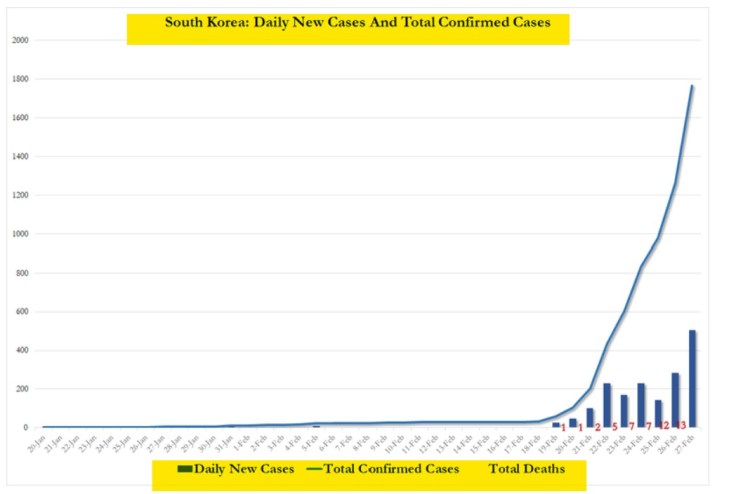
A few hours later, and South Korea has reported another 171 cases, bringing the total cases confirmed on Thursday to 505 – surpassing China’s daily total (433) for the first time, as Bloomberg pointed out. So far, South Korea has confirmed 1,766 cases, along with 13 deaths, in the 38 days since the first case was reported on Jan. 20. The US and South Korea have cancelled planned military exercises after a US soldier caught the virus in Korea.
CAP

Over in Hawaii, Hawaiian Air has suspended service to South Korea starting March 2 through April 30, while Delta reduces flights as the outbreak in South Korea intensifies (Hawaii has already had one COVID-19 scare involving a Japanese tourist; we suspect the state wants to avoid a similar episode involving South Korea). Congresswoman and presidential candidate Tulsi Gabbard requesting a suspension of flights from South Korea and Japan as the outbreak in the US worsens.

Fearing the sudden breakout in the Middle East might spread inside its borders, Saudi Arabia has halted pilgrimages to Islam’s holy sites – known as the Hajj – that are a mandatory practice for Muslims, an unprecedented decision that is likely to spark controversy across the Muslim world. Across the Persian Gulf, Iran has now confirmed 26 deaths 245 cases. But given the virus’s rapid spread throughout the Islamic Republic, many suspect that the real number of cases is far higher (earlier in the week, a local lawmaker said 50 people had died in the city of Qom alone).
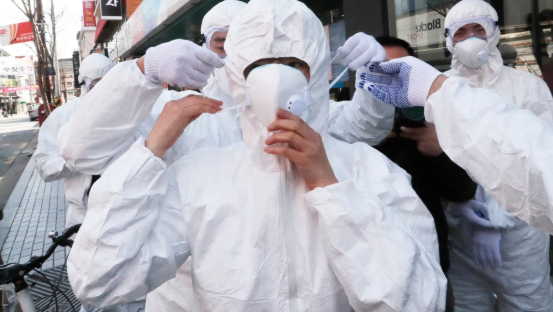
Iran Health Ministry spokesman Kianoush Jahanpour said the large number of new cases is due to more labs handling virus tests. He warned that the public should expect more cases in the future.

Yesterday, Greece was one of eight countries – Brazil, Pakistan, North Macedonia, of course Greece, Georgia, Algeria, Norway and Romania – to confirm their first cases. On Thursday, Greece confirmed two more cases, one of them in its capital city of Athens. The initial case was found in Thessaloniki, Greece’s second city.

At last count, coronavirus has infected more than 80,000 people around the world and caused more than 2,700 deaths since the outbreak began in Wuhan back in December.

Following Brazil’s confirmation overnight, its Latin American neighbors are taking steps to stop the virus from spreading across their borders. According to the AP, Peru is keeping a team of specialists working 24/7 at Jorge Chávez International Airport. Argentina has asked citizens to report any flu-like symptom. Puerto Rico has established a task force to prepare for an outbreak in Puerto Rico. And Chile has announced a health emergency and purchased millions of masks and protective outfits for health workers.

But perhaps the biggest story overnight came out of Japan, where the government swore yesterday that the Tokyo Games would take place as scheduled this summer, after an IOC member speculated that if the virus wasn’t cleared up by late May, Japan might be forced to cancel the Olympics.
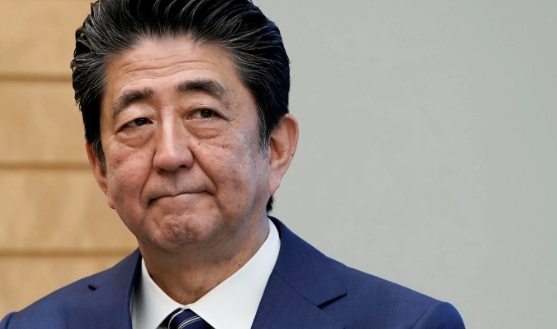
PM Shinzo Abe asked all schools in Japan to remain closed until the spring holidays begin late next month to try and contain the virus. Abe’s decision follows a rash of new cases reported in the north of Japan, including the first cases in Hokkaido, with no discernible path of origin, Nikkei reports.

As of Thursday, 175 cases have been confirmed across 19 of Japan’s prefectures, including Hokkaido, Tokyo, Aichi, and Chiba. Earlier on Thursday, Hokkaido instituted a weeklong closure of all 1,600 public elementary and junior high schools. Abe made the announcement during a meeting of the government’s headquarters.

Schools must now decide whether to abide by the PM’s non-binding ask, though it’s expected that nearly all schools will comply.

Chinese Premier Li Keqiang, President Xi’s ‘point-man’ in charge of the coronavirus response, said that China will extend its school closures for another month because of the virus, according to CCTV.

Earlier this week, we noted that WHO’s team of researchers claimed they found no evidence that the virus had ‘mutated’ during their study of 100+ strains isolated from patients. Well, another group of scientists have done some research that appears to conflict with this.

In Australia, which confirmed a handful of cases during the early days of the outbreak, but has since gone quiet, PM Scott Morrison said Thursday in what some might describe as a ‘fearmongering’ speech that “there is every indication that the world will soon enter a pandemic phase of the coronavirus.”

“As a result, we have initiated the implementation of the coronavirus emergency response plan. While the WHO is yet to declare the nature of the coronavirus and its move toward a pandemic phase, we believe that the risk of a global pandemic is very much upon us and as a result, as a government, we need to take steps to prepare.”

WHO’s Dr. Tedros, who yesterday asked officials not to use the word ‘pandemic’, must have been thrilled to hear Morrison’s screed.

Morrison said Australians can still go “to the football match, or the concert” because Australia has “stayed ahead” of the virus. But now it’s time to move onto the next phase, which includes “preparation for the possibility of a much more significant event.”

Over in France, French President Emmanuel Macron said “we have a crisis before us. An epidemic is on its way” during a visit to a Paris hospital where coronavirus patients are being treated. His statement followed reports that 2 have died in France, an elderly Christian tourist and a 60-year-old French national. The Frenchman died earlier this week in Paris at the hospital Macron visited Thursday. The total number of cases in France reached 18 on Wednesday, roughly the same number as neighboring Germany.

Spain detected two more cases on Thursday, bringing the total this week to 14. Neither was connected to Italy, health authorities said. Switzerland confirmed 3 more cases, bringing its total to 4, though Swiss authorities said they’re testing 66 others. In Italy, the number of confirmed cases climbed to 528. Of those, 278 are self-isolating at home, 159 recovered with symptoms in hospital and 37 are in intensive care.

As the AP reminds us, Germany’s health minister said Wednesday that the country was “at the beginning of an epidemic” as authorities in the west tested dozens of people. New cases on Thursday brought Germany’s total to 21.

Two new cases confirmed in the UK on Thursday raised the total to 15. A primary school in Buxton was forced to close for “a deep clean” after a parent of one of the students tested positive for the virus.

The EU Commission doubled-down on its anti-border-closure position, saying no EU country wants to close internal borders. Meanwhile, the FT reports that EU officials are weighing the risks of clusters of Italian-style outbreaks surface across the continent.

What will it take for the EU to acknowledge that border closures might be necessary?
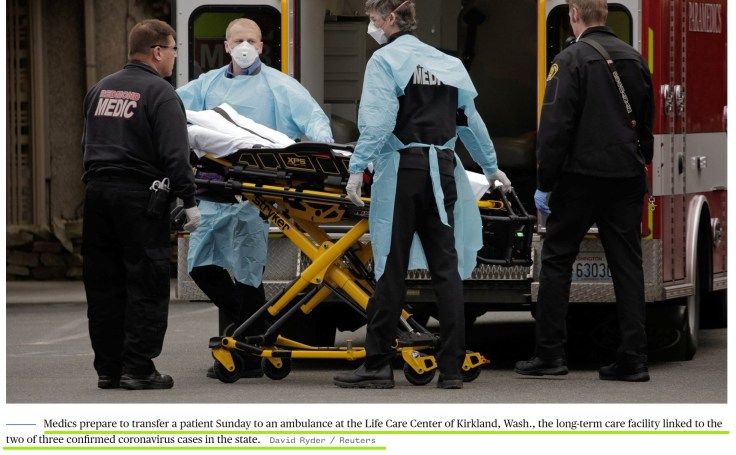
Coronavirus now spreading faster outside of China – amid pandemic fears

2/26/2020

The Pope is helping to spread the virus among weak and vulnerable. … you can’t make this stuff up!

Don’t worry we can contain this virus….. Said every country that’s tried and failed. Also its wreckless the government saying not to worry about the people returning from known infected areas with flu symptoms. I bet they wouldn’t send their own children in that situation! I swear between the horribly currupt who and the advice from some countries leaders its like they want it spread.

China is welding people in their homes. UK gov says “wash your hands”. I’m very comforted.

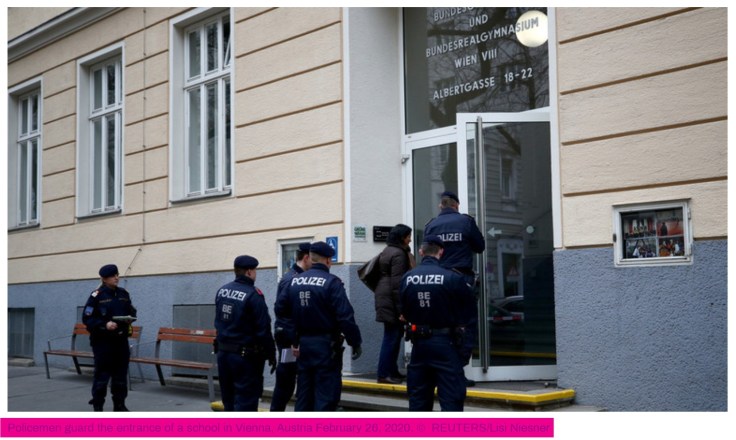
Austrian high school on LOCKDOWN amid fears teacher is infected with coronavirus

CAP

Students at a school in Vienna, Austria have been barred from leaving the building after one of their instructors was flagged as potentially carrying the deadly coronavirus, currently spreading across the globe.

No one is allowed to leave or enter the Albertgasse high school, located in Vienna’s inner-city neighborhood of Josefstadt, police said in a Twitter message posted on Wednesday. Officers also denied rumors that the school had been evacuated. Streets around the school have been closed to the public.

The precautionary measures were taken after a teacher returned from a trip to Northern Italy, which has seen more than 300 cases of coronavirus in recent days. The teacher and students are currently undergoing screening for the deadly virus, according to Austrian media reports.

Bahrain orders all schools & kindergartens SHUT DOWN for 2 weeks as coronavirus cases soar

CAP

Students at the school were reportedly seen looking out windows and shouting. They have been allowed to communicate with their parents by telephone. If one or more results do come back positive, the school could potentially face quarantine, Chancellor Sebastian Kurz said.

The lockdown coincided with the quarantine of 12 people in Austria who were in close contact with a couple identified as the country’s first coronavirus cases.

Originating in Wuhan, China late last year, the illness has infected at least 80,000 people worldwide — the vast majority in mainland China. Now present in nearly 30 countries, the virus has become a major health concern in Italy, which has seen over 320 cases and 11 deaths.


Germany facing coronavirus ‘epidemic,’ govt can no longer track infection chains – health minister

CAP

German Health Minister Jens Spahn has said that his country is facing a “coronavirus epidemic.” Since breaking out in northern Italy, the deadly COVID-19 virus has spread to more than a dozen European countries.

“We are at the beginning of a coronavirus epidemic in Germany,” the minister told reporters in Berlin on Wednesday. Spahn added that infection chains can no longer be tracked in Germany, and called on hospitals and employers to review their pandemic planning.

A new instance of the deadly infection confirmed in the state of Nordrhein-Westfalen on Tuesday brought to 18 the number of cases recorded in Germany.

European borders remain open, as Italian coronavirus outbreak kills 11 & infects HUNDREDS

CAP

Spahn claimed earlier that “detection and containment” efforts in Europe were working to hold back the spread of the virus, but an explosion of cases in northern Italy and at least 13 other European countries have forced him to reevaluate the situation. At his last press conference on Tuesday, Spahn admitted “it could get worse before it gets better.”

Tracking the ‘infection chains’ – noting the previous travel and social encounters of the infected – is vital to understanding the spread of the illness. Thus far, the majority of patients in Germany were found to have recently traveled from Italy or China, or had contact with travelers.

“The infection chains are partially no longer trackable, and that is a new thing,” Spahn said on Tuesday. “Large numbers of people have had contact with the patients, and that is a big change to the 16 patients we had until now where the chain could be traced back to the origin in China.”

Despite growing panic across the continent, EU health ministers agreed on Tuesday to keep international borders open for the time being. Closing borders would be a disproportionate and ineffective measure at this time,” Italian Health Minister Roberto Speranza told reporters after a meeting in Rome.

Originating in Wuhan, China, in November, the novel coronavirus has since spread to around 40 countries worldwide. Over 80,000 people have become infected, and more than 2,700 have died, the majority of them in China.

Blog at WordPress.com.

Up ↑