Los Angeles County Sheriff Alex Villanueva has announced that they will be closing all gun retailers as they are “not an essential function.”
Sheriff Villanueva also added 1,300 more deputies to patrol the county and released 1,700 “nonviolent” inmates from county jails since Governor Gavin Newson issued a stay-at-home order in the state.
Speaking to Fox 11, Villanueva claimed to support the Second Amendment, but spewed anti-gun talking points while announcing the gun store shut down.
“We will be closing them, they are not an essential function,” Villanueva said. “I’m a supporter of the 2nd amendment, I’m a gun owner myself, but now you have the mixture of people that are not formerly gun owners and you have a lot more people at home and anytime you introduce a firearm in a home, from what I understand from CDC studies, it increases fourfold the chance that someone is gonna get shot.”
The station reports that he also freed 10% of the inmate population from county jails — nonviolent offenders with misdemeanor sentences that were up within 30 days.
“We’re gonna keep violent felony suspects who are a threat to the community in the jail no matter what,” Villanueva said. “Anybody who has an idea that somehow we’re not going to be hard on crooks out there on the streets, they’re tragically mistaken, there’s twice as many deputies on the street now so the odds of you getting caught are a lot higher.”
Though he has doubled the police patrol, he claims that the National Guard is not active in the county, despite photos posted to social media that show large amounts of military vehicles.
“If we start losing major portions of our sworn personnel, that impacts our ability to man jails or our patrol obligations, and were running out of people to do that, if were in that position typically our counterparts in LAPD they’ll be in the same boat, then we can use the National Guard to start assigning them to security operations,” Villanueva said.
On Monday, the Pennsylvania Supreme Court denied an emergency request that would have blocked the governor’s order to close all gun retailers in the state in response to the coronavirus pandemic.
The court ruled on Sunday evening that the gun shops could be closed down, letting the order go into effect on Monday.
The gun shop shut down was part of an order by Democrat Governor Tom Wolf that closed all businesses that are not considered to be “life sustaining.” Gun rights groups argued before the Supreme Court that this should include weapons retailers, but they were denied.
The order shut down the stores on Monday without any timeline for when they can reopen.
The opacity of the Chinese Communist government obliges responsible outside observers to look for clues to the truth of the coronavirus epidemic, instead of merely repeating official information without question.
The official count from China is 3,277 fatalities from 81,171 infections as of Tuesday, but the Epoch Times noted the troubling disappearance of some 21 million cell phone accounts in China over the past three months – an unprecedented decline that hints at more fatalities than Beijing is prepared to admit.
It should be stated at the outset that we should not be forced to read tea leaves to figure out what really happened in China, especially in the virus epicenter of Hubei province and the city of Wuhan, where Chinese officials are currently making claims of zero new infections that no one seriously believes. While more responsible governments issue troubling warnings of a second wave of infections, severe enough to prompt the re-imposition of quarantine procedures that were only recently lifted, China claims it has no second wave and all of its new coronavirus cases are imported.
With that in mind, the Epoch Times thought it was a bit odd for 21 million Chinese cell phones to abruptly disappear, given that cell phone usage has been increasing constantly in China for years, and phones have been touted as an important tool for containing the coronavirus epidemic:
China’s Ministry of Industry and Information Technology (MIIT) announced on March 19 the number of phone users in each province in February. Compared with the previous announcement, which was released on Dec. 18, 2019, for November 2019 data, both cellphone and landline users dropped dramatically. In the same period the year before, the number of users increased.
The number of cellphone users decreased from 1.600957 billion to 1.579927 billion, a drop of 21.03 million. The number of landline users decreased from 190.83 million to 189.99 million, a drop of 840,000.
In the previous February, the number increased. According to MIIT, the number of cellphone users increased in February 2019 from 1.5591 billion to 1.5835 billion, which is 24.37 million more. The number of landline users increased from 183.477 million to 190.118 million, which is 6.641 million more.
According to China’s National Bureau of Statistics, the country’s population at the end of 2019 was 4.67 million larger than in 2018, reaching 1.40005 billion.
The article went on to postulate that some of the landlines might have been shut down as a consequence of the coronavirus quarantines, particularly lines used by shuttered business operations, but the sheer magnitude of the cell phone user decline makes it more difficult to explain. China Mobile, the nation’s largest carrier, reported gaining 3.7 million new accounts in December but then losing over 8 million in January and February, months in which it posted gains of 3.5 million users the previous year.
The Epoch Times considered several explanations for the loss of users, such as migrant workers who kept different cell phones for their home and work cities – necessary due to some of China’s regulations on phone service – abandoning the work phone because it was not needed during the quarantine period, or people generally canceling their phone service because they wanted to save money during the hard months.
On the other hand, the government is currently requiring citizens to use their cell phones to generate “health codes” so their movements can be tracked and permission to travel can be restricted to healthy individuals, so as U.S.-based commentator Tang Jiangyuan put it, it is effectively “impossible for a person to cancel his cellphone.”
“Dealing with the government for pensions and social security, buying train tickets, shopping … no matter what people want to do, they are required to use cell phones,” Tang noted.
The New York Times explained just how heavily Chinese authorities are leaning on those cell phones to monitor their population, and not just for coronavirus infections:
The Times’s analysis found that as soon as a user grants the software access to personal data, a piece of the program labeled “reportInfoAndLocationToPolice” sends the person’s location, city name and an identifying code number to a server. The software does not make clear to users its connection to the police. But according to China’s state-run Xinhua news agency and an official police social media account, law enforcement authorities were a crucial partner in the system’s development.
While Chinese internet companies often share data with the government, the process is rarely so direct. In the United States, it would be akin to the Centers for Disease Control and Prevention using apps from Amazon and Facebook to track the coronavirus, then quietly sharing user information with the local sheriff’s office.
The system, which relies on a unit of the immense Chinese e-commerce company Alibaba, assigns users a green, yellow, or red “health code” in the style of a traffic light. Predictably, Chinese citizens find the opaque system cryptic and frightening, since the government has not explained exactly how it works.
“In some cities, residents now have to register their phone numbers with an app to take public transportation,” the Times added.
At the beginning of March, the so-called Alipay Health Code system had been launched in the city of Hangzhou, expanded to 200 other cities, and was on its way to a complete nationwide rollout. The rollout ran into some hitches over the following weeks, from technical glitches to confusion caused by local governments adding their own health codes to the already intimidating system.
A correspondent writing for Bloomberg News on March 18 reported using the system and said it was in the process of being “rolled out nationwide at railway stations, restaurants, pharmacies, and more.” Other reports in China have noted how cell phones are ubiquitous there and are employed for everything from accessing public and commercial resources to telecommuting to school during the coronavirus lockdown.
With this in mind, it might not be completely impossible to get by in Chinese cities without a cell phone at the moment, but it seems unlikely that a huge number of citizens would choose this moment to get rid of their phones.
“Lacking data, the real death toll in China is a mystery. The cancellation of 21 million cellphones provides a data point that suggests the real number may be far higher than the official number,” the Epoch Times concluded.
“We’re on the Italian track,” of mass infection among healthcare providers, one expert said.
By Olivia Messer – 3/24/2020
Thousands of doctors and nurses inItalyhave contracted the 2019 novel coronavirus, and American health workers have said they’re terrified of getting the illness, especially in the face of startling and systemic equipmentshortages.
Some emergency room doctors in the U.S. have already tested positive for the virus, and other medical providers have personally prepared for the possibility of infection—creating wills, isolating off parts of their houses from the rest of their families, recording bedtime stories for their children on their phones. But what happens to an already-cascading national health crisis when, even if equipment shortages are resolved, medical personnel are falling out of rotation?
Without concerted action to protect healthcare workers, experts said, America could be facing a shortage when its citizens need them most.
Irwin Redlener, director of the National Center for Disaster Preparedness at Columbia University and an expert on U.S. readiness for pandemics, said there were three main ways to staff hospitals if a large number of providers get sick.
The first scenario is already playing out in New York City, where retired health officials—doctors, nurses, administrators, dietitians, and more—were recently asked to join the Big Apple’s medical reserves. More than 1,000 retired healthcare professionals and private practice physicians answered the call in just one day last week.
“Many of us in the business are worried about this, about the back-up plan for if they’re ill or have to stay home or—God forbid—don’t survive,”said Redlener. “The only problem with bringing in retired people is that they’re older, and many will have preexisting conditions.”
Then there’s the federal National Disaster Medical System, which exists to supplement health and medical systems during times of crisis. The system has sent reserve doctors from all over the country to respond to emergencies, including the aftermath of natural disasters like Hurricane Sandy. The pool of doctors and nurses from the system can be requested by federal, state, local, tribal, or territorial authorities.
But those resources are finite, and travel is no simple matter in the face of a creeping trend toward nationwide lockdown.
“If we’re dealing with a single major disaster someplace, then we have enough for that, but if we have clusters all over the country pop up, it becomes a problem because there’s so much demand across the board,” Redlener said. “For every health professional we call up, we take them away from their regular jobs, which are also critical.”
A physician might not, for example, be able to take off to help treat the outbreaks in Washington state or New York if their own hospital is having trouble with staffing because of the spread of infection there.
A third option Redlener cited would invoke the use of international medical graduates who have been educated, trained, and employed as physicians or nurses in other countries, some of whom already live in the U.S. and are waiting to be placed in an American gig.
“If you’re moving to the U.S. and want to practice medicine here, you usually have to take a residency all over again in the U.S., and it’s very difficult to secure places in those programs,” he explained. “For those people, it’s time to think about waiving the requirements to repeat a full-blown residency.”
Of course, none of this would feel as precarious if it weren’t for the dire shortage of personal protective equipment, including masks, for medical professionals, which federal officials have promised to shore up.
Many hospitals have lowered standards of care, delayed elective surgeries, and begun utilizing telemedicine in unprecedented volumes to accommodate the potential surge of critically ill patients, as Slate reported.
For better or for worse, the options in the U.S. mirror what’s been done in Italy to handle the dramatic caseload of more roughly 60,000 patients. As of last week, more than 2,629 health care workers in Italy had reportedly contracted COVID-19. Throughout the country, medical students and nurses have graduated early to work in the field, technicians and medical assistants in training were fast-tracked to the front lines, the country’s health ministry has asked retired doctors to return to work, and health workers have put in double shifts with few breaks.
Health providers also succumbed to the coronavirus in China—including a whistleblower in Wuhan who tried to call attention to the deadly disease. But safety measures largely implemented in Hubei province to protect healthcare workers were meticulous, according to William Haseltine, president of the global health think tank ACCESS Health International, who recently chaired the U.S.-China Health Summit in Wuhan, where the virus is believed to have originated.
“All of their healthcare workers were outfitted with high-quality hazmat outfits—not makeshift,” said Haseltine. “If you were in what’s called ‘controlled quarantine’ in a hotel room, the person who delivered your food was in a hazmat outfit. The people who came in to clean your room were in full hazmat outfits and cleaned your room with Lysol every day.”
Meanwhile, in the U.S., in addition to nationwide supply shortages for protective gear, precautions and preparations vary from state to state.
“We have contingency plans, a command center, cross-site privileges for staffing, so we can move bodies around if needs arise and staff gets sick,”said Rob Davidson, an emergency physician at Spectrum Health Gerber Memorial in Fremont, Michigan. Davidson also serves as executive director of the Committee to Protect Medicare, a self-described public advocacy and grassroots lobbying group that works “to persuade elected officials to support health care for all Americans.”
“We’re preparing for this, but don’t know when it’s going to hit and how bad,”he told The Daily Beast on Friday. As of Monday morning, the total number of cases in Michigan had more than doubled, surpassing 1,000. At least nine people had died.
Davidson said he knew of at least one physician at risk of severe infection who transferred his practice to telemedicine, and Davidson said that his family decided he should isolate himself in the basement of their home if he comes into contact with a positive patient that requires intubation or other intense exposure.
“Our dedication is to doing the right thing for our patient, and what if we can’t do good enough medicine, or end up choosing who lives and who dies just because there were too many patients?” asked Davidson. “The nightmare scenarios that you hear playing out in Italy, that’s where none of us want to be.”
Do you know something we should about 2019 novel coronavirus, or how your medical providers are responding to it? Email Olivia.Messer@TheDailyBeast.com or securely at olivia.messer@protonmail.com from a non-work device.
He was far from alone in wondering how the system might respond.
“The entire hospitalist team at my hospital is terrified,”said an internal medicine doctor in Ohio who asked to remain anonymous over fear of retaliation from her employer. “Our worst fear is contracting the virus and spreading it to our spouses and children. We are worried about our patients, of course, but none of us want our personal decision of becoming a doctor—and serving on the front lines—to adversely affect the ones we love.”
She said that older doctors in her practice—primarily those with grown children and no loans—have mentioned that they’ve considered quitting.
“Fear of harming your family will lead to those thoughts in even the most virtuous physician,”she said.
A pharmacy executive who works at a rehabilitation hospital in Austin, Texas—and who also requested anonymity over fear of professional retaliation—described a similar calculus.
“My wife is a surgical physician’s assistant, and I work with elderly people, on average in their seventies, who are mostly recovering from strokes and hip surgeries,” he said, adding that his 71-year-old mother lives in his home and helps care for his one-year-old baby with a congenital condition who is vulnerable to severe infections—and his kindergarten-aged daughter.
After reading what he called “horror stories” about “not enough gowns, not enough masks,” the pharmacist said he and his wife began discussing contingency plans for the possibility that they could end up in the intensive care unit after contracting the disease.
“Worst case scenario, my kids lose both parents,” the pharmacist said, adding that he was processing his fear the way many other Americans were: “wine and denial.”
Dr. Bernard Ashby, a vascular cardiologist based in Miami Beach, Florida, told The Daily Beast that high numbers of sick—or dead—medical providers is “a plausible scenario given that we’re not protecting them.”
The Virus Is Killing Italy’s Doctors. The U.S. Could Be Next
NO ONE IS IMMUNE
Barbie Latza Nadeau
“That would spell out disaster for our patients and our healthcare system,”Ashby said, adding that, like most doctors, he’s more worried about becoming a vector than about getting sick himself. “I have a newborn child and a mother with chronic illness. I’m very concerned about spreading it to my family, so I’m currently self-isolating from them. It’s tough.”
“There’s been a failure of leadership at multiple levels, and because of that, the healthcare system will get overwhelmed, and a lot of people will suffer unnecessarily,” said Ashby. “We will suffer unnecessary casualties as a result of a lack of proactive measures to mitigate this pandemic.”
Ashby said that hospitals all over the country should be screening the temperature of providers as they come into work and testing hospital staff more readily, which has not yet been possible because of the nationwide shortage of diagnostic kits.
But based on the federal response to the crisis and the lack of supplies in the U.S., said Haseltine, “We’re on the Italian track.”
Losing doctors and nurses to the coronavirus “is going to be devastating,” he continued, noting that the overwhelming fear “is already psychologically extremely damaging to our healthcare workers.”
And as a country, he said, “It puts us in even higher jeopardy.”
The number of Covid-19 cases in Italy is probably ten times higher than official numbers, according to Italy’s civil protection chief Angelo Borrelli, who said that as many as 640,000 people could be infected in the country.
“It is credible to estimate that there are 10 positive cases for every one officially reported,” Borrelli told La Repubblica newspaper on Monday.
The latest figures show almost 64,000 people have been infected and 6,077 have died from the infection in barely a month, making Italy the worst-affected country in the world, with close to double the number of fatalities in China, where the virus emerged last year.
Medical experts confirm that Italy has focused its testing only on people showing severe symptoms in areas with high epidemic intensity like Lombardy, Emilia-Romagna and Veneto in the north of the country, thus it is difficult to say the real numbers.
“This causes an increase in the fatality rate because it is based on the most severe cases and not on the totality of those infected,”says Massimo Galli, head of the infectious disease unit at Sacco Hospital in Milan.
Italy reported 602 new deaths from the coronavirus on Monday. The number of fatalities dropped for a second day in a row, after reaching an all-time high of 793 on Saturday.
A video out of Naples, Italy shows migrants roaming around the streets, ignoring the coronavirus quarantine and putting other people’s lives at risk.
The entire country of Italy is currently on lock down with citizens only allowed to venture out for groceries and medical supplies.
“Only supermarkets and pharmacies windows are open. Only one person from each household can go on a shopping run. Police write tickets for people who are out wandering,” reports CNN.
However, video footage shows migrants in Naples completely ignoring those orders as they mill around and bicker with each other.
Sono giorni che nel quartiere Vasto di #Napoli, i migranti affollano vicoletti e marciapiedi. Sfidano i divieti, noncuranti del rischio.Mentre noi viviamo barricati nelle nostre case, c’è chi si prende gioco della nostra salute. Le regole valgono per tutti! #IlNostroPostopic.twitter.com/6feNt6XqvN
“It’s been days in the Vasto neighborhood of #Napoli , migrants crowd alleys and sidewalks,” tweeted Severino Nappi. “They defy prohibitions, regardless of the risk. While we live barricaded in our homes, there are those who mock our health. The rules apply to everyone!”
Judging from the audio of the clip, some people who are following the quarantine rules appear to be pleading with the migrants to go indoors.
By remaining outside, the migrants are helping to spread coronavirus, which has already claimed 2,158 lives in Italy.
Once again this proves that diversity is most certainly not a strength.
Baltimore’s mayor has called on the city’s inhabitants to refrain from killing one another for the time being, asking them not to“clog up” hospital beds as the coronavirus pandemic spreads far and wide across the country.
“I want to reiterate how completely unacceptable the level of violence is that we have seen recently,” Mayor Jack Young said at a press conference on Wednesday, adding, “For those of you who want to continue to shoot and kill people of this city, we’re not going to tolerate it. We’re going to come after you and we’re going to get you.”
We cannot clog up our hospitals, or their beds, with people who are being shot senselessly, because we’re going to need those beds for people who might be infected with the coronavirus.
The call to action – or inaction, rather – came after a police-involved shooting in Baltimore’s Madison Park neighborhood on Tuesday night that put at least seven people in the hospital, all believed to be in stable condition. Police say it’s not clear if the officer shot any of the wounded individuals himself, but did confirm that he discharged his weapon after encountering a man firing what they called a “semi-automatic long gun” into a crowd.
Baltimore – Maryland’s most dangerous city by far in terms of violent crime – isn’t the only locality struggling to deal with criminals amid the virus panic. Hoping to limit officers’ exposure to the deadly pathogen, Philadelphia’s police commissioner on Wednesday ordered departments to adopt a catch-and-release policy for non-violent offenders, temporarily letting carjackers, drug dealers and looters off the hook for the duration of the crisis. While the city plans on pursuing the suspects with arrest warrants after things return to normal, for now they will be left to walk free.
Late last week, Portland police similarly declared that officers would no longer respond to calls that don’t involve a “life-threatening” situation, in an effort to conserve police resources and insulate personnel from Covid-19. Police spokesman Kevin Allen later clarified that officers would only stop responding to “lower level stuff.”
“The bigger stuff, of course we’re going to respond,” he said. “We’re just going to be looking for any opportunity we can to use the phone to do our job.”
Police from the Logan County Sheriff’s Office in Colorado took a slightly different approach, taking to Facebook to ask “all criminal activities/nefarious conduct to cease until further notice,” adding they would “update you when you can return to your normal criminal behavior.”
Los Angeles and New York City, meanwhile, have begun freeing non-violent inmates to make room in already-crowded prisons, another attempt to stem the spread of the outbreak.
Mnuchin says wants to get checks in Americans’ hands within 3 weeks
BoE cuts rates, launches QE after ’emergency’ meeting
Confirmed cases in the US climbs ~50% as testing ramps up
Connecticut reports 2nd death as US death toll hits 137
NY reports ~600 new cases, bringing total to 2,959; death toll hits 21
Cuomo signs NY unemployment-benefit expansion benefit package, warns of ‘astronomical jump’ in cases
China reports zero new cases in Wuhan for first time in months.
Treasury weighing 50- and 25-year bonds to finance stimulus package
South Africa case total passes 150
India halts incoming international flights for a week
Hong Kong doctors find virus inside 2nd dog
Spain total cases climb 28% overnight
Italian death toll expected to pass China’s on Thursday
Pentagon says 2,000 nat’l guardsman deployed around the country
NY implements 90-day delay on mortgage payments due to hardship
FedEx says drop in deliveries in China was smaller than expected
Trump and Xi reportedly agree to deepen medical research ties
UK gov’t denies plans for London lockdown
Amazon closes warehouse for ‘deep clean’ after worker tests positive
Germany death toll climbs to 43
Treatment trial in Wuhan yields disappointing results
Germany’s Bafin bans short selling
Russia reports first death
SPR to buy 30 million barrels immediately, will eventually buy 70 million
Wuhan police erase record of ‘admonition’ delivered to Dr. Li Wenliang
German gov plans to suspend debt brake on Monday
Netherlands reports another jump in cases after unveiling stimulus package outline
Switzerland warns situation rapidly deteriorating along the Italian border
Tiffany closes all US stores
* * *
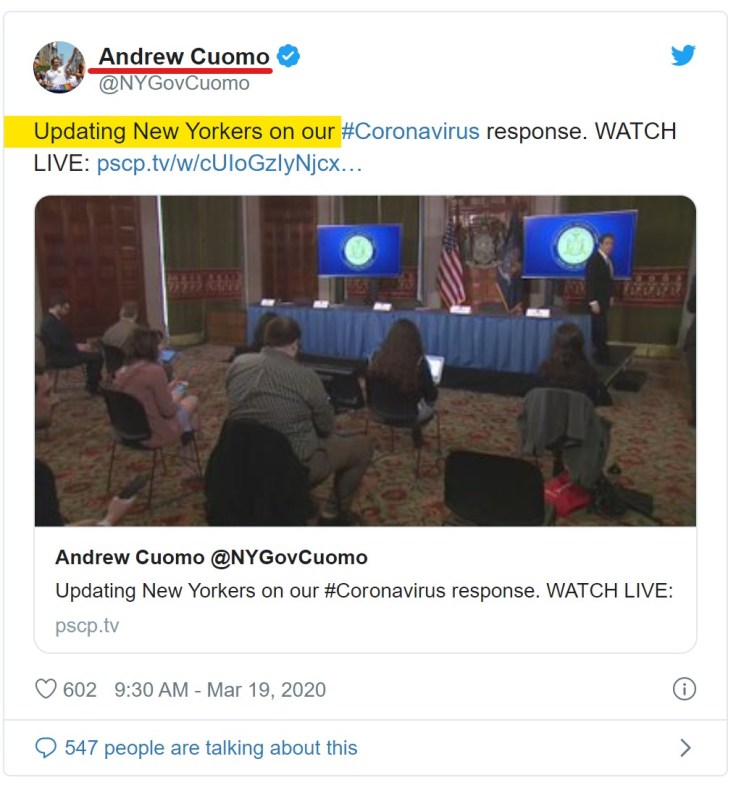
Update (1100ET): New York Gov. Andrew Cuomo reported yet another round of new case data on Thursday as he held his daily press briefing following an earlier interview on “the TODAY Show”.
As NY emerges as the countrywide leader in testing, Cuomo announced that the state tested ~7,500 people on Wednesday night alone. The state confirmed 1,769 new cases last night, bringing the total to 4,152. 21 New Yorkers have died so far, along with 7 additional deaths in Conn (2) and NJ (5), bringing the tri-state area death toll to 28.
He also instituted a 90-day relief period allowing New Yorkers to delay mortgage payments during the period, but only due to financial hardship (not just because they feel like it). The state has already postponed any foreclosures, banned negative credit reporting and waiving overdraft, debit card and credit card fees.
Watch his press conference below:
Cuomo also said he has no plans for a ‘shelter in place’ order.
After ordering businesses earlier this week to let at least half of their employees stay home on any given workday, Cuomo said the state would now require 75% of “non-essential” workers to stay home.
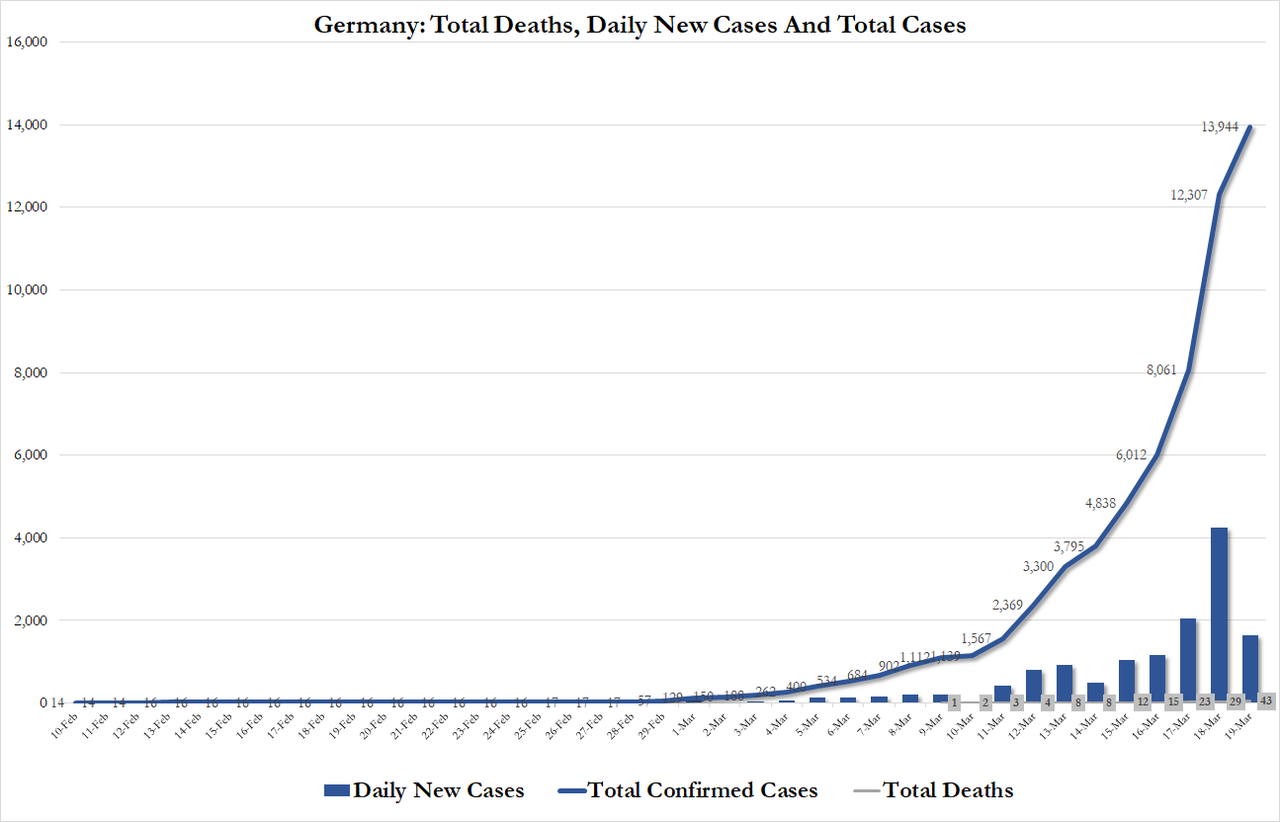
Germany’s latest batch of new cases raised its national total to 13,944, up from 12,307, and an additional 14 deaths, bringing the total to 43.
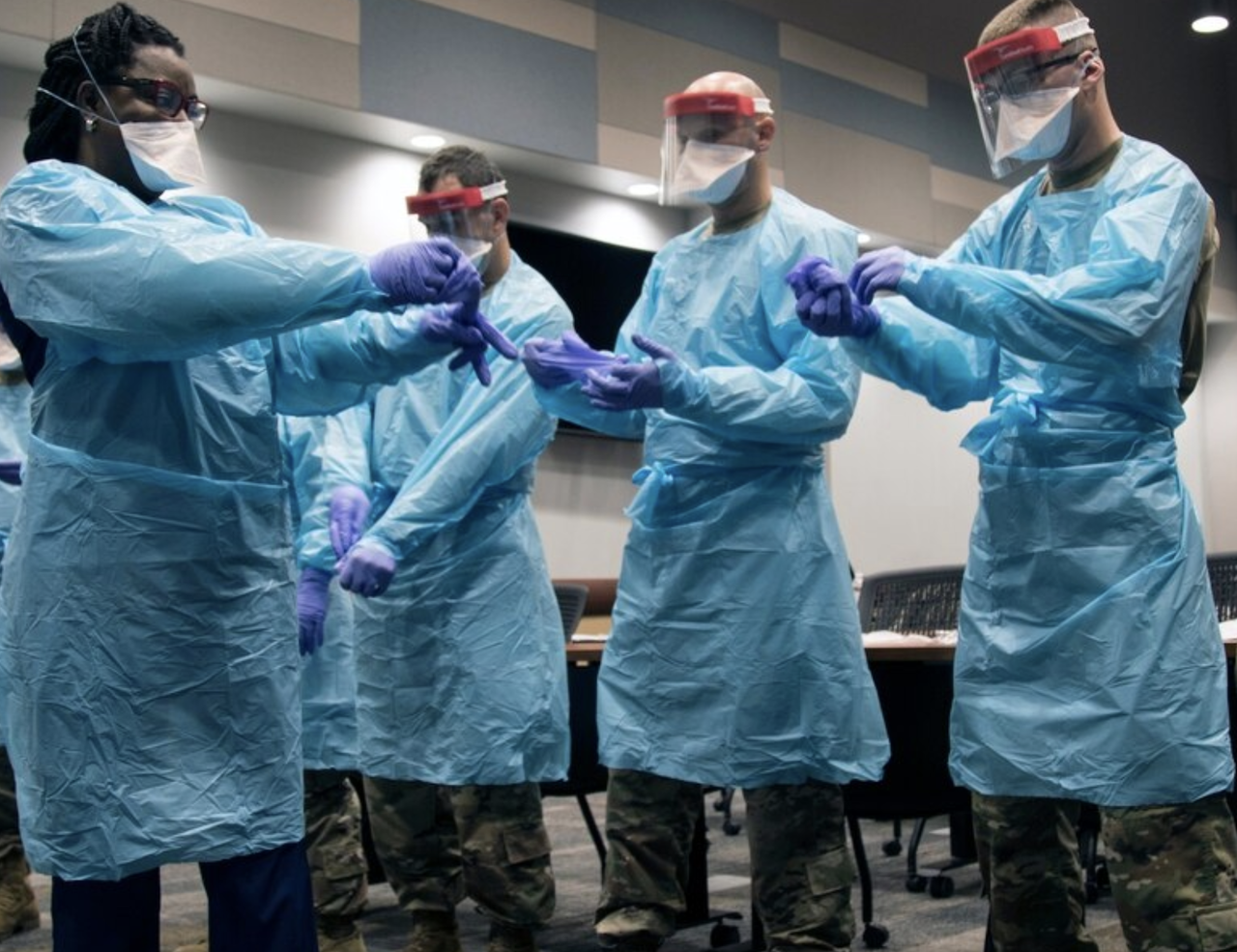
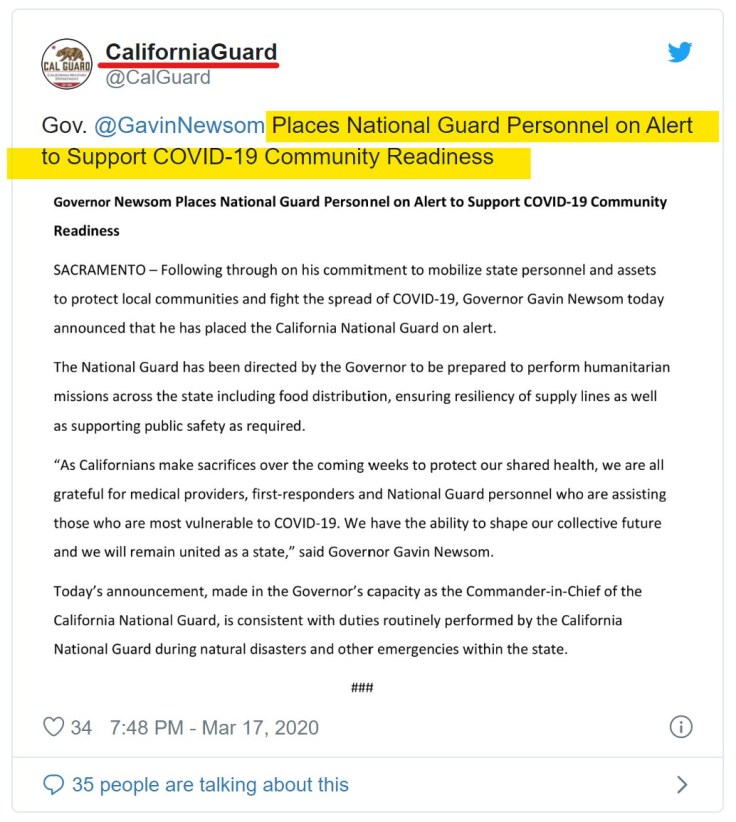
The Pentagon just confirmed that 2,000 national guard soldiers are deployed across the country as more governors have called up the national guard to assist with the virus response effort. According to the Military Times, governors across 23 states have mobilized components of the Army and Air National Guard to assist in their state’s response to the pandemic.
The states where guardsmen have been mobilized include California…
…Illinois…
…and Maryland, among other states.
Additionally, the Navy is dispatching two hospital ships, plus millions of pieces of vital medical equipment.
Meanwhile, President Trump and the White House task force are preparing for today’s briefing, where President Trump is expected to unveil measures to get experimental treatments into the hands of patients, despite some resistance from the FDA.
* * *
Update: In keeping with the coordinated central bank response via Europe, the BoE held an emergency meeting on Thursday and has announced some unprecedented stimulus measures, including launching a £645 billion bond-buying program of government and corporate bonds “as soon as operationally possible.”
Meanwhile, the cut the target from a record low of 0.25% to a new record low of 0.1%
* * *
Update (0930ET):Just before the US open, health officials in the Netherlands reported a jump in cases to 2,460.
The Dutch government has announced a rescue package designed to shield companies from the impact of the coronavirus that Finance Minister Wopke Hoekstra said is unlimited but will likely cost tens of billions of euros. The government is working on eight measures, including a fund that makes it easier for firms to request compensation for lost revenues and helps them pay wages, Hoekstra said Tuesday at a news conference.
Swiss authorities warned Thursday that the situation in the southern canton of Ticino is rapidly unraveling as the government scrambles to secure more hospital beds. Ticino is situated along the Swiss border with Italy, and is the worst-hit region of the small Alpine nation.
Meanwhile, Tiffany said it would temporarily close all stores in the US.
* * *
(0920ET): With oil price benchmarks around the world sliding below $30 a barrel, the US, the strategic petroleum reserve will immediately buy 30 million barrels of oil, and eventually buy as much as 70 million.
In China, police in Wuhan on Thursday officially revoked the government admonition issued to Dr. Li Wenliang, the martyred doctor who was censored for trying to warn the government and the people about the outbreak.
* * *
Update (0835ET):It’s shaping up to be another busy day on Thursday as Treasury Secretary Steven Mnuchin said his goal is to get checks into the hands of Americans within three weeks, up from two yesterday.
Some updates from Europe: the Swiss press is reporting that the number of confirmed coronavirus cases in the country climbed to 3,888.
Back in New York State, Cuomo reported another ~600 case jump to 2959 cases. The death toll in the state has climbed to 21, with at least 11 of those in NYC, as Gov. Cuomo warns that
After signing a paid sick leave law to guarantee pay for those under mandatory or precautionary quarantine into law, Cuomo appeared on “the Today Show” to discuss his response to the crisis, which has won him accolades from practically everyone, including President Trump, Rudy Giuliani, and other conservatives like Candace Owens.
We are seeing the enemy on the horizon and they are approaching very quickly.
What we do between now and then matters gravely.
Do everything you can. Do everything you can to flatten the curve.
The NY governor repeated his claim that the ‘hysteria’ surrounding the outbreak is more damaging and dangerous than the virus itself during a Thursday appearance on the “Today Show.”
It’s a claim he’s made several times during press briefings and television appearances.
“We know what we have to do on the virus. It’s going to be hard, it’s going to be disruptive but we know what we have to do there. The fear and the panic can actually get out of control more than the virus can,” he said in an interview on “TODAY” with Savannah Guthrie.
While he warned against increasing fear and panic, Cuomo said, “This is a war, Savannah. We have to treat it like a war.”
Cuomo appeared on the show one day after NYC Mayor Bill de Blasio. When asked about his spat with de Blasio over the ‘shelter in place’ order, Cuomo again rejected the idea, saying it would be unnecessary thanks to NY’s proactive efforts to quarantine clusters like New Rochelle.
“States don’t fight wars…they need the federal government…equipment, equipment, equipment is going to be key…the federal government has recognized and is acting that responsibility…” Cuomo said, referring to the Defense Production Act invocation and the Army’s plan to send 2 Navy Hospital ships and millions of pieces of medical equipment across the US. Even Nancy Pelosi called on Trump to use his powers this morning.
New Yorkers should prepare to see an “astronomical” jump in cases as testing ramps up, Cuomo said. But that’s not necessarily a bad thing: the more cases exposed, the more quickly the government can act to stop the spread.
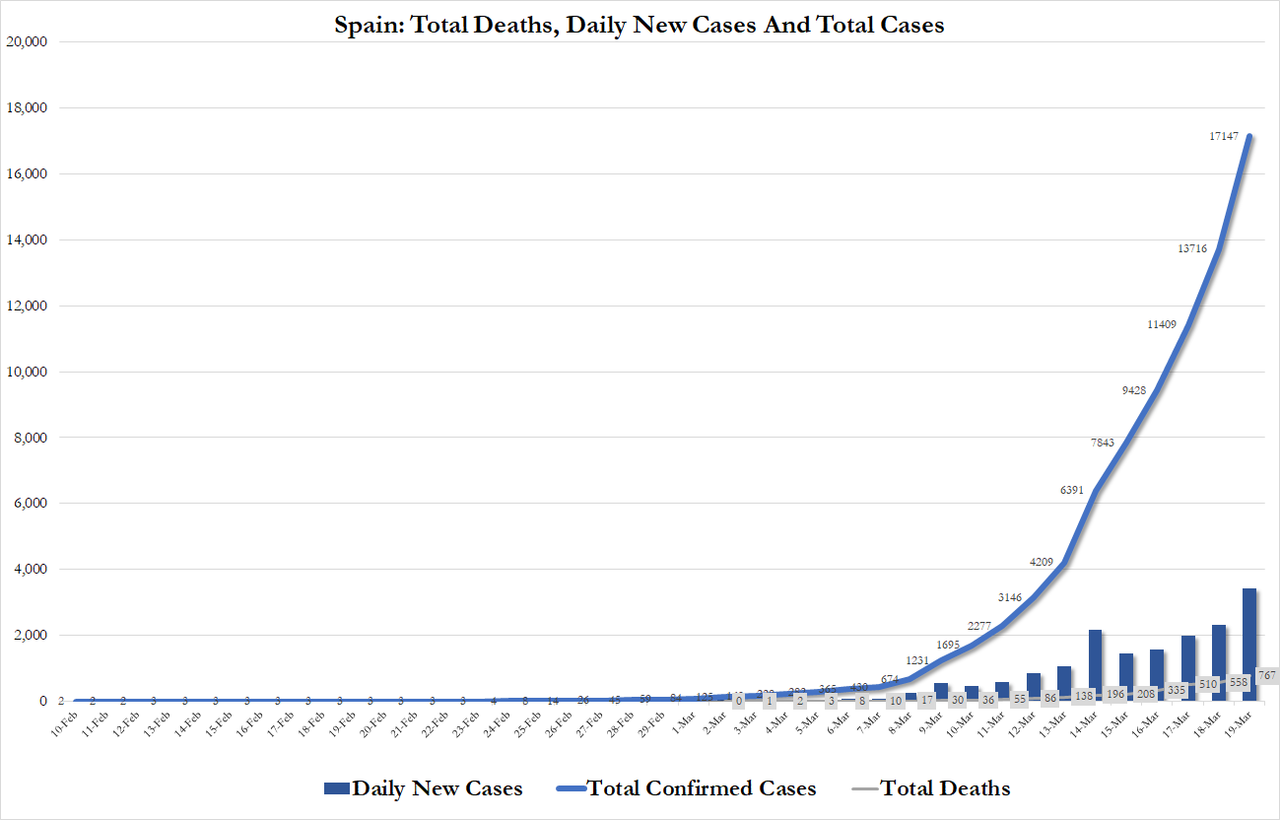
Meanwhile, in Spain, the country’s health minister declared that the government of PM Pedro Sanchez will pass a €210 billion stimulus package to help alleviate the crisis as the total number of cases in Spain has climbed 28% to 17,147. 169 new deaths were reported, raising the country’s death toll to 767, as we noted earlier.
At the Treasury, Steven Mnuchin and his staff are reportedly considering issuing a 50-year bond and 25-year bond to finance the $1.3 trillion stimulus, despite telling Congress during testimony earlier this year that demand for the 50-year bond was tepid.
As the number of cases explodes in India, PM Modi has halted arrivals of international flights for at least a week beginning on Sunday.
And as the virus spreads in Africa, South Africa said its total cases confirmed climbed to 158 on Thursday after reporting its first case of human-to-human transmission within the country.
In Hong Kong, researchers have apparently found samples of the novel coronavirus inside another dog, the second time the pet of a Covid-19 patient was also found to be carrying the virus.
However, pet owners needn’t worry – at least not yet. As CNBC’s Eunice Yoon reports, there’s no evidence that these dogs can be the source of the virus for humans.
Following a barrage of easing measures by global central banks overnight, and more talk of German fiscal stimulus Thursday morning, stock futures have sunk back into the red as promising gains from overnight fizzled.
It seems the world is finally waking up to some disappointing realities: In many places around the US, and around the world, millions of people simply aren’t heeding advisories – and, in some cases, emergency declarations – pertaining to avoiding.
In California, the backlash against Elon Musk and Tesla has intensified as the billionaire openly beckoned employees of his Fremont, Calif. factory back to work despite a ‘shelter in place’ order requiring everyone to stay home to avoid the virus. Now that testing is finally ramping up around the country, with New York State taking the lead with its aggressive drive-thru push, the total number of cases confirmed in the US climbed to 9,415 (according to Johns Hopkins data), an increase of roughly 50% overnight.
It’s becoming increasingly clear that President Trump’s decision to stop travel from China, although prescient, was clearly not enough to stop the virus’s spread in the US. Officials squandered the entire month of February, and the Trump Administration is finally beginning to realize just how far it has fallen behind.
The biggest news overnight was out of Italy, which has been reporting record numbers of newly confirmed cases and deaths, as well as a surprising number of young and healthy people hospitalized in serious condition. Italian PM Giuseppe Conte said Thursday that the government would extend the nation-wide lockdown beyond April 3 because too many Italians are disregarding the orders. The extension comes as Italy faces an alarming milestone: On Thursday, Italy is very likely to officially overtake China as the country with the largest number of deaths from the virus. 475 people lost their lives on Wednesday, the largest daily jump yet, taking the total in Italy to 2978. Officially, China’s death toll is 3,231, according to the WHO, though many suspect the real death toll is much, much higher.
As of Thursday morning in New York, Italy has recorded 35,713 cases, along with 2,978 deaths.
After pleading with Schengen Zone members to keep their borders open, the EU has closed its external borders to non-EU citizens as a growing number of countries close their borders. In the South Pacific, Australia and New Zealand, members of the British Commonwealth, have barred non-resident, non-citizens from entry. The closures will take effect on Friday, local time.
China again tightened its restrictions on foreign nationals traveling to the country by requiring airlines to “reduce” international flights.
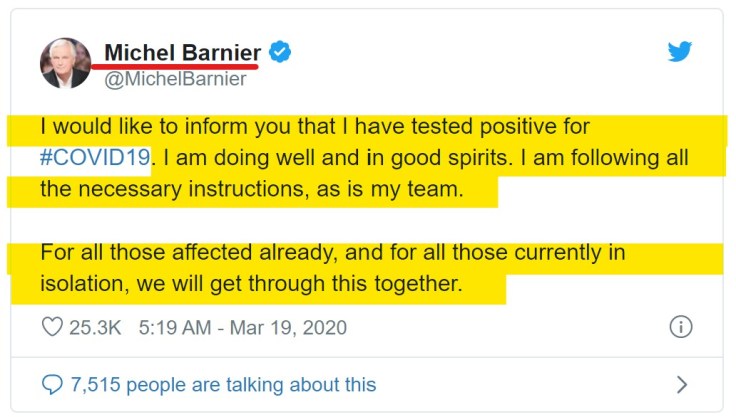
In other news, Michel Barnier, the EU’s chief Brexit negotiator, announced on twitter Thursday that he had tested positive.
By now, we’ve heard dozens of dire predictions from Wall Street banks about the economic fallout from the crisis. At this point, a recession is virtually assured, and an all-out global depression – the likes of which haven’t been seen for nearly a century in the developed world – could arrive by the second quarter, according to JPM Morgan and Mohammed El-Erian.
Now, Germany’s Ifo Institute forecast a 1.5% contraction in the German economy after one of its preliminary gauges released on Monday showed a sharp drop in sentiment.
Yesterday, we saw some rumblings about Russian disinformation campaigns targeting the West, as Vladimir Putin seizes the opportunity to destabilize the West after taking steps to fortify Russia from the onslaught (by being one of the first major countries to close its border with China, among other measures).
A document sent to European lawmakers Monday by EU officials asserted that Russia is carrying out a “significant disinformation campaign” in an effort to sow discord and panic in Western nations over the coronavirus, according to a Reuters report. Reuters apparently got its hands on the 9-page memo, and now a handful of left-wing media organizations like Axios and the Daily Beast are spreading the news.
How much longer until the West blames the severity of the “Chinese Virus” outbreak on Vladimir Putin? At any rate, despite Russia’s lockdown measures, the country recorded its first virus-related death on Thursday. A 79-year-old woman died in a Moscow hospital, the country’s pandemic response agency said on Thursday.
Yesterday, we shared a report published by the Telegraph claiming that PM Boris Johnson had asked his cabinet heads to draw up plans for a total lockdown in London, with hefty criminal penalties for all those who disobey. Dozens of reports across social media showed how millions of Londoners appear to be ignoring the government’s advice, prompting the NHS to prepare to be overwhelmed by cases. Some have warned that tens of thousands could die in the UK thanks to Johnson’s perhaps misguided hope that he could shield the British economy from the worst of the fallout by simply focusing on containing the sick. Unfortunately, one of the themes of this outbreak has been millions of people putting their own petty wants and desires above protecting the public health.
Florida and Texas have finally shut down most of the beaches where thousands of undaunted spring breakers have continued to party.
It’s likely this crisis won’t truly be over until a vaccine is mass-produced. And looking forward, headlines pertaining to drug trials for treatments and vaccines might be some of the only positive news investors get. Unfortunately, the opposite happened on Thursday, when the first scientifically controlled clinical trial of existing antiviral drugs to treat Covid-19 has delivered disappointing results.
As the FT reminds us, the next important controlled clinical trial result to look out for involves remdesivir, a drug originally developed by Gilead Sciences of the US to treat Ebola. That trial is also taking place in Wuhan. Meanwhile, in the US, a vaccine trial is underway in the Pacific Northwest.
Though the trials are continuing in Wuhan, the epicenter of the crisis, which has been struggling against the virus since it first emerged in early December, finally saw a day where no new coronavirus cases were reported. While it’s important to take this news with a grain of salt, the city has pretty much reopened for business.
A few days ago, the NYT ran a story praising India’s response to Covid-19, which had kept the number of confirmed cases down. Unfortunately, the good times couldn’t last forever, and the Indian people are finally getting a taste of the hoarding and panic that has come to dominate life in the US. After Prime Minister Modi announced plans to deliver a televised address on Thursday, which prompted Indians to scramble to stock up on essentials as they feared a national lockdown order could be delivered during that speech.
In the US, Amazon announced that it had closed one of its warehouses in New York for deep cleaning after a worker tested positive for coronavirus.This is a major threat to the US, since Amazon has emerged as a last lifeline for US consumers. If its warehouses are sidelined by the virus, the gears of consumption could truly come to a screeching halt, per Bloomberg.
Bafin, the German financial regulator, joined Italy’s Consob and a handful of other European regulators by imposing restrictions on short-selling. Though the West has been reluctant to adopt the heavy handed measures imposed on China’s population, when it comes to markets, China style crackdowns on shortsellers are apparently more palatable. Handelsblatt reported Thursday morning that Germany could move ahead with suspending its constitutional ‘debt brake’ as soon as Monday.
After UK PM Boris Johnson announced earlier this week that he would close UK schools for all except the children of essential workers and those who wouldn’t have access to food otherwise, Gavin Williamson, his education secretary, said there are “certainly no plans” at this stage to force the closures of bars and restaurants, even as speculation about a possible London lockdown continues to grow. Another government spokesperson said Thursday that there is a “zero chance” of a London lockdown.
A few minutes ago, Spain reported another alarming jump in deaths and confirmed cases that was on par with the figures coming out of Italy. Spanish Covid-19 cases rose to 17,147 (prev. 13,716) and deaths climbed to 767 (prev. 558):
Back in the US, the state of Connecticut on Thursday confirmed its second virus-linked death as the US death toll nears 140, with 137 deaths confirmed so far.
Meanwhile, as millions of young people brush off the risks to their personal health due to the virus, Bloomberg has some disappointing news: New evidence from Europe and the US suggests that younger adults aren’t as impervious to the virus as they would like to think.
Before we go, we’d like to leave readers with a rare bit of positive corporate news, courtesy of last night’s FedEx earnings report:










 Tom's Blog