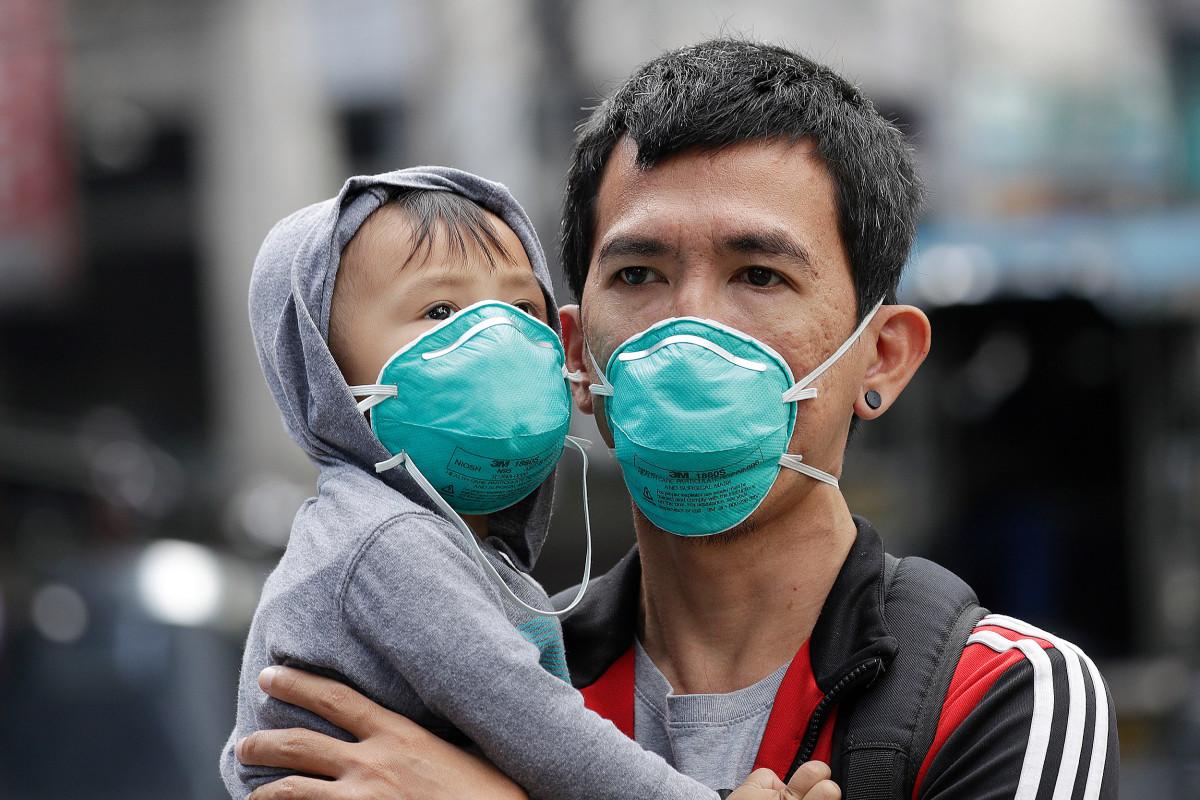
PANIC BUYING HITS GERMAN STORES AS CORONAVIRUS CASES DOUBLE

Panic Buying Hits German Stores as Coronavirus Cases Double

Grocery chains report rising demand for canned goods, other long-term provisions

Deutsche Welle – MARCH 2, 2020

Germans are slowly coming to realize that they, just like 50 other nations in the world today, could soon be facing a coronavirus epidemic.

Indeed, the pathogen has become a major topic of discussion in the country – so much so, in fact, that some residents are now stockpiling food out of fear they could be placed under quarantine.

Bulk-buying supplies

On Friday, a spokeswoman for one of the country’s largest supermarket groups, REWE, told DW that while they didn’t register any panic at the start of the week, the situation quickly changed.

“We have noticed rising foodstuff and canned goods purchases across the entire country to which we are adapting accordingly,” said Kristina Schütz from REWE Group, which is headquartered in Cologne and runs the Penny, REWE and Nahkauf grocery chains.

Discount chain Lidl has recorded a similar spike in purchases, with a spokesperson confirming that “we are noticing a rise in sales in certain regions and stores.”

According to the chains, Germans are stockpiling long-lasting and canned food, pasta as well as toilet paper and disinfectants.

CAP

What do authorities recommend?

Four years ago, the Bonn-based Federal Office of Civil Protection and Disaster Assistance (BBK) published a checklist of long-lasting foods it recommends stockpiling for emergencies.

The BBK, which is staffed by some 300 civil servants, educates the general population on how to prepare for crises. It advises Germans to stockpile food and drink for about ten days.

Specifically, the checklist states that one person needs 14 liters of liquid a week, and recommends stocking mineral water and fruit juice in particular. Even so, the BBK warns against panic buying, advising Germans to stockpile only foods and drinks “that you and your family would consume anyway.”

The BKK also suggests stocking food that keeps for a long time without needing refrigeration, to pay attention to sell-by dates, and mark when items were purchased, in case they don’t have dates printed on them. It also advises Germans to “store newly bought food items at the back of the cupboard so that you consume older items first.”

Sound advice

This comprehensive emergency checklist hasn’t gone unnoticed abroad. Bulgarian daily 24 Tschassa, for example, praised the advice provided by German authorities, saying that in most cases “consumers just hoard all kinds of products – without a proper idea how long they will come in useful or whether they might need them at all.”

The paper said sticking to the German checklist is a good idea “as it makes no sense to buy excessive amounts of supplies.”

Warning against stoking fear

While many pundits in Germany agree the list is useful, they simultaneously warn against stirring hysteria. So far, Germany has confirmed 129 cases of coronavirus, with 16 having already recovered, and no deaths reported. More than half of the cases are in the western state of North Rhine-Westphalia, the country’s most populous state.

The German Journalists Association (DJV) therefore emphasizes that media outlets should avoid stoking fear.

Accordingly, DJV head Frank Überall stated that “people need clear information as well as advice” to make sense of the situation.

He has called on journalists to heed the German press code which calls on them to “avoid an inappropriately sensationalist tone when reporting on medical issues, as this may give rise to unfounded fears or hopes.”

The press code also states that “stoking fear and hysteria is incompatible with responsible journalism.”

https://banned.video/watch?id=5e5c645c265ff4005b24a7d9

https://infowarsmedia.com/js/player.js

THIS ISN’t HELPING: Devout Muslims Lick Shia Shrine in Iran to “Prove” Their Faith Can Beat the Coronavirus (VIDEOS)


According to the Coronavirus website there have been 1,501 cases of coronavirus in Iran and 66 deaths.

These numbers are suspect as the regime is not open with its data.

** The Gateway Pundit posted an extensive report from Iran on the coronavirus on Sunday night.

What is clear is that devout Muslims are not making the situation better by licking the Shia shrines.

There are currently several videos making the rounds on social media of Muslims licking shrines to prove their faith is greater than the coronavirus.

Yuck.

Embedded video


Media, Democrats Spread Fake News That Trump Called Coronavirus ‘A Hoax’

Steve Watson – 3/2/2020

Bloomberg tweets edited video clips

After last week blaming The President for the coronavirus spread, Democrats and the leftist media are now falsely claiming that Trump said the entire outbreak is not real.

Politico published an article Friday claiming that Trump called the coronavirus a “hoax” at his rally in South Carolina.

The article claimed that Trump “tried to cast the global outbreak of the coronavirus as a liberal conspiracy intended to undermine his first term.”

In reality, Trump referred to “politicizing” of the coronavirus by Democrats as “their new hoax.”

Even Facebook flagged Politico’s piece as false information:

CAP

The President clarified his remarks over the weekend, noting noting that he was “referring to the action that they take to try and pin this on somebody because we’ve done such a good job.”

“The hoax is on them. I’m not talking about what’s happening here. I’m talking what they’re doing. That’s the hoax,” Trump said, according to NBC News.

Mike Bloomberg proved Trump’s exact point by spreading an edited video and claiming that Trump believes the virus isn’t real:

Bloomberg repeated that claim in an interview with CBS, prompting host Scott Pelley to correct him:

“He said that the Democrats making so much of it is a Democratic hoax, not that the virus is a hoax,” Pelley told Bloomberg.

Mini Mike simply ignored Pelley, and argued “This is up to the scientists and the doctors as to whether there is a problem,” adding that Trump’s response to the coronavirus outbreak has been “ignorant and irresponsible.”

Meanwhile, over at CNN, the mental gymnastics went a step further, with Inside Politics host John King saying that “you can read this how you wish” as far as Trump’s ‘hoax’ comments go.

https://www.mrctv.org/videos/cnn-tells-viewers-take-trumps-hoax-comment-how-you-wish

VIDEO: FATHER FRESH OUT OF CORONAVIRUS QUARANTINE REPEATEDLY COUGHS ON AIR

Video: Father Fresh Out Of Coronavirus Quarantine Repeatedly Coughs On Air

‘They said I’m fine,’ the coughing man reassured Fox hosts

  – FEBRUARY 28, 2020

A Pennsylvania father who was recently cleared of coronavirus after being quarantined in San Diego, California could not stop coughing during an interview with Fox News on Friday.

Frank Wucinski and his family were sent to the quarantine location after returning from Wuhan, China where they were attending a funeral for Wucinski’s father-in-law.

“Fortunately, it is contagious, but the death rate is pretty low,” Wucinski said during the Fox interview, as he stopped to cough while his young daughter sat on his lap.

When the Fox hosts noticed Wucinski was still coughing and asked about it, he responded, “They said I’m fine. I got tested twice. Negative both times. The cough, probably just nerves.”

Wucinski had to take a swig from his daughter’s water bottle just to get through the interview.

As coronavirus fears continue to escalate, stocks worldwide are responding and governments are preparing for worst-case scenarios.

The level of calamity we are facing due to the half measures by states like California to handle the Coronavirus outbreak is enough for any half-conscious person to scramble to get their bug-out survival gear ready.

Flashback: CDC Workers Were “Crying in the Hallways” When Trump Was Elected President


Are concerns expressed by Rush Limbaugh and others that workers in the federal bureaucracy may try to politicize the response to the coronavirus as a weapon against President Trump’s reelection that far fetched? Workers in many federal government departments and agencies have tried since his election to sabotage Trump from within, proudly calling themselves part of the Resistance.

On Tuesday while Trump was wrapping up a state visit to India, a Centers for Disease Control and Prevention (CDC) official, Dr. Nancy Messonnier, gave an alarmist briefing to reporters that ran counter to Trump’s efforts to calm the public and markets. While some, including TGP’s Joe Hoft, have noted Messonnier is the sister of controversial former Trump Deputy Attorney General Rod Rosenstein, suggesting that relationship may have been behind the alarmist briefing, Trump himself has said he does not believe the CDC is trying to hurt him.

However, a November 9, 2016 report by NPR station WABE-FM in Atlanta where the CDC is headquartered headlined an article on CDC employees’ reaction to Trump’s victory: “Atlanta CDC Employees Express Anxiety Over Trump’s Win”.

The WABE article details a somber, depressing, tearful, binge eating reaction by CDC staff:

Employees at the Atlanta-based Centers for Disease Control and Prevention say the mood in their office is somber.

The employees of one of the largest federal agencies in Atlanta said they’re concerned about job safety, funding and new public health policies under Donald Trump’s presidency.

At the General Muir deli across the street from the CDC, a few employees talked to WABE, asking that their names not be used. One microbiologist said her colleagues were crying in the hallways.

“It’s really sad,” she said. “It’s depressing. I’m eating a bagel to try and be happy.”

See the source image

One anti-TRUMP CDC worker spoke of using the CDC to ‘reach out to (the) electorate’

But, she said, they are looking for a silver lining, specifically reaching out to low-income, rural communities.

“My team is trying to identify how to reach out to this electorate that has clearly expressed that they’re hurting,” she said. “We’re thinking, you know, how can we reach out to these people so they don’t feel the need to feel disenfranchised, I guess.”

Trump Q&A about the CDC at Wednesday’s press briefing on the coronavirus:

Q Thank you, sir. A number of your supporters online have embraced these theories reported — these theories that the CDC may be exaggerating the threat of coronavirus to hurt you politically. Rush Limbaugh the other day said this has been advanced to weaponize the virus against you.

THE PRESIDENT: You don’t mean my supporters. You mean my — my people that are not supporters?

Q Right. Your opponents.

THE PRESIDENT: Yeah, I agree with that. I do.

Q Have you seen evidence of that?

THE PRESIDENT: I think they are. I think — and I’d like it to stop. I think people know that when Chuck Schumer gets upset — I mean, he did the same thing with a couple of trade deals that are phenomenal deals now — everybody has acknowledged they’re phenomenal deals — before he ever saw the deal. He didn’t even know we were going to make a deal. They said, “What do you think of the deal with China?” “I don’t like it. I don’t like it.”

He talked about tariffs. I left the tariffs on: 25 percent on $250 billion. He said, “He took the tariffs off.” He didn’t even know the deal. And he was out there knocking it because that’s a natural thing to say. But when you’re talking about especially something like this, we have to be on the same team. This is too important. We have to be on the same team.

Q Have you seen evidence that the CDC is trying to hurt you? That there are career officials —

THE PRESIDENT: No, I don’t think the CDC is at all. No, they’ve been — they’ve been working really well together. No, they really are. They’re professional. I think they’re beyond that. They want this to go away. They want to do it with as little disruption, and they don’t want to lose life. I see the way they’re working. This gen- — these people behind me and others that are in the other room, they’re incredible people. No, I don’t see that at all.

Link to the CDC website on the coronavirus.

A Big Coronavirus Mystery: Where Are The Children?

Profile picture for user Tyler Durden

Authored by Alvin Powell via The Harvard Gazette,

As coronavirus cases continue to spread around the world, American officials acknowledged this week that cases of COVID-19, the illness caused by the virus, are likely to become much more widespread across the nation. 

That announcement comes amid a rush of developments surrounding the outbreak, including: reports of a potential vaccine, a shift in the majority of new cases to nations outside of China for the first time, the emergence of cases in California and Germany with no obvious source of transmission, the monthlong closure of Japanese schools, and the continued decline in global financial markets over economic downturn fears.

Public health officials, however, have expressed cautious optimism over evidence that China’s drastic control measures, such as strict travel restrictions, lockdown of some cities, and the closure of factories, businesses, and schools, seem to have been effective.

The Gazette spoke with Marc Lipsitch an epidemiologist and head of the Harvard T.H. Chan School of Public Health’s Center for Communicable Disease Dynamics, about the course of the epidemic, including the still-unresolved question of its effect on children.

Q&A

Marc Lipsitch

GAZETTE: For the first time, the number of new cases outside of China was higher than those inside of China. Is that due to the daily fluctuation in case numbers or might it represent an inflection point in the course of the epidemic?

LIPSITCH: I don’t know. I would want to see something happening for several days before characterizing it, but the evidence is now pretty strong that China’s approach to very, very intense social distancing has really paid off in terms of reducing transmission. The WHO mission came back confirming that, and, from what I’ve been able to learn, it really is true. That’s encouraging, but at the same time, other countries are discovering that they have lots of cases and don’t have those kinds of measures in place. I also don’t think that China is out of the woods. I don’t think any country can keep that kind of social distancing in place indefinitely. In fact, China, from what I understand, is trying to go slowly back to work, so there’s a risk that it will resurge there. But in many parts of China it seems like, for the moment, it’s really under control.

GAZETTE: What strikes you as the most surprising development in the last week or so?

LIPSITCH: It’s that clusters of new infections have appeared in nations that nobody would have thought were at high risk compared to places that have more direct contact with China — Iran and Italy being examples. Given those appearances, it’s striking that it hasn’t appeared in more countries like the United States on a bigger scale. Part of the reason the United States hasn’t had many detected cases may be because we’re not testing very heavily. But even so, those countries where outbreaks occurred weren’t testing that heavily either. So I’m a little surprised that we haven’t had an outbreak somewhere in the U.S. so dramatic that we couldn’t miss it.

GAZETTE: Would you recommend that testing here be routine?

LIPSITCH: I would recommend that some routine testing start here. I don’t think it makes sense to do it on a large scale until we know that there’s something to find. But to give a sense of what’s happening elsewhere, Hong Kong, for example, is now testing every hospitalized patient who has a cough. They’re also testing every undiagnosed pneumonia case, which is at least hundreds of tests per day. Guangdong, according to the WHO press conference Tuesday, tested more than 300,000 cases of relatively mild respiratory illness or fever in a three- or four-week period. That is the scale at which a serious testing effort would have to happen. I’m not suggesting we scale up to that level now because it doesn’t make sense to, but we need to know whether there’s transmission going on. We’re not going to find that out if we restrict testing to people who are known contacts of those already infected.

GAZETTE: When does an epidemic become a pandemic? We’ve had several sizable outbreaks in countries outside of China.

LIPSITCH: The terminology is almost unhelpful, I think. A pandemic is sustained transmission of an infection in multiple locations around the globe, and with Iran, Italy, China, Japan, and South Korea, we have that. It’s unnecessary to keep debating the name. I wrote a piece in Scientific American last week about three categories of ideas, ranging from hard facts to fact-based inference to speculation and opinion. When I said I thought there was a pandemic going a few weeks ago, that was fact-based inference. Now, I think, it’s a fact.

GAZETTE: You’ve been quoted you as saying you expect between 40 percent and 70 percent of humanity to be infected with this virus within a year. Is that still the case?

LIPSITCH: It is, but an important qualifier is that I expect 40 to 70 percent of adults to be infected. We just don’t understand whether children are getting infected at low rates or just not showing very strong symptoms. So I don’t want to make assumptions about children until we know more. That number also assumes that we don’t put in place effective, long-term countermeasures, like social distancing for months at a time which, I think, is a fair assumption. It may be that a few places like China can sustain it, but even China is beginning to let up.

GAZETTE: You mentioned children having been hit only lightly by this. What about other parts of the population? What do we know about the impact of this from a demographic standpoint?

LIPSITCH: It’s definitely the case that the older you are, the more at risk of getting infected you are and, if you get symptomatic infection, the more at risk of dying you are. Men also seem to be overrepresented among those getting severe illness. The reasons why are a really important research question. One thing that also needs to be looked at is the impact on health-care workers because they are at high risk of getting infected, and I would like to know whether they’re at higher risk of getting severe infection. Some of the anecdotal cases of young physicians dying make me wonder whether they’re exposed to a higher dose and that’s making them sicker.

GAZETTE: A Cambridge company this week, Moderna Inc., delivered a vaccine candidate to the NIH for human testing, which has been hailed as a remarkable development in such a short time. Does that reduce the minimum one-year timetable we’ve discussed as needed to develop and distribute a vaccine to patients?

LIPSITCH: I don’t know how much things can be shortened — that’s in part a regulatory decision. It’s possible that a vaccine could be rolled out without as much clinical-trial evidence as is usually the case, but I would be cautious about doing that because, while licensed vaccines are beneficial, untested experimental vaccines are sometimes not just ineffective, but harmful. That’s why you do the trials. So we need to move as fast as we can while being appropriately cautious. The phrase “all deliberate speed” is probably relevant here. I would not want to see a vaccine rolled out before we have pretty strong evidence that it’s going to be beneficial.

GAZETTE: Officials at the Centers for Disease Control and Prevention yesterday said an outbreak is very likely here in the U.S. and mentioned “social distancing” as a possible tactic. Can social distancing, without a treatment or vaccine, have a significant impact?

LIPSITCH: It remains to be seen what the impact of different measures would be. I think we can slow transmission through social distancing in a way that would be acceptable to Americans. It happened, for example, in 1918 with the flu. And I think it can happen now. The question is how much and for how long? But delaying infection is good — it can reduce the peak burden on health care, reduce the total number infected, and push more of the infections into the future, when we will understand more about how to treat them.

GAZETTE: What do you think of the president’s comments Wednesday evening that the U.S. is adequately prepared to meet this challenge?

LIPSITCH: I came away from the press conference feeling cautiously optimistic. The president repeatedly praised the scientists and public health officials standing beside him and put the vice president in charge of the response, suggesting he was taking it seriously. And Secretary Azar laid out important priorities including expanding state and local response capacity. As is often the case, many of the president’s individual statements were at odds with his actions and with scientific fact, and he seemed to still be in denial.  And with the news today that the leadership is shifting again and that federal health and science officials will be muzzled from speaking without clearance, my cautious optimism is gone. It is simply authoritarian and un-American for politicians to tell public health leaders what they can and can’t say about a public health crisis.

GAZETTE: The Olympics are scheduled for July in Japan. Can we say now whether it will be a good idea to stage a major international gathering in a few months, or is it too early yet?

LIPSITCH: The next few weeks will show us a lot about the extent of global transmission. And if it’s everywhere around the globe then it may not be as important to restrict travel, though it will still be important to restrict gatherings like the Olympics. So we’ll see.

GAZETTE: What’s the most important unanswered question to your mind?

LIPSITCH: One of the most important unanswered questions is what role do children play in transmission? The go-to intervention in flu pandemic planning is closing schools, and that may be very effective or it may be totally ineffective. It’s a costly and disruptive thing to do, especially in the United States, because many people rely on school breakfast and lunch for nutrition. So we really need evidence that closing schools would help. We need detailed studies in households of children who are exposed to an infected person. We need to find out if the children get infected, if they shed virus, and if that virus is infectious. The second issue that we should be trying to get ahead of is the extent of infection in communities and in places that aren’t doing extensive testing.

GAZETTE: What do we know about for sure about how children are affected by this virus?

LIPSITCH: We know that the cases of children sick enough to get tested is much lower per capita than those of adults. And we also know that, in China outside of Hubei province, the difference between children and adults is smaller. Children are still underrepresented, but they’re a larger part of the total than inside Hubei province. That would suggest that part of the equation is that they are getting infected but they’re not that sick — it’s easier to identify less-severe cases in a system that’s not overwhelmed as it is in Hubei. But we don’t know whether they’re infected and not as sick or whether there are a lot of kids that aren’t getting infected even when they’re exposed.

COVID – 19 Friday update 28 Feb

By Dr. John Campbell 2/28/2020

I love how Doc just stares at the camera in silence when he wants show disapproval

I’m so glad you mentioned the comparison with influenza, I’ve been trying to highlight the transmissibility of COVID-19 for weeks compared to flu. Add to that the incubation period, asymptomatic potential and aerosolised transmission!! It’s an incredibly risky virus especially to older and vulnerable populations and the government should have been pouring support into nursing homes and social care support long before now.


Blog at WordPress.com.

Up ↑