Illinois Leaders Warn Illegal Aliens of Possible ICE Raids

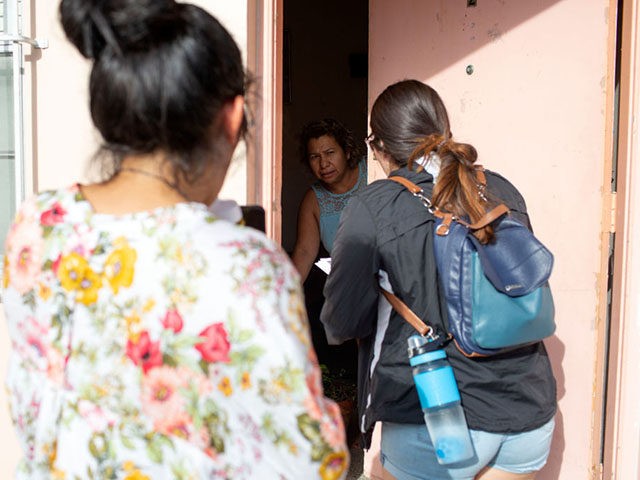
MIAMI, FL - JULY 13: Immigration advocates with the Florida Immigrant Coalition go house to house handing out fliers on July 13, 2019 in Little Havana in Miami, Florida. The Trump administration is moving forward with a nationwide immigration enforcement operation this weekend targeting migrant families. (Photo by Saul Martinez/Getty …

By Amy Furr

Government leaders in Illinois urged illegal aliens to know their rights after U.S. Immigration and Customs Enforcement (ICE) agents were reportedly seen in a Chicago neighborhood on Thursday.

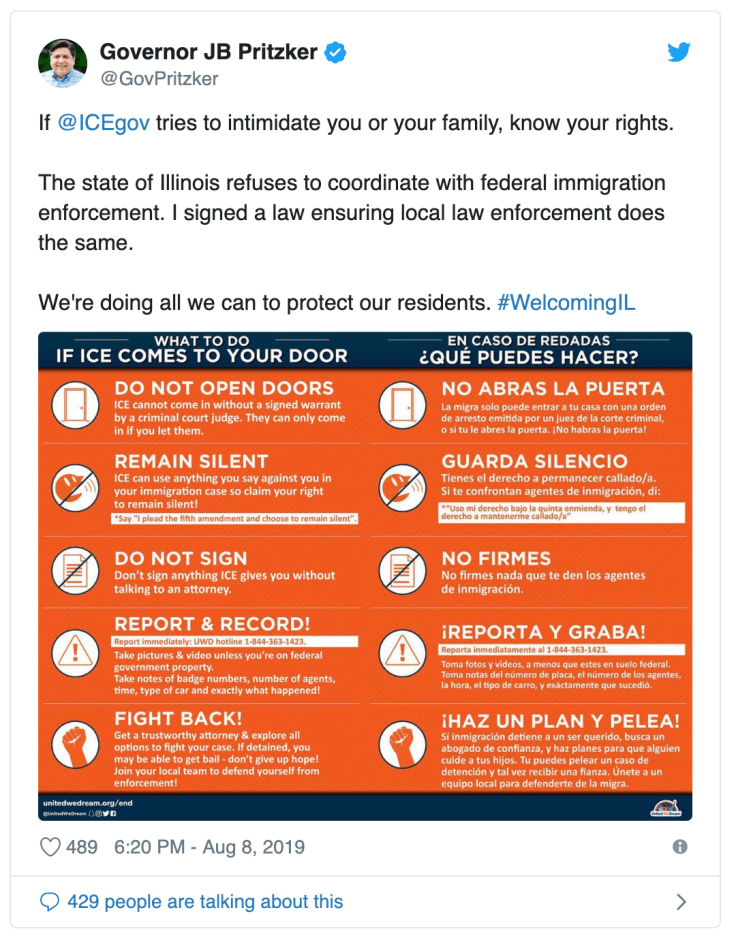
“If @ICEgov tries to intimidate you or your family, know your rights,” Illinois Gov. J.B. Pritzker tweeted. “The state of Illinois refuses to coordinate with federal immigration enforcement. I signed a law ensuring local law enforcement does the same. We’re doing all we can to protect our residents.”
Screen Shot 2019-08-10 at 11.34.47 AM

Byron Sigcho-Lopez, 25th Ward alderman, tweeted that his office had received reports of ICE agents approaching businesses and homes in the Pilsen area.

“We’ve confirmed these reports with the National Immigrant Justice Center,” he said.

The reports come after ICE agents arrested 680 illegal aliens in Mississippi this week, the largest single-state raid in U.S. history, Breitbart News reported.

The individuals were arrested at seven food processing plants across six cities including Bay Springs, Carthage, Canton, Morton, Pelahatchie, and Sebastapol.

“According to federal officials, some of the hundreds of illegal aliens arrested on Wednesday have already been ordered deported by an immigration judge and have refused to self-deport. Those illegal aliens will be quickly deported,” the report said.

press release from the ICE website stated that the agency will investigate the individuals arrested on a case-by-case basis.

“In all cases, all the illegal aliens encountered as part of this operation are either being placed into removal proceedings before the federal immigration courts, and for those who already received due process and have been ordered removed, processed for removal from the U.S.,” the release said.

However, Rep. Sheila Jackson Lee (D-TX) called on President Trump during an interview Thursday to stop the raids, comparing them to the tactics of the Nazi secret police.

“I think it’s unfortunate when ICE has to be made into this kind of agency and to be an intimidator rather than an agency that has in the past made sure that we are safe in this nation,” she said.

“But when their neighbors are rounded up in a vile way, when children are left unprotected, I’m disappointed. And the president and Stephen Miller need to stop these Gestapo tactics, and we need to work together to pass comprehensive immigration reform,” Lee concluded.
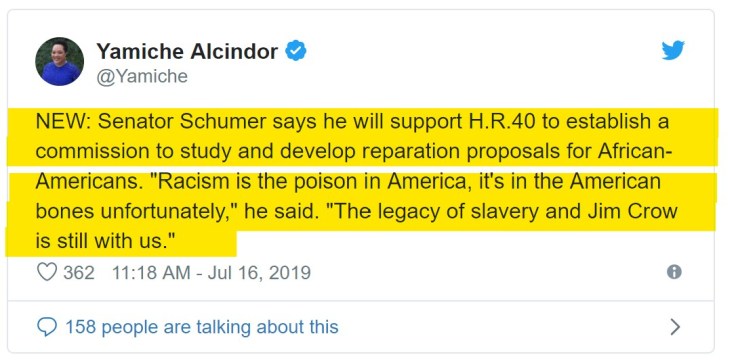
Chuck Schumer Backs Reparations Commission: Racism Is ‘in the American Bones’

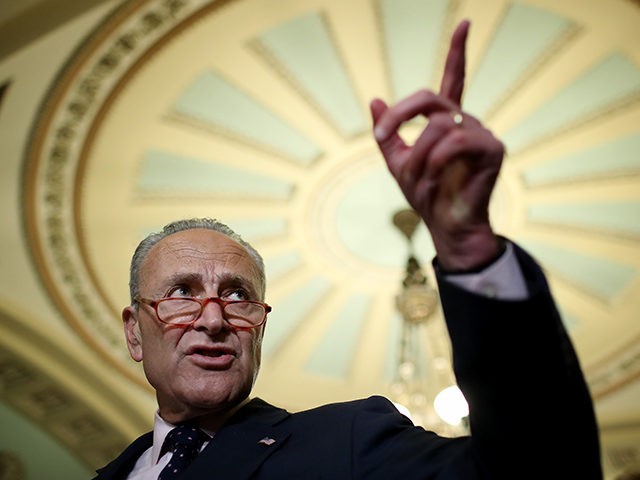
WASHINGTON, DC - JULY 09: Senate Minority Leader Chuck Schumer (D-NY) answers questions at the U.S. Capitol on July 09, 2019 in Washington, DC. Schumer answered a range of questions during the press conference including queries on recent court cases involving the Affordable Care Act. (Photo by Win McNamee/Getty Images)

By Joshua Caplan

Senate Minority Leader Chuck Schumer (D-NY) announced his support Tuesday for establishing a commission to study reparations proposals for black descendants of African slaves.

“Racism is the poison in America, it’s in the American bones, unfortunately,” Schumer said as voiced support for H.R 40, a bill championed by Rep. Sheila Jackson Lee (D-TX) that would create a commission to study the issue of reparations. “The legacy of slavery and Jim Crow is still with us,” added Schumer.

CAP

The debate over reparations catapulted from the campaign trail to Congress last month when lawmakers heard testimony for and against the idea of providing compensation for slavery. On June 19th, the House Judiciary Subcommittee on Constitution, Civil Rights and Civil Liberties held a hearing on Jackson Lee’s bill. The panel invited 2020 White House hopeful Sen. Cory Booker (D-NJ), Hollywood actor and left-wing activist Danny Glover, author Ta-Nehisi Coates, and others to discuss the measure re-introduced in January.

Booker, who testified first before the panel, said the country has “yet to truly acknowledge and grapple with the racism and white supremacy that tainted this country’s founding and continues to cause persistent and deep racial disparities and inequality.”

“The stain of slavery was not just inked in bloodshed, but in policies that have disadvantaged African Americans for generations,” the lawmaker added.

Earlier this year, Booker introduced a version of Jackson Lee’s measure to the Senate.

Following Booker was Glover, who called establishing a national policy on reparations a “moral, democratic, and economic imperative.”

“Despite much progress over the last centuries, this hearing is yet another important step in the long and heroic struggle of African-Americans to cure the damages inflicted by enslavement, post-emancipation and forced racial exclusionary policies,” Glover told lawmakers

The hearing came amid a growing discussion in the Democrat Party about reparations. Several of the party’s presidential candidates have endorsed looking at the idea.

In a Point Taken-Marist poll conducted in 2016, 68 percent of Americans said the country should not pay cash reparations to African American descendants of slaves to make up for the harm caused by slavery and racial discrimination. About 8 in 10 white Americans said they were opposed to reparations, while about 6 in 10 black Americans said they were in favor.

Senate Majority Leader Mitch McConnell (R-KY) has said that he opposes reparations, telling reporters: “I don’t want reparations for something that happened 150 years ago. We’ve tried to deal with the original sin of slavery by passing civil rights legislation.”

“It would be hard to figure out who to compensate” for slavery, the Kentucky Republican noted. “No one currently alive was responsible for that.”

Last week, McConnell said his family’s history of slave ownership doesn’t change his opposition to reparations.

The Kentucky Republican noted that he and former President Barack Obama have opposed reparations, and “both are the descendants of slave owners.”

The Associated Press contributed to this report. 

Kamala Harris on Reparations: ‘Writing a Check’ Not ‘Gonna Be Enough’

The Associated Press

By Tony Lee

Sen. Kamala Harris (D-CA) believes that “writing a check” to the descendants of slaves is not “going to be enough” when it comes to reparations.

In an interview with Jemele Hill’s podcast that was released on Monday evening, Hill, playing a game of “for or against,” asked Harris if she was “for or against” reparations. Harris answered: “complicated.” Hill, who interviewed Harris during Essence Fest in New Orleans, told her “that wasn’t one of the choices.”

Screen Shot 2019-07-16 at 10.57.28 AM

The presidential candidate then elaborated, saying she supports Rep. Sheila Jackson Lee’s (D-TX) commission to study reparations.

“We need to address how we’re going to do it… because back to the point I was making about home ownership…back to the point I was making about disparities around education… you can look at health outcomes when you know that black women are three to four times more likely to die in connection with child birth,” Harris said. “So there’s a lot that has to be about looking at this in a way that is about structural and systemic investment in communities.”

Harris said she was “reluctant” to give a simple answer on the issue because she fears Americans will not want to talk about structural and systemic inequalities that reparations advocates have argued have been compounding if the government just writes checks to the descendants of slaves.

“So that’s why I’m reluctant to have a simple answer to it because frankly I don’t believe that writing a check is gonna be enough,” Harris told Hill. “I really don’t… And the worst thing that I think could happen is that checks get written and then everybody says ‘ok, stop talking about this now’ without addressing the systemic inequities that are deep and require investment.”

Harris previously told The Root that “there has to be some form of reparations”—even for “undiagnosed and untreated trauma”—because “we’re looking at more than 200 years of slavery” and “almost a hundred years of Jim Crow.”

“We’re looking at legalized segregation and, in fact, segregation on so many levels that exists today, based on race,” she told The Root earlier this year. “And there has not been any kind of intervention done understanding the harm and the damage that occurred to correct course, and so we are seeing the effects of all of those years play out still today.”


Watch Live: House Holds Slavery Reparations Hearing

By Penny Starr

The House Judiciary Subcommittee on Constitution, Civil Rights and Civil Liberties is holding a hearing on Wednesday to discuss H.R. 40, Rep. Sheila Jackson Lee’s bill entitled “Commission to Study and Develop Reparation Proposals for African-Americans Act.”

The text of the bill states: 

To address the fundamental injustice, cruelty, brutality, and inhumanity of slavery in the United States and the 13 American colonies between 1619 and 1865 and to establish a commission to study and consider a national apology and proposal for reparations for the institution of slavery, its subsequent de jure and de facto racial and economic discrimination against African-Americans, and the impact of these forces on living African-Americans, to make recommendations to the Congress on appropriate remedies, and for other purposes.

The bill includes findings the commission would study:

(1) Approximately 4,000,000 Africans and their descendants were enslaved in the United States and colonies that became the United States from 1619 to 1865;

(2) The institution of slavery was constitutionally and statutorily sanctioned by the Government of the United States from 1789 through 1865;

(3) The slavery that flourished in the United States constituted an immoral and inhumane deprivation of Africans’ life, liberty, African citizenship rights, and cultural heritage, and denied them the fruits of their own labor;

(4) A preponderance of scholarly, legal, community evidentiary documentation and popular culture markers constitute the basis for inquiry into the on-going effects of the institution of slavery and its legacy of persistent systemic structures of discrimination on living African-Americans and society in the United States; and

(5) Following the abolition of slavery the United States Government, at the Federal, State, and local level, continued to perpetuate, condone and often profit from practices that continued to brutalize and disadvantage African-Americans, including sharecropping, convict leasing, Jim Crow, redlining, unequal education, and disproportionate treatment at the hands of the criminal justice system; and

(6) As a result of the historic and continued discrimination, African-Americans continue to suffer debilitating economic, educational, and health hardships including but not limited to having nearly 1,000,000 black people incarcerated; an unemployment rate more than twice the current white unemployment rate; and an average of less than 1⁄16 of the wealth of white families, a disparity which has worsened, not improved over time.

The list of witnesses includes presidential hopeful Sen. Cory Booker (D-NJ) and actor Danny Glover.

Other witnesses set to testify at the hearing at 10 a.m. EST are: Ta-Nehisi Coates, Distinguished Writer in Residence, Arthur J. Carter Journalism Institute of New York University; Katrina Browne, documentarian, Traces of the Trade; Coleman Hughes Writer, Quilette;v Burgess Owens, speaker and writer; Rev. Eugene Taylor Sutton, Episcopal Bishop of Maryland, Dr. Julianne Malveaux, economist and political commentator; and Eric Miller, professor of law, Loyola Law School, Loyola Marymount University.

Blog at WordPress.com.

Up ↑